The 125th Anniversary of the Vilas Window

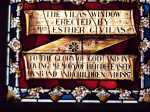
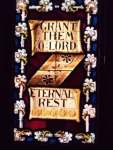
When precisely Grace Church’s oldest stained glass window, the “Resurrection” Window, was dedicated, is unclear. Various historical accounts claim it was on Holy Innocents’ Day, December 27, 1887. Then as now, however, Holy Innocents was observed on December 28. My guess is given that it was in memory of Esther Vilas’s husband and five of her children, the connection with Holy Innocents is correct and an error down the line turned the 28th into the 27th.

The Vilas family was among the most important families in Madison in the second half of the nineteenth century. Mrs. Vilas’ husband, Levi, served as Madison’s mayor and their son William was a US Senator, Postmaster General, and Secretary of the Interior under President Grover Cleveland. William’s daughter Cornelia is memorialized in Grace’s Vilas Guild Hall and his son Henry by the Henry Vilas Zoo.

The window was made by Cox and Sons of London, England. The window’s colors are rich and deep and it is especially beautiful when it refracts the afternoon and early evening sun. Commonly called the “Resurrection” window, the window depicts three stories from the gospels’ accounts of Jesus’ resurrection. The large central image shows the women at the tomb hearing the angel say, “He is not here, he is risen.” The two images to the left and right are of Jesus on the road to Emmaus and Mary Magdalene’s encounter with the risen Christ in the garden. The window was restored in 2005 as a memorial to Mrs. Betty Kurtenacker with funds raised by the Episcopal Church Women.

Some photos of the window are here:

And Every Stone Shall Cry: A Sermon for Christmas Eve, 2012

Where is God? It’s a question we often hear in the aftermath of a natural disaster but especially after a tragedy like the massacre at Newtown. When we ask the question where is God, we are asking not only about God’s presence in a particular instance. We are also questioning God’s presence in the world, in our lives. We are questioning God’s providence—the idea that God is in charge of things. Sometimes behind our question is another question, Is there a God? Continue reading

My Soul Proclaims the Greatness of the Lord: A Sermon for Advent 4, Year C

The familiar story we have heard today has been painted thousands of times throughout history. Two women, one young, one elderly, both of them pregnant, greeting each other. Often, the elderly one is deferring to the younger one, kneeling before her. Other times, the two are embracing. It’s such a familiar image, such a familiar story, that we tend to pay it little attention. Certainly, it does not factor largely in our devotion. Though it’s the occasion for two of the most common hymns or devotions in Catholicism—the Ave Maria and the Magnificat—we probably rarely reflect on the narrative context from which these hymns come. And really, it’s hardly shocking that we don’t pay closer attention to the Visitation, for it’s a brief episode, not more than a couple of verses (not including the magnificat itself).

pontormo3

Jacopo da Pontormo, 1528

ghirlandaio_visitation

Ghirlandaio, 1491

Continue reading

Archbishop of Canterbury weighs in on gun control

Rowan Williams who is soon to leave office spoke out on a BBC radio program, “Thought for the Day. Here’s an excerpt:

And there is one thing often said by defenders of the American gun laws that ought to make us think about wider questions.  ‘It’s not guns that kill, it’s people.’  Well, yes, in a sense.  But it makes a difference to people what weapons are at hand for them to use – and, even more, what happens to people in a climate where fear is rampant and the default response to frightening or unsettling situations or personal tensions is violence and the threat of violence.  If all you have is a hammer, it’s sometimes said, everything looks like a nail.  If all you have is a gun, everything looks like a target.

People use guns.  But in a sense guns use people, too.  When we have the technology for violence easily to hand, our choices are skewed and we are more vulnerable to being manipulated into violent action.

Perhaps that’s why, in a passage often heard in church around this time of year, the Bible imagines a world where swords are beaten into ploughshares.  In the new world which the newborn child of Christmas brings into being, weapons are not left to hang on the wall, suggesting all the time that the right thing to do might after all be to use them.  They are decommissioned, knocked out of shape, put to work for something totally different.

You can listen to the program here; or read a transcript here.

I wonder how conservative American Episcopalians and Anglicans will respond, perhaps by telling him to butt out of our affairs?

Some links on Newtown

I’ve gathered here some of what I consider to be the most important and thoughtful things I’ve read this week. If you’re still struggling to make sense of it all (and who isn’t) I hope you will find one or more of them helpful.

My friend and colleague Andy Jones points to Episcopal Bishop of Washington Marianne Edgar Budde’s Christmas letter in which she calls for Christians to lead efforts for gun control. The NYTimes has an article about the efforts of religious leaders. Dean Gary Hall of the National Cathedral is taking leadership in this effort. He preached a powerful sermon on Sunday on Newtown.

The article mentions a call for a moment of prayer at 9:30 AM tomorrow and asks churches to ring their bells 28 times. If I can get to Grace tomorrow morning, I’ll do it.

Some other thoughtful reflections on Newtown:

  • From Ian Douglas, Bishop of Connecticut
  • From Stephen Prothero: “Six Things I Don’t Want to Hear after the Sandy Hook Massacre”
  • From Rachel Held Evans (on Advent, Christmas, and Sandy Hook): “God Can’t Be Kept Out”

Katherine Newman offers a fascinating sociological analysis of the roots of school shooting rampages:

There has been only one example of a rampage school shooting in an urban setting since 1970. All the others have taken place in rural towns miles from places like New York or Chicago, or in suburbs in the Western states.

What is it about these towns where no one locks their doors that generates these deadly outbursts? We argued the very thing most Americans celebrate about small-town life—close-knit neighbors, friendly families, adults engaged in the schools and churches—become sources of stultifying depression for marginal boys. We interviewed kids who were attending the same high school as their grandparents, in communities where very few left town for college, preferring to stay home and attend the local community college or state institution. For most people, this is a sign of social solidarity. For Michael Carneal, the shooter in a 1997 attack at Heath High School (outside Paducah), that solidarity felt like a life sentence of exclusion.

Theological reflection in the same vein from Marilyn McCord Adams:

Those of us who have experienced rage or fear, would probably do well not to be confident about what we would have done in Nazi Germany. Maybe we should not overestimate our own mental health or degree of spiritual integration. Still, I venture to say, most of us could not have done what Adam Lanza did on Friday: shot little children, school teachers and staff in cold blood.

For that very reason, we need to heed Jesus’ warning that “otherizing” is spiritually dangerous. Otherizing undermines sympathy, pronounces the perpetrator “beyond the pale,” definitely not one of us. We could not have shot children and school workers in cold blood, because we identify with them: they are us, their children could be our children, their town could be our town. But it is counting killers as not one of us, that tempts us to acquiesce in state-sponsored cruelty, torture, and executions. Who knows? Perceived alienation may have prompted Judas to betray Jesus, permitted Adam Lanza to “otherize” the children and adults he was shooting at the school. Our instinct to “otherize” should make us shudder with the realization that we are more like traitors and socio-paths than we would like to admit.

Jesus’ injunction to love enemies is a hedge against otherization. My point is not that parents and citizens of Newtown, Connecticut should forgive the killer, today, tomorrow, next month, or next year. That would be another “quick fix.” Grief and trauma have their seasons. I would not say any of these things to them. I am speaking to us, who the dubious luxury of standing back and assessing, to remind that otherizing is part of, sometimes lies close to the roots of our problem.

Kottke.org links to “Portraits of gun owners in their homes.”

The photos seem to prove Garry Wills’ point in his powerful essay “Our Moloch.” He begins with some lines from Paradise Lost:

First Moloch, horrid king, besmear’d with blood
Of human sacrifice, and parents’ tears,
Though for the noise of Drums and Timbrels loud
Their children’s cries unheard, that pass’d through fire
To his grim idol. (Paradise Lost 1.392-96)

And then comments:

The gun is not a mere tool, a bit of technology, a political issue, a point of debate. It is an object of reverence. Devotion to it precludes interruption with the sacrifices it entails. Like most gods, it does what it will, and cannot be questioned. Its acolytes think it is capable only of good things. It guarantees life and safety and freedom. It even guarantees law. Law grows from it. Then how can law question it?

Its power to do good is matched by its incapacity to do anything wrong. It cannot kill. Thwarting the god is what kills. If it seems to kill, that is only because the god’s bottomless appetite for death has not been adequately fed. The answer to problems caused by guns is more guns, millions of guns, guns everywhere, carried openly, carried secretly, in bars, in churches, in offices, in government buildings. Only the lack of guns can be a curse, not their beneficent omnipresence.

The Magnificat: The Songs of Advent, Part 3. Lectionary Reflections for 4 Advent, Year C

This week’s readings are here.

This week’s gospel is the story of the Visitation, Mary’s visit to her elderly cousin Elizabeth. The focus of the selected verses is on the interaction between the two women as well as the response of the child Elizabeth is carrying in her womb. There’s a great deal of artifice in Luke’s depiction of this scene (what do two pregnant women talk about when they get together for coffee or a visit?) and our interest is easily diverted from their conversation to the sons they are carrying.

There’s a third woman present in the scene, not physically, but in her words. Mary’s song echoes the Song of Hannah from I Samuel 2:1-10. The ties between Mary and Hannah extend beyond the similarities of their songs. In I Samuel 1:11, Hannah identifies herself as the “handmaid of the Lord” just as Mary identifies herself in the same terms (Lk 1:38 and 1:48). The NRSV translates “servant” but the word means female slave.

Again, as in the other songs Luke uses in his story of the Nativity, the resonances with Hebrew Bible language, imagery, and psalmody are very strong. Like Elizabeth, Hannah was barren. She had prayed devoutly in hopes of having a child and promised to dedicate her son to the service of God. Both Hannah and Mary sing of God’s activity on behalf of the poor and oppressed; strikingly, Mary puts God’s actions on their behalf in the perfect tense. That is to say, God has already begun intervening on behalf of the oppressed; it is not only something we can hope for in the future and (there’s something of a parallel here to Luke’s version of the Beatitudes although in this case, God’s action lies in the future:

‘Blessed are you who are poor,
for yours is the kingdom of God.
‘Blessed are you who are hungry now,
for you will be filled.
‘Blessed are you who weep now,
for you will laugh.

When we sing or reflect on the Magnificat our tendency is to see these words as Mary’s words, not our own. We lack the imagination and faith to make these statements ours. But if we believe in a God who comes to us in a manger in Bethlehem, it shouldn’t be beyond our capacity to believe in a God who acts in history on behalf of the poor, powerless, the hungry and the oppressed. If Mary and Hannah can believe it, so ought we.

Joy in the midst of mourning: A Sermon for Advent 3, Year C

The images have become so familiar to us, the stories so eerily similar that we had almost become immune to their horror. They no longer surprise us. A shooting in a mall in Oregon went by almost unnoticed. Then on Friday, another horrific event. This time, because it was an elementary school, because children were involved, the shock and horror penetrated our thick skins. We watched as parents rushed to the scene to comfort their children who survived the massacre. We watched and heard as other parents wept inconsolately. As a society, we watched, we grieve, wonder. Continue reading

Holy God, Holy and Mighty, Holy Immortal One, Have Mercy on Us

Some prayers in the midst of horrific tragedy.

Grieving Our Lost Children by Walter Brueggeman

We remember today, O God, the slaughter of the holy innocents … Receive, we pray, into the arms of your mercy all innocent victims; and by your great might frustrate the designs of evil tyrants and establish your rule of justice, love, and peace; through Jesus Christ our Lord, who lives and reigns with you, in the unity of the Holy Spirit, one God, for ever and ever. Amen. Collect for Holy Innocents, December 28 BCP

From Rev. Emily Heath (West Dover, VT)

An Article on the Daytime Shelter and Sarah Gillmore

Pat Schneider is effusive in her praise.

From the article:

day-to-day tasks to keep the center running — from greeters to food service to clean-up — are performed by volunteer users of the center. An advisory council of shelter users gives feedback on operations, and a community justice group discusses how to minimize conflicts.

Having a role in running the operation is important, Gillmore told me.

“The idea of someone being able to contribute their skills is so powerful. We’re based on building a sense of empowerment to increase self-worth and make life changes,” she said. By being involved with running the center, as well as participating in support groups and connecting with local service agencies, shelter users make steps toward more stable lives.


Songs of Joy–The Songs of Advent, Part 2: Lectionary Reflections for the Third Sunday of Advent, Year C

This week’s readings are here.

I’m not a big fan of the recent tendency to focus our attention in Advent on one particular theme, so that the Third Sunday of Advent becomes “Joy.” While three of the readings could be construed as joyful or as exhorting joy, I don’t see much joy in the gospel or in the preaching message of John the Baptizer. In fact, if you go back and read the contexts for both the reading from Zephaniah and the canticle from Isaiah 12, you will note that the larger textual context is full of doom and gloom, prophecies of destruction, fears of being invaded and destroyed by larger powers.

Listen to some of Zephaniah’s words:

I will utterly sweep away everything
from the face of the earth, says the Lord.
I will sweep away humans and animals;
I will sweep away the birds of the air
and the fish of the sea.

This week’s reading comes from the very end of the text and is remarkably different in message and tone. Now Israel has been restored; the people are urged to sing, shout, and rejoice. Yahweh, too, sings:

The Lord, your God, is in your midst,
a warrior who gives victory;
he will rejoice over you with gladness,
he will renew you in his love;
he will exult over you with loud singing (Zeph 3:17)

In fact, there’s something of a puzzle here. What reads in the NRSV as “he will renew you in his love,” appears in the Hebrew as “he is silent in his love.” Imagine God struck silent by joy!

The Isaiah song, (Is 9:2-6), is another song of joy, presumably from a similar dire situation as that of Zephaniah, although perhaps a century earlier. Christians have interpreted these words as a prophecy of Jesus Christ but they are backward-looking as well. The imagery of the first few lines recalls Israel’s flight from Egypt and sojourn in the wilderness. The image of God as Savior, stronghold, and defense are all military images, calling to mind that early song of the Hebrew Bible, the Song of Moses, sung after the Israelites passed through the Red Sea:

The Lord is my strength and my might,
and he has become my salvation; (Ex. 15:2)

The next image also returns to the wilderness and the miraculous streams and fountains that came when the people were thirsty. Like the songs I talked about last week, these songs of Advent look backward in history as well as forward. They are songs of remembrance as well as anticipation.

The difficulty we have in feeling or expressing joy often comes from the difficulties in our lives; our personal struggles and pain. Joy is also difficult when we know of others’ suffering or when we think of all the problems facing our nation, community, and world. Both Isaiah and Zephaniah lived in periods of deep national crisis. In both men’s lives, Judah and Jerusalem faced existential threat. Within a decade or two after Zephaniah’s death, Jerusalem itself lay in ruins, its political and religious leadership carried off in exile in Babylon. But in Babylon, hope persevered and the exiles created a religious community and religious texts that survive to the present.

Perhaps these joyous songs of Advent will help us remember God’s mighty acts in history and give us hope that God continues to act in the world around us, bringing deliverance and salvation to a desperate world.