Peter Gomes, RIP

I woke up this morning to learn of the death of the Rev. Peter Gomes, whose official title at Harvard was “Plummer Professor of Christian Morals and Preacher to the University.” He suceeded George Buttrick in that position in the early 1970s. When I arrived at Harvard Divinity School in the early 1980s, Peter was already a fixture at Harvard. His weekly teas at Sparks House were a popular tradition and his sermons at Memorial Church were brilliant and beautifully-written.

Peter, along with New Testament Professor Helmut Koester, taught the course from which I gained the most for my ministerial practice, and on which I continue to draw. Entitled “Exegesis and Preaching,” the two picked the most challenging texts in the New Testament. We were assigned three of them. One week, we would have to write an exegesis paper that would pass muster with one of the greatest New Testament scholars of his generation. The next week we would write and deliver a sermon on that text. Each step was a lesson in humility, as well as in the interpretation of scripture and the proclamation of the Word.

Following the public delivery of the sermon, we would spend an hour in a one-on-one tutorial with Peter. That amount of time with a Harvard professor was unheard-of. I don’t think I got that much individual attention from a professor in a semester, even when I was writing my dissertation.

The tutorial was humiliating. We were to bring the manuscript to the tutorial. Peter would take it from our hands when we entered his office, we would sit down, then he would deliver it back to us; our pathetic words in his majestic voice. I remember the first session like it was yesterday. As I heard him read my text, I wanted the floor to open up and bury me. It was perhaps the most difficult moment of my entire academic career.

What an experience and how exhilarated I was when both he and Helmut praised my final work, passable exegesis on Revelation 21 and a decent sermon. Whatever my gifts and skills as a preacher, I owe them to that class and those two brilliant professors.

Peter was also quite funny. I still remember the story he told about communion wine. One of the students in class asked him about what wine he used for communion. Peter replied:

My predecessor, George Buttrick, always said that one should use nothing but the best domestic port for communion wine, and he deemed Taylor’s Tawny Port to be that wine.”

I always hoped to see a commercial for Taylor’s with Peter standing on the steps of Memorial Chapel, in full ministerial regalia, holding a bottle of Taylor’s Tawny Port in his hand, and saying those words.

In the 1980s, Peter was often vilified by progressive students at Harvard Divinity School for being a Republican. He gave the benediction at Reagan’s second inaugurals, preached at the National Cathedral in conjunction with George H. W. Bush’s inaugural. That all changed when he “came out” in the 1990s.
Making Meaning out of Mayhem

It’s been a few weeks since the tragedy in Tucson and the initial frenzy to place blame has given way to some more sober reflection and thoughtful attempts to place the events that Saturday in a larger context.

I came across this essay today by Rochelle Gurstein. Riffing off of the coincidence that Christina Green was born on 9/11, Gurstein puzzles over various attempts to make sense of it all.

The horrific mass shooting, I am supposed to tell myself, was nothing more than the act of a lunatic, signifying nothing, utterly absurd. And this is how Representative Giffords’s forum with its homey name, “Congress on Your Corner,” that terror-filled Saturday morning is starting to feel, now that providence, fate, and finally, cause-and-effect relationships have lost their powers of elucidation. All we are left with is the standard, all-service, therapeutic explanation of mental illness…

Gurstein resists the attempts to make some connection between the coincidence of Christina’s birth, observing that had she grown up and gone into politics, that might have provided an context or explanation for her life choices. She also is critical of efforts on left and right to connect the events in Tucson with political rhetoric or violence in the media. At the end of the article, she even opposes the desire of Christina’s father to grasp some larger meaning from the donation of her organs.

Gurstein’s ruminations are challenging, especially in light of the universal human effort to make meaning out of life and out of events. And it offers an interesting perspective from which to examine another exchange, this one between Mark Ralls and Melinda Hellenberg. Hellenberg, writing in Politics Daily, argues that Christians should not label mental illness as evil:

Yet it’s the Christian underpinnings of my view of evil, in a world in which we do have free will, and sin, which in all cases involves a choice, that makes it impossible for me to ever see those who suffer from schizophrenia as an embodiment of moral evil. We don’t know for sure that Loughner has schizophrenia, though his paranoia and references to “mind control” are classic markers. But those who are so afflicted haven’t chosen their delusions and hallucinations; a stand-out even in the pantheon of dreadful diseases, theirs is an illness no one would choose.

I found her analysis somehow wrong, but couldn’t put my finger on it. Then I read Mark Ralls. Building on the Augustinian notion of evil as a privation of the good, Ralls articulates the conception of evil as a “tear in the fabric of creation.” He goes on to point out that in Loughner’s fascination with nihilism. Then he shifts to an observation about our culture’s embrace of nothingness:

Consider something as silly – and seemingly harmless — as “Reality TV.” Shows like “The Jersey Shore” not only make light of terrible life choices. They glorify the wasted life. They propagate the cultural myth that our lives lack purpose. As Christians fail to counter this myth with prophetic utterance and interceding prayer, we are complicit in the cultivation of troubled young hearts and minds.

With Ralls, I agree that naming evil is among the most important tasks of Christian theologians and communities; to name it, not only in the choices of individuals, but in structures and institutions like inadequate mental health. He concludes:

Melinda Henneberger is right. We must not personify evil and casually ascribe it to someone else. Yet Barack Obama is more right. We must dare to speak of evil when we encounter it. Otherwise, we have no chance of recognizing it when it comes to “sleep in our bed, to eat at our table.”

Reading the three essays together is an instructive lesson in theodicy.

Inviting Advent

Inviting Advent

Jesus stands at the door knocking. In total reality, he comes in the form of the beggar, of the dissolute human child in ragged clothes, asking for help. He confronts you in every person that you meet. As long as there are people, Christ will walk the earth as your neighbor, as the one through whom God calls you, speaks to you, makes demands on you.

That is the great seriousness and great blessedness of the Advent message. Christ is standing at the door; he lives in the form of a human being among us. Do you want to close the door or open it?


–Dietrich Bonhoeffer
God is in the Manger: Reflections on Advent and Christmas
(Westminster John Knox Press; 2010)
Thanks to CREDO

Now that’s a St. Nicholas Day celebration!

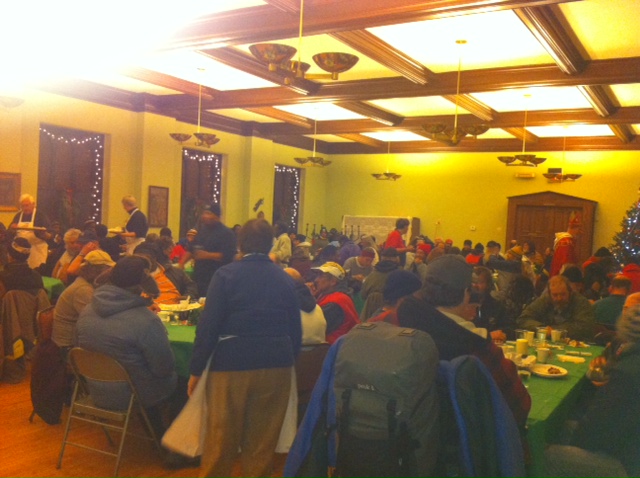
On the first Monday of each month, Grace Church provides a meal to the guests who stay in the Men’s Drop-In Shelter, and to anyone else who might want to join us.

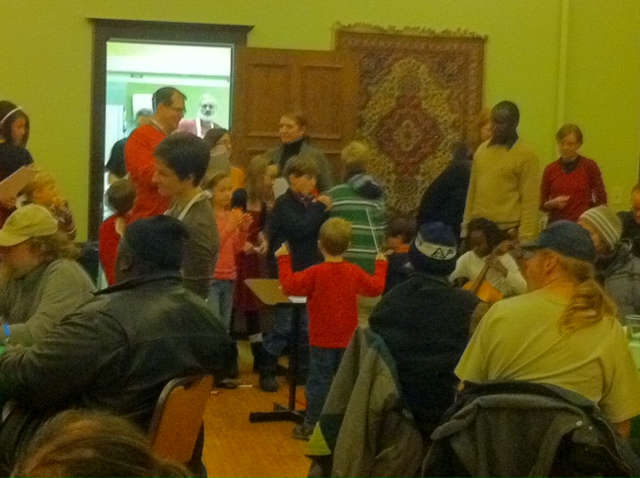
Today is St. Nicholas Day, so we decided to use that as our theme. The Guild Hall was decorated for the holidays, complete with Christmas tree (all thanks to the hard work of Ginny Shannon and her crew); members from our choir sang, as did our kids. The menu was ham, potatoes gratin, green beans, and lots of Christmas cookies. We collected socks and gave a couple hundred pairs away to our appreciative guests.

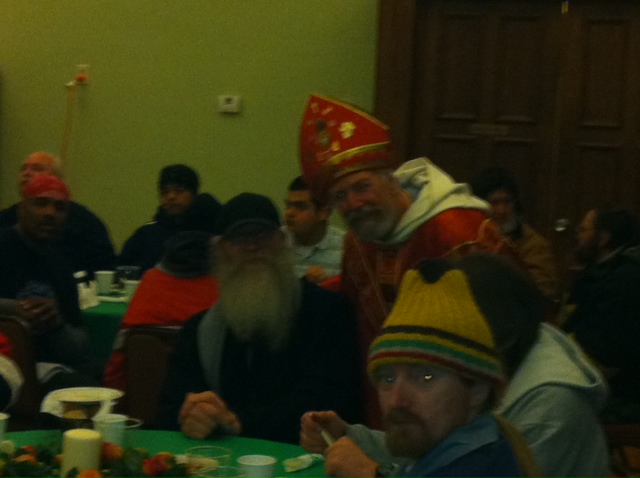
St. Nicholas Day needs an appearance from the bishop himself, so he came to pass out chocolate and socks.

A few pictures from the gala:

Here’s St. Nick, comparing beards:

Here’s a shot of Guild Hall:

Here are the kids with their kazoos:


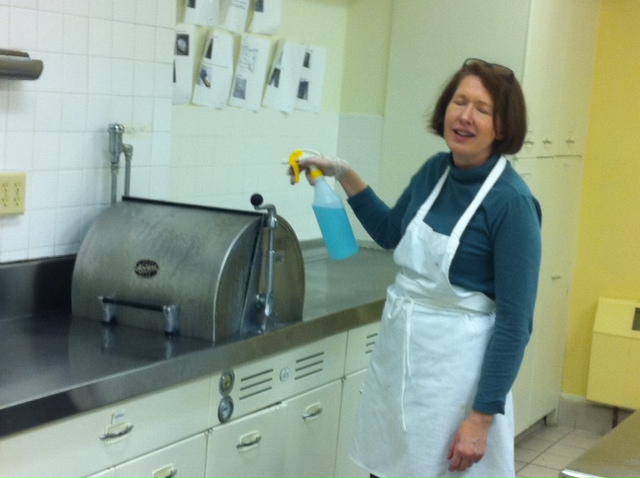
And tonight may have been the final performance of our 50-year old Hobart dishwasher. The last time we tried to get it repaired, when the guy called in for parts, the home office had to search for the parts book in their archives. We hope to have a new one installed by our next shelter meal on January 3.

Thanks to everyone who helped with the meal tonight: the volunteers, the cooks Wolfgang and Christian, the shelter meal committee, and to all those who helped preparing food and cookies in advance, and the Rector’s Guild, who donated money toward the holiday ham.

Revisiting the Civil War

It’s the 150th anniversary of the election of Abraham Lincoln to the presidency in 1860 and we’re coming up on the similar anniversary of the beginning of the Civil War. The New York Times got the idea of “live-blogging” history and it makes for fascinating reading: DISUNION – Opinionator Blog – NYTimes.com.

I’m not much of a Civil War buff, although I watched the Ken Burns documentary, and one summer read Shelby Foote’s history when I should have been working on my dissertation. Having lived in the South for fifteen years, the first five in Sewanee, the home of The University of the South, one of the “Lost Cause” colleges. The history of Sewanee is recorded in stained glass in All Saints’ Chapel, including when the Yankees blew up the college cornerstone. Charles Wilson Reagan’s Baptized in Blood: The Religion of the Lost Cause tells the story of how Christianity in the South was shaped by the Civil War. That was certainly the case at Sewanee, with the prominently-displayed portrait of “The Battling Bishop” Leonidas Polk in a Confederate gray uniform, with sword in one hand and prayer book in the  other.

I was bemused to learn that my former colleague’s lectures on the Civil War at the Greenville County Public Library in South Carolina have been picketed. Among the signs being held: “Lincoln was a mass murderer.”

It’s hard for Northerners to understand the complexity of the relationship Southerners have with slavery and with the Civil War. The comments in the Times blog offers evidence of that. Even liberal Democrats who live in the South may express their discomfort at certain historical arguments, or what one called “South bashing.” The response is more complex when it comes from the thoughtful, and progressive descendant of a slave owner. The war lives on in the South in ways it doesn’t up north and the commemorations in the coming years will no doubt raise emotional arguments over a history that still affects contemporary life.

It Gets Better

In response to the recent suicides by gay teens, Dan Savage started a video project.

Here’s the pledge:

We are the kids who have been bullied for being gay, lesbian, bi or trans. We pledge to stay open and strong. We are also the friends, family members, teachers, mentors, and allies of anyone who’s ever felt like they didn’t fit in, gay or straight. We pledge to talk to the kids in our lives to put an end to the hate, violence, and tragedy — and to offer advice on coping, strategies to make it better, and to remind kids that It Gets Better.

Here’s the link to the videos.

And here’s the video from Bishop Gene Robinson of the Diocese of New Hampshire:


Church marketing and self-promotion

There’s a website I visit occasionally called churchmarketingsucks.com. It’s actually pretty insightful, if geared toward evangelicals and mega-church wannabes. But I wonder what their take is on the current controversies around the Ground Zero Church and the guy in Florida. It turns out the Ground Zero church had its first service this past Sunday. About fifty people were in attendance, at least half were members of the media. And the guy in Florida has about fifty in his congregation. But they’ve both gotten lots of attention. It may not result in “saved souls” but perhaps there are book deals in their future.

We live in a culture that prizes outrage–that’s what the political right has feasted on for years. We also live in a media culture and a twenty-four hour news cycle that requires product. Both of these pastors are appealing to that and both of them have gotten what they wanted. The question is not whether burning the Q’uran is wrong or inappropriate, or resorting to the tactics of Al Qaeda and the Taliban. He wanted to draw attention to himself and he got his wish. He’s also given progressive and moderate Christians something to be outraged about, and help them feel good about themselves by joining facebook pages that decry his actions.

The question for the rest of us is not how to protest the actions or beliefs of people like this. The question is how we can model a different kind of Christianity, that embraces diversity and expresses love to all.

More on end of life care

A study of British doctors and end-of-life care has received a good bit of publicity. It reveals that the less religious the doctor, the more likely he or she is to provide care that may hasten death. On the other hand, more religious doctors are less likely to have talked about end-of-life issues with their patients. Cathy Grossman asks, which is the bigger news? Most reports emphasized the attitudes of non-religious doctors. Read her blog here.

If you haven’t read the fascinating article about end of life care in a recent New Yorker, you can find it here.

More on opposition to mosques

Laurie Goodstein has an article in today’s NY Times that details the growing opposition to mosques throughout the country. She points out that where previous campaigns in local communities to prevent construction of mosques focused on issues like traffic and parking, now the efforts argue that mosques are breeding grounds for Islamic extremism. Their tactics now include speeches and presentations from former Muslims.

In fact, studies show just the opposite.

As she writes:

A two-year study by a group of academics on American Muslims and terrorism concluded that contemporary mosques are actually a deterrent to the spread of militant Islam and terrorism. The study was conducted by professors with Duke’s Sanford School of Public Policy and the University of North Carolina. It disclosed that many mosque leaders had put significant effort into countering extremism by building youth programs, sponsoring antiviolence forums and scrutinizing teachers and texts.

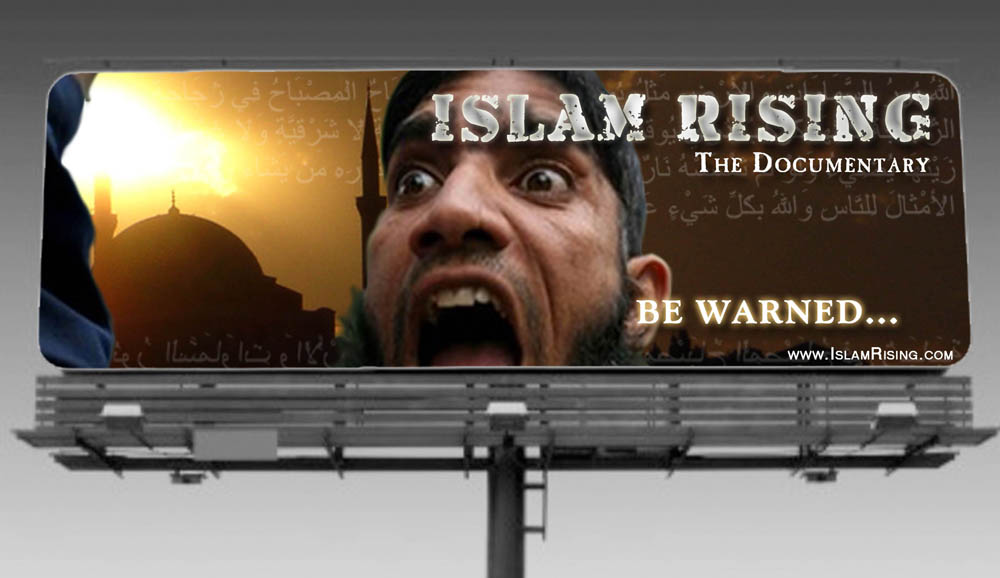
A former student directed me to this website after seeing billboards like this on the highway: