This week’s update on homelessness in Madison

It’s increasingly clear that there will be fewer services and no day center available for homeless people this winter. Pat Schneider has the story. Her reporting on the exchange between Mayor Soglin and Alder Palm:

Mayor Paul Soglin forcefully repeated his conviction that the city cannot and should not be expected to take care of homeless people, many of whom he believes are dropped off in downtown Madison by nearby communities or agencies like the state Department of Corrections.

“I want to know why some struggling household in this city should pay for that,” he told members of the Board of Estimates. “I’m sick and tired of seeing letters in newspapers saying ‘you have responsibility to take care of the homeless.’ Oh, there are no homeless in suburban communities, no homeless in the townships, no homeless outside of Dane County?”

Palm responded that if people are living here now, they’re Madison residents.

“We should treat them like they are our neighbors. I’m sorry if there’s a huge political battle with the state, other municipalities and neighborhood associations,” Palm said. “At end of the day, none of that helps people trying to find a warm safe place to stay and get assistance.”

Ah, but there’s the newly renovated Central Library where homeless people can spend the day. Here’s Joe Tarr’s story.

We’ll be talking at Grace this evening at 7:00 about these developments and what else we might do to respond to the ongoing crisis in our neighborhood.


Thinking with the Church–Some reflections on the Pope’s Interview

The internet and Christianity are abuzz with the interview Pope Francis gave with Jesuit publications.

What surprised me most was not the soundbytes pulled out by reporters about the hot-button issues but rather the thoroughly Ignatian tone of the entire piece. Pope Francis is not just remaking the Church and the Papacy, he is bringing to the fore the Jesuit mode of proceeding. His talk of discernment, his humility and simplicity, his approach to spirituality and prayer, his demeanor all point to his Jesuit background.

But at the same time as he is revolutionizing the Church, he is also revolutionizing the Ignatian tradition. There is no better example of that than in the section of the interview “Thinking with the Church.” James Martin, SJ says that what Pope Francis said here has “immense ramifications” for the Church.

Pope Francis is referring to a section appended to the Spiritual Exercises: “Rules for thinking with the Church.” Most famously, Rule 13 which reads:

To be right in everything, we ought always to hold that the white which I see, is black, if the Hierarchical Church so decides it, believing that between Christ our Lord, the Bridegroom, and the Church, His Bride, there is the same Spirit which governs and directs us for the salvation of our souls. Because by the same Spirit and our Lord Who gave the ten Commandments, our holy Mother the Church is directed and governed.

Pope Francis rewrites this rule, emphasizing that the Church is the whole people of God, not just the hierarchy, and that it is as the whole people of God that one needs to “think with the Church.”

Pope Francis:

“This is how it is with Mary: If you want to know who she is, you ask theologians; if you want to know how to love her, you have to ask the people. In turn, Mary loved Jesus with the heart of the people, as we read in the Magnificat. We should not even think, therefore, that ‘thinking with the church’ means only thinking with the hierarchy of the church.”


“This church with which we should be thinking is the home of all, not a small chapel that can hold only a small group of selected people. We must not reduce the bosom of the universal church to a nest protecting our mediocrity.”

As an aside, having taught Ignatius many times over the years, requiring students to read both the Autobiography and The Spiritual Exercises, I always struggled with students’ preconceptions about the Jesuits (“The shock troops of the Counter Reformation) and more broadly Roman Catholics. It was always a challenge to try to get them to understand the flexibility, adaptability, and moderation of the Jesuits, all of which were keys to their success in the 16th and 17th centuries.

The “Rules for Thinking with the Church” were in part Ignatius’ attempt to help later Jesuits learn from his experience. When we read, we should think white is black if that’s what the Church says, we assume the worst of the Jesuits and the Roman Catholic Church. A more charitable reading would be that we should submit our own reason and perspective to the long perspective and wider vision of the Church. Pope Francis, by taking “hierarchical” out of the equation, broadens the perspective still further.

The back story on how the interview came about is here.

From James Martin’s commentary:

But there is one thing of which Pope Francis is sure.  In the best Jesuit tradition, which asks us to “find God in all things,” the pope speaks movingly of his commitment to finding God in every human being.  That is his certainty.  For me, this was the most moving part of the entire interview: “I have a dogmatic certainty: God is in every person’s life.  God is in everyone’s life…Even if the life of a person has been a disaster, even if it is destroyed by vices, drugs or anything else—God is in this person’s life. You can, you must try to seek God in every human life.”

“Discerning the Papal Interview” (From Eric Sundrup, SJ in The Jesuit Post)

There is much for all of us to ponder here. Pope Francis has had an enormous impact on the Roman Catholic Church in the few months of his papacy; he is also challenging all Christians to a more humble, careful, and discerning approach in the world.

Something very fishy going on in the Episcopal Church

This one is primarily for Episcopal insiders, that very small, and declining number of people who care about what happens in the Episcopal Church.

This week, Mark Harris broke the news that four boardmembers of the UTO (United Thank Offering) had resigned in protest of what seemed to them to be an attempt by The Episcopal Church to take over their assets, their good name, and their mission. The UTO is a longstanding tradition in the Episcopal Church. Begun by women at a time when women were shut out of the organization, leadership, and structure of the church, it collects money from individuals and parishes and gives a crazy high percentage of that money away in grants. It has almost no administrative costs. What costs that do exist are largely assumed by the Episcopal Church.

But apparently, in an effort to increase transparency and accountability, a committee consisting of UTO board members and Church Center staff have created new bylaws for the organization that, in the judgment of the resigning board members:

The revised bylaws document eviscerates the United Thank Offering. It is monstrous and the worst set of revisions ever seen by one longtime bylaws expert.   Several Board members described initial reactions to the document as “Horror.”  The Board President said the word “eviscerate” occurred to her as well.

Mark, a former member of the Executive Council, and also a former member of the committee that was charged with studying the relationship of the UTO to TEC, is following this story very closely and has offered comment on the new bylaws. His questions and concerns are very helpful.

In the course of the day yesterday, the President of the House of Deputies, and “the Leadership” (whatever that may mean) also offered their takes on the matter. You can read their pieces here.

Part of what seems to be at stake here is that the proposed bylaws remake the nature of the UTO board (it was previously elected from various Episcopal Church Women bodies) and put the power of final approval of UTO grants in the hands of the Executive Council of the Episcopal Church.

Quite apart from another public relations disaster for the Episcopal Church, the Presiding Bishop, and its Chief Operating Officer, all of this seems to me to be quite contrary to the push for restructuring, and allowing grassroots organizations to thrive. To add another level to the grantmaking process is to make the process more cumbersome, more time-consuming, and more expensive. To take power away from the periphery and concentrate it on the center is to exacerbate problems.

The PR is awful; it’s embarrassing. To issue press releases under the aegis of “The Leadership” is laughable. They might as well call it the Politburo. It looks like all either the Presiding Bishop or the COO care about is money, property (a charge thrown out repeatedly by those involved in property litigation), and power. And because the UTO was largely independent, it had all of those things.

There is so little trust in the periphery for TEC; so little trust from ordinary members, from parishes and congregations. The UTO is one of those things that we could all agree on. We knew its origins; we knew that the money collected would go to amazing mission projects across the US and across the world.

Once again, instead of focusing on what we need to do, and what UTO has done in the past, we are focused on process, on power, on hurt. I’m really not sure we’ll have a UTO ingathering at Grace this fall. I certainly won’t be able to say with any certainty where the money will go.

How can you mess something up so completely?

But my prayer remains:

GRACIOUS GOD, source of all creation, all love, all true joy: accept, we pray, these outward signs of our profound and continuing thankfulness for all of life. Keep each of us ever thankful for all the blessings of joy and challenge that come our way. Bless those who will benefit from these gifts through the outreach of the United Thank Offering. This we ask through Him who is the greatest gift and blessing of all, Jesus Christ. Amen


Troubled over events in Syria?

I am, too.

Once more, the neo-cons, the media, the usual suspects, are beating the drums of war. Our president (remember the Nobel Peace Prize?) seems to be planning “surgical strikes” by way of retaliation and punishment. The consequences of our intervention and the long-term effects on Syria and the wider Middle East, seem not to be taken into consideration.

George Packer summarizes the debate and the futility of it all:

What are you saying?

I don’t know. I had it worked out in my head until we started talking. (Pause.) But we need to do something this time.

Not just to do something.

All right. Not just to do something. But could you do me a favor?

What’s that?

While you’re doing nothing, could you please be unhappy about it?

I am.

Where are the Christian voices speaking out against violence as a solution to violence?

Here’s one:

From Jim Wallis of Sojourners:

It’s natural to feel moral outrage, and there is no doubt that the Assad regime is responsible for more than 100,000 civilian deaths. But a moral compass must guide our moral outrage.

Christians, both who identify as pacifists and those who subscribe to a just war theory, can agree that rigorous criteria and conditions must be applied before there is any decision for military intervention. As part of that process, we must first ask if military strikes are a last resort. Have we exhausted peaceful, multilateral solutions to the conflict? Will military intervention have a reasonable chance of success, and how would we define that success? And does military intervention comply with international and U.S. law.

We also need to consider the unintended consequences of U.S. military action in Syria both at home and abroad. Our involvement could add fuel to the fires of violence that are already consuming the region. It could exacerbate anti-American hatred and produce new recruits for terror attacks against the United States and our allies. Military action could also increase refugee displacement, further risking regional destabilization.

From  Archbishop of Canterbury Justin Welby (speaking in Parliament today):

I feel that any intervention must be effective in terms of preventing any further use of chemical weapons. I’ve not yet heard that that has been adequately demonstrated as likely. That it must effectively deal with those who are promoting the use of chemical weapons. And it must have a third aim which is:  somewhere in the strategy, there must be more chance of a Syria and a Middle East in which there are not millions of refugees and these haunting pictures are not the stuff of our evening viewing.

The Archbishop was participating in something that doesn’t happen in Congress anymore: debate over military action. That debate has slowed down the rush to war but it probably hasn’t prevented it.

A piece by Maryann Cusimano Love examines the proposed action in light of Just War Theory.

Cat-blogging: Thomas Merton

We received the terrible news that Thomas Merton, our fourteen-year old, has a tumor in his jaw and will likely die within a few weeks. He’d been drooling for the past several weeks and Corrie took him to the vet in our cat stroller. We’re shocked because other than that, he’s showed no symptoms of illness. And we attributed his mouth issues to the fact that he had two or three teeth removed in January and had something of a grimace ever since.

The vet asked Corrie if his tongue had been sticking out, but that had been the case for years. Apparently there’s nothing that can be done with this particular sort of tumor except to try to control the pain, and when he is no longer able to eat, that will be a sign that we need to let him die.

Merton came to us in the winter of 2000. Corrie had the bright idea, after we’d moved to Spartanburg, that Margery needed a friend. He had been found with his siblings in a box in an abandoned mill. A rescue organization found a foster home for him. He was about nine months old when he joined our family. The adoption process was quite rigorous. They made a home visit before placing him with us, and then after he’d been living with us for several weeks, they came back. This time, the foster family came along, including the little children, pre-schoolers. When we told them that we had named him Thomas Merton (our other cats were Maggie Pie and Margery, so we were going with “M”s), the little boy asked if that was a “Christian name” (they had called him “Lazarus”). The family were fundamentalists, and I suppose the boy worried that a name change might mean that Merton would burn in hell for eternity.

The idea of having a playmate for Margery never worked out. Merton was an alpha male and bonded with Corrie immediately. He is vocal, and playful. For years, he would play “ballie ball” with us. As soon as we got into bed at night to read, he would jump in the bed with one of his balls (spongie things the size of golf balls). He would drop it and start to meow until we tossed it across the room. He would run and catch it, bring it back. This would continue until we turned the lights out. He’ll still occasionally find one of these balls and bring it to us, but at fourteen, he’s content to watch us throw it.

Bodhi arrived as a tiny little kitten in 2003 and the two of them were fast friends (Merton always annoyed the two older cats, occasionally jumping them when they emerged from the litter box, or otherwise just terrorizing them). But when Pilgrim arrived at Thanksgiving 2004, Merton’s took to her. They could play for hours, often rough-housing throughout the house.

He’s slowed down considerably over the last few years but one thing hasn’t changed. He is incredibly affectionate and deeply attached to Corrie. He wants to be on her, or near almost all of the time. He usually sleeps between our pillows in the bed, depending on the mood he’ll lean on one or the other of us.

Oh, and like so many males, he’s never met an 18-year old girl he didn’t like. When Corrie was teaching at a women’s college and often had students over, he would be in the middle of the group, accepting their praise and their caresses as were his due.

My favorite picture of him is this one, where he seems to have just completed reading Augustine’s City of God, and has decided it wasn’t worth the effort (probably somewhere between 2002 and 2004):

162829_1565031438172_3235424_n

Here is in his prime, somewhere between 2006 and 2009, proving that although he weighed 20 pounds, he could still act like a kitten.
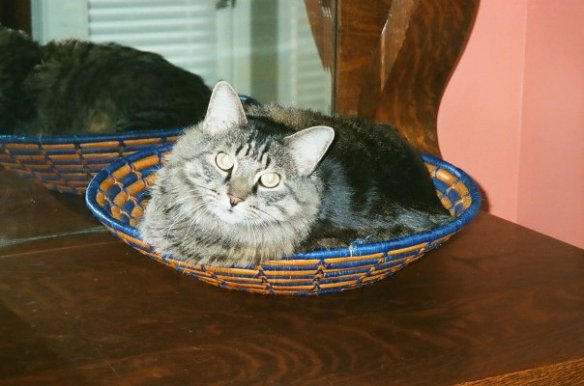
4422_1092553226512_5665392_nAnd here he is tonight:

photo(1)I blogged about Margery’s last days and death last December, and linked to Anne Lamott’s description of her cat’s death here.

Andrew Sullivan lost one of his beloved pet dogs over the weekend, and in the past few weeks has been blogging about what we learn as we watch our pets die.

 

St. Ignatius, Pope Francis, and the Jesuits

Today was the Feast of St. Ignatius of Loyola, founder of the Jesuits.

To mark the feast, Pope Francis celebrated mass at the Church of the Gèsu, the “mother church” of the Jesuit order. Here are his remarks to his fellow Jesuits:

To be men routed and grounded in the Church: that is what Jesus desires of us. There cannot be parallel or isolated paths for us. Yes, paths of searching, creative paths, yes, this is important: to go to the peripheries, so many peripheries. This takes creativity, but always in community, in the Church, with this membership that give us the courage to go forward. To serve Christ is to love this concrete Church, and to serve her with generosity and with the spirit of obedience.

Drew Christiansen, SJ, has a useful essay on Francis, the Ignatian Pope:

As I witnessed his day by day abandonment of centuries-old custom, I marveled at his joyful, spiritual freedom. I soon realized it manifested his appropriation of the Ignatian value of “indifference.” It is an old-fashioned, philosophical term, borrowed from the Stoics, but what indifference means is freedom from distracting and degrading attachments, so as to be free to do what is more conducive to the good of souls. As Pope Francis has made his daily changes, it has become clear that his aim is to make the church the church of Christ, welcoming to all, and appealing because it shows its care for all people.

One maxim that comes from the Spiritual Exercises, tantum quantum, summarizes the principle for using all created things: Use them insofar as they contribute to the glory of God and the salvation of souls. Discard and reject them, when they lead away from that goal.

And Pope Francis himself talked about his Jesuit spirituality during the press conference on the flight back to Rome from Brazil that received so much press for other reasons:

Pope Francis said he still considers himself a Jesuit, but first he posed a tricky logic problem: “The Jesuits make a special vow of fidelity to the pope. But if the pope is a Jesuit, does he have to make a vow to the superior of the Jesuits?”

“I am a Jesuit in my spirituality, a spirituality involving the Exercises (of St. Ignatius),” he said. “And I think like a Jesuit,” he said, but smiled and quickly added, “but not in the sense of hypocrisy.”

The rose-colored glasses of progressive Christians

Earlier this week, my twitter and facebook feeds were awash with likes, shares, and retweets of an article in which the author urged mainline churches (especially, presumably, Episcopalians) not to abandon traditional forms of worship to accommodate young adults. She urged us to change wisely.

Towards the end of the week, there was a similar response to a survey from the Public Religion Research Institute that claims there are more religious progressives (23%) among the millennial generation than religious conservatives (17%, with 22% unaffiliated). Of those aged 67-88, only 12% are progressive while 47% are conservative.

In the midst of a dominant narrative of long-term decline among mainline Christianity, such stories reassure us that we’re on the right track. We don’t have to do anything about our liturgy or worship to adapt to the tastes of a changing culture. In fact, the culture is changing in our direction–if the trend continues, in a few decades there will be more progressive Christians than conservative Christians!

But a closer look at the numbers tells a different story. Among those classified in the survey as “religious progressives” are people “who are unaffiliated with a religious tradition but claim religion is at least somewhat important in their lives” (18% of the overall total) as well as non-Christians (13%). Both of the latter are no doubt going to continue to grow in the coming decades as the number of affiliated Christians continues to drop. If the designers of the survey had divided things up a little differently and defined the religiously unaffiliated as non-religious, the percentages would have been quite different.

And the same is true of the lovely piece proclaiming the appeal of traditional liturgy to young adults. For every article that makes such claims, there are probably a thousand or ten thousand stories of young people who find our liturgy and institutional life stultifying and meaningless. And Dilley herself pointed to what is a distinct possibility:

Even so, your church (and your denomination) might die. My generation and those following might take it apart, brick by brick, absence by absence.

Grasping at straws isn’t the answer. Facing the future and creatively responding to its possibilities and challenges, is.

Not all atheists are created equal

Salon reports on a new study that reveals the complexity within the general grouping of “atheists and non-believers.” Most interesting for church folk is this:

6. Ritual Atheist/Agnostic. While you might think the anti-theist is the non-believer type that scares Christians the most, it turns out that it may very well be the Ritual Atheist/Agnostic. This group, making up 12.5 percent of atheists, doesn’t really believe in the supernatural, but they do believe in the community aspects of their religious tradition enough to continue participating. We’re not just talking about atheists who happen to have a Christmas tree, but who tend to align themselves with a religious tradition even while professing no belief. “Such participation may be related to an ethnic identity (e.g. Jewish),” explain researchers, “or the perceived utility of such practices in making the individual a better person.”

Huffington Post also reports on the study. The study itself can be found here.

Its description of the “Ritual Atheist/Agnostic” includes this observation:

The Ritual Atheist/Agnostic individual perceives ceremonies and rituals as producing personal meaning within life. This meaning can be an artistic or cultural appreciation of human systems of meaning while knowing there is no higher reality other than the observable reality of the mundane world. In some cases, these individuals may identify strongly with religious traditions as a matter of cultural identity and even take an active participation in religious rituals.

This is hardly a new phenomenon but it’s still worth pondering the significance of it for matters like church growth and congregational development, not to mention evangelism.

Benedict of Nursia, 547, on prayer

Today is the feast day of St. Benedict of Nursia, the author of the Rule that has shaped Western monasticism for nearly fifteen hundred years (to call him the “founder” of the Benedictine order is somewhat misleading). While looking for something from the Rule to read for our mid-week Eucharist, I came across the following (from ch. 20, “On Reverence in Prayer”):

Whenever we want to ask some favor of a powerful man, we do it humbly and respectfully, for fear of presumption. How much more important, then, to lay our petitions before the Lord God of all things with the utmost humility and sincere devotion. We must know that God regards our purity of heart and tears of compunction, not our many words. Prayer should therefore be short and pure, unless perhaps it is prolonged under the inspiration of divine grace.