Dietrich Bonhoeffer, April 9, 1945

Today is the seventieth anniversary of the martyrdom of Dietrich Bonhoeffer. While in prison, he wrote a series of letters to his close friend Eberhart Bethge in which he began speculate about “religionless Christianity.” While this notion has received considerable attention over the decades beginning in the 1960s, his words remain as challenging and questioning in the twenty-first century as they did when he wrote them while imprisoned for his participation in an assassination plot against Hitler, and as World War II was coming to an end:

Our whole nineteen-hundred-year-old Christian preaching and theology rest on the “religious a priori” of mankind. “Christianity” has always been a form–perhaps the true form–of “religion.” But if one day it becomes clear that this a priori does not exist at all, but was a historically conditioned and transient form of human self-expression, and if therefore man becomes radically religionless–and I think that that is already more or less the case (else how is it, for example, that this war, in contrast to all previous ones, is not calling forth any “religious” reaction?)–what does that mean for “Christianity”? It means that the foundation is taken away from the whole of what has up to now been our “Christianity,” and that there remain only a few “last survivors of the age of chivalry,” or a few intellectually dishonest people that we are to pounce in fervor, pique, or indignation, in order to sell them goods? Are we to fall upon a few unfortunate people in their hour of need and exercise a sort of religious compulsion on them? If we don’t want to do all that, if our final judgment must be that the Western form of Christianity, too, was only a preliminary stage to a complete absence of religion, what kind of situation emerges for us, for the church? How can Christ become the Lord of the religionless as well? Are there religionless Christians? If religion is only a garment of Christianity–and even this garment has looked very different at different times–then what is a religionless Christianity?

I’ve previously written about Bonhoeffer here and here.

The Cross and the Lynching Tree: Words from James Cone for Good Friday

To understand what the cross means in America we need to take a look at the lynching tree in this nation’s history–that “strange and bitter crop” that Billie Holiday would not let us forget. The lynched black victim experienced the same fate as the crucified Christ and thus became the most potent symbol for understanding the true meaning of the salvation achieved through “God on the Cross.” Nietzsche was right: Christianity is a religion of slaves. God became a slave in Jesus and thereby liberated slaves from being determined by their condition.

The real scandal of the gospel is this: humanity’s salvation is revealed in the cross of the condemned criminal Jesus, and humanity’s salvation is available only through our solidarity with the crucified people in our midst. Faith that emerged out of the scandal of the cross is not a faith of intellectuals or elites of any sort. This is the faith of abused and scandalized people—the losers and the down and out. It was this faith that gave blacks the strength and courage to hope, “to keep on keeping on,” …. The cross and the lynching tree interpret each other. Both were public spectacles, shameful events, instruments of punishment reserved for the most despised people in society. Any genuine theology and any genuine preaching of the Christian gospel must be measured against the test of the scandal of the cross and the lynching tree…..

As I see it, the lynching tree frees the cross from the false pieties of well-meaning Christians. When we see the crucifixion as a first-century lynching, we are confronted by the re-enactment of Christ’s suffering in the blood-soaked history of African Americans.

Thus the lynching tree reveals the true religious meaning of the cross for American Christians today. The cross needs the lynching tree to remind Americans of the reality of suffering-to keep the cross from becoming a symbol of abstract, sentimental piety. Before the spectacle of the cross we are faced with a clear challenge: as Latin American liberation theologian Jon Sobrino has put it, “to take the crucified down from the cross.”

Yet the lynching tree also needs the cross, without which it becomes simply an abomination. It is the cross that points in the direction of hope, the confidence that there is a dimension to life beyond the reach of the oppressor….

Though the pain of Jesus’ cross was real, there was also joy and beauty in his cross. This is the great theological paradox that makes the cross impossible to embrace unless one is standing in solidarity with those who are powerless. God’s loving solidarity can transform ugliness–whether Jesus on the cross or a lynched black victim–into beauty, into God’s liberating presence.

James Cone, The Cross and the Lynching Tree

Monday in Holy Week

djgrieser's avatarPreaching Grace on the Square

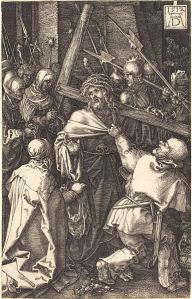
385px-Albrecht_Dürer_-_Christ_Carrying_the_Cross_(NGA_1941.3.3)Albrecht Dürer, Christ Carrying the Cross

The Collect for Monday in Holy Week

Almighty God, whose most dear Son went not up to joy but first he suffered pain, and entered not into glory before he was crucified: Mercifully grant that we, walking in the way of the cross, may find it none other than the way of life and peace; through Jesus Christ your Son our Lord, who lives and reigns with you and the Holy Spirit, one God, for ever and ever. Amen.

View original post

Palm Sunday

Almighty God, whose most dear Son went not up to joy but first he suffered pain, and entered not into glory before he was crucified: Mercifully grant that we, walking in the way of the cross, may find it none other than the way of life and peace; through Jesus Christ our Lord.

The Feast of the Annunciation

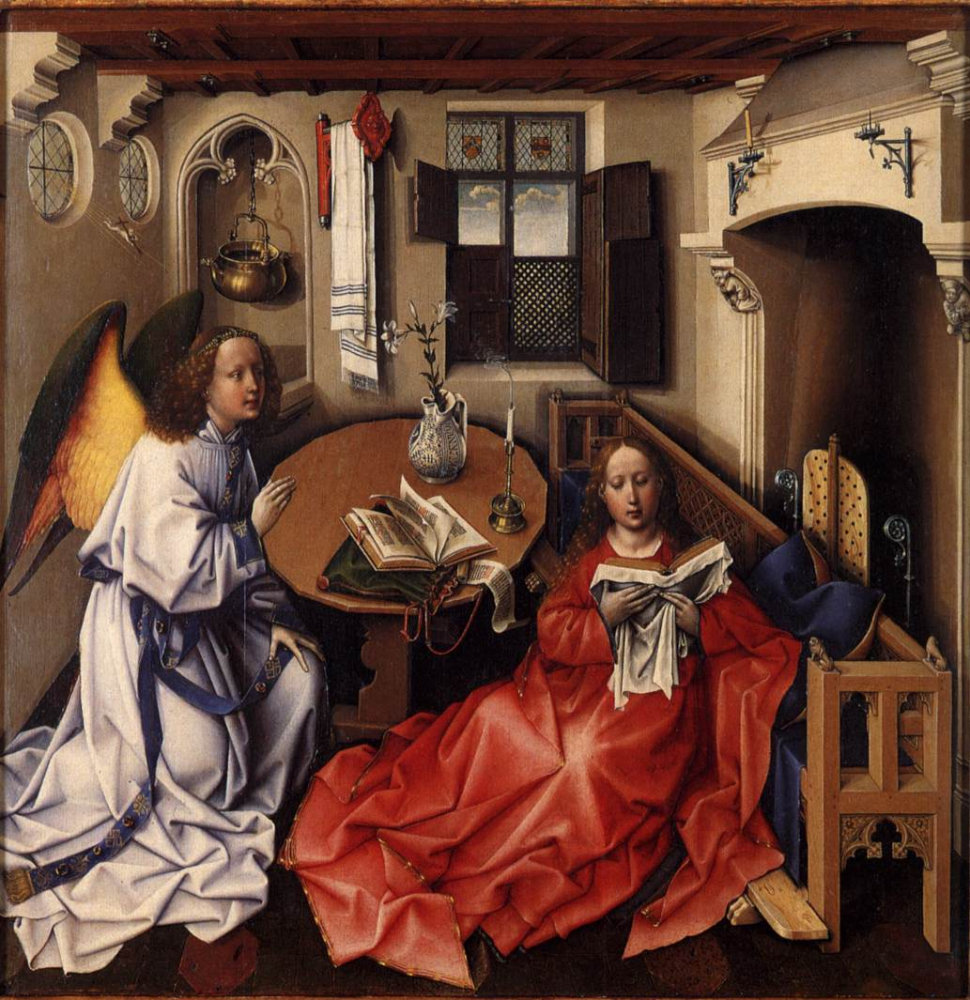
campin_merode_midden_grt –Robert Campin, The Merode Altarpiece (1425-1430)

Today is the Feast of the Annunciation, commemorating the story in Luke 1:26-38. It is the occasion for Mary’s hymn of praise, The Magnificat and has been a focus of Christian devotion for centuries. The angel’s greeting, “Hail Mary, full of grace” and Mary’s response, “Let it be with me according to your word” have shaped reflection and devotion to Mary, and served as models for Christian piety.

Meister Eckhart, the 14th century mystic said this:

We are all meant to be mothers of God. What good is it to me if this eternal birth of the divine Son takes place unceasingly but does not take place within myself? And what good is it to me if Mary is full of grace if I am not also full of grace? What good is it to me for the Creator to give birth to his Son if I also do not give birth to him in my time and my culture? This, then, is the fullness of time. When the Son of God is begotten in us.

And this:

I affirm that had the Virgin not first borne God spiritually He would never have been born from her in bodily fashion. A certain woman said to Christ, “Blessed is the womb that bear Thee.” To which Christ answered, “Nay, rather blessed are they that hear the Word of God and keep it.” It is more worthy of God that He be born spiritually of every pure and virgin soul, than that He be born of Mary. Hereby we should understand that humanity is, so to speak, the Son of God born from all eternity. The Father produced all creatures, and me among them, and I issued forth from Him with all creatures, and yet I abide in the Father. Just as the word which I now speak is conceived and spoken forth by me, and you all receive it, yet none the less it abides in me. Thus I and all creatures abide in the Father.

Marilynne Robinson on Religion, Society, and History in The Nation

In the 150th Anniversary edition of The Nation, there’s a brief interview with Marilynne Robnson, author of Gilead, Home, and Lila:

We have lived through a period when we can see religion used very harmfully in society, which is of course not unusual in human history, either. Perhaps it’s typical, because history is kind of a mess. The thing that I think it is important to remember is that every question is always real. People can’t be passively religious. They have to be critical of what is being presented to them as religion. They can’t be passively liberal. They have to think about the consequences of what they are assuming to be liberal values. Human existence is so complex and so volatile that there is never any fixed solution. There is never any fixed understanding. Everything requires moral scrutiny over again, always.


Madison isn’t Ferguson

Madison is deeply divided racially. I’ve written before about the chasm separating whites from African-Americans in our city and county. You can follow some of those posts and sermons here. The Race to Equity report from 2013 lays out the details and is a must read. It’s available here: WCCF-R2E-Report

The contrasts are especially striking when it comes to the criminal justice system. While arrest rates for African-Americans in general, and African-American juveniles are down over the last decades, they remain considerably higher than those of whites and of the national averages. For example, in 2010, the arrest rate for African-American juveniles was 469 per 1000; for white juveniles it was 77. Nationally among the same age group, the rates were 71 per 1000 for African-Americans, 33 for whites. Although African-Americans account for only 9% of Dane County’s youth, they make up 80% of those sentenced to Wisconsin’s juvenile correctional facility. In 2012,43% of the new adult prison population were African-American men, while they account for only 4.8% of the county’s total population. More information on these statistics is available here.

But it’s important to note the significant differences as well.  Perhaps those differences are best exemplified by the response of the city’s leadership to Tony Robinson’s death. Both Mayor Soglin and Chief Koval were on the scene of the shooting Friday night. Michael Johnson, head of the Boys and Girls Clubs of Madison, took Chief Koval to meet with Tony’s family that night where he prayed with them. In his press conference on Saturday, Koval refused to comment on Robinson’s background. There’s an informative piece on Chief Koval here.

There’s another difference. The shooting did not take place in some strip mall in the suburbs or in a primarily African-American neighborhood. It took place on Williamson (Willy) Street, close to downtown and in the heart of Madison’s eastside, most progressive neighborhood. It really is quite jarring to drive down Willy St. as we did yesterday on our way to visit friends. As you drive past the artisanal butcher shops, bakeries, and shops, you suddenly see four or five police cruisers, police tape blocking the sidewalk. Just as quickly, the site recedes from your rear-view mirror. The wound in our social fabric won’t disappear so easily.

The response from the community has been remarkable. The engagement of African-American leadership, clergy, politicians, and ordinary folks has already made a difference. There is anger, yes. There is grief and mourning. But there is also renewed commitment to work on our city’s problems, to work toward solutions, so that Madison can become one of American’s “most livable cities,” not just for whites, but for everyone.

From Ferguson to Madison

I woke this morning to hear the horrible news that a Madison police officer shot and killed a 19-year old African-American man yesterday evening. The incident took place on Williamson St., which is the heart of Madison’s east-side progressive neighborhood. Here’s the story from the Madison State-Journal

This comes less than a week after gunfire in the parking lot of Westtowne Mall forced its early closure last Saturday. After that event and several other shootings, the official word was that these incidents were gang-related. Earlier this week, arrests were made in those shootings.

Over the last couple of years, the progressive veneer has been stripped from our city, revealing the ugly underside of racism, division, and deep disparities between black and white. These incidents have brought the horrors of that reality to the very heart of where white Madison lives, works, and plays.

It also couldn’t come at a worse time. We are in the midst of a mayoral election and our relatively new police chief hasn’t handled issues of racism very well in his tenure. With the political turmoil in our state, our community as a whole has been struggling to find a way forward.

My prayers go out, for the repose of the soul of Tony Robinson, to his family and friends, to the officer involved and to all members of Madison’s police force, and to our city.


Humanity and Grace in the Presence of Horror

The New York Times has a remarkable story today about a death-row inmate in Georgia who has completed a certificate in Theological Studies and has corresponded with and met the great German theologian Juergen Moltmann. She is scheduled to be executed on Monday after her final clemency appeal was rejected by the state board.

There’s more to the story. Bethany Foster of Mercy Junction in Chattanooga provide a deeper portrait of Kelly Gissendaner:

“Every man Kelly’s ever come in contact with has done something horrible to her,” Kara Tragesser said. “From her stepfather who started molesting her when she was 9 years old to the man who raped her and got her pregnant when she was a teenager, to the judge and the DA and now the five men on the clemency board who decided to kill her in a meeting she wasn’t even allowed to attend.”


It’s a story of grace and humanity in the midst of horror. Gissendaner has been in solitary confinement for eighteen years but the women who served time with her speak of her care and compassion. Read it all here:  Former inmates say fight to save Gissendaner is only the beginning.


The St. John’s Bible: Reflections on encountering the text

I finally made it over to the Chazen Art Museum to take in the current exhibition featuring illuminations and text from the St. John’s Bible. Surprisingly, seeing the text of the New Revised Standard Version in beautiful calligraphy had a more profound effect on me than the many remarkable illuminations. Seeing familiar words in a radically different form on a very different medium was strange, powerful, and revelatory.

As I wandered through the exhibition, reading Psalms and other texts I know by heart, texts I’ve preached, study, taught, the text became holy again, sacralized by the vellum, the years of work and craftsmanship, the beauty on the page. As I wandered and paused to read familiar passages, I realized how very different this encounter with scripture was from my normal experience of it.

I rarely read the text of the Bible on a printed page. When I read scripture, whether it’s studying in preparation for a sermon or the personal devotion of the daily office, the text I read is digital, on a computer screen or ipad. There are sound reasons for this. Access is much quicker and easier. I can call up the text I want in my web browser or my daily office app. I can manipulate the font size to make it easier to read; I can easily cut and paste the verses I want into the text I’m working on. All of that instrumentalizes the text. Even when I’m praying the psalms or using lectio divina, I’m approaching the text of scripture using the same techniques and technology that I use when I’m browsing the web or reading online. The text serves me; it’s at my beck and call.

One of the most disorienting things about the St. John’s Bible is that it is the New Revised Standard Version—the version I use when preaching; the version I used when I taught Bible. It’s the version I know; the version I’ve instrumentalized. Even more shocking is that the calligraphers included the footnotes from the NRSV, the textual variants or alternative translations that complicate the text. To see even this minimal scholarly apparatus in beautiful calligraphy, at the bottom of beautiful pages is jarring.

The exhibition includes items related to the production of the Bible. At the very end are several examples of early printed bibles, a leaf from one of the first editions of the Authorized Version (King James Version) from the collection of the Hill Monastic Library at St. John’s University, and two 17th-century editions of the same version from the University of Wisconsin Library. The inclusion of the two latter bibles in the exhibition invites reflection about the different role of scripture in print and Protestant culture as opposed to its role in Medieval Christianity. The Protestant Reformation was shaped by the new technology of printing and Protestant culture was shaped by printing as well. The possibility of cheap, mass-produced bibles was unthinkable in the fifteenth century. While printing made the text accessible to anyone who could read (or hear), it also began a process of transformation that has only been accelerated by the arrival of the computer. The introduction of versification led to the extraction of the text from its literary context, just as my ability to call up the verse I want on the internet permits me to ignore the same literary context. That, along with the reproduction of the text on cheap paper and in cheap bindings, appearing visually very much like any other text we might encounter, allows us to approach the text, to read it even, less deferentially. What we have gained in accessibility over the last five hundred years we may have lost in sacrality.


More information on The St. John’s Bible is available here: http://www.saintjohnsbible.org