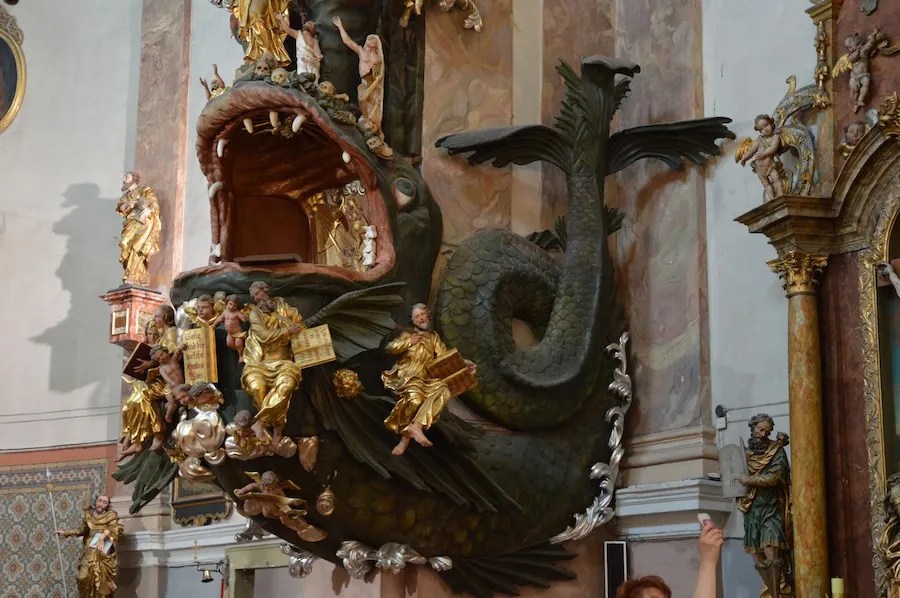
The Wildness of Advent: A Sermon for Advent 2B, 2023

On Monday, I had the opportunity to spend a few hours with poet, theologian, trans activist, and faithful Christian Jay Hulme. I have been following Jay on Twitter for many years. I’m not sure how I got connected but over the years, in addition to sharing his spiritual journey and some of his poems, he posted photos of many of the old churches he visited, and whose towers he climbed. He is currently churchwarden of St. Nicolas, Leicester, England, one of the oldest, perhaps the sixth oldest continuing church in England. Dating from the 8th or 9th century, it is built on the ruins of a sixth century church, which in turn is built on Roman ruins. 

Jay’s poetry is fierce and powerful. He writes about the many places he visits, about holy wells, and saints, and sacred places. There’s a wildness about his poetry and personality. He is courageous and frank. We talked about the very different senses of history that come from being among buildings that date back 500 years or a millennium and the relatively newness of our own buildings. I showed him Grace Church and sent him up the bell tower and I expect we might see a poem one day about that experience or about the cheese curds we shared at the Old Fashioned over lunch.

Listening to him read his poems brought home to me the wildness of the God he encounters in those strange places, on holy islands like Lindisfarne, or in the saints like Joan of Arc about whom he writes. So I was thinking about wildness when I reread the gospel for today, Mark’s take on John the Baptizer. 

In fact, there’s a wildness about Mark as a whole. Probably the first of the gospels to appear, Mark begins in the middle of things and ends abruptly, with an empty tomb and frightened women. In between, there are stories of Jesus encountering people possessed by evil spirits, by demons, Jesus taming storms, and there’s a sense that Jesus himself is doing battle with Satan and demonic forces. 

But wildest of all may be John the Baptizer himself. As Mark tells it, John suddenly appears in the wilderness, preaching and baptizing and attracting large crowds. He is clothed in camel hair and ate locusts and wild honey. Did the crowds come out of curiosity or a desire to hear the words of a prophet? Ultimately, his wildness, his uncontrollability will lead to the inevitable result, his arrest by the authorities, in this case Herod, and his execution.

Our observance of the season of Advent is complicated and contradictory. It is a season of preparation and waiting, preparing for Christ’s coming at Christmas, but as our scripture readings and hymns remind us, it is also about the Second Coming-Christ coming in majesty.

 We tend to downplay that aspect of the season. It can make us feel uncomfortable and inappropriate in light of the larger cultural focus on the coming of Christmas, the round of holiday concerts and get-togethers; the ways in which the advent wreath, for example, originally intended for use in homes, has found its way into churches and given liturgies that focus on themes like love and joy. 

And then we encounter John the Baptizer, with his wild hair, his wild dress, and his wild preaching—Repent! For the kingdom of God has drawn near. John breaks in on us and our complacency. John breaks in on our self-satisfaction and our delusions. John breaks in on the certainties of our lives and our of our seasonal celebrations and cries “Repent.”

This is wildness, uncontrollable. Like the images of the second coming that have dominated our readings over the last month. Like the threats of judgment and warning given to servants, and to bridesmaids, and to us.

That wildness surrounds us—wildness of our own making and not of God’s. The threats of climate change. Are we at a tipping point, with the threats of the melting of the Greenland icesheet while politicians dither over concrete actions, in of all places, Dubai, a monument to our thirst for fossil fuels and conspicuous consumption?

Are we at a tipping point, with thousands already dead in Gaza, and threats to hundreds of thousands, while politicians and pundits debate “genocide” and silence critics of the devastating war that is taking place in front of our eyes and with the support and weapons of the US.

We look around and see all of the crises that continue to threaten us—and the ways in which we threaten the lives of others and all the while we make our plans, do our shopping, plan our menus. The chaos of it all, the wildness, threatens to overwhelm us and so we grasp at those familiar rituals that help to center us and to stave off those feelings of fear and despair.

Wildness, chaos is often understood to be a product of evil yet it’s worth remembering that in the story of creation, God was there, in the midst of chaos, bringing order, speaking the universe into existence, bringing light, and life and creativity. The voice of John crying in the wilderness is not a sign of chaos but a call to repentance, a call from God to us.

Advent reminds us that God is coming into the world, a world beset by evil, threatened by chaos, changed and degraded by our own human actions, our hubris, greed, and rampant desires. But God is coming into the world, coming to us. Indeed, if we pay attention, as we should, we will realize that God is already here, in the wildness, and in the chaos, remaking us in God’s image, bestowing grace in our lives and in those we love.

We may be fearful; we may be disheartened; we may lose hope. But God calls us from the wilderness and the wildness, God calls us in our own wildernesses and wildnesses, when our steps falter, our faith flags, our strength fails. God calls us, comes to us and leads us into the future where there is hope, and justice, and peace.

The Reign of Christ: A sermon for the last Sunday after Pentecost, 2023

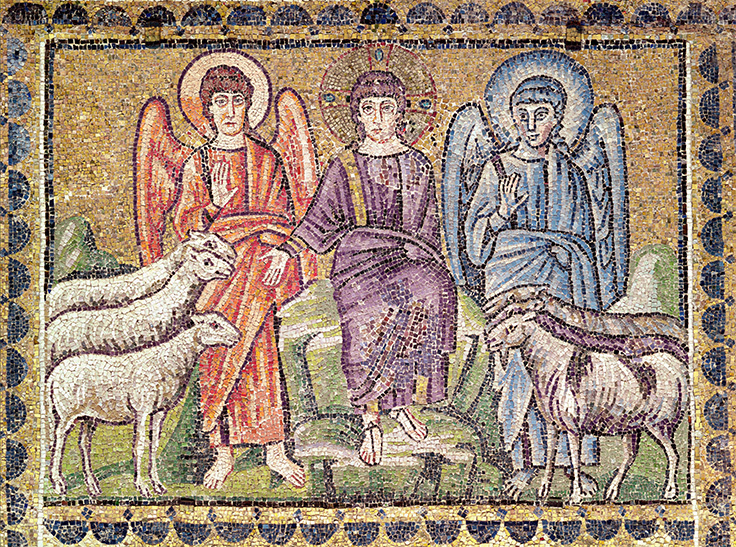
Christ separating the sheep from the goats, San Apollinaire Nuevo, Ravenna, 6th century

Reign of Christ

November 26, 2023

It’s been nearly forty years since I’ve visited Ravenna, Italy but its churches and their mosaics are still alive in my memory. So too is the awe and wonder that they evoked in me then. In the sixth century ce, Ravenna was the western capital of the Byzantine Empire, and the emperors and their families undertook a vast building project to express their power and faith. The mosaics conflate and combine imperial and religious imagery and while their meaning and significance are much debated among art historians and historians of late antiquity, their power, in the sixth century and today, are not.

You can see that imagery on full display on the the cover illustration of today’s service bulletin. What you cannot see is that in addition to looking like a ruler sitting on a throne, Christ in this mosaic is clad in imperial purple, wearing all the trappings and symbolism of a Roman emperor. 

I chose that image because today is the observance of Christ the King, or the Reign of Christ in contemporary parlance, is a 20th century innovation, this mosaic seems to capture perfectly the lectionary choice of Matthew 25:34-46. Christ, reigning in majesty, separating the sheep from the goats. 

Thinking about this image in the context of the parable may help us to encounter the story with new eyes, for it has become something of a favorite for many of us, a way of thinking about our responsibilities as followers of Jesus and to distinguish our sort of Christianity from that of many others—a focus on doing good rather than believing correctly. That interpretation is both comforting and self-gratulatory, and as always with the parables, I want us to experience its strangeness.

One way to do that is to note its context and the parables that precede it. Over the last few weeks, we’ve heard the parable of the wise and foolish bridesmaids, the talents, the wedding banquet. The parable of the wise and foolish bridesmaids concludes with the foolish ones locked out of the banquet hall. The parables of the wedding banquet and the talents end with someone cast into outer darkness, where there is weeping and gnashing of teeth. This one ends similarly with the goats banished to eternal punishment.

After the last two Sunday gospel readings, two parables of judgment and warning about the return of Christ, two parables that make us uncomfortable both in their urgency and in the message of judgment they proclaim, the judgment in this parable seems to support all of our prejudices and values.

In today’s reading, we are inclined, thanks to two thousand years of Christian reflection on this story, to see the separation of sheep and goats into good and evil as obvious, a given. Well, not so fast. In the ancient near east, goats were a prized animal. Their milk and meat were staples. They were not seen as evil—a goat was an acceptable sacrifice in Israelite religion. 

Perhaps more interesting is the fact that it was a common practice to keep goats and sheep together in a single flock. The only time the two animals were separated by the shepherd was on cold nights, when goats needed more protection. In short, in this reading as in the two preceding parables, the separation of sheep and goats into good and evil, is rather arbitrary. 

In fact, that’s something of a theme in Matthew’s gospel, that one can’t distinguish good from evil until the time of judgment—remember the parable of the wheat and the weeds, when “the devil” sowed weeds in a field and the farmer said that at the time of harvest, the wheat and the weeds would be separated and the weeds burned. So there’s something typically Matthean about this whole passage, something that Matthew as a gospel writer is especially interested in. It’s probably a result of something I mentioned a couple of Sundays ago, that a central concern for early Christians that Jesus had not yet returned.

I would like to draw your attention to something else in the text. Jesus is describing what the coming of the Son of Man will be like. First, he uses royal imagery. He will come in glory and sit on his heavenly throne. But immediately, that imagery is combined with another image, that of the shepherd. He will separate the people like a shepherd separates his flocks, the sheep from the goats. 

This image may draw us back to the reading from Ezekiel, where another visionary sees God coming like a shepherd, judging between the fat sheep and the lean sheep, rescuing them from wherever they have been scattered, feeding them, binding up the injured. We might find it odd that these two images—the shepherd and the king—are linked together in the biblical tradition. As the reading from Ezekiel makes clear, one reason for that linkage is the tradition that the founder of the Davidic monarchy—King David, was a shepherd. But for Christians, when shepherd imagery is used of Jesus, it is almost always used to emphasize Jesus’ care for us and his intimate love for us. 

Yet here in Ezekiel, the shepherd is a judge who culls his flocks, separating the fat from the lean sheep. So too in the gospel, the Shepherd King is a Judge who divides the sheep from the goats. In the Ezekiel passage the contrast between the care and tender concern the shepherd shows for the lean sheep and the harsh words with which he judges the fat.

The same is true in the gospel. The king judges harshly, unequivocally between the sheep and the goats. Christ appears to us here as a shepherd-king, but there are two other important images of Christ in the gospel. One is the obvious one. When the king says, inasmuch as you did it to one of the least of these my brothers and sisters, you did it to me, identifies the presence of Christ in the naked, the prisoner, the hungry, the sick. The third image is less obvious. The text begins with a reference to the Son of Man. In Matthew, when Jesus uses that title of himself, it almost always is in reference to his crucifixion. Christ the King is also the Crucified One and the least of these.

We are called to hold these three images together, we might think of them as three facets of a prism that together refract the light. If we ignore one of them, the other two become less brilliant. Emphasizing one over the other is a common temptation for Christians, but the gospel itself warns against it. We might prefer one image over the other. Some might want to encounter Christ only in the face of the poor and hungry; others only in an image of the Crucifixion. There are even those who can conceive of Christ only as the judge who comes on a cloud of thunder and reigns in majesty. 

Each image taken by itself will lead to a distortion of our faith. Those who focus only on the crucifixion will see Jesus only as the one who offers forgiveness for our sins. Those who focus on Christ in Majesty will think only about the second coming and making sure that they are on his right side. Those who focus only on outreach to others turn the Christian message into a social service agency. 

The judge separates sheep from goats, those who reached out to the needy and those who didn’t. The surprising thing here is that all are surprised. Neither group knew that Christ was present in the naked, the stranger or the prisoner. So for those whom the King welcomed into the kingdom, their actions in reaching out to the needy were not a conscious response to Jesus’ teachings or the result of acting out of duty or in order to gain their salvation. Their actions were an unconscious, unknowing part of who they were as Jesus’ disciples.

The same Christ who will come in Majesty to judge the living and the dead; the same Christ who was crucified for our sins; the Christ in whom we proclaim our faith when we recite the creed, that very Christ is present in all of those people—in the prisoner, the naked, the hungry, the stranger, and the sick. To hold these different images together, to confess Christ crucified, risen, reigning in majesty along with recognizing Christ’s presence in the sick, the imprisoned, the hungry and naked is our task as Christians seeking to follow him.

Happy Saints: A Sermon for All Saints’ Sunday, 2023

Today is All Saints’ Sunday. I love it because of its wide range of meanings and observances. Today, we remember the faithful departed, a commemoration that is connected with November 2, traditionally All Souls’ Day. We also remember all of the saints. The observance of All Saints’ goes back to the early Middle Ages and arose as an occasion on which to recognize all of the saints, mostly martyrs, mostly nameless, who did not have a day reserved for their memory. For us, it’s also an opportunity to think of those anonymous saints, the people in our lives and community that have helped to shape us as followers of Jesus and served as models of faith.

All Saints’ is also one of those days set aside in the liturgical calendar that is especially appropriate for baptism. So, in addition to remembering those who have passed, and acknowledging the pillars of faith that uphold our community now, we are bringing into the body of Christ new members. It’s a visible, and powerful symbol of body of Christ that includes those who have gone before us, and those who will come after us.

But what sort of community is this one to which belong and into which we are bringing Evie? It is a question that we must ask ourselves as we seek to be faithful disciples of Jesus Christ. It is a question we must ask as we explore God’s call to us in this place, in this moment. And there is perhaps no better place to begin exploring that question than in the words of Jesus we hear in the gospel this morning—the Beatitudes.

Today’s gospel helps us to make sense of the roles others play in our lives, and also about the roles we may play in the lives of others. It takes us back to the very beginning of Jesus’ public ministry in the Gospel of Matthew. For Matthew, these are the first words that Jesus says publicly. It’s the beginning of the Sermon on the Mount, and we commonly call these first verses the beatitudes—the blessings. Blessing or blessed is one of those words we don’t use in regular conversation anymore, except when someone sneezes, or in certain phrases, like the southern “Well, bless your heart!” and even then we use the word without thinking about it much.

The word that’s translated as “blessed” could also be translated “happy” and that translation may help us get at all this means. “Happy are those who mourn, for they will be comforted.” Get it now?

I didn’t think so. That makes no sense, but that may be what Jesus means by all this. Happy are the poor in spirit; happy are the meek, happy are the merciful, happy are they who hunger and thirst after righteousness, happy are the peace makers, happy are those who are persecuted for righteousness’ sake. We don’t associate any of those things with happiness. For us, happiness is associated with a very different range of ideas, emotions, and states of being. We can’t fathom how the poor in spirit might be happy.

 So we try to do something else with these sayings. We try to make them goals for ourselves—if we become poor in spirit, we will attain the kingdom of heaven, if we become merciful, we will receive mercy. But that’s not what Jesus is saying, either. Rather, those who are already poor in spirit are blessed, those who are merciful are blessed. Jesus is describing people who are already doing or being the things for which they are blessed.

We know the world we live in isn’t like the world that Jesus describes. We know that the meek, the pure in heart, peacemakers, the poor in spirit are not praised or rewarded in our culture. What Jesus is describing is an alternate reality with different values. Jesus is proclaiming, as he does throughout the gospel of Matthew, the reign of God. It’s a world turned upside-down, where the last are first and the first are last, where the meek, not the powerful inherit; where the merciful receive mercy.

There may be no more urgent message in our time than this—that God is not on the side of the powerful, the prideful, the wealthy but rather, on the side of the weak, the humble, the poor. In a time when military force is being used against captive populations; when nations seek to extend their influence by force of might, when those who are victims of state violence and climate change seek better lives in other places and are repelled at borders and treated inhumanely, to express the values of the beatitudes is revolutionary indeed.

And that is what we are called to be and to do as followers of Jesus. That is what we commit to in our baptismal covenant. When I baptize Evie later, I will ask all of you: 

CelebrantWill you proclaim by word and example the Good
News of God in Christ?
PeopleI will, with God’s help.
 
CelebrantWill you seek and serve Christ in all persons, loving
your neighbor as yourself?
PeopleI will, with God’s help.
 
CelebrantWill you strive for justice and peace among all
people, and respect the dignity of every human
being?
PeopleI will, with God’s help.

The commitments we make and remake today are signposts on the way to the world Jesus is calling into existence in his teaching and ministry. Our response to his teachings help to bring that world into being, even as all around us the forces of evil, death, and destruction fight mightily against it. That evil may seem more powerful than the words and vision of Jesus. Nevertheless, in the midst of that evil, we, and all the saints bear witness to the greater power of Jesus’ love. May his love and grace give us the strength to embody that love in all that we do.

Buried in Love: A Sermon for Proper 25A, 2023

October 29, 2023

This has been a year of funerals at Grace. By my count, including those of members both here and offsite, we’ve had twelve, including the one coming up on. That many funerals takes a toll, on volunteers and staff, on the life of the congregation, on our emotional and spiritual well-being. The number of those who have passed, their absence from our pews and from the life of our congregation is a burden we will carry with us. For me and for many of you, it’s not just those we’ve lost this year; it’s all the others who have entered the larger life; people who gave so much of their time, energy, skills, and expertise to Grace; people who meant so much to us.

This past Tuesday, I performed another ritual as part of our love and care for our deceased loved ones. I took a spade, and in the courtyard garden, dug a hole in which we would later inter the ashes of one of our faithfully departed members. “Earth to earth, ashes to ashes, dust to dust.” I would say those familiar words a few minutes later, but as I dug, a few steps away, volunteers were welcoming guests to the food pantry, and a few steps further away, people were walking by on the sidewalk, oblivious to what I was doing.

In today’s reading from Deuteronomy, we come to the final scene of Moses’ life. We have heard over the last months, the story of the God’s promise to Abraham, Isaac, and Jacob, that God would make of them a mighty nation, and that God would give them the land of Canaan as their possession. But those promises have not been realized. Now, at the end of Deuteronomy, the Israelites have still not entered the Promised Land, and their leader, Moses, who had brought them out of bondage in Egypt, would die, like his ancestors, with that dream and promise unfulfilled. 

But in the last scene of his life, God showed him all of that land. It’s particularly poignant to hear that story, and that promise now, in these weeks, as war rages in that very land, some three thousand years later. The effects of that promise endure, weaponized by hatred and the thirst for revenge, countless lives have been lost over the centuries and today.

But there’s the promise and God showing Moses all of that land, and then Moses dies. I would like to draw your attention to another theme in the story and that is the relationship between Moses and God. Here, we are told that God knew Moses face to face. We have seen details of the intimate relationship the two shared. We have seen Moses appeal to God on behalf of the Israelites, we have seen him ask to see God’s glory, and instead to be seen God’s backside from the cleft of a rock, while his face was shielded by God’s hand. We have seen his face transformed by his encounter with God, shining.

Now we see something else, although it is obscured by the translation we use. In the report of Moses’ death, our text reads, “He was buried in a valley in the Land of Moab…” The Hebrew actually reads, “he buried him” that is, God buried him. That tender, intimate act, the image of God taking up a shovel and burying God’s beloved and devoted servant is evidence of the intimacy the two shared. It points to God’s care and concern for God’s people.

It also calls to mind other stories. At the very beginning of the Pentateuch, in Genesis, we are shown God’s tender actions in creating human beings, the man out of the dust of the earth, and the woman from the man’s rib. We also see God’s tenderness, care, and protection of the first humans, when after they sinned, God made clothes for them out of animal skins.

We might be turned off by the intimacy and earthiness of this imagery, of the notion that God might create out of the dust of the earth, that God might take up needle and thread, or that God might bury Moses. Such language might seem overly mythological or anthropomorphic, a far cry from the God of the philosophers or of contemporary theology. 

But such language can offer us comfort and strengthen our faith. To imagine a God so intimately involved in the lives of those God loves, a God whose concern and care extends to the clothes on our back or the disposition of our final remains, a God who knows us face to face, can be a source of strength when we struggle or stumble.

And it also, I think, helps us reflect in a new way on the story from the gospel, in which a lawyer asks Jesus to prioritize the commandments. Jesus’ response is hardly revolutionary.  His words are quotations from Deuteronomy and Leviticus, straight out of Moses’ law. 

It’s worth stressing that Jesus is saying nothing outside of the Jewish tradition. It’s not just only that this understanding of the centrality of love of God and neighbor in the Mosaic law is enshrined in scripture. In Jesus’ own day, it was an idea that was widely shared. A contemporary of his, Rabbi Hillel, is remembered to have said in response to a similar question, “What is hateful to you do not do to your neighbor; that is the whole Torah, the rest is commentary; go and learn it.”—A reminder, much needed in these days of rampant Anti-Semitism, that Jesus’ teachings were well within the larger framework of 1st century Judaism.

Be that as it may, these words of Jesus continue to challenge us profoundly. We have compartmentalized so much of ourselves, so much of our lives. We place our faith in God in one small sphere of our lives, for Sunday mornings, for example, or for those quiet moments of prayer and meditation. We think of love as an emotion, we talk of falling in or out of love, or we say, we love this or that food, or activity. We are commanded, in Deuteronomy, here in Jesus’ words, to love the Lord our God with all of our heart, soul, and mind—we might say “with all of our selves, with our whole being.” I’m not sure I can even fathom what that might look like for me, what that would be like to love God with all of myself. And then, on top of that, we are commanded to love our neighbor as ourself. Is that even possible?

Here’s where I think the earthy, intimate image of God burying Moses might be of help. For in that very human, incredibly intimate action—I bet most of us are turned off by it, by the idea of the transcendent, immortal, invisible, omniscient, omnipotent, being though of performing that very intimate even offensive act, who of us could imagine, in this day and age, actually burying a loved one with our own hands—in that incredibly intimate action, we see a parable of God’s love for us. Imagine God lowering Godself to care for us so intimately. Imagine that love. If God can love us so powerfully and intimately, how can we not love God with the same intensity, with our whole selves, hearts, minds, and souls?

 And if God can love us, how can we not love our selves? That element of this statement is often ignored. We might think that to love ourselves is somehow sinful, inappropriate; yet if you think about it, love of neighbor is predicated on love of self; love of neighbor requires love of self. And when so many people have internalized self-hatred, to open out the possibility that we, too, are worthy of love, well; that’s a gift worth receiving.

And finally, if we love God, and love ourselves as God loves us, how can we not also love our neighbor, who like us, is loved by God? How we live out and incarnate love may take different forms. It may be in the way we at Grace care for members of our community and their loved ones when they pass. It may be through the work of our food pantry and its many volunteers who offer food to those who are food insecure. It may take many other forms as well, by welcoming the stranger; opening our doors for programs like Uptown Sanctuary or Off the Square Club. There may also be new opportunities that we haven’t yet discerned; ways the Holy Spirit may be moving among us to share God’s love, to be God’s love.

Have patience! I’ll pay everything: A Sermon for Proper 19A, 2023

Some of Jesus’ parables are enigmatic, puzzling. They seem to defy interpretation, like the parable of the Workers in the Vineyard, that we will hear next Sunday. Some are familiar, so familiar that their interpretations seem fixed for all time. Some seem to be obvious, stories with a single point that gets hammered home. Then there are parables like the one we heard this morning, a story that we can all connect with but that has some twists and turns that may make us uncomfortable.

On the surface we get it. Though it’s set in an ancient context, in slavery, with a lord or master who demands accounting from his slaves, debt is something we all know about. We’ve heard about the effects of crushing medical debt, incurred through no fault of one’s own, the product of illness, or injury, the random attack of cancer, but caused above all by a medical system that seems designed to draw profits from people at their most vulnerable and weakest. We know about student loan debt, again incurred in the effort to improve one’s lot in life, but thanks to federal policy, and a higher education system more interested in profits than learning, it can become crushing and impossible to pay off, with interest often far exceeding the original amount of the loans. 

So when we encounter a story about debt, and the forgiveness of debt, we think we’re in territory we know. But wait a sec. Let’s consider the numbers. What is a talent (and no, it’s not a God-given ability; in fact, our word talent derives from the Greek word that’s used here). A talent was a unit of measure, of weight. It was about 130 lbs, and in monetary terms, used of silver, and was roughly equal to 15 yrs of an ordinary worker’s wages. So 10,000 talents would be worth 150,000 yrs of work. To put it another way, about equal to 3000 lifetimes. An astronomical sum, isn’t it?

And so the questions start popping up. How could a slave incur so much debt? Well, say for a moment it’s hyperbole. The point is that it is an amount that could never be repaid in one’s lifetime—there, that brings it back down to earth, and to a place we’re familiar with. We have all heard the stories of people saddled with hundreds of thousands of dollars of medical debt; and the only way out from under that debt is to declare bankruptcy.

We get all that. We can even imagine pleading with a debt collecting agency for mercy. We can see our selves down on our knees, begging to be given relief from that staggering debt. And we can imagine also the joy when we hear the response: “Your debt is forgiven.”

But then comes the twist. Having received mercy, his enormous debt forgiven, the slave goes out and encounters another slave who owes him a debt. It’s not as big a debt as the first; only 100 denarii—a denarius being roughly a day’s wages for a laborer. We hear the very same words from the second slave, “Have patience with me and I will pay you everything.” 

But the first slave reacts differently than his master did. Instead of offering mercy, he has the second slave imprisoned. But he gets his comeuppance. The other slaves, having seen all this, probably having heard about what their master had done for him, his sudden good fortune, his freedom from debt; having heard all this, they go back to the master and tell him what happened. He ends up in the same place where he had sent the second slave, in prison being tortured for his lack of mercy. 

One of the challenges of this parable is that it is so easy to allegorize it—to equate the master, the lord with God. But if we do that, we’re left in a very uncomfortable place at the end of the story—with a master, a God, who retracts his mercy, punishes the slave for his actions and his debts. What was it Jesus said in the intro to the parable? To forgive as many as seventy seven times—hardly what the master did, is it?

I think there’s something else going on here. In the Roman empire as in our own day, debt was ubiquitous. It was hard to imagine a world without debt, an economy that didn’t rely on debt. In the end, neither the master, nor the slave could break free of those assumptions, that worldview that saw debt as essential, as all-pervasive.

But in the Jewish tradition, in the Biblical tradition there was an alternative. The Torah imagines a debt-free society; a day of rest when one has no work obligations; a sabbatical year when the land lies fallow; and the year of Jubilee, the 50th year, when all debts are erased, slaves freed, land that was sold returned to its original owner. 

You may be thinking of the Lord’s Prayer—In Matthew, the text reads, “Forgive us our debts as we also have forgiven our debtors.” To be free of debt; to live in a society that is debt-free, what would that even look like?

I was fascinated and saddened this summer as I watched the debate over student loan forgiveness unfold. Countless people spoke of their experiences, attending college without accumulating any debt; or working hard for years to pay it off as they criticized the president’s plan to forgive student loans. It wasn’t fair, they said. They rarely pointed out that when they were in school, the price of tuition was much lower, interest rates on student loans were much lower. They didn’t point out that all of those billions of dollars of payroll protection loans made during COVID were forgiven. Like the first slave, we may rejoice if our debts are forgiven, and we may be reluctant to forgive the debts of others.

The parable leaves us with questions, even though its meaning is quite clear. We should forgive those who owe us, just as God forgives us. But the questions—why does the king not forgive the slave a second time? After all, Jesus has told Peter to forgive not seven but seventy seven times. The parable invites us to think of forgiveness as a calculus—there exists, somewhere a finite number of times, beyond which it is not necessary to forgive. But that’s precisely the wrong way of thinking about things.

To think about forgiveness as a debt suggests that we understand it in terms we comprehend—mathematics or economics, and given all the talk of debt in our culture, we are sorely tempted to go down that route. That’s overlooking something that is crucial in understanding Peter’s question: “How often should I forgive my brother? For that question implies there is relationship between the one forgiving and the one owed. Including that in the equation changes everything. 

We ask God to forgive us and we experience God’s forgiveness, rich, unbounded, unmerited. It is that relationship and that experience that should shape our own forgiveness. That is the point both of Jesus’ answer to Peter and the parable itself.

I have lived long enough and served as a pastor long enough to know that pain and anger from hurt can last a very long time. We process things quite differently; in different ways and at different speeds. Even the same hurt inflicted on two different people can linger in very different ways in those who have been affected. That’s true not only in our personal lives, but also when we think about events like those we commemorate today. Forgiving others may be difficult, even, at times, impossible. Yet our God, who has forgiven us so deeply and so completely, invites us, not only to be forgiven, but to forgive in the same way, richly, unboundedly, and totally. Thanks be to God!

A reflection on the life of Ada Deer

Ada Deer

August 24, 2023

I certainly didn’t know Ada as long or as deeply as Art, or Ben, or Joe, or Lynn, or many of you. In fact, when we met on the day after her 88th birthday to talk about this service, I told her that there was no need for me to say anything, but she insisted. So if you don’t like what I have to say, or think I speak too long, blame Ada.

As I listened to the Menominee Second Island Drum and singers, I reflected on this historic event, and on this historic space. In the 165 years since Grace Church was built, it has witnessed thousands of worship services but I wonder what past parishioners would think of what we are witnessing today—a room filled with Native American people, their music, honoring someone who did so much for her people and is a icon of resistance and resilience.

I met Ada probably 7 or 8 years ago when Lynn brought her to Grace to attend an anti-racism workshop she had organized. It was after church; and as soon as I walked in the room, Lynn pulled me aside to introduce me to Ada. I sat down, and after introductions, almost the first thing out of her mouth was a rather salty take on Christianity. She may have been surprised that I wasn’t taken aback or offended. As a trained historian I knew about the effects of White settler colonialism on Native peoples, their culture, and their lives. From Ada and others I have learned a great deal more, especially about the horrors of the boarding schools that resulted in generational trauma.

I was surprised, deeply humbled and honored both for myself and for Grace Church, that Ada us to hold a memorial service in her honor. When I agreed, I wasn’t quite sure just what I was agreeing to. After her death, as I began to read the accolades in local, state, and national media, I began to realize more clearly how important Ada was to her tribe, the Native American community, and to our nation’s history. And I’ve been surprised over the last couple of weeks when I mention her name to friends and acquaintances in the community who are not connected with the circles of political or civic activism, the University or progressive circles, at how many people were touched by her life, people she didn’t even know.

 It speaks to her prominence and to her generosity of spirit and openness to others; it also speaks volumes about the deepening relationship she developed with Grace Church and its members as we have examined the history of Christianity and Native peoples, and begun to take steps toward restorative justice.

To take measure of a life like Ada’s is no easy thing and to place it in a larger context of the struggle for justice and equality of Native Americans, or American Indians as Ada preferred to call her community, is beyond the scope of what we can do on this day. That is something for historians to reckon with in coming years. Still Ada’s life is a testament to the ongoing struggles of American Indians and to their resilience in the face of centuries of oppression and violence.

Our scripture readings today speak to this moment and to our efforts to honor and remember Ada. From the Hebrew Bible or Old Testament, words written over 2500 years ago that remind us of the passage of time, of cycles of mourning and joy, life and death, laughter and tears. Our memories of Ada evoke so many emotions: gratitude, love, respect. We may laugh as we remember her love of humor and her own beaming smile. We may cry as we feel the loss of her presence, and a world that seems just a bit smaller and less colorful with her passing. But the words from Ecclesiastes are words of comfort, reminding us that our grief will fade in time, even as our memories linger to be cherished and shared.

From the gospel, we heard the beatitudes, blessings that Jesus spoke to his listeners in his first sermon recorded in the Gospel of Matthew. They speak directly to us as well: Blessed are those who mourn, for they shall be comforted. More broadly, they reflect Jesus’ overall message calling into existence a new community, a new way of being in the world—a community of love, peace, and radical inclusion. It is a vision that has often been obscured and distorted to fit political agendas, military conquest, oppression. Those distortions were among the reasons for Ada’s distrust of Christianity. In our day these distortions have become even more pronounced, being twisted into the sins of White Supremacy and Christian Nationalism. But Jesus’ words continue to call out to us across the centuries, to work for justice, and peace, and to care for the most vulnerable; to welcome the stranger, and the alien; to build bridges across communities divided by histories of hatred, violence, and oppression. 

It was something of that same vision that Ada embodied in her tireless and inspirational work for justice for American Indians, in the vast network of friends she made over the years, in the community she built and nourished wherever she found herself. She called all of us to do better; to listen to the stories of the marginalized and vulnerable, to unite with those working for justice, to break the bonds of oppression, and to heal the wounds and scars of trauma.

We are here to mourn, to remember, to celebrate Ada’s life, to give thanks for all that she did in her long and illustrious career. But we would be unfaithful to her spirit if we left it at that. Today should also be a time when we renew our spirits, rekindle our hope, and gather our strength. Let us go from here into the world to share Ada’s passion for justice, to continue her work for equity, and to build community across difference. May we all one day, see justice roll down like water, and righteousness like an ever flowing stream.

Our Canaanite Woman: A sermon for Proper 15A, 2023

In a recent essay for The Atlantic, David Brooks, ponders the question “How America got mean.” He begins with a litany of examples: the restaurateur who tells him that he has to kick a customer out of his restaurant every week because of bad behavior; the hospital administrator who talks about staff leaving because of abusive patients. We could add to the list—road rage, minor disagreements that devolve into violence; vitriolic, dehumanizing political discourse. 

What Brooks doesn’t discuss is the institutional and structural mean-ness or violence that has been a part of our society since its beginning—the racism, misogyny and sexism, the genocide of Native Americans, the greed, rapaciousness, and exploitation of American capitalism. When wasn’t America mean? Genteel manners can conceal horrors.

That question, about mean-ness or cultural violence provides an interesting perspective from which to reflect on today’s gospel. It is certainly one of the strangest, perhaps most offensive stories in all of the gospels. It appears on the surface, at a cursory reading or listening, that this is a story of Jesus behaving badly. And in fact, I’m always amused when this story comes up, at the conversations or “discourse” as its often called, that it generates on social media. I’m also bemused that of all of my sermons that I’ve posted on my website, it’s the one that gets the most traffic, month after month, year after year. It’s a story that continues to confound and challenge preachers, ordinary Christians, and biblical scholars.

 To unpack this story, we need first of all to pay attention to geography. We’re told that Jesus and his disciples are in the region of Tyre and Sidon. We’re given no explanation for this, and given that we are reading this in mid-August, I’m always inclined to say something like: “Jesus and his disciples decided to go the beach.” 

Tyre and Sidon are ports on the Mediterranean. More significantly, they are far away from the area where Jesus has been exercising his ministry, Galilee, which in Jesus’ day was under the authority of the Tetrarchy of the Herods. Tyre and Sidon were in the Roman province of Syria. They were outside of the traditional territory that had been part of the monarchy, and outside of the region that was largely populated by Judeans. While Jesus had crossed over the Sea of Galilee to visit Gentile territory, this was his furthest and longest journey outside of Judean territory.

         There’s no explanation for his trip to the coast and from his response to the Canaanite woman, it’s pretty clear that he wasn’t on a Mission Trip, which another one of those summer pastimes many people undertake. He didn’t go there to preach or to heal, or to do any other things he had been accustomed to doing. Maybe he really was taking a vacation. He probably needed one. If that’s the case, Jesus seems to be behaving very much like the insensitive tourist, ridiculing the local population.

         There’s another fascinating and important detail in Matthew’s telling of the story that should help us make sense of it. That is his description of the woman as “Canaanite.” When the Gospel of Mark tells the story, the woman is described as “Syrophoenician,” which is more appropriate. We twenty-first century readers of the story might not find the reference to Canaanite here as strange. After all, the Canaanites appear regularly in the Hebrew Bible—they inhabit the land before the Israelites enter and resist the Israelite occupation. They persevere and over the centuries of the monarchy, Canaanite religion and culture continue to be a seductive alternative to worship of God and the kind of society that is laid out in the Mosaic law. 

The point is, that “Canaanite” here is wildly anachronistic. Canaanite culture had long since been subsumed by the Hellenistic culture of later centuries and Canaanites no longer existed as a separate ethnic, religious, or cultural identity. The best analogy I could come up with is when the British referred to their German enemies as “huns” in the first World War. They were assimilating German culture and military power to the 4th century invaders who sacked Rome. There were no Huns in early 20th century Europe, just as there were no Canaanites in 1st century Palestine.

So why the term? It should be obvious. Matthew wants to depict the woman as wholly “other”—beneath respect and notice, a member of a group existentially distinct from Jews and their mortal enemies. And to top it off, she was a woman, doubly marginalized, non-Jew, a woman, who was transgressing every social and cultural taboo to approach Jesus.

This is the story, a woman breaking all of those boundaries to approach Jesus in desperation, to find healing for her daughter. Can you imagine how much courage she had to muster to confront Jesus? 

It’s this woman, by gender voiceless and powerless, by ethnicity and religion, totally other, to be avoided, it is this woman who comes to Jesus in search of help for her daughter, and Jesus first ignores her, then refers to her as a dog. I won’t use it, but you know what epithet in contemporary English would fit this situation. 

But she persists. Her need is so great, the love of her child so powerful, that she brushes off Jesus’ lack of concern and his verbal cruelty and offers a retort. “So you think I’m a dog, Jesus. Well, even dogs are given the scraps from the master’s table.” 

And with that response, she wins the argument, beating Jesus at his own game. Now, he is shocked out of his complacency, his eyes that were clouded by prejudice, his heart, cold because she wasn’t one of those he understood to be his mission area, opened to her need. Jesus is transformed by her words and her need and he heals her daughter.

It’s a challenging and uncomfortable story. It seems to depict a Jesus who is insensitive to the needs of someone. It also depicts a woman whose behavior might seem to be obnoxious, or at the very least, in appropriate. She doesn’t behave as she ought. She cajoles Jesus into helping her daughter. Where’s the good news here? 

As I was wrestling with this question and this story this week, I was also preparing for two memorial services; the one for Michael yesterday, and the service for Ada Deer that will take place here on Thursday. As I was riding into church this morning, I realized that both Michael and Ada were our Canaanite woman. Michael touched many lives, building community among people who have been marginalized and ostracized. He found sobriety in AA and over the decades accompanied many others on their journeys toward sobriety. He also supported the LGBT community, working with and caring for HIV/AIDS patients during the height of the epidemic. 

Ada spoke truth to power, advocating for justice for Native Americans, challenging our nation, our state, and we at Grace to confront Christianity’s history of mistreatment, oppression, and erasure of Native American religion and culture.

In part, this gospel reading is a story of the transformative power of advocacy. God hears the cries of the oppressed and the suffering. As followers of Jesus we are called to hear those cries and respond to them. They may challenge us; they may confront us with uncomfortable truths but we are called to listen to them.

We are also called to unite our voices with the voices of the suffering and the oppressed; to walk with them, support them. It also testifies to the power of those voices. We may grow disillusioned and disheartened by the lack of response, by the closed ears and closed minds of those to whom we cry. But our voices will be heard, our calls for justice answered. May we open our ears, our hearts, and our mouths; and may we join with those who are crying for justice.

Hiroshima and Transfiguration.: A sermon for the Feast of the Transfiguration, 2023

Feast of the Transfiguration

August 6, 2023

Today is The Feast of the Transfiguration, when the church commemorates the mysterious, ethereal appearance of Elijah and Moses with Jesus. Jesus’ appearance was transformed—hence, transfigured—and appeared “dazzling white” as our gospel reading relates. This is actually the second time this year that we have heard about the Transfiguration. It is also always the gospel reading on the last Sunday before Lent. Today, August 6 is its feast day, and the Book of Common Prayer stipulates that when the 6th falls on a Sunday, it supersedes the customary lectionary readings.

Today is also the 78th anniversary of the dropping of the atomic bomb on Hiroshima. That’s an event that has returned to our cultural consciousness with the recent release of Christopher Nolan’s bio-pic Oppenheimer about the leader of the Manhattan Project, the effort to harness the power of the atom for military use. I’ve not seen the movie yet, although I have read a great deal about it. In case you were wondering, I’ve not seen Barbie, either—In fact, I’ve not stepped inside a movie theatre since the pandemic.

Among the many things written about Oppenheimer, one commonly noted observation is that the film does not go into any detail about the horror unleashed by the bomb, the deaths of hundreds of thousands of people, the destruction of Hiroshima and Nagasaki. Also left untold is the impact on the local community of the creation of the facilities at Los Alamos—the dispossession of native and Hispanic residents; their employment at the site, and the effects of the radiation on those workers and the local population as a whole; a danger from they which were not given protection, unlike the white scientists and employees.

For people of my age or older, the image of mushroom clouds, the description of the flash of light of detonation, are firmly fixed in our memories. We remember air-raid shelters, the threat of nuclear war, of mutually assured destruction. The awesome, horrible power of an atomic bomb was never far from our thoughts or fears until the gradual thaw of relations between east and west and the end of the Soviet Union, fears that began to rekindle with the invasion of Ukraine last year.

The mushroom cloud, the blinding light of explosion, the invisible radiation that continued to devastate the bodies of survivors for the rest of their lives, seem to confirm the famous quote from the Bhagavad Ghita that Oppenheimer used to make sense of the bomb and his role in it: “Now, we are become death, the destroyer of worlds.”

The horrific, literally blinding, brilliance of an atomic bomb explosion offers a dramatic contrast to the brilliance described in today’s gospel reading. If we were able to make a film of the scene, we might be inclined to make use of the special effects and CGI now common in Hollywood, and exploited by Director Christopher Nolan in showing the explosion of the first atomic bomb. And it might lead us to conclude that Peter’s response to this experience, “to make booths or dwellings” for the three heavenly beings, is completely inappropriate and misguided

But in fact, there’s more to it than that. Our reading from Exodus points us to the larger biblical and Jewish context for the Transfiguration. The lectionary is probably intended to have us look for parallels between the Transfiguration of Christ and the changed visage of Moses after his encounters with God on Mt. Sinai. Our translation is strange enough, with the mention of the veil that Moses wore over his face when speaking with the people. In the traditional Vulgate, the dominant Latin translation used throughout the Middle Ages, it reads that Moses’ face was horned; which explains why in so many works of art, most notably Michelangelo’s sculpture of Moses, he is depicted with horns.

But there’s another, equally significant connection between the story of the Transfiguration and Moses on Mt. Sinai. When Peter says, “Let us make booths, or dwellings…” –the word Peter uses here can also be translated as “Tabernacle” which was the symbol of God’s presence among the Israelites during their time in the wilderness, including Sinai. Tabernacle, booth, dwelling, is also an allusion to the Jewish Festival of Sukkoth, or Tabernacles, which commemorates the Israelites time in the wilderness.

So, rather than not getting the point, as is usually assumed with regard to Peter in this story, and elsewhere in the gospel, it may be that Peter is trying to make sense of this event, and to interpret it in light of his own experience and categories of understanding. A good Jew, encountering Christ’s transfiguration, and encounter with Moses and Elijah on top of a mountain, might readily assume that this was somehow connected with God’s appearance to Moses on Sinai and the traditional ways the Jewish community observed that event.

As we have been reminded so often in recent years, cataclysmic, unexpected, unthinkable events can change everything—Whether it’s the pandemic, insurrection, the reality of global warning that has been predicted and denied for so many years and now confronts us headon. But often those cataclysmic events, even when greeted with the response that “nothing will be the same after this” can lead to denial or escapism. We want things to return to the way they were, we want to pick up our lives right where they were left in abeyance. We want to reinterpret those events, downplay them. We want, like the Israelites responding to Moses’ shining face, to hide it behind a veil, to find ways to ignore or forget it. We want not to be reminded of the horrors, the awesome power, the way such an event changes us and everything around us.

That may be why the disciples told no one anything about what they had seen. They couldn’t understand it, they couldn’t find words to describe it, or their response to it. But they remembered.

Luke’s version of this story offers an additional insight into its meaning for the gospel as a whole and for us. Luke is the only one of the gospels to mention what Jesus, Moses, and Elijah talked about while they were together. We’re told: “they were speaking of his departure”—the word used here for departure is Exodus. It’s another allusion back to Hebrew Scripture but it also points to the deeper theme of Exodus—liberation. 

When they come down from the mountain, Jesus and his disciples will make their way to Jerusalem, to the cross and resurrection. It is a journey, an exodus, of liberation. It is a journey he invites us to join him as his followers and disciples. It is a journey into an uncertain future and into a challenging world. The disciples who experienced Jesus’ transfiguration had that experience to strengthen them, to give them courage and hope along the way. But the other disciples, the ones who didn’t go up the mountain with Jesus, had no such certainty. They accompanied Jesus nonetheless.

 Some of us may, like Peter, James, and John, have had spectacular experiences of spiritual enlightenment or clarity. We may have seen Jesus. But many of the rest of us may never had such high moments. We have no memories of such certainty to fall back on; and some of us, who have had such experiences, may no longer feel their power.

 Even so, Jesus calls us to walk with him on this journey of liberation, this exodus from the world we have inhabited, a world dominated by violence and evil, symbolized by the horror of the atomic bomb;  to a new world, the world of God’s reign, where God’s beauty and glory are made manifest in events like the Transfiguration; a world in which justice, peace, and love prevail. May our journeys liberate us from the bondage of the past, and free us to be the people God calls us to be.

The Parable of the Crazy Sower: A sermon for Proper 10A

I never knew my grandfather, my dad’s father. He died around a decade before I was born. But growing up I heard lots of stories about him, and my dad and his siblings had the wisdom and foresight in the 1990s to write down their memories of growing up in the twenties and thirties, so my picture of my grandfather was filled out with more detail. 

He was a dairy farmer. He was an experimenter and innovator on the farm, trying new crops, like peanuts one year. One of the stories I heard repeatedly was how he would sort through the corn after the harvest, picking out the best ears and setting them aside as seed for the next year. Then he would take.a few kernels from each of the selected ears, keeping track of which ear they had come from, and try to get them to germinate in the house. If kernels didn’t germinate, he would not use the other kernels from those ears for seed corn. This was long before the widespread availability of hybrid seeds, of course.

In setting aside some of that year’s crop for the next year, he was doing what humans have been doing for thousands of years, since the beginning of agriculture. For most of human existence, preserving seed has been a difficult choice between having enough food to eat until the next harvest, and having enough seed to plant for the next year’s crop. 

Gardeners often do something similar; saving seeds from a favorite variety from one year to the next. It’s why we have heirloom tomatoes after all, varieties that were preserved by gardeners for generations while hybrids took over the marketplace. Those old varieties often have much better flavor or are much better suited for particular cliates.

This may be a useful context for us as we contemplate today’s gospel reading, the familiar Parable of the Sower. I have to confess something to you before I go any further. I did something that I almost never do. I altered today’s gospel reading. Well, I didn’t so much alter it, as shorten it. In the lectionary, the reading includes not only the verses read this morning but also vss. 18-23, which provide an interpretation of the story we heard. I left those verses out because I think they change the way we might hear the story. I’m not saying that interpretation is wrong, just that, as in the case of most stories, there is more than one possible interpretation.

Jesus taught using parables, stories that involved settings and characters often very familiar to his listeners. He used these stories to instruct his listeners about God and especially about the reign or kingdom of God. Often, these stories are so familiar to us that we don’t see how radical and strange they are. In many cases, we fit them into pre-existing categories, or we allegorize them. In this case, as in the interpretation I didn’t include, the sower is God, the seed is God’s word, etc., etc., etc.

But let’s try again. Listen, a sower went out to sow his seed. Some fell on the path, some fell on rocky soil, some fell among thorns. We may not think anything of that—we may have seen yards that have just been seeded where there is grass seed in the street or on the sidewalks. We may have seen farmers who inadvertently corn or soybean seed in a ditch or on a road while planting.

But remember, we’re not talking about industrial agriculture here. We’re talking about subsistence farming, where the seed is precious and may have been preserved while the family went hungry. And what self-respecting gardener would waste their seed or their time by throwing it haphazardly out in the garden?

In other words, the sower doesn’t seem to be behaving as a farmer ought to behave. Think about where he got the seed. Well, it came from the previous year’s crop and it was likely the case that at some point, he had to make a decision between feeding his family with the grain or save it to plant the next year. Given the value of the seeds, he would not be so careless as to allow seed to go to waste by flinging it on rocks, or on a compacted path, or among weeds. 

The sheer profligacy of the sower’s actions only become clear when we interpret it against this backdrop of subsistence farming and the annual reality that there might not be enough grain to feed one’s family or to sow the next year’s crop. Seen this way, the sower’s actions are so out of character, so unpredictable and unnatural that we can begin to tease out the parable’s meaning from those very actions.

 The sower’s behavior is one thing. There’s another odd detail in the story we often overlook—the seed that fell on the good soil produced widely differing results: 100 fold, 60 fold, 3 fold. That sn’t be. Think about Wisconsin cornfields. What should they look like? Absolutely uniform in height. It’s only if the field has drainage problems that we expect variable amounts of grain.

Seen in this light, there is often, perhaps almost always, unexpected and unpredicted details in the parables. Yet, this reality may not bring us any closer to their meaning. Jesus often introduces his parables by saying, “the kingdom of God is like…” So how is the kingdom of God like a sower who acts irrationally and unexpectedly, with such extravagance and profligacy? How is the reign of God like a field that produces widely variable amounts of grain? Or, to put it another way, what does this parable tell us about God, God’s vision for the world and for human community?

Asked in this way, the parable invites us to imagine, to believe in a God who acts in ways completely counter to our values and expectations. We live in a world in which religion, especially Christianity, seems to be imagine a God who reflects our values and expectations. It’s not that God rewards the good and punishes the evil; it’s that God rewards us and those like us and punishes those we unlike us or those we don’t like. But the God of the parables, the God of Jesus Christ, may not behave at all in ways that conform to our expectations and values.

There’s another thing. We expect that our efforts will be rewarded and our evil deeds go punished. Sometimes that means we can be rather smug and presumptive about how God sees us, and that we judge others according to our standards of behavior. 

One of the things about gardening and farming is that it can be humbling. In spite of all of your best efforts, it can all come to naught. We all know this lesson, relearned this summer as we’ve suffered through a drought. As I was riding out the Badger State trail yesterday, I noticed corn fields, right next to each other. In some the corn stood tall and was tasseling; in others, the stalks had barely reached knee-high. 

Just as we want hard work to pay off in our daily life, we want God’s economy of salvation to be fair and to play by the rules, our rules. But the parable of the sower teaches us that the reign of God does not operate by our rules or conform to our expectations.

As hard as that is for us to conceive as we look out at an unjust and suffering world, it is often even more difficult to imagine when we look inside ourselves. We are often apt to hear words of judgment on our selves, our actions, know our own broken and hurting selves, and assume that God rejects us. But that’s not the case either. Whatever we have done in the past, all of the hurt and brokenness we have caused, indeed all of the hurt and brokenness that we experience in our own lives, all of that we can bring to God, and find love and acceptance.

To experience that love is what God’s reign is all about; to know, and love a God whose love towards us is as profligate and expansive as the seed thrown by the sower on good and bad soil, to love that God is what our faith proclaims. That message, God’s expansive love and accepting love, is also our duty to proclaim and share in this broken and hurting world.

Trinitarian Love: A Sermon for Trinity Sunday, 2023

Today is Trinity Sunday, the one Sunday in the liturgical year when our focus is not on some event in Christ’s life or ministry but on a doctrine of the faith. The doctrine of the Trinity is both central to the Christian faith, and some of such great complexity and mystery that it has confounded and puzzled Christians since the beginning of our faith. Trinity Sunday also brings to a close the long period of the liturgical year that begin last December with the First Sunday of Advent. We have been commemorating the life of Christ—his birth and baptism and then his crucifixion, resurrection, and ascension. Now in the coming months we will focus on his ministry, especially his teaching and healings. 

But alongside the rhythms of the liturgical year, there are other rhythms and sometimes, the life of a congregation takes on its own rhythms and focus. We lost one long-time member earlier this week, and yesterday, we learned of the death of another, beloved member. Many of us have heavy hearts today. Those of us who have been members for some time, will naturally think of all of the others who have gone before; those whose favorite pews are empty, or occupied by newcomers who we have come to know and love. We have said our farewells to so many in these last years; but we have also welcomed many others.

That’s the life cycle of a congregation, the cycle of human life that is lived in community. There are comings and goings; arrivals and departures. Some of those departures are painful, as in the case of deaths; but other departures are painful as well, when someone comes to be alienated, or suffers hurt, or departs because of conflict. 

You may be wondering what any of this has to do with the Doctrine of the Trinity, which seems rather disconnected from anything to do with the life of a congregation, with life in community. In fact, the Trinity is all about relationship. Reflecting on it makes clear, or should that at the heart of God, is relationship—Father, Son, and Holy Spirit. Our lessons point to that mystery in God’s nature; that God reaches out from Godself toward others, toward the world.

That’s precisely what Paul is referring to in the brief passage from his Second Letter to the Corinthians. In 2 Corinthians 13, today’s epistle reading, St. Paul offers us a framework within which to understand our God. I doubt he was doing it self-consciously. It’s a benediction, a blessing, and it comes at the end of a letter in which Paul has bared his soul. He had founded this congregation a few years earlier and had written a letter (I Corinthians) in which he had dealt with a number of issues that divided the community. A few more years passed, and by now, the divisions had deepened. More problematically, a deep rift had emerged between Paul and the Corinthians. Apparently they had called his ministry and his apostolic authority into question. 

Now, in very emotional language, Paul has defended himself and challenged his opponents. Finally, at the end of the letter, he appeals to them to mend the rift: “Agree with one another, live in peace; and the God of love and peace will be with you.” And he concludes, in words that are familiar from our liturgy, “The grace of the Lord Jesus Christ, the love of God, and the communion of the Holy Spirit be with all of you.” In other words, in the heat of conflict, when the divisions between Paul and this church that he had founded are at the breaking point, the apostle appeals once again to some central values: the love and peace of God, and the fellowship, communion of the Holy Spirit.

The doctrine of the Trinity does not just mean that we encounter God in three ways, in three persons, Father, Son, and Holy Spirit, though we do. It does not just tell us how God acts, it also tells us who God is. In this three-ness, in fact, what makes this three-ness so hard for us to understand, is that these three are also one. To put it another way, in the relationship among Father, Son, and Holy Spirit, is also something fundamental about our faith, that in God, there is fellowship. Quite simply, God is love. And that love expresses itself in the Trinity.

In fact, the great theologian Augustine of Hippo, who wrote a treatise on the Trinity, used love as one of his first analogies as he sought to understand the Trinity. He posed the question, might we understand the Trinity by means of lover, beloved, and the love that binds the two together—Father, Son, and Holy Spirit? Ultimately, he would reject that image as inadequate to explain the Trinity’s complexity, but it’s a worthwhile starting point.

If we’re struggling to understand the doctrine of the Trinity, or for that matter, any of the doctrines of our faith, it’s worth remembering that to struggle, to question, to doubt, is not a sin but it is inherent in our faith and in our human nature. In the gospel reading, we have Matthew’s version of Jesus’ ascension into heaven. Two weeks ago, we heard Luke’s version of that same event, and it’s worth noting Matthew’s unique emphasis. The thing that jumps out at me is Matthew’s description of the disciples: “When they saw him, they worshiped him; but some doubted.” Even now, after all that has happened, after all they had experienced, some doubted. But consider this: In spite of their doubt, Jesus gave all of them the same commandment: “Go therefore and make disciples of all nations, baptizing them in the name of the Father and of the Son and of the Holy Spirit, and teaching them to obey everything that I have commanded you.” And he concluded with a word of promise and comfort, “And lo, I will be with you always, even to the end of the age.” Some disciples may have doubted, but they were still called to share the good news, and given the promise that Jesus would be with them always.

With us, but also apart from us. The doctrine of the Trinity challenges us because on the one hand, we experience God in Christ as a human being, flesh and blood, one of us. We hear that promise of his ongoing presence with us, near us, a source of comfort and strength in difficult times. But at the same time, the Trinity affirms that God is utterly beyond us—something affirmed in the reading from Genesis, which describes God’s creation of the world, speaking it into existence. God’s majestic power and transcendence expressed through the words of an ancient poet and theologian. 

But even here, there is a deep connection and relationship between God and humans: “Let us make human beings in our own image. There is much to explore here, not to least to ponder, as St. Augustine did in the treatise I mentioned earlier, whether we might find in ourselves, in our mind and soul, an image of the Trinity that helps us to understand the trinitarian nature of God. But what I think matters most here, is to understand that because at the very core of God’s nature is relationship—Father, Son, and Holy Spirit, God’s nature also moves out from God’s self into the world, first creating the world, but then also creating us, to be in relationship with other humans and with God.

In this time when so many in our culture are calling into question the dignity and worth of other human beings—whether because of their race, or gender, or LGBTQ+, or political perspective, it’s crucial that we remember that we are all created in God’s image, that we all have inherently the dignity and worth as beloved creations of God, and that we are called, created to be in relationship, not just with people whose political perspectives we share, or whose race or ethnicity, or gender, or nationality, we are called and created to be in relationship with other humans, just as God created us to be in relationship with God.