
Signs of the Times: Advent 1, Year C

The Signs of the Times

Advent 1, Yr C

November 29, 2009


There were many things that I never got used to in fifteen years of living in the South. Grits, for example. I first tasted grits when I visited Corrie’s parents just after our engagement. There was this mess of off-white something on my breakfast plate the first morning I was there. Politely, I had a spoonful. Tasteless, with the texture of wallpaper paste, I swallowed. It was the last taste of grits I had for many years. I avoided them assiduously, even refusing them vocally in a buffet line in Charleston, leading to a delightful interchange with Natalie Dupree, the doyenne of Southern cooking.

In fact, the list of things about the south I never grew accustomed to is quite long. If pressed, I might be able to come up with a similar list of things I liked. But one of the oddest things was the way Southerners approached, or didn’t approach, winter. As a native Midwesterner, with a dozen years in Massachusetts under my belt; I knew what to do when October came around: You got out the storm windows, you made sure you knew where the snow shovel was, and all of your winter clothes, and coats, and the like. You should have gotten the car winterized. In the south, none of that is necessary.

In the south, in South Carolina, where we lived for the last decade, when November came around, life continued pretty much like it had in the previous months. In fact, often by late October or November, it was actually cool enough that you could enjoy the outdoors after a summer of 90+ degree weather.

The only times people actually gave a thought to what winter might bring were when weather forecasters promised snow or ice. Then, everyone got into high gear, making sure that all of the grocery stores were sold out of bread and milk, long before the first snowflake or ice pellet appeared in the sky.

As a somewhat snobbish northerner, I came to think that the climate had shaped Southern culture and character in negative ways. Not needing the annual discipline of careful preparation for a bitter winter, many Southerners tend to approach all of life with a somewhat lackadaisical, carefree attitude. What are the consequences down the road of some decision we make now? Who cares, we’ll deal with that when the time comes. Don’t worry, be happy.

They may be hardnosed businessmen and women, but if it’s a really nice day, many would be inclined to take it off for a round of golf or a day at the beach. One could call it “flip-flop” culture; the tendency to wear overly casual clothes, summer clothes deep into the winter. Of course, one need only drive down University Avenue once to see flip-flop culture’s advance north—as students everywhere seem to have adopted that mode of footwear.

It’s hard work to get ready for winter. I’m beginning to remember that, even though we are renting. We don’t own a house and have all of those preparations. I did, finally put on the storm doors over the weekend. Hey, don’t criticize me, these were the first two solid, consecutive days off I’ve had since moving here. We’ve got a cord of wood laid in; we’ve been out shopping for new winter coats, winter clothes, boots, and the like. I think we’re ready, but not psychologically.

We think about the hard work of getting ready for Christmas—the shopping, the party planning, the decorating, and we may think that when we come to church, we can leave all of that hard work behind us and enjoy another year’s worth of Advent music and upbeat sermons. But Advent is hard work too. Advent is all about preparation, about getting ready. But it’s about more than that. More than that, it’s also about paying attention.

In today’s gospel, Jesus warns his disciples to be on the lookout. Be on guard, be alert, Jesus cautions his listeners. Today’s reading comes from what scholars call the little apocalypse; a sermon that is common to Matthew, Mark, and Luke, in which Jesus tells his disciples about coming events. It’s called an apocalypse, because it, like the book of revelation and parts of Daniel, including the section we read last Sunday, focus on events that are promised to take place in the near future.

Now there’s a lot I could say about apocalyptic, I once taught a course on the topic, but what’s important for us to understand is that apocalyptic presupposes a cataclysmic end to the world as we know it. It posits an eternal battle between the forces of good and evil, and in the end, a final victory of good over evil. Most scholars argue that in spite of all of the predictions that seem to linger in apocalyptic literature, it’s actually more focused on what has already happening, or what is happening right as the author is writing.

In fact, most of us are probably uncomfortable with apocalyptic language and unless we’ve attended church services regularly over the years, and paid attention to the readings, chances are we’re wondering what this gospel lesson has to do with the coming of Christmas. Where’s the joy? Where’s the party?

In fact, Advent is about two comings. Yes, we look forward to the incarnation, the birth of Jesus Christ in Bethlehem; but of course, when we do that, we are really looking back to events that took place more than two millennia ago. Advent is not just about preparing us for Christmas. It is also about the second coming, the coming of Jesus Christ at the end of the age, an event we all proclaim our faith in every time we recite the Nicene creed.

The symbol we use to mark the first Sunday of Advent, a single candle, is a reminder to us of all that Advent means. We may miss its significance in a well-lighted church, but by itself, one advent candle shines brightly in the darkness. It reminds us of the darkening world in which we live, as the days grow shorter and we near the winter solstice, the shortest day of the year. But it takes effort to notice it; we are easily distracted away from that single candle toward other things.

Jesus warns his disciples about being distracted, and about missing the meaning of the signs they are seeing: “There will be signs in the sun, the moon, and the stars, and on the earth distress among nations confused by the roaring of the sea and the waves. People will faint from fear and foreboding of what is coming upon the world, for the powers of the heavens will be shaken.” On first blush, the language and the imagery may startle us. We may be inclined to dismiss it as nothing more than another example of apocalyptic language that has no place in our lives. Yet the resonances are real, and it may be that by dismissing it as apocalyptic, we lose sight of the real power behind the words.

“Signs in the sun, moon, and stars, nations confused by the roaring of the sea and the waves?” This sounds a great deal like the very world we live in, a world in which we are reminded again and again of the destructive forces of nature, and the extent to which we humans have brought destruction to our world. Our climate is changing; the scarce natural resources from which we live are vanishing at an alarming rate; our food supply is endangered by all manner of threat. But for the most part, we go about our daily lives, oblivious to the future, oblivious to the myriad ways in which our decisions every day contribute to ultimate global catastrophe.

Those problems seem quite distant from us. Instead, we focus on our own concerns, our own lives, and however much we might pay lip service to the world around us, we do everything in our power to keep all those fears, all that uncertainty, all that change as far away from us and our families as possible.

But my brothers and sisters, think about it for a second. Such attitudes fly in the face of the evidence around us. At some point, our personal hopes and expectations are going to meet up against the cold, hard, reality of the world. Try as we might, be it by willful ignorance, by blinding ourselves through entertainment, or relentless consumption, we might try to keep the world at bay. But it has its way of breaking in upon us, reminding us that all our efforts at avoiding pain and suffering will come to nought.

But it still breaks in upon us. The world surprises us at every turn. We have lit one faint candle, a sign of hope in a darkening world. There may be no clearer symbol of the meaning of this season of Advent than to light the advent wreath. In this time of the year, as we move toward the winter solstice and the shortest day of the year, we defy the inevitability of our darkening world by lighting candles each week. We light candles, proclaiming our faith that in spite of the darkening world around us, we look for the coming of the Light of the World.

Our every tendency may be to ignore the suffering in the world around us. There’s nothing we can do about it; the problems seem so great and intractable. Our impulse is to circle the wagons, retreat inside our homes, perhaps even inside of our gated communities and there to live life to the fullest, perhaps assuaging our guilt with an extra donation of money in this season of giving. But our faith does not let us do that.

Think about that candle again. Think about the irrelevance, the meaninglessness of lighting a single candle in the growing darkness of December. How can that dispel the gloom of a winter’s day? Yet we do it, each year. Each year we proclaim our faith in the Light of the World. We proclaim our faith that our redemption is near as we light the candles of the Advent Wreath. A simple, insignificant act like that should give us hope that all of our actions, no matter how small and insignificant may also contribute to the redemption of the world.
Proper 29, Year B

Christ the King

Last Pentecost, Yr B

November 22, 2009


I’ve long been fascinated by the power of visual images. For some odd reason, that power always comes to mind when I reflect on the texts for the last Sunday of the Church Year, what has come to be known as “Christ the King.” In all three years of the lectionary cycle, the texts we read paint vivid pictures of the kingship of God, and of Jesus Christ. Over the centuries, the rich and evocative biblical imagery of Christ or God ruling in majesty as a king has inspired equally rich and evocative visual images.

The one I’ve been reminded of all week is “Ancient of Days” by William Blake. Blake is one of those historical figures who is a perennial focus of fascination and debate. His religious views were unorthodox; he was a visionary, a visual artist, and a poet. The print depicts a strong man, with white hair and a long, flowing white beard. He seems to be surrounded by, and standing on the sun. He is bent over on one knee, with an arm stretched out. His fingers are splayed in a 90 degree angle and from them emanate two shafts of light, perhaps even a compass, as he creates the universe.

Blake is depicting another visionary’s image. We heard today from the Book of Daniel the description of the “Ancient one… his clothing was white as snow, and the hair of his head like pure wool; his throne was fiery flames, and its wheels were burning fire. A stream of fire issued and flowed out from his presence.”

In fact, the reason we heard these verses read was not so much for the ancient of days, but for what is translated as “one like a human being coming with the clouds of heaven” who was given dominion and glory and kingship. What is translated here as “one like a human being” reads literally in the Aramaic, “the son of man” and of course that title comes to be used in the NT of Jesus Christ. Much of the imagery in Daniel is repeated in the reading from the Book of Revelation.

A copy of Blake’s print leaned against the back of the rood screen up until last week. I don’t know how it got there or why, nor why it was removed, though I suspect its absence has something to do with the bishop’s presence here last Sunday night. Perhaps no one wanted to give him any ideas.

Images like these exercise immense power on our psyches. We are still, even the most sophisticated and intellectual of us, prone to occasionally conjure up images for ourselves of God with white hair and a beard, in a flowing white robe. On the surface such images may seem harmless, but often they can be fraught with danger. If God is an old man with white hair and a beard, then we may be prone in our relationship to God, to act toward God like we might act toward an old man with white hair and a beard.

This is even more true when it comes to other images, like kingship. Even though few of us have ever lived under a monarchy, and what passes for monarchy these days bears little resemblance to ancient monarchies, our hymns, psalms, and liturgy, is full of language of kingship: Today’s psalm reads “The Lord is king, he has girded himself with strength… Mightier than the breakers of the sea, mightier is the Lord who dwells on high.” To think of God as King seems obvious. When we think of God, we think of power and might, a vast distance between ourselves and the deity. We imagine ourselves bowing before him. Of course that’s a gesture full of meaning itself, as we heard last week of the outrage on the right when President Obama bowed to the emperor of Japan.

Both of these images—the ancient of days, and God as king resonate powerfully and seductively. Yet there are dangers when we use such language of God. You may have noted that I used the male pronoun consistently when I spoke of the Ancient of Days and King. I did so deliberately, because both of those images are tied to masculinity. What would you have thought if instead of speaking of God as King, I had begun speaking of God as Queen? No doubt many of you would have been uncomfortable, perhaps some of you would have smirked, even.

The point is that such images are used to say something about God, but in the end, they are inadequate to fully describe God, and it is relatively easy to elevate the image in our mind, to a reality. Thus children often think of God as an old man with a white beard, but as we grow older and mature, we come to see the inadequacy of that image. If we don’t we may in fact fall into the sin of idolatry.

The inadequacy of the image of kingship is glaringly obvious in our gospel passage. Pilate asks Jesus a straightforward question, “Are you the king of the Jews?” Jesus responds finally with those famous words, “my kingship is not of this world.” It’s hard for us to hear these words freshly because of our own history, and indeed our culture’s history, with these concepts. It seems to be a rather obvious and clear distinction between secular and spiritual between political kingship and divine kingship. We tend to blame Pilate, and the Jewish authorities for misunderstanding what Jesus was about. But as we’ve seen this fall while reading through the Gospel of Mark, contemporary notions of messiah-ship were focused on the political, that the Messiah would deliver the Jewish people from the Roman occupation and would restore the fortunes of the Jewish people.

What’s important to recognize is that in the synoptic gospels, in Matthew, Mark, and Luke, when Jesus rejected the notion of the Messiah as a political deliverer, he was not rejecting the political implications of messiah-ship or indeed of divine kingship. If God is Ruler, there can be no secular ruler. And of course in the Roman Empire, by proclaiming the kingdom of God, the reign or rule of God, Jesus was explicitly challenging Roman rule. That’s why there was so much conflict between the Roman empire and Christianity. In Rome, as the notion of the divine emperor developed, there was no room for another ideology that proclaimed a different ruler or emperor.

All of this may seem rather far from our twenty-first century lives, but it’s not. The temptation to equate the nation with God is a persistent human tendency that has profound, long-lasting, and dire consequences.

Nowhere is this more true than in contemporary America, where many Christians view the United States as uniquely ordained, blessed and protected by God. Perhaps it is especially common in the South, where churches advertise a special patriotic service on the Sunday before Memorial Day or the one nearest the 4th of July. Instead of hymns of praise, God Bless America, My Country tis of thee, and the like would be sung. There’s often a pageant, and the promise of a color guard, or military presence in the service.

Now don’t get me wrong. I’m not saying it’s wrong to be patriotic. It isn’t. It’s wrong to allow patriotism to take the place of religious faith or to equate patriotism with faith in Jesus Christ. To do so, is to commit the sin of idolatry and even worse to see one’s enemies then, as enemies of God, as satanic. Apparently, it has gotten so bad in some places that conservative Christians are advocating praying for the death of our president, because to them he so clearly is going against God’s will. They are apparently using a verse from a psalm as sanction for such desires.

What does it mean to think of Christ as King and ruler of all? What does it mean to imagine God reigning in majesty over the universe? These are political images so it is impossible not to draw out political implications from them. Typically when Christians have done so, they have tended to equate the political system in which they find themselves in light of that political imagery. But we live in a democracy, not a monarchy or empire.

There’s a profound irony at the heart of Christ the King Sunday. It is an irony expressed in Jesus’ words, “My Kingdom is not of this world.” Our king Jesus Christ does not ride in majesty, he rides into Jerusalem on a donkey. The purple in which he is clad is a purple that is mocked. The crown he wears is a crown of thorns. He has no palace or throne, but as he said “Foxes have holes, birds of the air have nests, but the Son of Man has nowhere to lay his head.”

Over the centuries, and even in our own day, Christians have defended and legitimized their power, wealth, and oppression of others with the language and imagery of the bible, of Christ reigning in majesty. But as Jesus told his disciples repeatedly in the Gospel of Mark, and as the gospel of Mark has reminded us all these weeks of the fall, “You know that among the Gentiles those whom they recognize as their rulers lord it over them, and their great ones are tyrants over them. 43But it is not so among you; but whoever wishes to become great among you must be your servant, 44and whoever wishes to be first among you must be slave of all. 45For the Son of Man came not to be served but to serve.”

Our ruler is a servant, not a king. His power is the weakness of the cross, not of weapons or armies. His kingdom is not of this world, and if we are his disciples, we should hope and trust in his love, not in the power and might of any government. Thanks be to God.

Widows and Orphans

Widows and Orphans

Proper 27, Year B

November 8, 2009


I hope that as you listened to the reading from the Book of Ruth, you were filled with questions and puzzlement. There’s a whole lot there in those few verses that doesn’t seem to make sense from a contemporary perspective, and it seems like we’re missing a whole lot of the story. Well, we are missing much of the story. Had we not been celebrating All Saints’ last Sunday, we would have heard the first few verses of the book of Ruth, which might have helped to put today’s reading in context.

The book of Ruth is a fascinating and compelling piece of literature, and to give it its due, we should have read the whole thing. It is set in the period of the Judges, before the formation of the monarchy, and one of its purposes is to provide a small bit of King David’s genealogy. Ruth and Boaz are the grandparents of David’s father Jesse. But it’s much more than that. It is a story about love and loss, about friendship and commitment, and about humans’ responsibility to provide for the weak and defenseless.

A man and his wife move from Bethlehem to the neighboring country of Moab during a time of famine. They have two sons, and the sons marry Moabite women—one is named Ruth, the other Orpah. The man dies, leaving his wife, Naomi, a widow. Ten years later, the two sons die, leaving their wives childless. Naomi decides to return to Bethlehem since the famine is over, in hopes of finding refuge with relatives. She tells her daughters-in-law to remain behind, but one of them, Ruth refuses. The words she says are among the most familiar in all of biblical literature: “Wherever you go, I will go, wherever you lodge, I will lodge, your people shall be my people, and your God my God.”

The drama of the book of Ruth gains urgency because of the extremely vulnerable position in which childless widows were placed in ancient patriarchal societies. The Torah stipulated that if a married man died without an heir, his brother was responsible for marrying the childless widow and ensuring the dead man’s name would live on. It is, from the twenty-first century perspective, a frighteningly patriarchal rule, dependent on the notion of wife as property and her value only in giving birth to male heirs.

There’s another side to the story, however. As vulnerable, weak, without any connection to family, a widow’s plight was dire. This is obvious in that, when left widowed, Naomi chooses to return to an uncertain home and urges her daughters-in-law to return to their families, where they might be welcomed back. When they come to Bethlehem, Ruth forages for food. Torah explicitly commanded that when farmers harvested grain, they were to leave some for the destitute, so that they might glean it.

Ruth gleans in Boaz’s fields, comes to his attention, and he ensures that she gathers enough for both her and Naomi. He is a kinsman of Naomi, and the text suggests that he comes to see the two widows as his responsibility, that the responsibility of levirate marriage extends beyond brothers, to all male relatives. In the text we heard today, Ruth and Boaz are married, and become the grandparents of King David.

It’s remarkable that such a story is in the Bible; perhaps it was told and preserved because of the connection to King David, but to have so much space in an ancient text focused on the lives of women, especially widows is worth pointing out. As I said, widows in ancient culture were the most marginal of people, Ruth, because she was an alien, was even more marginal. Yet Hebrew scripture took note of her, and Israelite law, Torah, cared for her and all those like her. Again and again in scripture, a law setting a preference for the widow, orphan, or alien, is based on the Hebrews’ experience as foreigners in Egypt: “When you reap the harvest of your land, you shall not reap to the very edges of your field, or gather the gleanings of your harvest… you shall leave them for the poor and the alien. I am the Lord your God.”

It is a concern the prophets come back to again and again, Amos and Isaiah, for example repeatedly criticize the Israelites of their day for oppressing the poor, for neglecting the obligations of the law for the aliens and the outcast. But that such laws were continually ignored is shown by Jesus’ very similar teachings.

In today’s gospel, we see another widow, one who didn’t benefit from all the legal requirements on behalf of widows and orphans. It is a dramatic scene from the closing days of Jesus’ public ministry. In the gospel of Mark, Jesus enters Jerusalem (the triumphal entry) on Sunday, goes to the temple to look around, then goes back out of the city to spend the night. Each following day, he returns to the temple where he engages in teaching and disputation with opponents. In fact this is one of those moments of confrontation.

Jesus threw out the money-changers the day before. Today he has had a series of encounters with leading religious figures—Pharisees, scribes, Sadducees. And then comes this little incident with the widow. Jesus sits down, opposite the treasury, and watches everyone coming in to give donations. Note that he does not criticize their actions; he doesn’t rail against the wealth and opulence of the treasury and all that it represent. Instead, he draws his disciples’ attention to this woman who gives two almost worthless coins, everything she had.

There’s a powerful irony here; perhaps you noticed it. Jesus has just criticized the scribes “who devour widows’ houses and say long prayers.” Now, moments later, no doubt in the presence of such scribes and others who are making their ostentatious donations to the temple treasury, comes one of these widows to make her tiny, but all-significant donation.

It’s an act that challenges us and our faithfulness to Jesus Christ to the very core. We might be tempted to read it, as Christians have so often done over the centuries, as Jesus’ simple and straightforward commendation of a widow’s actions. And so it is. But it is also, clearly, a continuation of Jesus’ condemnation of the scribes. He has just mentioned that the scribes destroy widows’ houses, was hers one of those? And note that in fact Jesus does not here condemn those others who give out of their abundance—that’s all well and good, but the widow, she gives all.

We, too, most of us, give out of our abundance and there’s more than a slight chance that we receive a pang of guilt when we hear the story of the widow who gives all. In fact, studies reveal that in contemporary America, the poor give a much larger percentage of their income to charity than do the wealthy. The same is true of giving to churches.

But there’s another question confronting us in this text. Our focus is naturally drawn to the widows’ actions; but what about Jesus’ condemnation of the scribes, for destroying widows’ houses? What actions, what aspects of our lives and lifestyles are dependent on the abject poverty of people in much of the world? What is our responsibility to them? What is our complicity in their oppression?

Once again, the gospel leaves us, not with warm, fuzzy feelings, but with challenges, in a very hard place. For us who would be faithful disciples of Jesus Christ, we have to ask not only what is he calling us to do, but what is our responsibility to those who are less fortunate than ourselves. Is it simply to give a little something from our abundance? Or should we, like Jesus, challenge those in authority to create a society that is more just, that takes care of the widow and orphan, the weak, the oppressed, the alien.


All Saints’ 2009

All Saints’ Day

Year B

November 1, 2009


All Saints’ is one of my favorite Sundays. I love wearing white after all of those Green Sundays of Summer. I love singing “For All the Saints.” I relish the opportunity to pause and reflect over the past year. All Saints’ is always tinged with grief as I inevitably am put in mind of those people at whose burial services I’ve presided in the last year, but it’s also an opportunity to remember them again, to pause and think of all of those people to whom we’ve said good-bye. It is also a glorious celebration. All Saints is a reminder that the community to which belong, the body of Christ is not confined to the living alone, but rather that we are united with those who have gone before in one communion, one Church.

Traces of those who have gone before us surround us. It was they who built, renovated, and preserved this beautiful building, the women and men who were a part of Grace long ago. There’s a closet that’s full of memorabilia of Grace—photos, records and the like that go back decades. Some of that material is on display in the Guild Hall today. For some of us, as we look around at the various memorials, as we go into the Guild Hall later to enjoy the food prepared for us, some of us will remember the men and women whose names appear in the documentation. Some of us may still grieve their passing.

The legacy of the past is not only something to celebrate and enjoy. It can also be a burden. It is a temptation to live in the past, to remember things as they were and to desire a return to a great golden age. History can be a burden in another way; it can be so oppressive that it prevents us from living in the present, and developing vision for the future.

All Saints’ may be a time when we want to look back, remember, and perhaps become somewhat nostalgic. But that is not the primary purpose of this feast. As a reminder that we belong to a communion that is larger than ourselves, larger than this life, All Saints’ challenges us to remake our lives, our community, our church, in accordance with the divine example.

What that means can be different in different contexts. Given what we are doing today in our worship and at our coffee hour, I would like us to think about  our worship and our feasting. You may think it odd that I choose to focus on these things today, but I don’t think it’s obvious, or given, that we worship the way we do. Certainly not in this day and age—when most Christians in America worship in spaces that resemble movie theaters or corporate headquarters rather than the beautiful sanctuary in which we find ourselves.

Some of you may have come because of the Kodaly mass; others may be wishing they hadn’t. After the service, I hope you will join us for the celebration of Grace’s cooks over the last 125 years, the saints who fed Grace all of those years.

It’s fitting given the latter event that our lesson from the Hebrew Bible is a vision of a new day. In fact, the prophet sees a New Jerusalem, a new Zion, but he describes it somewhat differently than does John in the Book of Revelation: “On this mountain the Lord of hosts will make for all peoples a feast of rich food, a feast of well-aged wines, of rich food filled with marrow, of well-aged wines strained clear.” It is a vision of divine hospitality that moves into speaking of a time when there will be nothing dividing God from God’s people, and where there will be no mourning.

Some of that imagery is carried over into the reading from Revelation. It, too is a vision of the New Jerusalem. One thing that distinguishes the new Jerusalem from the old is that God will be dwell there, “The home of God is with mortals.” Later in this same chapter, John will tell us that there is no temple in this new Jerusalem, there is no need of a temple, because God is present everywhere.

In the New Testament, in Revelation and in the Letter to the Hebrews that we’ve been reading this fall, there is a strong connection between the worship that takes place here on earth with that which takes place in the presence of God. But it’s not just the New Testament—in our Eucharist, we sing “with angels and archangels and all the company of heaven.” Our worship is an imitation of what takes place in heaven. And that’s why beauty is so important.

It’s been interesting for me to see the reaction of visitors who enter Grace Church on Saturday mornings. We all know that it is a wonderful space, but it is also a holy space, a beautiful space, where people can gain a sense of the divine. It’s clear in watching people as they enter, that they are experiencing something new and different, something quite unlike the rest of their lives.

Of course, for us, we know that and we come for the same reason. But our experience is not limited to the visual, and the aural. We also taste and see that the Lord is Good. At the Eucharistic table, we experience God’s hospitality, bread and wine that become the body and blood of Jesus Christ.

This fall, in our adult formation program, we have been exploring the connections between our faith and food, both the ethics, and the aesthetics. For many of us, it is hard to see a connection between what we do in the Eucharist, indeed, what we do in worship, and the way we eat. That’s largely because the Christian tradition sought to separate the two, but the Eucharist began as a meal, and in early Christianity, one of the most popular forms of devotion was to throw big parties in the places where the saints and martyrs were buried.

“The Lord of Hosts will make for all peoples a feast of rich food, a feast of well-aged wines.” It may be difficult to see the connection between the Eucharist and a feast—after all, the wafers that we eat are only distantly related to bread, and the wine, well the wine is not the finest either. But the Eucharist is a feast and it is important that we see the connection between this table, at which our Lord is a host, and the tables around which we serve as hosts. And I mean it, whether those tables are the ones we set for dinner guests in our homes, or the tables on which the food for coffee hour is spread, or the tables for the meal that will be served to our homeless neighbors tomorrow night.

We also say in the Eucharist “give us a foretaste of that heavenly banquet” For us to worship in ways that not only reflect our needs, desires, faith and doubt, but also reflect the glory of the one we worship, everything we do, our music, liturgy, and yes, the food we eat at this table and at every table, should be beautiful, delightful, and glorious. When we do that, we truly are joining with all the company of the saints. Thanks be to God!


Old Blind Barnabas

Blind Bartimaeus

Proper 25, Year B

October 25, 2009

With today’s readings from Job and Mark, we are coming to the end of a series. We heard today the very end of the book of Job, and the gospel story of blind Bartimaeus brings this section of the gospel of Mark to a close. As we have heard for several weeks, Jesus and his disciples have been wandering around the countryside. Sometimes their journey has seemed aimless. Occasionally Mark gives us geographical details that seem absurd. But as they go along the way, Jesus seems to be ever clearer on the fate that will ultimately await him in Jerusalem.

As they go, Jesus predicts his suffering and death, and says a great deal about what it means to follow him, to a group of people who have no idea why they are following him. And now, at the very end of this section of the gospel, comes the story of blind Bartimaeus. In fact, this brings us to the end of Jesus’ journey to Jerusalem, because the very next story in the gospel is the story of Jesus entering into Jerusalem, which we remember each year at Palm Sunday. So this story of blind Bartimaeus has enormous significance.

But before exploring that, I want to go back to the very beginning of this crucial section of the gospel of Mark because Mark has done something very interesting here. He bookends this section having to do with Jesus’ death and discipleship with two stories of Jesus healing a blind man.

The first took place near Bethsaida at the beginning of this section. It is a very odd story because it involves a two stage healing process. A blind man is brought to Jesus; Jesus leads him by the hand out of the village. First Jesus put saliva on the man’s eyes and laid his hands on him. After that, Jesus asked if he could see and the man’s response was “I can see people, but they are like trees, walking.” Then Jesus laid his hands on him again, and the man’s sight was fully restored. Jesus sent home, instructing him to tell no one.

In the second healing, all is different. It takes place near Jericho, only 13 miles from Jerusalem. One important difference is that this man has a name, the only one of all of those healed in all four gospels to be named. Second, in the first healing, the blind man was brought to Jesus, and it was those who brought him who pleaded with Jesus to heal him. Here, Bartimaeus speaks on his own behalf, calling Jesus “Son of David” a messianic title. Then, when he continues to cry out for help from Jesus while onlookers tell him to shut up, Jesus calls to him. Bartimaeus throws off his cloak, runs to Jesus.

Jesus asks him a rather odd question, given that Bartimaeus is a blind beggar. “What do you want me to do for you?” Bartimaeus asks to be healed, and Jesus responds, “Go, your faith has made you well.” In response, Bartimaeus follows Jesus “along the way.”

Mark uses these stories to emphasize everything he has stressed in these chapters of his gospel. In the first story, a blind man slowly comes to see, he needs extraordinary effort from Jesus, and when he’s healed, he goes back home; he doesn’t proclaim the good news. It’s as if nothing had happened. In fact, Jesus orders him to tell no one.

Bartimaeus is just the opposite. He takes the initiative, first crying out to Jesus, then abandoning everything, even his cloak, in order to have an encounter with Jesus. He asks Jesus for help, and when he’s healed, instead of returning to his home and family, he follows Jesus on the way—to Jerusalem.

Between these two stories of Jesus healing blind men, one who goes back home and one who calls him the Son of David, and follows him on the way, Mark puts much of Jesus’ teachings on discipleship, on what it means to follow Jesus. In fact, Bartimaeus stands as something of a contrast to the disciples, who weren’t really, or didn’t know how, to follow Jesus.

But I don’t want you to think that these stories or only symbolic, that they lack concrete, literal meaning. One of the things that may be the hardest for us to get our heads around in the twenty-first century is that Jesus healed people. The gospels are quite clear on that. He gave sight to the blind, restored the hearing of deaf people, made the lame to walk. He also cast out demons.

Now what precisely these healings consisted in I don’t know, I do know that such healings were relatively commonplace in the ancient Mediterranean—Greek and Roman sources, as well as Jewish materials give evidence that there were miracle workers around. I also know that health meant something quite different in the ancient world than it does to day. Indeed, the Greek word that is most often translated as “salvation” could also be rendered as health or wholeness. In the ancient world, health involved body and soul, not just body. Part of our problem in understanding Jesus’ miracles lies there, we are thinking in terms of modern medicine and science, when the people in the ancient world thought in very different terms.

We are often very uncomfortable with the notion of Jesus healing people of their illnesses and maladies, and yet when we find ourselves struggling with our health, or the health of loved ones, we pray to God for deliverance. Few of us would be comfortable with what seems to be the message of Mark’s gospel in this instance, that Bartimaeus’ faith healed him. To make such a clear link is deeply problematic.

As I was thinking about this story this week, a song came to mind that has been going through my head repeatedly. Perhaps some of you know it. “Old Blind Barnabas” I know from a version the Blind Boys of Alabama sang on an album a few years ago. From the lyrics that I recall, I’m pretty sure it’s based on this story. The name Bartimaeus was changed to Barnabas to fit the meter. The Blind Boys of Alabama came together as a group in 1936 at the Alabama School for the Blind; and the core group sang together until a couple of the members retired in 2006, but Clarence Fountain kept on, and the group continues to sing. I wonder how many times over the decades they sang that song. I wonder how they thought about it, their faith and their blindness.

We know that God doesn’t take away all of our pain and suffering. But many of us may sometimes wonder whether it’s because we don’t have enough faith, or perhaps God is punishing us for something. That of course brings us back to the book of Job, and finally, today, we’ve reached the end of it. I must say, of all the works of literature I’ve ever read, this may be the least satisfactory conclusion to any. It’s as bad as a typical “Hollywood ending” of a movie, where the boy gets the girl, or everything works out ok. Job has gone through all of this pain, all of this intense suffering. His children have died, his flocks and his herds, he’s lost his property, and finally he is plagued with a wretched ailment of the skin. After all of his complaints and challenges to God, after God in the end tells him, “Shut up.” Now this. After all of his trials and tribulations, after all of his suffering, after all of that profound poetry, Job is rewarded with twice as much stuff as he had in the beginning. It makes me sick.

Now let me be clear. The book of Job is not a history book or a biography. It is a morality tale. There was no historical figure named Job. Even though his story seems to be set in the time of the patriarchs, the time of Abraham, Isaac, and Jacob, on close reading it clearly comes from a much later period. Job is a sort of everyman, he is one of us; and the whole story is intended to help us think about the problem of suffering—theodicy, as the philosophers call it.

Those middle chapters of the book, where Job rails against God for his plight, are meant to be words we might say in a similar situation—Job is speaking for us, and for every human throughout the existence of the human race, who has tried to make sense of why they are suffering. The problem is, the book of Job raises the question of human suffering with eloquence and profundity, but it does not provide an answer.

As we saw last week, when God finally responds to Job, when God speaks to Job out of the whirlwind, the answer God gives is, in a nutshell, “Shut up.” Or to put it in the Book of Job’s terms, “where were you when I created the universe?”

Now, I don’t think there is an adequate answer to the question of theodicy, of why bad things happen to good people. I don’t think it’s God punishing us, I don’t think it’s intended to teach us something. Sometimes suffering simply lacks meaning. And when we struggle with our pain, misfortune, or suffering, one of the things we as humans want to do is to make sense of it, to put it in a framework that helps us comprehend it. That’s what the book of Job is trying to do, but in the end, it fails to give an adequate response to Job’s suffering.

And in the end, the story of Bartimaeus, as important as his healing is, is not an object lesson on the power of faith, or miracle, or the nature of Jesus Christ. It, like the chapters that come before it, is a lesson about discipleship. Bartimaeus healed of his blindness, follows Jesus. All of Jesus’ teaching in these chapters was intended to open the eyes of the disciples to Jesus and to the cost of following him. As we have seen these last weeks, the disciples could not, would not open their eyes to Jesus. Like them, we are often blind to what following Jesus really means, to the commitment it requires, to the life that beckons us. With Bartimaeus, let us cry out to Jesus, “Teacher, help us see!”

Preaching Every Sunday

One of the biggest adjustments I’ve had to make in my ministry is that I am preaching every Sunday for the first time. My guess is my longest previous stretch was three. The adjustment is not to the work load but rather to thinking how sermons work or do not work cumulatively.

That has really struck me this month as we work through the central section of Mark’s gospel and are also reading snippets of Job.  Of course, I hope my sermons stand on their own, but I am also searching for ways to make connections week to week. Right now, I’m especially looking forward to this week’s propers: the story of blind Bartimaus and the end of Job. Juicy texts both and even juicier in conjunction with one another.

It’s also interesting to make those connections for people from week to week, to help them understand that the biblical texts aren’t single verses, or even short readings, but that they are part of larger narratives which help to shape them.

I’m disappointed that I’ve not been able to do much with Hebrews these past weeks. Perhaps I’ll remedy that situation in three years when Year B comes around again.

Proper 24 Year B

The Whirlwind

Proper 24, Year B

October 18, 2009

I’ve been enjoying the embarrassment of riches the lectionary has given us these last few weeks. As I’ve said before, we are in the heart of those chapters of Mark in which Mark places Jesus’ teachings on discipleship in conjunction with his predictions concerning the fate awaiting him when he and his disciples finally arrive in Jerusalem. Today we have come to the end of our brief excursion into the Book of Job, and we finally hear God’s response to Job’s criticisms, questions, and demands. And the letter to the Hebrews, which I’ve not preached about, continues to expound its author’s understanding of the meaning of Jesus Christ. Wonderful texts, all, profound themes and questions.

As I’ve been reminding you these past few weeks, this section of Mark is tightly and very carefully constructed, around three episodes where Jesus predicts his suffering and death, followed by the disciples’ misunderstanding, and concluding with Jesus giving them instructions on how to be his disciples. Today’s Gospel comes immediately after the third prediction. Given that it is the third time through, the repetitive nature of the whole sequence becomes more clear, and the absolute idiocy or incomprehension of the disciples stands in ever-sharper relief.

In fact, on careful reflection, this sequence of events, with the disciples continually misunderstanding Jesus seems somewhat artificial. After all, who could be that dumb? As teachers, as parents, as bosses, if we’ve said something three times, we expect it to be learned. So if they still don’t get it, we suspect it’s not a matter of incomprehension, rather it is willful ignorance. This construction puts the disciples in such bad light, that when Matthew goes to rework this section of Mark, he rewrites it so as to soften the negative depiction of the disciples.

The first time it was Peter, the second time it was “the disciples,” this time it is James and John, the Sons of Zebedee, who put their feet in their mouths. In Matthew’s version, however, it is not them, but their mother who asks this question of Jesus.

After Jesus predicts once again, for the third time, that he is going up to Jerusalem, where he will be arrested, tortured, and executed, two members of his inner circle come to him with a special request. When he comes into his glory, they want to be at his side, they want to be closest to him. Jesus has been teaching his disciples about a Messiah who will suffer and die, and the disciples are still thinking of a Messiah who will deliver the Jewish community from its Roman occupiers. They think that they are on their way to Jerusalem to challenge the Roman legions militarily.

Jesus’ response is full of symbolism: “You do not know what you are asking. Are you able to drink the cup that I drink, or be baptized with the baptism that I am baptized with?” When they say they are ready, Jesus predicts that they will share the cup and the baptism that Jesus will undergo.

The disciples were unwilling or unable to imagine the future that Jesus predicted. They were so bound by their values and world view that they couldn’t conceive of what Jesus was talking about when he talked about discipleship, suffering and death.

I always take comfort in the way Mark depicts the disciples, even though many Christians are scandalized by his portrayal. The disciples misunderstand Jesus at every step of the way. They are unable to do the kinds of things Jesus does, heal people or cast out demons for example. And in the end, when Jesus makes his final journey from the Upper Room to the cross, the disciples leave him utterly alone, abandoned by his closest friends. Many Christians find the brief synopsis I’ve given you of the disciples in the Gospel of Mark offensive. They can’t believe it’s true, because Peter, James and John, and all the rest—except Judas of course, became the pillars of the church, they are saints, they spread the word throughout the world.

I take comfort in this depiction because Mark depicts a group of men in some respects very much like ourselves. Why were they drawn to Jesus? Why did they obey him when he said, “Come, follow me”? And Jesus’ teachings were so astounding, so out of this world, that they had no way of understanding him, most of the time. Jesus didn’t choose them because of their brilliance, their talents, skills, whatever. He didn’t read their resumes he didn’t carefully assess how they would work together, he simply called them, and they followed.

But we are like them in many ways. We, like they, are so bound by our lives, values, and assumptions, that we can’t hear what Jesus is saying to us. We hear the words “cup” and “baptism” and we immediately think of the sacraments—Eucharist and Baptism. Who knows what James and John thought Jesus was talking about? But Mark knew—the cup and the baptism, were what awaited Jesus in Jerusalem, his arrest, torture, and execution.

For us cup and baptism have almost become what scholars of symbol call dead symbols, so often used that they have lost their meaning for us. Part of the reason for that transformation over the centuries is precisely because of another image used in Mark’s gospel, and then greatly expanded upon in the letter to Hebrews. At the end of today’s gospel, there’s a word that has taken on enormous significance in Christian theology—ransom, and in the letter to the Hebrews we have heard repeatedly of sacrifice.

These words, this doctrine, have so shaped our experience, our theologies, and our world views, that is hard to hear what Jesus said in the Gospel of Mark with open ears. For Mark, this word ransom, and indeed Jesus’ death on the cross was not about sacrificial atonement, it was not about Jesus dying for our sins. It was about something different, and perhaps even more radical. Throughout these chapters we have been hearing Jesus teachings about discipleship. Take up my cross and follow me, you will drink the cup that I drink, and be baptized with my baptism. For Mark, discipleship was all about sharing in Jesus’ death, about walking with him to Calvary. Disciples were to expect the same fate that awaited Jesus in Jerusalem.

The disciples recoiled from Jesus’ words, because his suffering and death were inconceivable to them. We drink the cup, and are baptized with water, never thinking of Jesus’ words here. That we might share his fate, suffer and die as he did is inconceivable to us. But of course, it is not just our own death that is inconceivable to us. We should not be able to make sense of Jesus Christ’s death either. The doctrine of atonement, that Jesus died for us, for our sins, should not make sense. The problem is, the notion is so familiar to us, that we can no longer see the horror of it, the evil of it.

Could God, did God, require Jesus die so that we might be saved? What does that say about God? Oh, I’m not talking about God’s love, but rather of everything else, the mercilessness, the lack of compassion, the sheer necessity. What does the doctrine of atonement say about our notion of God?

Let’s leave that question for a moment and move back to the book of Job. After all, in a sense, that’s Job’s very question. The understanding of God operative in the day of the book of Job had God rewarding the righteous and punishing the evil. Job suffered, therefore, he must have sinned. But Job refused to accept the equation of sin equals suffering, so he challenged God. And after lengthy speeches, finally, at last God speaks, out of a whirlwind, and says, “Where were you when I laid the foundations of the earth?”

This speech of God to Job is powerful, haunting, but in the end it is unsatisfying. For God does not explain Godself to Job. God simply tells Job that he cannot understand God, because God is so far beyond Job, beyond comprehension. God’s response to Job is meant to put Job in his place. It is meant to end the conversation, to shut Job up. And it does all of that, but in those questions are a reminder to us about the nature of God, and about our nature. True, God is ultimately beyond our comprehension, but this scene between God and Job reminds us not only of that, but also that too often we try to understand God by forcing God into categories of our making. We limit God by placing boundaries around God.

Job did it; James and John did it as well. When we define God in our terms, we limit the ways in which God might come to us; we close ourselves to the possibility of transformative experience. Occasionally, God comes to us in a whirlwind, sometimes God is present in bread and wine, sometimes God speaks in a still, small voice. Listen!

Proper 23 Year B.

Jesus Loved Him

Proper 23, Year B

October 11, 2009

Questions, questions. Today’s lessons are full of questions, full of hard questions. In Job, we have heard part of Job’s response to his suffering. As I said last week, Job’s response to his plight was not patience, or humble acceptance. He responded angrily, and today we have heard how deep and powerful that response was. Job insisted that his suffering was not punishment for some sin he had committed, and he persisted in that conviction even when his three friends challenged him to admit his wrongdoing, confess his sin, and do penance. Instead of looking within to find the reason for his plight, Job looked elsewhere.

As he tried to make sense of his situation, Job appealed to God to help him understand. But as he pondered his situation, he went further. Job began to wonder where God was for God seemed to have abandoned him.

“If I go forward, he is not there;

or backward, I cannot perceive him;

on the left he hides, and I cannot behold him;

I turn to the right, but I cannot see him.

Probably many of us have had times in our lives when we were in the same place as Job, profoundly aware, not of God’s presence, but of God’s absence. Sometimes that experience is a result of suffering, but sometimes it is also the product of profound questioning and reflection on our life and the life of the world. “Where is God” is a question that drives to the heart of our faith, and to the very heart of the human experience.

But even if we don’t most of us, most of the time, ask profound questions like the ones raised by the book of Job, still there are questions. The Christian life is full of questions, large and small, difficult and easy. Today’s gospel confronts us with two questions. The first question is asked by a rich man: “What must I do to inherit eternal life?” Jesus’ disciples ask the second question after hearing Jesus’ words: “Then who can be saved?”

Committed Christians reside in the interstices between these two questions, seeking salvation but profoundly challenged by Jesus’ words. Because Jesus’ words are so unsettling, because they amaze us, even as they amazed Jesus’ disciples, as Mark reports. Over the centuries Christians have done any number of things to soften the edge of his words: “It is easier for a camel to go pass through the eye of a needle than for a rich man to enter the kingdom of God.”

Those words are so difficult for us to hear, because, like the disciples, we wonder. These are hard words that Jesus says, words that put is in a hard place. If it is the case, if it is easier for a camel to go through the eye of a needle than for a rich person to enter the kingdom of God, then salvation is impossible. So we try to weasel out of the hardness of the place. We tell ourselves, we aren’t rich, not like the really rich, not like Bill Gates. So Jesus wasn’t talking to us.

Then we look for another escape route. There’s always the possibility that Jesus didn’t mean what he said or didn’t say what Mark has him say. Maybe Jesus said rope, not camel; the two words are almost identical in Greek. Or my favorite interpretation, that there was a gate in Jerusalem, called the “eye of the needle” through which a camel could squeeze with difficulty. In other words, these difficult words aren’t meant for us, we’re middle class, not wealthy; and camels can get through the eye of the needle after all. So let’s all breathe a sigh of relief and go about our business.

But, next Sunday is the deadline we’ve set ourselves, the day we return our pledges for 2009 to the church. We are in the middle of our stewardship campaign and I’m sorely tempted to turn this into a stewardship sermon. It’s that time of the year, after all, and what better hook for our stewardship drive than to connect Jesus’ reply to the rich man to our own pledging. That would make for a remarkably successful campaign. If all of us gave all of our possessions, Grace Church could do some pretty impressive things.

But as much as I would like to, I can’t do it. For one simple reason—Jesus is not speaking to our situation at Grace. The man has not come to Jesus to offer financial support. He has come for help, for advice. He approaches Jesus because he wants to know how to attain eternal life, how to enter the kingdom of God, of which Jesus preaches. He addresses Jesus with humility, bowing down before him, calling him “Good teacher.”

Jesus’ response is challenging—not simply because he challenges the rich man, but because he challenges us as well. His response to the man is to remind him of his obligations under Jewish law. In a nutshell, Jesus is saying, keep the commandments. The man asserts that he maintains his obligations to the Jewish law.

From a traditional, twenty-first century Christian perspective, the whole of this interchange between Jesus and the man is jarring. Things don’t seem to make sense. Jesus’ response to the man ought to be, “accept Jesus Christ as your personal savior;” or “have faith in me,” or even “I am the way, the truth and the life.” Instead Jesus tells him, keep the law. Furthermore, when the man insists that he does keep the commandments, that, in essence, he is a good Jew, Jesus doesn’t respond with words to the effect that keeping the law is impossible, righteousness under the law doesn’t work. Instead, he gives him another command: “Go, sell all that you have, give it to the poor, and come, follow me.” Doing that will give the man treasures in heaven, it will bring him into the kingdom of God.

But of course, the man finds those commands much harder to follow than the 10 commandments. Now we learn something new about him. Mark tells us for the first time, that he has great possessions and he can’t give them up. So he leaves Jesus. His desire to share in the kingdom of God, his desire to walk with Jesus, to be a disciple was not as intense as his desire to continue living the life he had, to enjoy his possessions.

But in the course of the story, Mark tells us something else. “Jesus loved him.” At first hearing, we may find such a statement completely unremarkable, but in fact, it is almost unique. Only one other time in the gospel of Mark, does the writer use the word “love”—that is when Jesus recites the two great commandments, to love God and to love neighbor. In other words, Mark never says elsewhere in the gospel, that Jesus loves someone.

Jesus loved him. These simple words challenge us, and challenge every interpretation of this encounter that we might have. In the first place, Jesus doesn’t simply tell the man, follow me. No, he adds conditions. In Mark’s version of Jesus’ calling of the disciples, Jesus words are simply, follow me. But here, Jesus adds conditions, demands. Go, sell, give, come and follow me. For this man, it seems, it’s not enough to follow Jesus, he must also turn his back on all that he has, publicly renounce it.

But then, even though he turns away from Jesus, we are told that Jesus loves him. Does it mean simply that Jesus feels sorry for him, that he has compassion on him? But no, it isn’t because the man turned away in shock after Jesus’ words. Jesus loved him and then said to him, Go, sell what you own.” Jesus commands were in response to his love of the man.

The man stood on the edge of a great opportunity. Having asked Jesus a question of eternal significance, he received an answer of equal significance. But it wasn’t simply a matter of the man’s eternal fate. It was also about a relationship. To have given up his possessions would have meant to accept, in radical and complete openness, the love of Jesus Christ.

Jesus has invited the rich man to follow him, to become his disciple, and the rich man turned away, he turned back from the possibility of that life. But this encounter challenges us to the core of our being, to the core of what matters most to us. In these weeks, we have been learning a great deal about what Mark, and Jesus, understand by discipleship. And each week, we hear the same message. Following Jesus changes everything.

So we are back to stewardship and we are back to discipleship. We, like the rich man, are facing a choice, a life-changing moment. We confess our faith in Christ, we claim to have personal relationships with Christ, we call ourselves his disciples. But Jesus stands in front of us. Jesus loves us, and asks us to give up what matters most, to live in radical openness and complete commitment to him. How will we respond? Will we try to weasel out? Will we, like the rich man, turn away in grief and shock? Or will we accept Jesus’ challenge?

Proper 22 Year B

Back in the days when I was layperson, I would sometimes amuse myself as I listened to the readings by speculating on what the preacher would do with the texts that were read. Sometimes I would hear something strange or challenging, and wonder whether the preacher would take on that challenge. In such cases, I was usually disappointed. I came to learn over the years I attended Episcopal churches as a layperson that there were preachers who did everything they could to avoid discussing difficult texts. There were some, of course, who always avoided preaching on the texts at hand.

For me, preaching is all about that struggle with the text, wrestling with it to try and find some word to say to my congregation. As I said last week, I like to face those challenges head-on, in part because I don’t want anyone to judge me as a homiletical wimp. Sometimes, it’s hard to find something to say. Sometimes the texts seem barren, or so alien to our lives that they are irrelevant, and sometimes, they seem banal. Other times, it’s just the opposite. The lectionary might present us with three texts that are so interesting, so rich, so challenging, that it’s difficult to find one’s way through.

This set of propers is just such an occasion. We are reading from two of the theologically richest books of the bible, Job and the Letter to the Hebrews, and the gospel today presents us with some of Jesus’ hardest sayings, hardest particularly for our culture. These words of Jesus are so hard for us to hear, because they seem so foreign, so antithetical to our contemporary culture. Divorce is a reality. Some of us have been through painful breakdowns in relationships; certainly we all know people whose marriages have ended in divorce. Few of us would say that divorce is never wrong, but few would also say that divorce is never the appropriate end of a marriage.

So our tendency is simply to disregard such statements when we come across them in the Bible, and especially when we hear Jesus saying them. Simply to dismiss them as ancient relics, though, fails to do them justice, and fails to wrestle with their implications. Jesus’ words about divorce do not come in a vacuum. Mark puts these words in response to a question from the Pharisees. But it’s more than a question, it’s something of a contest or attempt to trick or trap Jesus.

The grounds for divorce made for a lively debate among Jewish rabbis in Jesus’ day, and the Pharisees’ question was intended to get him to commit to one side or other, the side of leniency or strictness. But as is often the case in the gospels, Jesus responded here, not with an answer, but with a question of the Pharisees. He used their answer as a way of criticizing them. God allowed divorce in Torah, because of human weakness—hardness of heart, but God intended that male and female be together. Here, Jesus seems to allow for divorce, on account of adultery, and he also seems to allow wives to sue for divorce.

We are tempted, as Christians often are, to read in these words of Jesus, these words in favor of life-long commitment between husbands and wives, and his criticism of the disciples for not allowing children to come to him, that what Jesus is espousing are what have come to be called “family values.” The connection between family and Christianity has become so strong that in many minds they are synonymous. Many of us have only found our way back to church through marriage and child-rearing, and we view the church as a last bulwark against all that assails the family in contemporary culture. But it’s not quite so simple as that.

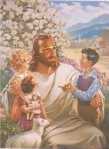
Jesus had many things to say that undermined the family in favor of the community of his disciples. He rejected his own family in favor of his disciples in chapter 3 of Mark, and later he will speak of conflict within families, brother taking up sword against brother. So Jesus’ message was not, primarily, about family values. When we come to his statement here about welcoming children we are inclined to interpret it somewhat sentimentally. I am always reminded of the mid twentieth century art work of the American painter Warner Sallman. You may not recognize his name, but I’ll wager all of you are familiar with his paintings. Sallman’s paintings are kitschy, emotional, childlike, showing Jesus with long blond hair, blue eyes. There’s one where he’s sitting in a green meadow, surrounded by children and lambs.

It’s the sort of image that continues to tug at our heartstrings, because it seems to depict a simpler time when nuclear families were intact, and Christianity was a part of everyone’s life, times when the bumper sticker “the family that prays together, stays together” was descriptive not nostalgic.

It’s that sort of nostalgia that drives much of our political discourse concerning family values. Politicians and pundits appeal to an idealized past when white middle class families had fathers who provided financially for their families, wives were stay-at-home moms, children were well-behaved. Of course the politicians who appeal to such imagery are very often no better at keeping Jesus’ teachings than those they criticize the most. I won’t bother reciting the litany of conservative politicians who have gained and retained power by appealing to family values but have divorced and remarried, or had affairs, or the like. We seem to quickly forgive them, or ignore their misdeeds.

We like the idea of family values, and want our politicians and churches to pay lip service to them, but we don’t necessarily want too close scrutiny paid to our own lives. And of course, every time the church emphasizes “family” it is being exclusive, it is driving a wedge between certain kinds of “families” and those who don’t have such relationships. Thus singles, gays and lesbians, people who are divorced or widowed, single parents, or couples who don’t have children are left on the outside, looking in.  The community that Christ is bringing together invites all into relationship, not just people who live in traditional American families.

We struggle in the tension between ideal and real. The reading from Job presents another kind of ideal picture, that of Job, a righteous man, who was successful economically. The two went hand in hand, for in the ancient near east, as is often the case even today, people see a connection between their relationship with God and their financial well-being. “God helps those who help themselves.” Throughout the Hebrew Bible, those who are faithful to God the patriarchs Abraham, Isaac and Jacob are rewarded with wives, children, wealth in cattle and sheep.

The book of Job undermines that connection. Job is suddenly beset by all manner of disaster. His wealth vanishes, his children are killed, and finally, he is forced to suffer from a skin disease. But why? That is the question this book tries to answer. As we read, we may be struck by just how very strange the world of the book of Job seems to be. In the first place, Satan (translated here as “the satan” literary the adversary, or prosecuting attorney, to use our language) seems to be on relatively good terms with God. It is God who brings Job to the satan’s attention, “Consider my servant Job.” Satan draws the obvious conclusion, he’s a righteous man because he’s got an easy life.

Having watched her husband lose everything, and losing it all with him, Job’s wife urged him, “Do you still persist in your integrity? Curse God and die.” Her response to Job’s suffering, and her own, is very human, comprehensible, even warranted. When you’ve lost everything, I mean everything, anger and despair are perfectly appropriate. But what fascinates me in her response is not her statement, “Curse God, and die” By the way, those words were so harsh that ancient scribes replaced the word curse, with bless. No what’s interesting is the question that she asks Job first, “Do you persist in your integrity?”

What does that question mean? From Job’s response, we get some sense of its intent. For Job, being righteous meant accepting what happened to him as coming from God, the good and the bad. As Jesus said, “the rain falls on the just and on the unjust.” In fact, that answer will not suffice for Job, In the coming chapters he will challenge God to help him understand his fate, he will ask God to explain; in short, he will put God on trial. But throughout his ordeal, one thing remained certain, Job persisted in his integrity. He maintained his faith in God. His actions, his statements, everything he did in the book, was an attempt to understand who God was in light of his faith in God.

Now, don’ get me wrong. I am not saying that people who suffer pain, or loss, or hardship, should simply accept it as God’s will. No, it’s perfectly appropriate to question God, to question one’s faith, to feel despair. What I’m saying is that Job’s response to his plight was in perfect keeping with who he was. It was who he was. It came from his deepest sense of who he was, it came from his soul. When Job challenged God, he was speaking from his integrity.

That’s a word that is hard to say in this day and age. We look around at our culture, our political discourse, our celebrities, we look even at ourselves and too often we find, not integrity, but competing selves, masks that we display to particular audiences or groups of people. I’m no better at this than anyone else. We even do it with God. That’s part of the reason we see so many hypocrites in our culture, politicians who rail against gay marriage, pass defense of marriage acts, then are themselves caught in affairs, Clergy who spout morality but do the same, good Christians who are caught for financial misdeeds.

Our role as Christians and as the Church is not to decry immorality, but rather as Jesus and Job did, to live with integrity, to approach all of life, and all of our relationships with honesty, open-ness, and sincerity. If we do that, aspire to that, we will do more than keep this or that commandment, we will show god’s love in the world.