Last month, I found myself following and to some extent participating in a twitter conversation or debate about the practice and theology of baptism. A number of people from various backgrounds took part as they discussed the relative merits of adult believer’s baptism or infant baptism, and explored the meaning of the rite—does it wash away original sin? Is it primarily a sign or symbol of membership in a community? Does it transmit grace, but only if the one being baptized makes a mature confession of faith or commitment? Continue reading
Category Archives: sermons
There were two kings, not three: A Sermon for the Feast of the Epiphany, 2018
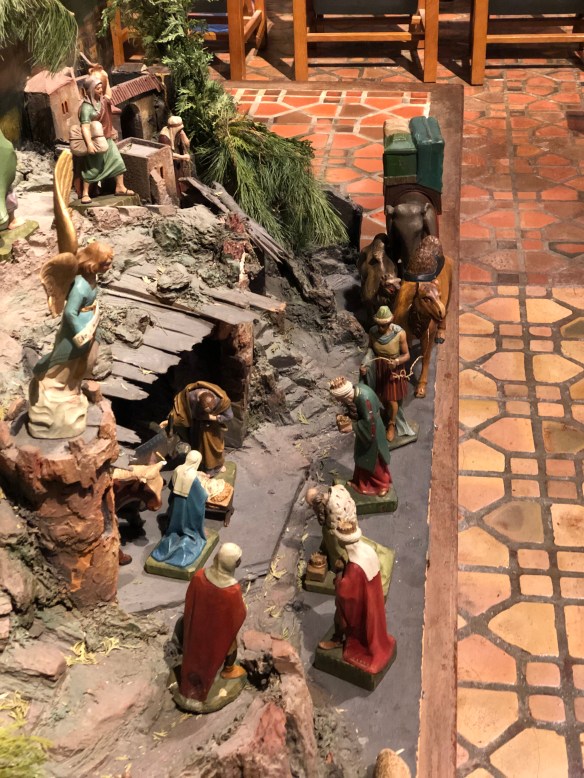
Today is the Feast of the Epiphany. While it is a major feast day of the Church, unless it falls on a Sunday, as it does this year, most Christians, most Episcopalians, don’t really observe it. Epiphany marks the end of Christmastide in our calendar, so while the church is still decorated for Christmas today, the decorations will be removed after today’s service. There’s a bit of confusion or controversy there, because many people take down their Christmas trees and other decorations on 12th night, which occurred yesterday, the 12th day of Christmas. We keep our decorations up largely because we want to retain the crèche and enjoy seeing the magi and their entourage worshiping the christchild at the crèche. If you weren’t here for Christmas, they spent the entirety of Christmas season on the table in the rear of the nave.
Our focus may be on the star and the magi or wise men on Epiphany, but it’s a feast that has other connections in the larger Christian tradition. It is also associated with Jesus’ Baptism and with Jesus’ first miracle recorded in John, the turning of water into wine at the wedding feast of Cana.
Both of those stories point to the deeper meaning of the feast of the Epiphany. The word Epiphany comes from the Greek word that means “appearance,” or “manifestation”—especially of the divine or of God. It was used in the Hellenistic world of Jesus’ day to describe those appearances of the divine to humans, moments when the gods seemed especially near. It was also used often as a title for rulers and became associated with the imperial cult, as emperors came to be understood as manifestations of the divine.
We see elements of that notion in our familiar gospel story, the story of the coming of the wise men following the star. It’s a lovely story, but one that’s been very much domesticated by the Christian tradition, so that we miss the deeper meaning and power of Matthew’s larger purposes in telling it. First of all, the wise men, or kings. Well, they’re not kings, are they? Associating them with kings derives from other scriptural references such as those from today’s reading from Isaiah and from the Psalm. When we call them “magi” we’re getting closer to what Matthew had in mind, astrologers from the East, very likely Zoroastrian priests from Iran—who were astrologers, using the movements of the constellations and planets to predict the future.
Their very exoticism, their “otherness” is part of Matthew’s point. Coming from the east, they had no knowledge of Jewish scriptures or traditions; they were Gentiles. In part, Matthew wants us to see them as part of the larger mission of sharing the good news—to all the world, as he has Jesus command his disciples in the last verses of his gospel. But he also wants us to understand that even apart from scripture, Gentiles can come to some understanding of God and of God’s saving work—all it took for the magi to begin their quest was to see a new star rising in the East.
The magi’s intuition of God’s new actions in the world provide a sharp contrast with that of Herod who had know clue about the birth of the “king of the Jews” and was terrified when he heard of it. He had to bring in scripture experts to answer the question the magi posed to him.
Let me tell you a little bit about Herod the Great. Herod’s father and grandfather had been supporters of Rome and rulers of provinces in Palestine. Herod’s father appointed him Governor of Judea. Eventually, in the midst of conflict over succession to Julius Caesar, Herod fled to Rome and succeeded in getting declared King of Judea by the Senate; returning to Palestine, he also gained control over Galilee, and eventually, by marrying the daughter of his chief rival, became de facto King of the Jews. He was a ruthless ruler, known for his excessive taxation. He built Roman style cities such as Caesarea Maritima and began the rebuilding and expansion of the Jerusalem Temple. He also had considerable conflict within his domestic life—he had five wives, one of whom he had executed, and killed two of his sons when he feared conspiring against him, and just days before his death, had a third son executed.
All of this is backdrop to Matthew’s story and while we didn’t hear the next episode of this story—the flight to Egypt and the execution of all boys in Bethlehem under the age of two, and while there’s no independent evidence to support this episode, it’s entirely in keeping with what we know about Herod historically. If he killed his own sons because of their efforts to wrest power from him, it’s likely he would have had no qualms with large-scale executions of whole demographic groups.
Matthew is drawing a sharp distinction between Herod, King of the Jews, and Jesus, King of the Jews. He is also drawing a sharp distinction between Jerusalem and Bethlehem. When Herod heard the news of these visitors from the East in search the child born “king of the Jews” Herod was frightened, and all Jerusalem with him. The magi say their intent is to go to the newborn child and pay him homage—we should have in mind a formal act of obeisance a subject might offer to a king or ruler.
So there are two kings in this story, not three. The two kings are rivals—both King of the Jews, one is Jesus, one is Herod. Herod represents the power and ruthlessness of the world, willing to take any action to gain and consolidate power, and once in power to use everything and everyone at his disposal to display and project his wealth and power.
On the other hand, the king of the Jews, born in Bethlehem, born to ordinary, poor, people who are at the mercy of the other king—whose experience of his kingship is terror and fear, who flee their home for another country in search of safety. That king of the Jews will grow up to proclaim the coming of God’s reign, a reign not of power and fear, maintained by bloodshed, but a reign of peace and justice. Jesus’ life will end as he is proclaimed “King of the Jews” by the charges leveled against him by the Roman Empire, a revolutionary, a rabble-rouser.
Like the magi, we stand between these two kings, these two kingdoms. Our journey in search of Jesus has brought us to this place, to this crossroads. We may want to make homage to the king of the Jews, but do we know what that truly means? Are we able to make that journey? Herod’s kingdom may beckon to us with its power and wealth, even with its ruthlessness, but the kingdom of the one who was born in Bethlehem, whose parents fled with him toEgypt, who preached mercy and peace, and whose life ended on the cross in Herod’s city of Jerusalem, beckons to us as well. To whom will we pay homage, before whom will we offer our gifts?
The shepherds were just doing their job: A Sermon for Christmas Eve, 2018
The shepherds were doing their job. It was a thankless, underappreciated life. They were little more than vagabonds, outsiders, feared and despised because they spent most of their time in the wilderness, living more like animals than humans. But it was a job someone had to do, like all those people who are doing their jobs tonight while we worship and celebrate: cashiers at convenience stores, employees at fast food outlets, hotel workers, doctors, nurses, orderlies, first responders. Continue reading
He has cast down the mighty from their thrones: A Sermon for 4 Advent, 2018
I’ve been reading W. H. Auden’s great poem: “For the Time Being” this Advent. Published in 1944, it very much reflects the mood of the time, the great struggle of good and evil that was playing out in World War II. It also reflects the struggles in the poet’s personal life. And yet, it is also universal and speaks to our situation, our world. It is a poem, meant to be an oratorio, of Advent and Christmas, of Incarnation.
It begins on a somber, dark note. And even if we haven’t felt blasts of cold winter air or snowstorms yet this year, we do know the darkness of the season. I’m grateful for a sunny day today but it’s not just that Friday was the shortest day of the year, it seems like we’ve had more overcast days this December than usual and the gloom outside can be oppressive. We are also aware of all of the suffering in the world. Auden writes:
The prophet’s lantern is out
And gone the boundary stone,
Cold the heart and cold the stove,
Ice condenses on the bone:
Winter completes an age.
Voices crying in the wilderness: A Sermon for Advent 3C, 2018
As most of you know already, my mother died this past Monday. Her death was expected. In fact, I received word of it just as I was packing up the car to drive six hours to be with her. Her death, and the memories and grief that have filled my thoughts over the last week have certainly recast my experience in this Advent season. But I realized that so much of what I was feeling, the emotional turmoil is consistent with the themes of this season of Advent. Continue reading
Songs of Suffering, Songs of Silence, Songs of Joy: A sermon for the 2nd Sunday of Advent, 2018
A couple of weeks ago, Corrie and I went to see Bohemian Rhapsody, the bio-pic of Freddie Mercury and the band Queen. If you’re around my age, Queen’s music was, and perhaps still is, part of the soundtrack of your autobiography. The lyrics, the showmanship, Freddy’s incredible voice—and those songs, Bohemian Rhapsody, We are the Champions, they defined an era, a genre within Rock music, and decades later, they are still ubiquitous, not only on playlists but at sporting events and in popular culture. The movie begins and ends at LiveAid 1986, when Freddy Mercury, already suffering from HIV/Aids and the band gave a show-stopping performance. It was a moment of cultural significance, artistic expression, cries of hope and pain that captured the world in an experience of such effervescence that one might call it a religious experience.
Music does that. Whether it’s a stadium performance with a rock band in front of tens of thousands of fans, a small jazz combo like John Coltrane’s in an intimate club, opera, or yes, even in a worship service, music transports and transforms us, helps us communicate our deepest emotions, our faith and our doubt; music also shapes our experiences; creates experiences for us, affirms or calls into question who we are, who God is, our pain, our hope. Continue reading
Your Redemption is Drawing Near: A Sermon for the First Sunday of Advent, 2018
Almighty God, give us grace to cast away the works of darkness, and put on the armor of light, now in the time of this mortal life in which your Son Jesus Christ came to visit us in great humility; that in the last day, when he shall come again in his glorious majesty to judge both the living and the dead, we may rise to the life immortal; through him who lives and reigns with you and the Holy Spirit, one God, now and for ever. Amen.
This beautiful and powerful collect for the First Sunday of Advent calls to mind both the first and second comings of Christ and prays that we might direct our energies and lives away from evil and toward the light of Christ brings to our awareness the central themes of this season and orients us to the scope of history and the history of salvation. We live as Christians between that time of Christ’s incarnation, his death and resurrection, and the consummation of our final hope in Christ’s return. As Christians, we have experienced the first fruits of Christ’s transforming work, but we live in this world, in this time, enmeshed in the powers of darkness and evil that surround us and seem to hold sway. Continue reading
My kingdom is not of this world: A Sermon for the Last Sunday after Pentecost, 2018
Today is the Last Sunday after Pentecost, the last Sunday in our liturgical year, and it’s commonly called “Christ the King.” To be honest, I’m not a big fan of that name, and not just because of the twitter debate this past week on whether it’s an appropriate observance in the Episcopal Church. No, my discomfort is deeper, with the history, imagery and temptations of the observance. It’s a relatively recent practice. Pope Pius XI introduced it in the Roman Catholic Church in 1925, just a few years after the end of World War I. He was concerned with the rise of secularism and the corresponding decline in the political power of the Roman Catholic Church, and thought that a robust celebration of Christ the King would combat those evils. Protestants came to embrace it as well, and even though the Episcopal Church has not adopted the name for this Sunday, the propers–the scripture readings and the collect focus on Christ’s kingship.
Discomfort with the observance is not just related to its provenance. It’s a bit jarring, in our ostensibly democratic society, to talk about kingship at all. And at a time when we are sensitive around issues of hierarchy, authority, and gender, to appeal to Christ the King is problematic.
Of course, as our readings point out, all of them, Jewish and Christian scripture are replete with imagery of kingship, especially as used of God. In the Psalm, for example, God is depicted as a king seated upon a throne, and the language here suggests an analogy between the rule of God and the rule of Israel’s king, an analogy that has persisted among Christians down through the centuries. At the center of the Psalmist’s vision is an image of the king ruling in splendor and majesty, on a throne.
Similar images dominate the readings from Daniel and Revelation. Both of them, as I mentioned last week, are apocalyptic texts, and in these excerpts we are treated to images of the world as the authors imagine they might become or will be, or even perhaps are, if we see the world as it really is, ruled and governed by a righteous and just God. Although we don’t see those themes in any of these three texts, the notion that God’s reign is a reign of peace and justice is self-evident. All of these images are meant to emphasize the fact that Christ’s kingship, though accompanied and understood with imagery from human experience of kingship, is of a totally different order. Christ’s kingship has no beginning or end; it will not fail or falter
Whatever the imagery that might come to mind when we think of kings and kingship—whether we imagine the British Royal Family, or perhaps Louis XIV, the Sun King and the resplendence and opulence of Versailles Palace, the reality of human kingship is rather different than its display. For that, the small portion of John’s gospel that was read will do quite well. For that is how kingship has played out in human history, in oppression, injustice, and violence.
As Procurator or governor, Pilate was the most powerful person in this little corner of the world. He had come to Jerusalem, as he did every year during the Passover to be present during a time filled with tension. The Jewish community was remembering and celebrating God’s deliverance of the Hebrews from an evil and oppressive ruler, and given that they were living under an equally evil and oppressive tyranny, tensions always ran high. That explains, at least in part, the charge that was brought against Jesus—King of the Jews. It was not simply a mistake, or an effort by his Jewish opponents to get the Romans to do their work for them. It was, quite frankly, accurate. Jesus did pose a political threat to the Roman Empire. By preaching the coming of God’s reign, Jesus presented a direct challenge to Roman power, and to the local leadership who both benefited from, and helped to exert that power.
We see that confrontation front and center here. When Pilate asks Jesus, “Are you the king of the Jews? Jesus, and we suspect that Pilate is not asking the question honestly. He does not know, or care who Jesus is. In fact, he seems most interested in finding some way to avoid responsibility for what is taking place. And Jesus seems willing to help Pilate avoid what is to come. As the Gospel of John tells the story, Pilate will make every effort to avoid condemning Jesus to death. He moves back and forth between Jesus and the other players in the drama—the crowd that according to John seeks Jesus’ death. He offers to free Jesus, but the crowd will have none of it. Then he stages a mock ritual of coronation with the purple robe and the crown of thorns.
Pilate asks Jesus, “Are you the king of the Jews?” Jesus puts the question back on him, asking him his motives for the charge. But Pilate will have none of it, and so Jesus responds, “My kingdom is not of this world—cosmos, to use the Greek word. And here, our western, 21stcentury conceptions get in the way of understanding what’s at stake. For when we hear Jesus saying, “My kingdom is not of this world,” we are inclined to think of the contrast between spiritual and material realms, or perhaps between political and religious, projecting our notions of completely separate spheres of human experience and human power back on to the first century.
But when Jesus says, “my kingdom is not of this cosmos” he is using a term that in the Gospel of John is introduced in the very first chapter, and recurs throughout. The world, the cosmos, is inveterately opposed to God: “He was in the world, and the world came into being through him; yet the world did not know him” (John 1:10). At every turn, the world rejected Jesus, yet throughout the gospel Jesus again and again expresses his desire and intent to save the world.
For example, John 3:17: “God did not send the Son into the world to condemn the world, but in order that the world might be saved through him.” And John 12:47: “I came not to judge the world but to save the world.”
But Jesus’ efforts came to naught. As we see in this passage, his apparent attempt to sway Pilate away from the predetermined course of events was a failure. Pilate was enmeshed in the world, he saw things only in terms of power and self-protection and in the end, condemned Jesus to death.
This gospel story presents us with a grave temptation. It is likely that we see the confrontation between Pilate and Jesus as a historical event, with a clear winner and loser, and with no implications for our own lives, except that it resulted in the crucifixion.
In a very profound way this confrontation between Jesus and Pilate presents us with a dilemma that faces us in our present lives and circumstances. We are blind to the ways in which we live in and share the values of the world into which Jesus comes and to which Jesus offers a clear alternative. To what extent do we place our trust in the might and wealth of empire? To what extent do we offer our allegiance to secular power? To what extent do we bow down in homage and worship of the kings of this world?
To put it that way is to obfuscate because we live in a purported democracy not a monarchy. But in so many ways, on so many levels of our society, the rules of raw power and dog-eat-dog contests determines winners and losers.
Christ the King Sunday is a problem because it allows us to elide the distinction between the reign of Christ and the kingdom of this world. Our king may not wear purple or a carry a crown, or even sit on a throne, but imperial power still holds sway and may be more brutal today than at any time in recent history.
When we think of the kingship of Christ, our attention and focus should be, not on images of Christ ruling in majesty, but rather images of Jesus in the dock, facing the oppressive power of an unjust and evil regime. When we think of the kingship of Christ, we should think of Christ, not elevated or seated on a throne in majesty, but hanging on a cross, dying at the hands of oppressive, imperial power.
When we think of the kingdom of Christ, we should think not of the kingdoms and empires of this world, fighting unjust and meaningless wars that claim millions of innocent victims. We should think instead of Christ the victim, suffering at the hands of an imperial power, suffering with and for, those innocent victims. And if we want to live under Christ’s reign, live in Christ’s reign, we should take our place beside those innocent victims, and work for justice and peace. For that is the nature of Christ’s reign, a reign not of this world, not of hate, or violence, injustice or oppression, but a reign of love, justice, and peace. May Christ’s reign come soon!

Not one stone will be left: A Sermon for Proper 28, Year B (Annual Meeting) 2018
We are nearing the end of the liturgical year. In the church, the new year begins on the first Sunday of Advent, which this year falls on December 2. But there’s a sense in which our gospel readings in the weeks leading up to that day help us prepare for Advent. Indeed some preachers and liturgists extend the season of Advent back three Sundays and advocate for a seven-week season of Advent.
There are at least two reasons for this move. The first reason for this extension of Advent is, I suspect, largely cultural. Since retailers replace their Halloween merchandise with their Holiday merchandise, and radio stations and satellite services have already started playing holiday music, extending Advent to the beginning of November is a way of offering a counter narrative to the excesses and consumerism of the Holiday season. The second reason for this longer Advent is that our gospel readings for these three Sundays are drawn from Jesus’ teachings concerning his return. They are what we call Apocalyptic literature.
Apocalyptic, which derives from a Greek word meaning revealing, emerged in the second century BCE during a period of crisis among the Jewish people. The central chapters of the book of Daniel are the earliest example of this type of literature. It is symbolic, full of strange beings. It presumes a cosmic battle between the forces of good and evil, in which ultimately, the good will prevail. While it seems to be describing events that will take place at a future time, in fact, it is describing in highly symbolic terms what is happening in the world right now. So, from time to time, after describing some event or some figure, a beast with seven horns, for example, the author will provide a clue, or a hint, and say, “let the reader understand.” Apocalyptic was also the context in which the idea of the resurrection of the dead first became popular, among the earliest clear references to the idea is in fact in the verses from Daniel in today’s first reading.
As I said, the world of apocalyptic is full of fear and danger, and we live in a context which is full of such imagery and events. Whether it’s mass shootings, terrorism, the continuous wars, or the wildfires that have transformed the landscape of California, taken lives, and changed the lives of so many people, our world seems to be collapsing around us. In such a context, Jesus’ words sound ominous indeed.
Today’s gospel, though written about two millennia ago, comes from a time and a community that were experiencing some of the same fear and uncertainty that we face as a world. As I’ve said before, it’s likely that Mark was written during the Jewish revolt against Roman occupation, and either shortly before, or after the destruction of the Jerusalem Temple. We date the gospel to this particular historical moment in part because of the very verses we heard today—the disciples marveling at the size and grandeur of the temple, and Jesus’ prediction of its destruction.
The Jewish Rebellion and the destruction of the temple constituted a cataclysmic change for Judaism. It was also of enormous significance for the tiny community of Jesus’ followers, who were caught in the midst of the conflict. As they looked around at what was happening around them, as they probably fled the violence, they were also reflecting back on Jesus himself, the hopes and faith he had instilled in them. As we have seen throughout this year, Jesus proclaimed the coming of God’s reign. It’s quite likely that many of those in this tiny community forty years later saw in the Jewish revolt and the Roman response, signs of Jesus’ imminent return.
You can almost hear the conversations of that community in Jesus’ words. He warns against false prophets—those who claim to be Jesus, those who claim to know when Jesus will return. All of the catastrophes, the wars, rumors of wars, earthquakes, and the like. There were people wondering whether these things were signs of Jesus’ return, signs of the end times. Of course, as we imagine first-century Christians wondering about these things, we know all too well that many contemporary Christians, and many in secular society, too, are fascinated with predictions of the end times.
Jesus’ words concerning his return are elicited by an observation of one of his disciples. Let me give you some background. In Mark’s chronology, this takes place of Tuesday in Holy. On Sunday, Jesus and his disciples made the triumphal entry into Jerusalem, which we reenact on Palm Sunday. After that, Jesus went to the temple and looked around.. Then he and his disciples left the city and spent the night in Bethlehem. On Monday, they returned to the temple, and overturned the moneychangers’ tables, after which they returned to Bethany. They came back to the temple on Tuesday where Jesus had a number of encounters with groups of Jews, the chief priests and scribes, some Pharisees and Herodians, some Sadducees. After the story of the widow’s mite which we heard last Sunday, they left the temple again, which is when this story takes place.
Once again, it’s as if the disciples are completely oblivious to what Jesus has just said, or has been saying all along. It’s the sort of remark we make as tourists, “Look at how big the stones are!” It’s the sort of remark I often hear when visitors come to Grace: “Wow, what a beautiful church!” Jesus’ retort may have been intended by Mark to reflect the reality that after Rome destroyed the temple, not a single stone was left standing but it’s an important reminder to us as well.
It’s not about the stones, even if it is our responsibility to make sure the stones of this building remain intact. The Jewish temple, Grace Church, are supposed to be places where people encounter God, where they experience the love of Christ and are transformed by that encounter. The beauty of our spaces, both inside and out, are meant to offer such opportunities, to invite people into relationship with God.
One way of thinking about all those encounters Jesus had with Jewish groups in the temple before this, from the moneychangers to the chief priests, Pharisees, and Sadducees, is to see them as challenges to the immediacy and accessibility of people to God. Spaces create barriers; institutions establish and maintain boundaries, communities dictate who’s in and who’s out. Jesus challenged all of those efforts to limit accessibility to God, to set boundaries. The threat he posed was part of what led to his arrest and execution.
2000 years later, those tendencies remain. We focus on the stones, not on God. Sometimes, instead of being a means of access to God, the building becomes our God, and we worship it or focus all of our energies and attention on it rather than on what it is supposed to be. Sometimes, a building can also be seen as an impediment, that it requires resources that might better be expended in other ways, in outreach to the community, for example. Striking the right balance is always a challenge, but I believe we at Grace do that.
I was reminded of the power and possibility of our spaces to connect us with God on Friday evening of this week. Corrie and I were walking on the square just as our bells began to ring at 6:00 pm. Hearing them from the other side of the square wasn’t just a distraction or noise. The sound of the bells reminded me of all that they represent: the faithful people who installed and now maintained them, their sound reminding me of God’s presence in this city, even on a Friday evening.
That is what our spaces should do—our building, our bells, our gardens, all should remind passersby of God’s presence in the world, and invite people to experience and enter into that presence more deeply, whether here at Grace or in other places or other ways in their personal lives.
We don’t know how long Grace Church will remain standing, whether for fifty, or a hundred, or five hundred years. But there will come a time, I suspect, when stone will no longer stand on stone, when there will only be rubble. But until that time comes, in God’s time, it is our responsibility, our mission, to ensure that our buildings and our congregation, are places where people encounter, experience, and share God’s love.
A communion of saints: A Sermon for All Saints’ Sunday, 2018
Today is All Saints’ Sunday. In the life of Grace Church, it’s a day full of opportunities to reflect on who we are as a community and who we are becoming, and called to become. We are baptizing a baby today. We commemorate those who have died from our congregation and our loved ones, in the last year and distant past. We welcome new members into our community, and finally, we gather up our pledges of financial commitment to the ministry and mission of Grace for the coming year. Continue reading