We beseech Thee to hear us, Good Lord: A Sermon for the First Sunday in Lent, 2020


“From lightning and tempest; from earthquake, fire, and
flood; from plague, pestilence, and famine,
Good Lord, deliver us.”

English-speaking Christians have prayed or chanted these words for almost 500 years. Often, they have been chanted in public procession, beginning at their first use back in 1543. The Great Litany is the first piece of the liturgy officially published in English and it was first used before Henry VIII embarked on one of his failed attempts to defeat the French. Since then, it has been prayed in times of plague and war. We use it here at Grace on the first Sunday in Lent both to mark the changed liturgical season and to emphasize human sins and shortcomings, and our need to repent, to ask God for forgiveness, and to receive God’s mercy and grace.

In many years, the language and imagery of the Great Litany seems not really to speak from or about our experience and our world. Words like “flesh and the devil” or petitions to “beat down Satan under our feet” remind us of the vast cultural distance that separates us from the people of the sixteenth century.

This year, our experience of the Great Litany may be different. Prayers that our political leaders would do justice, and love mercy, and walk in the ways of truth seem eerily on point and all of us are praying that we be delivered from plague and pestilence.

Ancient words made new and meaningful again. As we worry about immediate threats like the spread of coronavirus, about the health of the economy, about the direction of our country, and about the growing threats of global climate crisis, it’s increasingly clear that human existence is fragile, that the world we have known and in which we many of us have thrived may be in the process of becoming quite different, with threats on all sides, not just to our comfortable lives and living standards, but to human life itself.

Ancient words, ancient stories. We heard two stories that have deep power in our culture. From the gospel of Matthew, the story of Jesus’ encounter with Satan. It occurred immediately after his baptism, immediately after the voice from heaven said, “This is my son, the beloved, in whom I am well pleased.” And it’s as if this scene is set up to challenge that statement, that Jesus is the Son of God, and that God is well-pleased with him.

From Genesis, a foundational, perhaps the foundational story of Western Christianity, and with it all of western culture. The story of the man and the woman in the Garden of Eden. It’s a story we think we know. The reading from Romans 5 shapes our interpretative lens: “As sin came into the world through one man, and through sin came death…” The lectionary and our previous assumptions teach us that this is the story of original sin, the fall, an explanation of why there is evil in the world, why humans die, and why we have to work hard to achieve anything.

While that’s the story we know, it’s not the story that appears in Genesis 3. In the first place, the words “sin” nor “Satan” or the devil do not appear in the text. It’s the story of a woman, a man, and a serpent, who we’re told “was more crafty than any other of the wild animals that the Lord God had made.”

The inclusion of the verses from chapter 2 helps us understand the authors’ perspective on human beings and on creation. The Lord God took the man and put him in the garden, the Hebrew literally reads, “to serve it and to guard it.” Human beings were created to be in partnership with the garden, to protect it and preserve it. It’s a very different notion than that which appears in Genesis 1, when God commands the humans to have dominion, lordship, over all the animals and plants. We see here a sense of human beings cooperating with creation, given responsibility to protect it. One more point—there’s no sense here that before the fall, humans were intended to live in idleness, rather, they were placed in the garden for an end and a purpose. Created in the image and likeness of God, God intended them to flourish and to aid in the flourishing of creation.

But something happened. They met a talking serpent who gave them a different way to think about themselves and God. The serpent questioned what God had told them and promised them that by eating from the fruit of the tree of the knowledge of good and evil, they would become like God.

Everything the serpent tells them is true, if somewhat one-sided. They did not die after eating of the fruit of the tree and they did gain knowledge. And the fruit was desirable. Eve ate because the fruit was beautiful, good to eat, and would make one wise—all of these are appropriate reasons for her decision. And, I would add, of the two humans, at least the woman showed some agency: “she also gave some to her husband, who was with her, and he ate.”

What were the consequences? They gained knowledge; most immediately, of their nakedness. They were ashamed. So whatever intimacy the two beings, “bone of bone and flesh of flesh” had had was suddenly gone—they needed protection from each other. And they needed protection from God. Their nakedness and exposure broke the pair’s intimacy with each other; it also broke their intimacy with God. Instead of becoming like God, they becoming frightfully aware of their difference from God. They wanted to escape from God but God wasn’t done with them. God sought them out in their hiding place, and when God located them, God showed continuing care for them by sewing clothes for them from animal skins. Any punishment would come later.

It’s a story of disobedience and rebellion against God. God created the humans for a purpose, for relationship with God and to participate with God in the care of God’s creation. Rejecting that purpose, they chose to aspire to be like God and so spurned their true nature, having been created in the image and likeness of God. It’s the story of humanity; it’s our story. Like Eve and Adam, we grasp for the beauty and knowledge we can see; and in grasping for what we want, we turn away from God and deface the image of God in us. The knowledge we gain is knowledge of our own fallen humanity, knowledge of our shame and embarrassment.

The man and the woman in Eden grasped to become something other than who they were and who they were created to be. In the gospel reading, we see Satan testing Jesus to see what sort of “Son of God” he would be. Would he be one who gave people what they wanted—bread for their stomachs? Would he be one who would take all that he could, who would rule the world with power like the Roman emperors? In the end, Jesus chose a different model and would follow a different path, one that would end in a humiliating, tortured execution. In the end, Jesus accepted his identity as God’s beloved son, and loving the whole world, he offered himself for us.

The story of the man and the woman in Eden is a story about humanity, about our nature. We are curious, we desire wisdom and new, exciting experiences. We want our freedom and we want to challenge the limits of our identities and nature. And in so doing, we come up against our own limitations and discover, if we are discerning, our nakedness before God.

The story of Jesus’ testing in the wilderness is in some ways a very similar story. He is presented with everything any human being could want, wealth, power, popularity. But Jesus chooses to follow his call, accept his identity. In so doing, he shows us the possibility of human existence, and in the end, by his death and resurrection, offers us the possibility of being remade, truly in God’s image.

The purpose of Lent is not for us to beat ourselves with our shortcomings, to bewail our sins and weakness. The purpose of Lent is for us to discover and confess who we are—that we are broken human beings, broken by our self-indulgences, our sins, our disobedience, to admit that we are naked before God. When we do that, we make room in our lives for God’s grace and mercy, and we allow ourselves to begin to be recreated more fully in God’s image, more fully human. May this Lent be such a time for us, a time of self-discovery, repentance, and being recreated. Amen.


Ash Wednesday Crosses, ashy, oily, woody: A homily for Ash Wednesday, 2020

I have had many memorable Ash Wednesdays. There was the first year I officiated at an Ash Wednesday service as a layperson. There was 2011, the year of the Act 10 protests, when the final vote occurred during our evening liturgy and we could hear the demonstrations as we knelt for the Litany of Penitence.

But perhaps my most memorable Ash Wednesday only became that in retrospect. A few years ago, I put ashes on the forehead of a dying parishioner. It was the first time she was in church after beginning chemotherapy earlier that year, and I recognized her only because she was accompanied by her daughter whose face was familiar to me. A few weeks later, she would die and I would officiate at her funeral and burial.

“Remember that you are dust and to dust you shall return.”

Those words, these ashes are a sign of our mortality, a reminder to us that we are created from the dust of the earth, and that our bodies will return to the earth.

Those words weigh heavily on my soul when I say them to myself each year, and their weight accumulates on me as I say them to you. I suspect they weigh heavily on you as well, as they challenge all of us to reflect on our mortality, to admit to ourselves who we are—dust and ashes, and that we will once more be dust and ashes, that all of our efforts to the contrary, all of our attempts to hold death at bay will come to nothing.

But contemplation of our nature, our provenance and end, is not an end in itself. We do this ritual, we make this strange gesture, we wear this smudge on our forehead to remind us of who we are and to remind us also of who God is. For it is God who made us out of the dust of the earth. It is God who has given us life and all that we have. Yet like our fear and desperate attempts to ignore our mortality, to fight the finality of death, so too do we often find ourselves running away from or ignoring God. We construct defenses; we try to hide. We put in place of God all manner of idols that we worship and pursue: financial success or security, fame, power; bright, shiny possessions; or the thrill of new experiences.

Cross-shaped ashes on our foreheads, the admonition “Remember that you are dust and to dust you shall return,” lay bare the emptiness of all those pursuits. They break down the barriers, strip our defenses, leave us kneeling before God our maker and redeemer.

Our empty selves, our vain hopes, brought to nothing by those words, leaving us with broken and contrite hearts. It is then that we can encounter God, stripped of our defenses, and open ourselves to deeper relationship with our Creator and Redeemer.

We carry the ashy cross on our foreheads for a few hours, a day if we’re careful. But we’re just as likely to brush it off intentionally as soon as we leave church, or perhaps unintentionally, when it vanishes as we take off our winter hats or caps.

There’s a cross marked on us that is permanent, indelible, that can’t be brushed or washed off. It’s made with the same gestures, my thumb making the sign of the cross on foreheads, but with oil of chrism instead of ashes. And I say something quite different as well.

Instead of, “Remember that you are dust and to dust you shall return,” the words I say on Ash Wednesday, after baptizing someone, I dip my thumb in oil of chrism, and make the sign of the cross on the forehead of the newly baptized, saying while I do it, “You are sealed with the Holy Spirit in Baptism and marked as Christ’s own forever.

We bear that cross all of our lives, even if it is invisible. It is the mark of our belonging to Christ, the mark of our faith. And just as the cross of ash reminds us of our mortality, the cross marked in oil is a sign of who we truly are and of our ultimate destiny. We are beloved children of God.

We can forget that identity; as the cross is invisible, it can be forgotten under the weight of our sin and our doubts. But it may be that just as our foreheads are marked with ashes, the ash works as an abrasive, removing all of the accretions, so that our baptismal crosses are visible to ourselves and to the world. We are Christ’s own forever.

Of course, the Season of Lent has us think about another cross, the cross that looms ahead at the end of Jesus’ journey to Jerusalem. It’s a journey on which we are invited to accompany Jesus, to walk with him as his disciples and followers. When Jesus explained to his disciples what it meant to follow him, he said, “If you would be my disciples, take up your cross and follow me.”

We are carrying crosses today; these smudges of ash on our forehead. We carry that other cross on our forehead as well, the sign that we are Christ’s own forever. Lent encourages us to embrace another cross, the cross of discipleship, growing into our identities as followers of Jesus. As we walk this way of Lent, may we find it a time when we confront our mortality, claim our identity as children of God, and grow more deeply Christ-like as we accompany him.


Sacred Mountains, sacred encounters, listening: A Sermon for the Last Sunday after the Epiphany, 2020

Corrie and I lived on top of a mountain in the middle of nowhere for five years. Actually, it was in middle Tennessee, and it wasn’t technically a mountain but the Cumberland Plateau but it was usually referred to as the mountain, and it had sacred significance for many as it was the home of Sewanee, the University of the South, a university affiliated with the Episcopal Church with one of the church’s theological seminaries. The Cumberland Plateau rises high above the countryside of middle Tennessee and when you are one of the bluffs on a clear day, there are spectacular views of the valley below. Having grown up on the flat land of Northwestern Ohio, I couldn’t get enough of those vistas. Continue reading

Leave your gift at the altar: A Sermon for the 6th Sunday after Epiphany, 2019

In a few minutes, after the prayers of the people, the confession of sin and absolution, we will share the peace of the Lord with each other. For many of us, that is a moment of fellowship time, to greet our friends and neighbors in the pews near us, to introduce ourselves to newcomers, to engage in a moment of conversation. But I wonder how many of you know what is really supposed to be going on in that moment, what in fact is taking place liturgically. Continue reading

The Presentation of Our Lord Jesus Christ in the Temple: A sermon

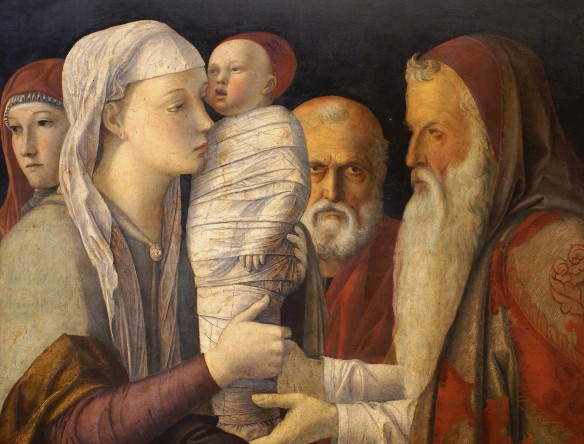
Presentation of Jesus at the Temple (detail), Andrea Mantegna, c. 1455

Today is the Feast of the Presentation of our Lord Jesus Christ in the Temple. It’s a major feast in our calendar but one we observe at Grace only when it falls on a Sunday. It commemorates the events recorded by Luke in today’s gospel reading. Jesus’ parents Mary and Joseph brought him to the temple forty days after his birth to conform to Jewish ritual obligations—the presentation of the first-born to God; and the purification of a woman after giving birth. Continue reading

Jesus’ Baptism and our own: A Sermon for the Baptism of our Lord, 2020

In our liturgical calendar, today is the First Sunday after the Epiphany. Saying that probably doesn’t help orient many of you to what is going on in our worship. The Feast of the Epiphany is celebrated on January 6. It brings the Season of Christmas to an end. It’s a feast that celebrates God making Godself manifest in the world and especially in Jesus Christ. Traditionally, the church has focused on three specific events in Jesus’ life on Epiphany: the coming of the wise men, Jesus’ baptism, and Christ’s first miracle in the Gospel of John—the transformation of water into wine at the Wedding at Cana.

The first Sunday after the Epiphany focuses on the second of these three events: Jesus’ Baptism. Each year, we hear one of the gospels’ versions of the story of his baptism by John. It is also one of the Sundays when it is especially appropriate to baptize and to bring into the body of Christ new members.

Reading the story of Jesus’ baptism on a day when we also celebrate the sacrament of baptism prompts us to think about what our baptisms might mean in light of Jesus’ own baptism. But Jesus’ baptism is not our only source for early Christian baptism. There is also Paul, for whom, as he writes in the Letter to the Romans: “all of us who were baptized into Christ Jesus were baptized into his death”—so baptism is a participation in the death and resurrection of Jesus Christ.

If you were to set the three different versions of Jesus’ baptism that we are given by the synoptic gospels, it would be very easy to see the different ways the gospel writers shape the story to reflect their perspectives on the meaning of the event and its significance for the person and ministry of Jesus. They differ in many small but significant details.

Looking only at Matthew’s version, as we are today, we can still detect some important themes that we will note repeatedly as we work through the gospel this year.

One thing to note is the important role of John the Baptist for Jesus’ ministry. For Matthew, Jesus’ proclamation and ministry is a continuation of John’s. Both preach the coming of the kingdom of God. John the Baptist will make appearances later in the gospel. There are occasions when others think Jesus is himself John the Baptist.

Remember that this is the first time we’ve seen Jesus as an adult in the gospel of Matthew, the first time we’ve seen him since the family’s return from Egypt after fleeing Herod. So Matthew’s depiction of this story is very important. What first impressions does he want to give us of Jesus?

He tells us that Jesus came to John in the wilderness. Jesus wasn’t just wandering by. He had come a long distance. He had come to John for this, to be baptized by John. But John refuses to do it. He says Jesus should baptize him. But Jesus insists, and says something very interesting: “Let it be so now; for it is proper for us in this way to fulfill all righteousness.” Jesus seems to be bringing John into this event, sharing with him in its enactment, and together, Jesus seems to be saying, they are fulfilling all righteousness. We might even say that it takes both of them, willingly participating, to fulfill all righteousness.

Righteousness is a complex term with many meanings in scripture. For us, it’s one of those old “religious” words that we never use except when we’re in church or talking about church; if anything, when it is used in popular culture it’s a synonym for amazing or cool. So we don’t know quite what it means. Earlier, Matthew described Joseph as a “righteous” man when he plans on quietly ending his relationship with Mary—he’s acting in accordance with Jewish law. We might regard it as both inner disposition and a matter of outward practice. But perhaps the most important element in it is obedience to God. Jesus is signaling here that both he and John are obeying God, seeking to live according to God’s will.

In Matthew’s telling of the story, it is that shared obedience, the willing participation of both John and Jesus in the event that leads to the confirmation of Jesus’ identity. As he comes out of the waters of the baptism, the voice from speaks, “This is my Son, the Beloved, in whom I am well pleased.”


I’m not sure many of you know why we baptize people, especially infants. I doubt very many of you believe that unbaptized babies will burn in hell if they die—even the Roman Catholic Church has rejected the traditional doctrine of limbo. And we have so internalized American values of self-determination and freedom when it comes to religion that the idea parents might make a religious for their children has come to be regarded by many as parental tyranny.

Yet here we are. Out of some sense of obligation, or tradition, we will gather around the font again. Often, there’s a powerful bond of family that tugs us to bring our babies to the font, whether or not we quite believe in it all, we’re doing it for our parents or grandparents.

It’s tough to be a parent today. Young families are juggling jobs and daycare; struggling to make ends meet in a changing world and changing economy. We wonder and worry what sort of world our children and grandchildren will inherit from us—whether the planet we live on will even be inhabitable in 50 or 75 years. We can’t do it on our own. I’ve been fascinated to see how many people have come to Grace Church in the last couple of years, moving here to be closer to their children and grandchildren. That’s not just about being closer to family, it’s about helping out, providing childcare, helping raise the next generation. I’ve also seen the struggles of those parents, single moms especially, who don’t have other family members to turn to in difficult times.

For parents to bring a child to the font, is a recognition and admission that they can’t do it on their own. These beautiful children, miracles of life and of God’s creative power, are at the very beginning of their life’s journey. None of us knows what lies in store for them, what challenges and possibilities they will face. Baptism brings them into the body of Christ, the fellowship of the faithful, where we all commit to helping them grow into their full stature as children of God.

For those of us who are observing this rite today, baptism is also a powerful reminder of who we are. There’s a sense in which we are like these babies, brought to God’s grace by power beyond ourselves, our salvation dependent not on what we might do or choose, but only through God’s love.

We can’t do it on our own. We can’t make it on our own. Baptism reminds us that we aren’t lone individuals making our way in the world. We are enmeshed in a network of relationships, and baptism grafts us into the body of Christ. Baptism is the means by which God reaches out to us, draws us into God’s loving embrace.

In a way, all of us here are like John and Jesus today, coming to the waters of baptism in obedience to God’s call, trusting in God’s grace. And like Jesus, of whom the voice from heaven said, “This is my Son, the Beloved;” in baptism we are all marked as Christ’s own forever, embraced as God’s beloved children. Thanks be to God.


Worshiping the King of Peace in a warring world: A Sermon for Christmas 2, 2020

Happy New Year! Was it only five days ago that we were celebrating the New Year, full of hope for what new possibilities a new year and a new decade might bring? Our celebrations may have been tempered a bit by the realities of all that is taking place around the globe and here at home—the horrific fires in Australia that have devastated the continent, its unique flora and fauna, and led to those images of people huddled near the ocean, waiting for transport away from the devastation. Continue reading

The Creche and the Word: A Sermon for Christmas 1, 2019

Today is the first Sunday of Christmas. You know that there are 12 days of Christmas, and that those twelve days begin, not end, on Christmas Day. Christmas continues right up to the Feast of the Epiphany—although in many places, Christmas decorations remain in the church until February 2, which is Candlemas, or also the Feast of the Presentation in the Temple. Continue reading

The Word tabernacled among us: A Sermon for Christmas Day, 2019

“And the Word became flesh and lived among us, and we have seen his glory.”

I love the contrast between our Christmas Eve and Christmas Day services. The early service on Christmas Eve is full of noise and excitement. Last night the church was almost full, with families, and children who were full of anticipation of the presents under the trees back home. They could hardly contain their excitement. Each year, I invite them to come forward and join me at our lovely creche, and I engage them in conversation about the story represented by the creche, and its meaning for our lives and our faith.

Then, at 10:00 pm, there’s a very different mood. Excitement still, but the mood is shaped by the beautiful music provided by the choir, organ, and instrumentalists as people gather in the nave. Both services end in darkness as we sing “Silent Night” with candles lit in a darkened nave. Finally, the bells peal the joyous sounds of celebration and we go out into the darkness, our hearts filled with joy.

Christmas Day is very different. In some years, though not now, we might come to church in the glorious, dazzling light, of sun shining on snow. The brightness of the sun corresponds to the glory of the gospel reading we hear each year, the first verses from John’s gospel.

This gospel reading offers a vivid contrast to the story we read each year on Christmas Eve, Luke’s version of the birth of Jesus. While Luke moves us in panoramic style from the powerful center of the Roman Empire to one of its obscure and distant corners, the village of Bethlehem, as the characters mentioned change from emperors and governors to a pregnant woman and a band of shepherds. The story ends in stillness and quiet, with Mary pondering all that happened and the shepherds returning to their sheep.

John’s gospel begins with an even wider view than Luke’s. Instead of setting the context in the Roman Empire, John expands out even further, to the beginning of time and the origins of the universe. He draws our attention not to how or where Jesus was born, but to the God who created all that is, and the Word through whom everything was created.

John begins with a panoramic view of the universe: In the beginning was the Word and the Word was with God and the Word was God. But from that vast eternal scope, he focuses in on us:

“The Word became flesh and lived among us.” The incarnation is a great mystery of our faith, something that we should ponder and treasure in our hearts, something we should puzzle over, ponder. More than that. The Word connects us with God because our words, our thoughts are attempts to approach and understand the Word. By thinking, reflecting, struggling to understand the meaning of the Word become flesh, there’s a way in which our thinking itself makes Christ present in our minds and in our lives.

You may find all this very abstract. It is, but John doesn’t stop there. He goes on. The word became flesh and lived among us.

With this verse, John brings us back to Bethlehem, to the reality of the incarnation. Literally the Greek reads, “and the word became flesh and tabernacled among us.” While John likely wants us to think of the tabernacle that was the symbol of God’s presence to the Israelites in the wilderness, it’s also the case that we are to think of Christ being among us, “living among us” in a temporary, make-shift way, like a tent. That is to say, the word took on frail human flesh to be like us.

This paradox, this mystery is quite beyond comprehension. The Word taking human flesh. St. Augustine captures the paradox in one of his sermons on this text for Christmas:

“He so loved us that for our sake He was made man in time, through Whom all times were made; was in the world less in years than His servants, though older than the world itself in His eternity; was made man, Who made man; was created of a mother, whom He created; was carried by hands which He formed; nursed at the breasts which He had filled; cried in the manger in wordless infancy, He the Word without Whom all human eloquence is mute.” — St. Augustine, Sermon 188

John goes a step further. For John, this infant, this tiny human creature, incapable of speech, vulnerable, utterly dependent on others for life itself, this infant reveals God’s glory to us.


So we are back in Bethlehem, back in the confusing paradox that God became incarnate in a very ordinary way, in the poorest of circumstances, in the weakest of all human forms, a baby. And it is in that paradox, that we see God’s glory. For John, it is the same paradox as the cross, which he almost always refers to as the glorification of Christ. What he is telling us is that in these moments of weakness, we see God’s majesty and power.

To see and know Christ, the Word, in the babe in a manger, is to see and know God’s glory. To see and know Christ in the cross, is to see and know God’s glory. To see and know Christ, to taste Christ in the bread and wine of the Eucharistic feast, is to see and know God’s glory.

May we experience, may we see and know the glory of God today, in our lives, and in the world around us, in the Christ made flesh in a manger and as we kneel at the altar. May we know and believe the mystery of our faith, the mystery of the Incarnation, the mystery of God’s love for us, today at Christmas, and throughout our lives. Amen.


Singing with Mary: A Sermon for Christmas Eve, 2019

Familiar carols, a beautifully-decorated church, our excitement and joy at the celebration of Christmas. It’s almost enough to take us away from the troubles in our lives and the troubles in our world—climate catastrophe, impeachment, refugees, endless wars and other conflicts.

Almost, but not quite enough. I was reminded of how very different the Bethlehem of 2019 is from that portrayed in the familiar carol by the nativity scene the artist provocateur Banksy produced this year. He calls it the “Scar of Bethlehem.” It shows Mary, Joseph, and the baby Jesus huddled in the shadow of the concrete wall that separates the Palestinian from the Israeli sides of the town; the light above the manger provided not by a star but by a hole in the wall made by a mortar shell. Today Bethlehem is hardly a town of peace; it suffers from the violence and terror of occupation and intractable conflict.

Our world, today, a creation groaning from the pains of evil inflicted on it by human greed, carelessness, and neglect; a world suffering from endless conflict; Our nation is deeply divided politically; with the gap between the few haves and the many have-nots widening daily; , the crushing burdens of medical and student debt affecting individuals across the generations; racism, America’s orginal sin continuing; The Church, the Body of Christ is torn apart by political and theological conflict.

In this world, in this place, we gather to celebrate again the coming of God to us, in human form, weak, tiny, vulnerable.

We have heard the familiar story, sung familiar carols and with them are brought out of the present day to our memories of Christmases past, but also, all the way back to that first Christmas. We sing in imitation and echo of the angels’ “Gloria in excelsis!” We come, kneel, and worship as the shepherds did, and if we pause for a moment, empty our minds of everything else that worries us or occupies our thoughts, we may, like Mary ponder all these things and treasure them in our hearts.

But if we ponder too long, we may be reminded of the deep wounds in our lives, in our nation, and in our world. We may grow weary, our hearts may grow cold; our despair deepen. If we ponder too long, we may want to avert our eyes, walk away, overcome by the weight of the world. Our pondering may have us contemplating the abyss, the fear, the helplessness, the hopelessness.

There are other ways to ponder. Luke says that when the Angel Gabriel came to Mary and greeted with the words, “Hail, favored one!” Mary was perplexed and pondered. After she learned that she would give birth to the Savior of the world; after she said her “yes” to God, as she reflected on the meaning of these events for her life and for the world, she eventually gave voice to her thoughts in the Magnificat, that great song of praise:

‘My soul magnifies the Lord,
and my spirit rejoices in God my Saviour,
for he has looked with favour on the lowliness of his servant.

His mercy is for those who fear him
from generation to generation.
He has shown strength with his arm;
he has scattered the proud in the thoughts of their hearts.
He has brought down the powerful from their thrones,
and lifted up the lowly;
he has filled the hungry with good things,
and sent the rich away empty. 

This powerful, prophetic hymn declares to us the work that God is doing here, tonight, in this place, in our world. It is work that God has been doing for a very long time and will continue to do until the final consummation of all things.

We Christians have domesticated and caricatured this great event. We have turned it first into an occasion of saccharine piety and sweetness that comforts and consoles us but never challenges or unsettles us. And our culture has cooperated with us to create and sustain a consumeristic spree of holiday spending and celebration that has nothing to do with the story we heard, the gospel that was proclaimed, the Word that has become flesh and lives among us.

We see a mother and baby, a loving family caring for its own. Onto that image we project our own images of loving families and see modeled ideals that we may or may not be able to achieve, or even want to achieve. The holy family is surrounded by all manner of figures, lost in wonder and worship. We hear the story, recreate and reimagine them but when we do they lose their power. We think of sweet, docile Mary, accepting her role, modeling her faithful and quiet devotion, ignoring the fierceness of her hymn:

He has brought down the powerful from their thrones,
and lifted up the lowly;
he has filled the hungry with good things,
and sent the rich away empty. 

As I reflected this week, as I read Mary’s hymn against the backdrop of the news, and the great events that occurring in our world, I was drawn to a sermon preached by Dietrich Bonhoeffer, that great German theologian and martyr. In Advent of 1933, as it was becoming clear the direction that Germany would take under Hitler, Bonhoeffer had this to say about the Magnificat, Mary’s hymn:

For those who are great and powerful in this world, there are two places where their courage fails them, which terrify them to the very depths of their souls, and which they dearly avoid. These are the manger and the cross of Jesus Christ. No one who holds power dares to come near the manger; King Herod also did not dare. For here thrones begin to sway; the powerful fall down, and those who are high are brought low, because God is here with the lowly. …

The manger, like the cross, is the place where we see Christ at his weakest, most vulnerable, most human. The manger is the place where we see Christ profoundly, wholly like us.

Yet the manger is where we also see God working out God’s marvelous purposes. We see God, in human flesh, coming to us, meeting us in our weakness and vulnerability. We see God, in human flesh, coming to encounter the poor, powerless, oppressed. We see God meeting refugees and strangers, prisoners, the homeless and hungry. In the manger, at the manger, we see God turning the world upside down, casting down the mighty from their thrones, turning away the rich, scattering the proud. In the manger, we see God bringing about a new world, a new order.

Into our world full of despair, fear, hatred, and evil, God has come. God has come among us as one of us, as the weakest, least powerful. It is mystery and paradox, that the Creator of the world, the Word, through whom all things came to be is now among us, with us, a wordless infant. His presence fills us with hope, and gives us words to speak.

Into our world, into our lives, God comes. Mary sang of God’s coming and of God’s mighty acts; casting down the powerful, sending away the rich, scattering the proud. Her faith proclaimed and sang those mighty acts, although there was little to show for them. Herod ruled, Rome ruled; the poor and the oppressed suffered.

So too, today. Let us proclaim and sing God’s mighty acts, let us declare to the world that Christ’s coming into it means a new world, a new creation. Let us rejoice and sing to the world that Christ’s coming brings hope to the hopeless, freedom to the prisoner, justice to the oppressed. May our hope burn brightly as our voices carry the tune: ”Gloria in Excelsis Deo” Thanks be to God!