Holy Innocents: A Sermon for the First Sunday after Christmas, 2025

December 28, 2025
Christmas I

Merry Christmas! While the world and even most Christians, at least in the US have turned their backs on Christmas, are putting decorations away, and the like, for us, we are still in Christmastide. It’s the fourth day of Christmas—four calling birds, remember? It is also the First Sunday after Christmas but we’re taking some liberties with the lectionary today. 

In the Episcopal Church, the gospel appointed for the First Sunday after Christmas is always John 1:1-18. That’s something of a challenge because the gospel for Christmas Day is virtually the same reading: John 1:1-14. As I told the congregation on Christmas, I’ve preached on that text every Christmas Day since becoming a priest, and a couple before that, and on many of the following Sundays as well. It’s one of my favorite gospels of all. But if you want to hear a sermon on that text from me, you’re going to have to wait until next Christmas, or check out my website, where I post many of my sermons.

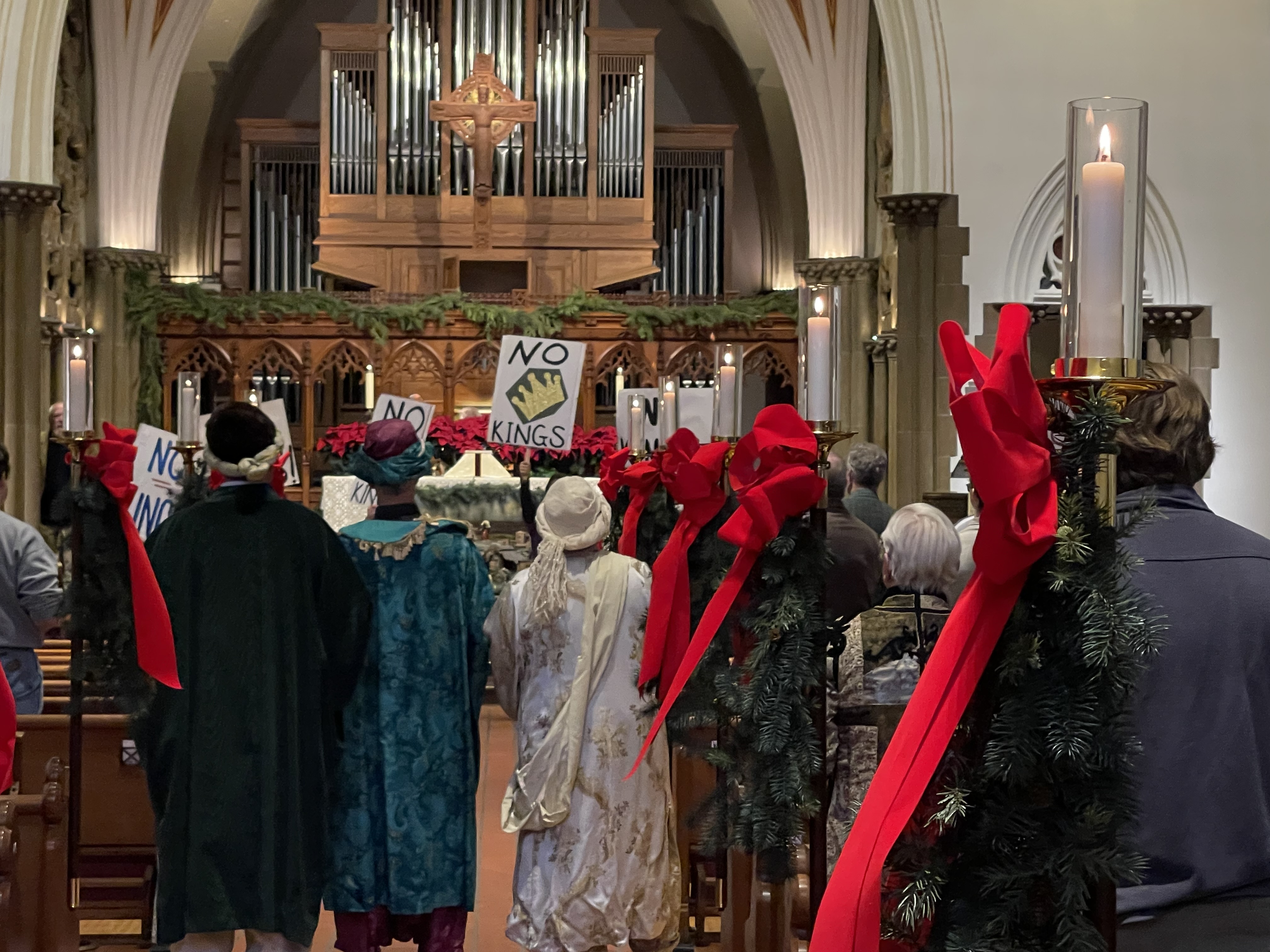
Instead, we are observing the Feast of the Holy Innocents today, which in the liturgical calendar falls on December 28, but because today is a Sunday, the observance would normally take place on Monday. We’re doing that at the request of our Stonecatchers group who has an activity planned later in the day, and thought this gospel story spoke especially well to the moment we are in.

There’s a historical connection with Grace as well. Our oldest stained glass window, the Vilas Window, was dedicated on the Feast of the Holy Innocents in 1887, commemorating Esther Vilas’s deceased husband and five of her children. That too speaks to our moment, for it’s a reminder that before the rise of modern medicine, many children died of childhood diseases that had been eradicated, or nearly so, thanks to vaccines.

Still, on this the fourth day of Christmas we should still be in full celebration mode. There are still Christmas cookies to be eaten, at least at our house; we’re looking ahead to New Year’s and another round of celebration, and the Packers have made it into the playoffs, although with three straight losses and all those injuries, it’s not looking good for them.

For all the joy and celebration of Christmas, and the nativity stories, in both versions related by the gospels of Matthew and Luke, there are ominous notes. That’s especially true of Matthew’s story in which Herod plays a prominent role. While this particular incident is not recorded in extra-biblical sources, we do know from the Jewish historian Josephus that Herod was a ruthless, murderous tyrant, and such an action would not have been out of character.

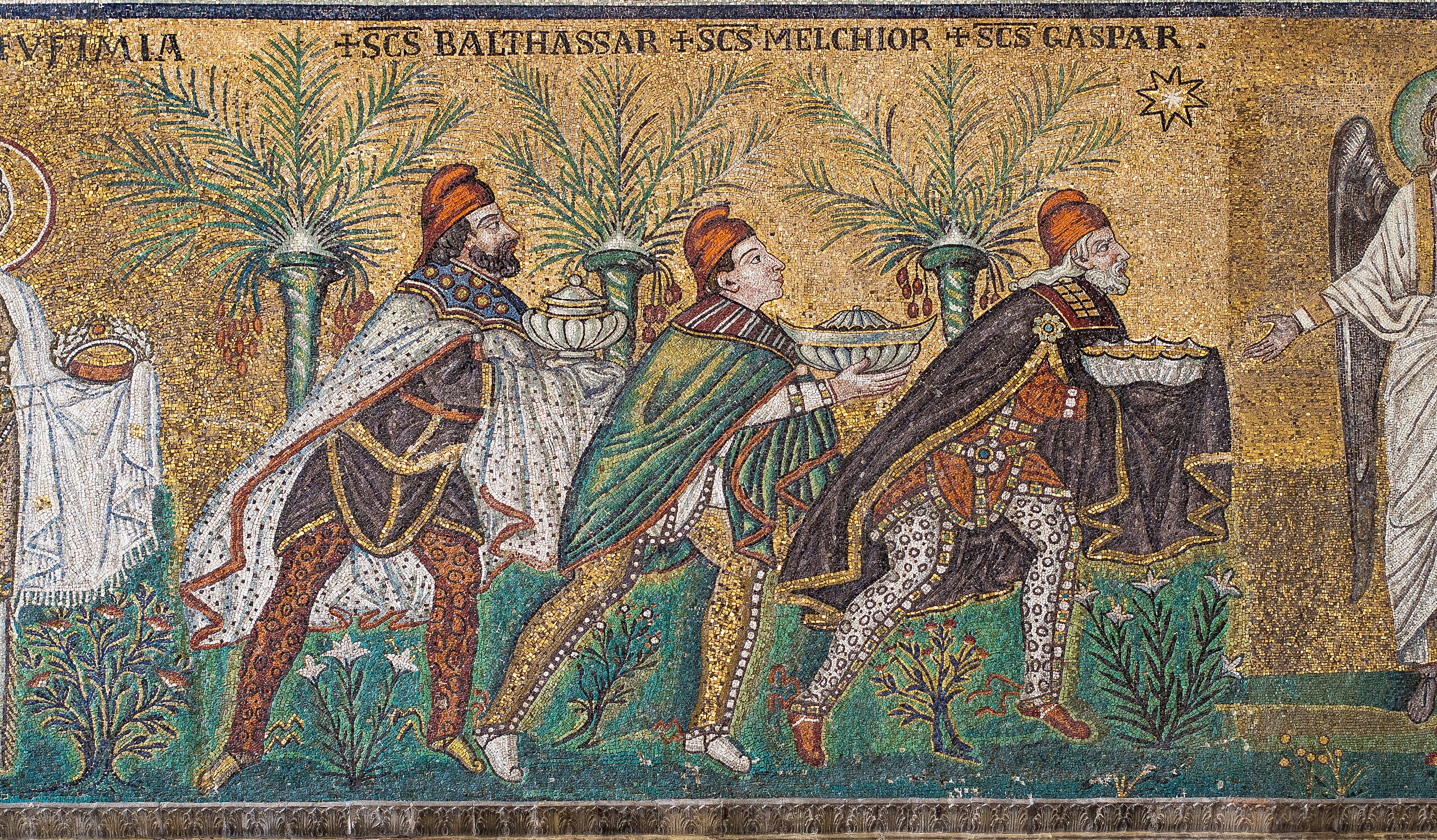
Still, the story is upsetting on several levels. First of all, to hear it now is to wreak havoc with the chronology of Christmas—it comes after the visit of the magi, which we will commemorate on later, on January 6, the feast of the Epiphany. And the utter evil of it—to kill all children, not just males, under the age of two. Such indiscriminate violence is more in keeping with our contemporary age, familiar as we are with genocide, carpet bombing, and school shootings.

Matthew isn’t content just to tell the story, he places it in the larger context of Israel’s salvation history, beginning with Joseph himself, who like his namesake in Genesis, is a dreamer of dreams. The flight to Egypt recalls the resettlement of Jacob and his family from the promised land of Canaan to Egypt in a time of famine, and the massacre of the holy innocents itself is an echo of Pharaoh’s decree that all the Hebrew baby boys should be killed.

It’s hard not to see another parallel to our own day. The image of the Holy Family desperately fleeing an evil ruler to save their lives, calls to mind all those who have fled evil regimes and desperate circumstances. We have heard horrific stories over the last year of refugees, asylum seekers, and others who have been forced to return to places where their lives would be placed in danger, families ripped apart.

While it may be overly facile to draw an exact parallel between the fate of the Holy Family as related in this story and the plight of refugees, it should give us pause to think. One of the realities of our day is the way in which many have dehumanized others unlike themselves, deriding them as subhuman as recent photos of tattooed refugees in incarceration (they’re all criminals); dismissing them as “illegals” or fear-mongering about their eating habits. To draw a connection between the Holy Family on the flight to Egypt and the plight of refugees and asylum seekers is to challenge all of us to see these vulnerable people as fellow humans, deserving respect and humane treatment.

So too with the massacre of the innocents. As one commentator wrote, “Tradition makes them the Holy Innocents, a remarkable kind of saint who never knew Jesus, but who were his companions and proxies in death.”

One of the interesting elements of the story is the juxtaposition of different understandings of kingship. On the one hand, there’s Herod a ruthless tyrant who for all his power rules only at the whim of the Roman Empire. In the background, there’s also Pharaoh, equally ruthless, like Herod, capricious and yet fearful. 

And then there’s Jesus, identified in this story by the magi as “King of the Jews”—a title mentioned only here in the Gospel of Matthew, and at the end of the gospel, when Jesus is labeled as “King of the Jews” first by Pilate, then in the inscription on the cross. Herod, a king who murders his subjects; Jesus, the king who identifies with his people, is crucified, suffering alongside and for them.

Later today, members of Grace and other Christians from throughout Madison will gather to bear witness to suffering that is taking place in our community and across our land. As you know one of the groups targeted by the current administration and their supporters are members of the trans community, beloved children of God. The Stonecatchers movement seeks to protect vulnerable communities in this time of division and hatred, and through their worship and action today, hope to express their solidarity with some of the most vulnerable people in society.

Many of us struggle with how to respond appropriately and effectively, offering a Christian witness of love and inclusiveness when weaponized hatred and all the power of the state are arrayed against the vulnerable. In many places, clergy and faithful people are taking a stand against ICE activity, speaking out against hatred and state violence. 

We may not know how to respond; we may be fearful ourselves, but this powerful, violent story reminds us that the Jesus we follow is a victim of such state violence, both in his family’s forced flight to Egypt and in his crucifixion, that Jesus stands on the side of and with the vulnerable and the oppressed, and that he calls us to join him in that witness.

And as the collect for the day reminds us, ultimately, it’s not in our hands but in God’s: “Receive, we pray, into the arms of your mercy all innocent victims; and by your great might frustrate the designs of evil tyrants and establish your rule of justice, love, and peace; through Jesus Christ our Lord.

Amen.

The Word became flesh: A Sermon for Christmas Day, 2025

“And the Word became flesh and lived among us, and we have seen his glory.”

I’ve been at this preaching thing for some twenty years, and for all of those years, except during the lockdown, I have preached on Christmas Day. It hasn’t become any easier over those years. I’ll be honest, I’m twenty years older than I was a started out as a priest, and my body feels that every day, but especially today. I got home after midnight last night, and the alarm woke me at 6 this morning.

There’s another reason it doesn’t get easier. After twenty times preaching on this gospel text, actually more than that, because it’s also the gospel appointed for the 1st Sunday after Christmas, you might think it difficult to come up with something new to say. Well, you’re right, but at the same time, who needs something new when you’ve got the majestic prologue to John’s gospel: In the beginning was the Word and the Word was with God, and the Word was God.

I’ve been thinking a lot about this text as it relates to our cultural moment. We live in a post-truth world. Politicians lie brazenly and are not called on it. Our social media feeds are filled with fake videos produced by AI; having lost our moorings in reality, we are at the whim of the loudest shouters, the most spectacular influencers; the billionaires with infinite wealth who can spread falsehoods and sway millions. We can create AI friends in our loneliness and despair.

And it is coming into the institutional church as well. You’ve probably all heard of the various chatbots used by churches and denominations—perhaps you’ve even found yourself using them. I was appalled this past summer when I saw an ad for a webinar sponsored by a major Episcopal entity that promised to show us how we might make use of AI, in our communications, outreach, and evangelism. I know there are many clergy who use AI in crafting their sermons.

But this: in the beginning was the Word and the Word was with God and the Word was God. Our Christian faith proclaims that there is a deep relationship between our thinking, our words, and the Divine Word. No matter how inadequate our words may be to express our faith, to convey the truth of our faith, when we use them, we are touching in some way, the Truth of the Word. We stretch ourselves to understand, comprehend, we stretch ourselves as we try to communicate our faith with others, and when we do, we are touching the Divine Word.

“The Word became flesh and lived among us.” The incarnation is a great mystery of our faith, something that we should ponder and treasure in our hearts, something we should puzzle over, ponder. More than that. The Word connects us with God because our words, our thoughts are attempts to approach and understand the Word. By thinking, reflecting, struggling to understand the meaning of the Word become flesh, there’s a way in which our thinking itself makes Christ present in our minds and in our lives.

You may find all this very abstract. It is, but John doesn’t stop there. He goes on. The word became flesh and lived among us. 

With this verse, John brings us back to Bethlehem, to the reality of the incarnation. Literally the Greek reads, “and the word became flesh and tabernacled among us.” While John likely wants us to think of the tabernacle that was the symbol of God’s presence to the Israelites in the wilderness, it’s also the case that we are to think of Christ being among us, “living among us” in a temporary, make-shift way, like a tent. That is to say, the word took on frail human flesh to be like us. 

This paradox, this mystery is quite beyond comprehension. The Word taking human flesh. St. Augustine captures the paradox in one of his sermons on this text for Christmas:

“He so loved us that for our sake He was made man in time, through Whom all times were made; was in the world less in years than His servants, though older than the world itself in His eternity; was made man, Who made man; was created of a mother, whom He created; was carried by hands which He formed; nursed at the breasts which He had filled; cried in the manger in wordless infancy, He the Word without Whom all human eloquence is mute.” — St. Augustine, Sermon 188

John goes a step further. For John, this infant, this tiny human creature, incapable of speech, vulnerable, utterly dependent on others for life itself, this infant reveals God’s glory to us.

So we are back in Bethlehem, back in the confusing paradox that God became incarnate in a very ordinary way, in the poorest of circumstances, in the weakest of all human forms, a baby. And it is in that paradox, that we see God’s glory. For John, it is the same paradox as the cross, which he almost always refers to as the glorification of Christ. What he is telling us is that in these moments of weakness, we see God’s majesty and power.

To see and know Christ, the Word, in the babe in a manger, is to see and know God’s glory. To see and know Christ in the cross, is to see and know God’s glory. To see and know Christ, to taste Christ in the bread and wine of the Eucharistic feast, is to see and know God’s glory. 

May we experience, may we see and know the glory of God today, in our lives, and in the world around us, in the Christ made flesh in a manger and as we kneel at the altar. May we know and believe the mystery of our faith, the mystery of the Incarnation, the mystery of God’s love for us, today at Christmas, and throughout our lives. Amen.

Things earthly and heavenly gathered into one: A Sermon for Christmas Eve, 2025

December 24, 2025
Christmas Eve
2025

On Christmas Eve, I always feel the chasm between the way things are and the way they ought to be especially acutely. There’s the beauty and brightness of our church, our worship, and our music; the joy of our celebration, our happy faces, excited children. And then outside, there’s the darkness of night, the realities of a world, suffering people, breaking hearts, hunger, homelessness, violence and evil.

Those differences have always been present, but in the past decade or so, I’ve been feeling that disjuncture more acutely, and it seems that gap between the world’s suffering and our celebration grows ever wider.

We live in tumultuous, chaotic times, as we watch our society collapsing, behavioral norms vanishing, as we witness the attacks on civility, on science, and learning, as institutions we held dear are under attack. We are fearful, anxious, and we know that others around us are even more frightened as families are ripped apart and immigrants deported. We avert our attention from the news because we can’t bear knowing all the details, whether it’s suffering in Gaza, war in Ukraine, or attacks on our healthcare system that put all our lives in danger.

This chaos has even come to Christianity as it is experienced and practiced in the United States. The rise of Christian nationalism has transformed the figure of Christ from the Prince of Peace to a Warrior, as it rejects his message of love of neighbor and enemy, and his embrace of the outcast, the vulnerable, and the foreigner.

It may be that you are tuning me out right now, because you came here to get away from all of that, to have a little peace and quiet, to sing familiar carols, to be reassured of well, normalcy, in these strange and unsettling times. We want to keep the barbarians, or our deepest fears, outside the gates, and activate security systems in our homes and our psyches to keep the chaos at bay.

But there are similar contradictions at the heart of the Christmas story, at the heart of the Christian faith. Think about Luke’s story of the birth of Jesus. On the one hand, he places his narrative squarely in the context of the Roman Empire: “In those days a decree went out from Emperor Augustus that all the world should be registered. This was the first registration and was taken while Quirinius was governor of Syria.” We see the reach of empire—a capricious, violent ruler demanding that the population be counted, why, so imperial domination could extend its way to the furthest reaches of the population. Rome, the eternal city, the city to which all roads led, the greatest power the world had ever seen.

On the other hand, and the contrast couldn’t be greater, another city is mentioned, the city of David, Bethlehem,  a tiny village far from the centers of power. But with the mention of David, an allusion to a long-ago monarchy that was conquered, a subject people, and a far away history.

And the people: the emperor, the governor, men in power, men of power, and Joseph, a powerless nobody, Mary, a pregnant, vulnerable teen. Their places: palaces, sumptuous furnishings and meals, many attendants; the other, Joseph and his family at a manger, in a cave? Because there was no room in the inn. Even more: The emperor would be announced throughout the empire as Savior, bringing peace; that’s the good news, the euangelion, the gospel. But the angels use the same language: a savior is born.

These contrasts like other contrasts of the season: light and darkness; the contrast between the emperor who reigns in Rome, and the king who is born in Bethlehem; the empire that rules by violence and intimidation; and the reign of God that ushers in peace and justice.  

Such dichotomies are present throughout Luke’s story. Think of the Magnificat, Mary’s great song of praise:

He has shown the strength of his arm, *
he has scattered the proud in their conceit.

He has cast down the mighty from their thrones, *
and has lifted up the lowly.

He has filled the hungry with good things, *
and the rich he has sent away empty.

Such divisions, between the weak and the powerful; rich and power are divisions we know too well today, as the differences between the haves and have nots grow wider, billionaires increase their wealth while people go hungry and unhoused around us. These divisions which we know so well are used to divide and demonize the other.

But it’s not just in the world around us where we see such stark differences. We see them in ourselves, as well. We know the person we want to be, and the person we so often are; the differences between our hopes and aspirations and the realities of our lives; the differences between what we should do, and what we actually do, all the ways we fall short and disappoint ourselves and the ones we love. 

Our tendency, when it comes to our own lives, and the dichotomies in the world in which we live, is to overlook or try to ignore those differences, to hide them from ourselves, to insulate ourselves from the suffering and pain in our hearts and the world around us. We may even want to hide them from Christmas, in our efforts to have the perfect celebration in an imperfect world.

But that’s precisely the sort of misguided exercise we humans tend to attempt. In fact, what we are celebrating at Christmas is the breaking down of those barriers: God becoming human, the word becoming flesh. In the words of a blessing often used at Christmas: “Christ, who by his incarnation gathered into one things earthly and heavenly…”

Or St. Paul: “In Christ, God was reconciling the world to Godself”

Christ comes into the chaos of the world, into its suffering and pain; takes on that suffering and pain, redeeming it, and us. In Christ, we receive adoption through grace, grafted onto his body. In Christ, all things are made new.

We see that taking place as Christ takes on human flesh, as a baby, in all the vulnerability and weakness that symbolizes, in the dependence of a baby on the love of parents and others. 

We will go from this place out into a cold and dark world, the light of our candles extinguished, but the hope in our hearts rekindled. The world will not have changed. There is still suffering, pain, despair; in the dark places of the world, and in the dark places of our heart.

But the coming of Christ brings rays of hope and love into that darkness for the light, the light of Christ, shines in the darkness and the darkness cannot overcome it. May the light of Christ, may the light of Christmas, shine in the darkness of the world, the darkness of our despair and fill us with his light and grace.

God with us: A Sermon for Advent 4A, 2025

You may have seen the stories over the last couple of weeks about the nativity scenes set up by various churches across the country that protest the actions of ICE. At a Roman Catholic Church in Dedham, Mass, the figure of the baby Jesus was removed and replaced with a sign “ICE was here.” Apparently the Archbishop protested and demanded it be removed, but the last I heard, it was still there. Similar scenes have been displayed in Chicago and Charlotte, where ICE activity has been especially pronounced.

We may find this sort of political protest unseemly or offensive, but it’s hardly new. There were similar displays during the first Trump administration and two years ago as Israel was reducing Gaza to rubble. Our tendency, our temptation is to want our Christmas celebrations to be escapes from the realities of the world and our lives, but the fact of the matter is that the story of Jesus’ birth is the story of God breaking into the world in all of its messiness and pain.

“Now the birth of Jesus the Messiah took place in this way.”

Today, on this fourth Sunday of Advent, we hear the story of the birth of Jesus as related by the gospel of Matthew. And I’ll bet that as you listened, you may have found it a bit strange, perhaps even unfamiliar. For it’s a very different story than the familiar one from Luke that we hear on Christmas Eve, with Bethlehem, the manger, shepherds, swaddling clothes, and all of that.

Matthew’s story seems to focus on Joseph. Mary and her pregnancy seem to be problems that need solving, and the birth itself is recounted in the sparest of terms. The focus on Joseph is odd in a way, if you think about it. It’s even odder when you put the reading we just heard back into the context of Matthew’s gospel, for these verses appear after a lengthy genealogy that relates Joseph’s ancestry back to Abraham. Thereby Matthew links Joseph not just to the ancient patriarchs and matriarchs—Abraham and Sarah, Isaac and Rebecca, Jacob and Rachel, but also to the Kings—David and Solomon. 

What’s odd about this is that of course Joseph is not biologically the father of Jesus.

Matthew gives us a genealogy for Jesus, and it’s worth considering why he thought it was appropriate, or important, to do so. There’s even something more interesting in all of this, because the words he uses to introduce the genealogy at the very beginning of his gospel, and the first words we heard in today’s reading, are very similar—both make use of the Greek word genesis—and it’s likely that Matthew intends his reader to think of the first book of the Hebrew Bible, Genesis. 

So it’s curious, isn’t it, that Matthew, after providing all of that background to the birth of Jesus, taking the time to carefully construct a genealogy that links Joseph back to Abraham, then tells the story of what basically constitutes an illegitimate birth.

The story that we heard is familiar. Joseph and Mary are engaged, or to use the traditional language, they are betrothed. It’s not just that he’s given her a ring, and they’ve begun to plan for the big day, scheduled the date and the venue, hired the caterer and the like. No, in Jewish law, the betrothal meant they were legally married, even though the marriage had not been consummated and they were not living together.

Because they were legally married, Mary’s pregnancy was not just an inconvenience. It indicated to Joseph that she had been unfaithful to him. Legally, because, as the text says, Joseph was a righteous man (in other words, he kept the law), he was obligated to divorce her publicly—something that might result in her execution for adultery. But Matthew tells us that he wanted to spare her the indignity, and perhaps himself as well, and divorce her privately.

So he’s got a huge problem on his hands, what to do. It’s likely, though Matthew doesn’t tell us, that Mary is feeling considerable anxiety and fear as well. After all, it’s in Luke’s version of the nativity that Mary is told by an angel that her pregnancy is miraculous, that she’s carrying the Son of God. 

In Matthew’s story, the angel comes to Joseph to explain things to him. He does as he’s told, and almost as an afterthought, Matthew tells us that the child is born and Joseph names him Jesus. Again, to use contemporary language, Joseph adopts Jesus as his son.

Christmas, which the songs tells is the “most wonderful time of the year,” can also be a time of great sadness and struggle. We are presented with images of the perfect family or the perfect holiday celebration but so often, our own experiences of Christmas are very different. We live in a messy world, we lead messy lives. Our families can be complicated; there can be ruptures or conflicts with family members; there are all the complications of modern family life, divorce and remarriage, blended families. We want everything to be perfect, just so, and so often the reality is very different.

I think there’s something reassuring for us in the twenty-first century in the way Matthew tells this story. He wants everything to be perfect, too. He fashions a genealogy that links Joseph to Abraham, carefully constructing 14 generations from Abraham to David and 14 generations from David to the exile, 14 generations from the exile to Joseph. To put it language from American history, it would be as if Joseph were descended from the Daughters of the Revolution and the descendants of the Mayflower. But it’s not just that the link from Joseph to Jesus is tenuous—it’s that in the midst of that genealogy are prostitutes like Rahab, and victims of rape and incest like Tamar, foreigners like Ruth.

And in the embarrassment of Mary’s unwed pregnancy, in the embarrassment of that genealogy, is an important lesson for us today. Just as we want our celebrations to be perfect, we assume that there’s something wrong with us if things don’t live up to those expectations and we wonder whether in the midst of our struggles, we can hope for God to come to us, for God to be with us.

The story of the birth of Jesus as told by Matthew is a reminder to us that God didn’t choose the wealthy, or powerful, or the Norman Rockwell family in the Norman Rockwell New England town. God came to Mary and Joseph, to a peasant woman and her fiancé, in the outmost corner of the Roman Empire. God came to people in the midst of enormous struggle and great heartache. 

The message of this story is that God is with us—here and now—no matter what our situation is, no matter what our lives are like, no matter what struggles we have, or worries, no matter what shame or guilt we might be experiencing. God comes to us. God is with us. That’s the point of this story. That’s the point of Christmas. God is with us. Here. Now. Emmanuel.  God with us. Thanks be to God.

Stir up thy power, O Lord: A sermon for Advent 3A, 2025

Advent 3A

December 14, 2025

Stir up thy power, O God, and with great might come among us…

The collects for Advent are beautiful and powerful, none more so than this one which provided the name this Sunday is known as” Stirrup Sunday.” It is a profoundly Advent prayer, bidding God to come to us in the midst of the suffering and evil in the world, which we experience so profoundly. With all the suffering that is taking place, our hearts breaking and broken, we may feel that we cannot bear anything else. But then…

I went to bed last night amid the news of the mass shooting at Brown University. This morning, as I was looking over my sermon again, I heard about the mass shooting targeting a Jewish Chanukah celebration at Bondi Beach in Sidney Australia. How do we maintain our faith that God is coming among is in the presence of such tragedy, such evil? Our gospel reading seems especially appropriate for us today.

Last week we saw John the Baptizer at the height of his power and career. Crowds were coming to see him and to be baptized by him. Even the movers and shakers were coming—the Pharisees and the Sadducees. How do think he was feeling as he saw the response to his preaching, the adoring crowds and the changed lives. As evidence of his power, we hear him attacking the religious insiders with language of great drama and violence.

Now, some weeks or months have passed and John is in a very different position. Herod had arrested him because John had criticized him for marrying Herodias, his brother Phillip’s wife. Another important point to note is that in the synoptic gospels of Matthew, Mark, and Luke, Jesus begins his public ministry only after John is arrested. In other words, John doesn’t actually see Jesus’ preaching and healing ministry in action. He only hears about it second hand. 

John is in prison, waiting. In the Roman world, prison was a place of waiting, not of punishment. Prisoners were waiting to find out what the judgment would be, whether they would be found innocent or guilty, and what their punishment would be. Execution, sentenced to the galleys or the mines? John was waiting.

John had been waiting for a long time, not to find out his fate. He, like Israel, had been waiting for the one who was to come; he was waiting for deliverance. And so, from prison, he asks that question, “Are you the one who is to come, or are we to wait for another?”

As we saw in last week’s gospel, John was looking forward to a great reckoning; the day when God’s justice would come down to vindicate the righteous and punish the wicked. John had prophesied, “Even now the ax is  lying at the root of the tree; every tree therefore that does not bear good fruit is cut down and thrown into the fire.”

John was now in prison, hardly evidence that God was making things right. And Jesus, the one whom John had baptized, the one in whom he had placed his hopes, had continued John’s preaching. He, like John, was proclaiming the coming of God’s reign. But there seemed to be no signs of its arrival.

So, John, lying in prison, wonders. He wondered whether everything he had been about had meant anything; whether his preaching had been worth it. So he sent two of his followers to ask the question. It’s an obvious question, but still it’s a very interesting and important one. And it is a profoundly “Advent” question. Advent is a time of already but not yet; it is a time when we recognize Christ’s presence among us, Christ’s having come among us as a human. But at the same time, we are looking ahead to that final reckoning. Like John, we are looking ahead for that time when God makes all things new; when God’s justice rolls down like water, and God’s righteousness like an ever-flowing stream.

John’s disciples asked Jesus the question, “Are you the one who is to come or are we to wait for another?” 

Jesus’ reply is not a simple and unambiguous affirmative. Instead, he instructs John’s disciples to tell him what they have seen, “the blind receive their sight, the lame walk, the lepers are cleansed, the deaf hear, the dead are raised, and the poor have good news brought to them.”

We hear this passage and we think it’s all so obvious and we may even wonder how John the Baptist could have had any question about who Jesus was.

But think about it a moment. Think about all of the suffering in the area where Jesus was preaching and healing. He may have performed some healings, but there were many other people who continued to suffer and the oppressive yoke of Roman occupation was as harsh as ever. Did Jesus’ answer convince John’s disciples? Did it convince John?

Like John, we are living in a time of already but not yet. We believe and proclaim that Christ has come into the world; that Christ has ushered in something quite new; that his death and resurrection have changed everything.

At the same time, we continue to see the suffering and injustice around us. Many of us experience great suffering and pain in our own lives. It may so overwhelm us that we despair.

Jesus’ answer to John’s disciples is his answer to us. In the midst of the world’s suffering, in the midst of our own pain, he challenges us to see signs of his coming; to look for signs of God’s coming reign; signs of his healing power. Those signs may be faint; they may be overwhelmed by the bright lights and glare of the world.

Like John, we want to see clear evidence; we want to see God coming in glory, destroying evil, beating down the devil. We want to see the carnage and a complete and total victory.

Instead, we are pointed toward this. A few people are healed; a few hear the good news and are transformed. God’s reign breaks in, tentatively, quietly, almost unnoticeably. So we have to pay attention. 

There are signs, but we need eyes that will see them; ears that will hear them. I invite you to look for those signs, to imagine what such signs might be in our world today. In the midst of the suffering in the world, in the midst of all of our troubles, where do we see Christ’s healing power? Where do we see God’s justice rolling down? Where do we see God’s reign breaking in and transforming lives and the world?

The Magnificat, Mary’s song, gives us another perspective on this, and another perspective on time. She sings:

My soul proclaims the greatness of the Lord,

my spirit rejoices in God my Savior; 

He has cast down the mighty from their thrones, *
and has lifted up the lowly.

He has filled the hungry with good things, *
and the rich he has sent away empty
.

Mary sings about God’s mighty acts, but she is not looking into the future, hoping for God’s making all things right. She sings in the past tense, these are things God has already done; this is God making things right, bringing justice and equity to the world.

Look for those signs, in the world, in the lives around you. Become those signs, to the world, to the lives you encounter. God is here among us, healing us and the world. Christ will come again to make all things new. May we rejoice to see his coming; and may we see the signs of his coming in our faith and in our actions.

Advent 1A

November 30, 2025

Time is a funny thing. There are times, as when we are in the middle of something exciting, when it seems like it passes in an instant. And then there are those times when we’re sitting in a waiting room and time seems to pass slowly, especially when the doctor is late for our appointment. Years ago, I would schedule my doctor’s appointments for first thing in the morning, so when I had to wait a half-hour for him to finally show up, I could let my outrage boil over, knowing the delay wasn’t due to them dealing with another patient, but rather they were just late getting into the office. Needless to say, I eventually tired of this and found a new primary care physician.

There’s also the way in which time can seem to pass in an instant. One of the realities I’ve had to deal with as I have been rector of Grace for now more than 16 years is the disorienting way in which time passes. I’ll find myself recalling some event, or someone, thinking that it occurred a few years ago, and suddenly realize that it’s been more than a decade. It’s particularly disconcerting to encounter young people who I baptized when they were infants and are now graduating high school.

The season of Advent challenges us to reflect on the meaning of, as well as our experience of, time. In the first place, it is the beginning of the liturgical year; for Christians who follow the liturgical calendar, the first Sunday of Advent is New Year’s Day.

While thinking about today as New Year’s Day would seem to help us place ourselves in time, in fact, we find it does something else entirely. It is profoundly disorienting to our sense of time, and our sense of our place in time. Advent encourages us to look forward—to Christmas and the birth of our Savior, but as it does so, it also prompts us to look backwards, to those events that took place two millennia ago in Bethlehem.

Simultaneously, though, Advent propels us forward not to December 25 and the rituals and stories of Christmas, but to the end of time itself, to the second coming. 

This disorientation and reorientation is fundamental to the season of Advent; and it is fundamental to the Christian faith.

One way in which we are being reoriented is through the changes in the lectionary. Each of the three years of the lectionary cycle, we focus on one of the synoptic gospels. This past year it was Luke. This year, it will be Matthew. This focus allows us to spend some time getting to know the gospel writer and the context and community within which they were writing. In Matthew’s case, as we shall see, there is a particular interest in laying out the similarities and distinctions of the Jesus movement with first-century Palestinian Judaism. At the same time, Matthew, like Luke, draws on the gospel of Mark for much of its chronological structure and many of its stories about Jesus.

Today’s gospel is one of those places where Mark’s influence is particularly evident. We have a section of what scholars call the “little apocalypse—” a sermon of Jesus given in the last week of his life, while he is teaching in and around the temple. We actually heard Luke’s version of some of the same material in recent weeks.

When I was a kid, for some reason, one year one of the local churches was given the opportunity to show Christian-themed movies in the schools. One of those films, I don’t know the title anymore, was about the second coming. I remember one scene especially. A man was in his bathroom shaving, and suddenly he was gone. It was a movie that aimed to depict what is called the rapture, an idea that emerged in nineteenth century Evangelicalism and captured the fascination of many—the idea that at the second coming, the faithful would be transported to heaven while the rest of humanity remained on earth to face the consequences.

One of the proof texts for the rapture is in this passage: “Then two will be in the field; one will be taken and one will be left. Two women will be grinding meal together; one will be taken and one will be left.”

It’s a frightening image, and especially as the idea has played out in modern Christianity, it has captured, and traumatized many. But it’s a misreading of scripture, and a profound perversion of the notion of the second coming. Contrast that fear-mongering with Isaiah’s vision from the first lesson:

they shall beat their swords into ploughshares,
and their spears into pruning-hooks;

nation shall not lift up sword against nation,
neither shall they learn war any more.

This vision, cast in the ninth century bce, continues to inspire. The idea of an age of peace, of justice and equity, when God reigns is a powerful image, reminding us that even as we experience all the ways in which our world and our lives fall short of that vision, our faith continues to express itself by hoping that God will make all things right.

But it will happen in God’s time, not ours. One lesson that Advent teaches is that even as we look ahead to Christ’s coming at Christmas, as well as Christ’s second coming, the day and the hour are not ours to set. God’s time spans past, present, and future. Indeed, God is outside of time.

Yet as the reading from St. Paul’s letter to Romans reminds us, our waiting, our experience of time is not flat and meaningless. “Salvation is nearer to us now than when we were first believers; the night is far gone, the day is near.”

Both the gospel and the reading from Romans point to the ways in which early followers of Jesus were disoriented in time. There’s a great deal of evidence that those early Christians expected Jesus’ imminent return. When he seemed to tarry, they began to wonder whether their hopes were real, and if there hopes of an imminent second coming were not going to be realized, what would that mean for their faith in Christ?

Jesus warns his listeners, “But about that day and hour no one knows, neither the angels of heaven, nor the Son, but only the Father.”

In a way, Jesus’ words are doing to his listeners just what Advent is doing to us. He is trying to reorient them toward a new understanding of time, to change their expectations and experiences of it. So too does Advent do this to us. We are betwixt and between. Even as the circles of time continue through the years, Advent breaks in upon us and presents us with a different sense, or senses of time. As we look ahead for four weeks to Christmas, we are looking even further beyond to Christ’s second advent and those two markers remind us that ultimately, we are not in our time, or time of our making, but in God’s time. And in God’s time, God will make all things new, and we will beat our swords into plowshares and our spears into pruning hooks. And we will study war no more.

Thanks be to God.

Visions of the Future: A Sermon for Proper 28C, 2025

Proper 28C

November 16, 2025

I have to tell you. I find it more than a little ironic that the gospel reading on the Sunday of our annual meeting, in two out of three of the three years of the lectionary cycle concerns Jesus’ prediction of the destruction of the Jerusalem temple. Did we spend over $1 million dollars on replacing the slate roof this year? Are we anticipating around $300000 in additional expenditures on the building and grounds over the next year? (You’ll hear more about that later). Does Jesus’ prediction of the destruction of the temple suggest that such expenditures are not in keeping with God’s will? I’ll leave that question for you to ponder.

And to be honest, even as we have talked about ensuring the continued presence of Grace Church on Capitol Square, not least by installing a slate roof with an expected lifespan of 80-100 years, I wonder sometimes whether this building will be standing a century from now. With climate change continuing, and the massive disruption it poses to life on earth, will this planet be habitable in 2125? 

We may not like to think that far in the future, unless we’re watching some Hollywood post-apocalyptic movie but our lessons today force us to confront such questions, if only because they present us with strikingly different visions of the future. In the gospel reading, we’re told that there will be wars, famines, earthquakes, and that followers of Jesus will be persecuted. It’s tempting to plot those events on our own situation, to wonder, as Christians are prone to do, whether all those things that are taking place in our world today, are portents of Jesus’ return. Especially this week, with the images of clergy being manhandled, pepper-sprayed and arrested as they bear witness to the injustice of ICE detentions and deportations at Broadview in Chicago, we may indeed wonder whether we are in the last days.

I’ll come back to that gospel reading in a minute but first, I want to draw your attention to the passage from the book of Isaiah, and the very different image of the future envisioned by the prophet. 

The passage from Isaiah is full of hope—written at a time when great things seemed possible. The Babylonian exile was over, the exiles had been allowed to return to Jerusalem, and they were rebuilding their lives, the city, and most importantly, the temple. It’s a reboot of creation with God promising to create a new heaven and a new earth, for the former ones had passed away. Other biblical texts tell us of the struggles the returnees had, of the devastation they encountered and the hard work they faced. The situation was so dire that in fact many of the exiles chose not to return. They had built comfortable lives in Babylon and preferred that to the uncertainty and struggles they would have faced in Jerusalem.

But still it’s a vision that captivates us as it has captivated Jews and Christians, artists and writers over the millennia: 

The wolf and the lamb shall feed together,
the lion shall eat straw like the ox; 
but the serpent– its food shall be dust!

They shall not hurt or destroy
on all my holy mountain, says the Lord.

To express such hope and faith in God, in these circumstances and after so much had happened—the destruction of the temple, being carried off to Babylon, fifty odd years living in a foreign place, and then to return and to face all of that struggle:

For I am about to create new heavens
and a new earth; 

the former things shall not be remembered
or come to mind.

The gospel reading puts us back into the last week of Jesus’ life. It’s an incident recorded in all three synoptic gospels, Matthew and Mark as well as Luke, but Luke does something interesting with it. Remember that Jesus and his disciples are coming from Galilee to the big city. They staged what we call the Triumphal Entry and then immediately, Jesus and his disciples go to the temple. He upends the tables of the moneychangers and then over the next days teaches in the temple.

In Mark’s version, the remark about the temple’s grandeur is made by some of Jesus’ disciples, and in that way, it might be something tourists might say when they see a remarkable building. But Luke changes it to “some in the crowd” and so Jesus is addressing his follow-up remarks, not just about the temple’s destruction but about the signs of his coming and persecution to a wider audience than his closest disciples.

Remember, Luke is writing after the cataclysmic events of the Jewish revolt and the brutal Roman repression that culminated in the destruction of the temple. Around the end of the first century, Luke and his readers are still processing those events and wondering what the fallout will be. It’s likely that there is also some concern among the early Christian communities because the Second Coming of Christ that they had expected imminently, perhaps even in conjunction with the temple’s destruction, had not occurred and they were wondering what it all meant.

But in among all of those warnings—not just of catastrophes like wars and earthquakes—but the dangers to come for followers of Jesus: persecutions, imprisonments, trials, and martyrdom are promises as well: “I will give you words and a wisdom that none of your opponents will be able to withstand or contradict.” 

And further: “Not a hair of your head will perish. Through your endurance you will gain your souls.”

As I said, following this service we will gather once again in Vilas Guild Hall for the annual meeting of our parish. This congregation has survived some 185 years; our church building around 170.Over those years, there have been enormous changes. Sometimes I wonder whether those who embarked on the construction of our nave in 1855 had any idea that in six years a Civil War would break out in our nation, and whether, had they known, they would have started construction.

We may not want to think about the future. We may, like so many people today, bury our heads in the sand and say to ourselves, and to future generations, that it’s not our problem: climate catastrophe, environmental devastation even if we contributed to them, are things they’ll have to deal with—or perhaps, they can colonize Mars and start the whole cycle over again.

Yet, there is another option. These readings remind us that our God is a God of history, working God’s purposes out in every age. The visions may be radically different—and Edenic paradise of a new heaven and a new earth or a dystopia of wars, rumors of wars, and earthquakes. But in both visions, God is present with God’s people, promising God’s providential care for all. The lucan passage ends with the remarkable promise that “not a hair of your head will perish” and that “through your endurance you will gain your souls.”

We don’t know what the future holds—whether it is climate catastrophe or a dystopian vision worthy of Hollywood or a sci-fi author, or something else. But whatever comes for us and for future generations, we know that God will be there, caring for God’s people, bringing about God’s reign, redeeming, forgiving, and remaking humanity. Thanks be to God!

Resurrection Life: A Sermon for Proper 27, Year C, 2025

November 9, 2025

On Thursday evening, I had the opportunity to meet with a small group of people who are participating in “100 Days of Dante” a national program that engages readers with Dante’s Divine Comedy. For me, it was an opportunity to return to a text I knew well. When I was teaching, I participated every year in Interdisciplinary Humanities Programs that included at least the Inferno on the reading list for the Medieval semester. It’s an expansive and detailed vision of the afterlife, encompassing Hell, Purgatory, and Paradise and peopled with figures from Italian history and Greek and Roman mythology. It’s also the story of Dante’s pilgrimage from a dark wood of uncertainty to eternal certitude.

While it is a great work of literature, it is also quite funny at times and very human. Wouldn’t you like to imagine where in hell you would put your enemies and how they would most appropriately be punished? That’s exactly what Dante did.

One topic we touched on briefly on Thursday was the way in which Dante’s vision of the afterlife influences our own. For example, how many of us imagine a hell in which unrepentant sinners are punished according to their desserts and the worse the sinner, the worse the punishment, and the closer to Satan. Similarly, do we imagine a heaven in which there is a hierarchy and the greater saints are closer to God, while we are further away?

I pose these questions because today’s gospel reading is all about our perceptions of the afterlife. But first, let me offer some context. There’s the context of Luke’s gospel. For many weeks now, we have been following Jesus on his long journey to Jerusalem. What the lectionary skips over now is his actual entry into the city, which we reenacted way back on Palm Sunday. Immediately after his entry, Jesus goes to the temple. Luke says that he spent every day teaching in the temple.

In fact, Luke recounts a series of encounters between Jesus and religious leaders in which Jesus is asked questions that seem intended to trap him. First, it’s the chief priests, scribes, and elders. Then Luke says they sent spies to trap him—that’s the question about whether it’s lawful to pay taxes to the emperor. And now Sadducees come and ask about the resurrection.

The Sadducees were a movement within first century Judaism. We might regard them as conservative or traditionalist. Unlike the Pharisees, who had an expansive view of scripture that included the prophets and writings, much of what would later become the Old Testament or Hebrew Bible, the Sadducees regarded only the Torah, the Five Books of Moses as authoritative. 

The Sadducees were also closely aligned with the priestly caste and the temple. When the temple was destroyed in 70 CE, the Sadducees faded into history. That they were unfamiliar to Luke’s readers is suggested by his side comment that they didn’t believe in the resurrection (a belief that isn’t attested in the Torah).

One more word of explanation. The question the Sadducees pose has to do with what is called Levirate marriage—the custom, attested in the Torah, that if a man died without a male heir, his brother was obligated to marry the widow in order to ensure his bloodline would continue. Now there’s no evidence that this was practiced in first century Palestinian Judaism, so what we have here is not an honest attempt to seek Jesus’ opinion, but an obvious attempt to point out the absurdity of the resurrection as a doctrine, and to ridicule Jesus, who like the Pharisees believed in it.

But Jesus will have none of it. In fact, the Sadducees made a fundamental error, and it’s one I think we’re prone to as well. In their opposition to the idea of resurrection, they imagined it to be something very like the life we have now. But Jesus tries to explain it to them. There will be no marriage in the resurrection, because resurrection life will be categorically different from the life we have now. That’s what I think he means when he says they will be like angels, children of God, children of the resurrection.

I think what Jesus is saying about the qualitative difference between our lives now and resurrection life is something that St. Paul was grasping at in I Corinthians 15 as well: 

What is sown is perishable; what is raised is imperishable.  It is sown in dishonor; it is raised in glory. It is sown in weakness; it is raised in power.  It is sown a physical body; it is raised a spiritual body. If there is a physical body, there is also a spiritual body.

One commentator points out that the doctrine of the resurrection emerged from a fundamental realization that earthly life is unfair and unjust. To believe in the resurrection is to believe that God will make things right in the end. One reason the Sadducees rejected the resurrection was because they had it pretty good in this life. They were wealthy and powerful and had no need to imagine a better life. 

There’s something else. The question posed by the Sadducees reveals a profoundly unjust reality. Think of a poor woman placed in that situation. Her only value is her ability to produce male offspring for her husband. She is locked into that system, lacking agency of her own. Her desires, her hopes, her feelings are ignored. Can you imagine what resurrection might mean for her? To be freed from that unjust, patriarchal system, free to live a life seeking meaning and fulfillment!

But, and this may be the most important thing, it is not a life lived for oneself. The passage with an intriguing statement: “Now he is God not of the dead, but of the living; for to him all of them are alive.” Alternatively, the Authorized Version (KJV) reads “all live to him.” Resurrection life is not about self-realization but is life for God. Just as life comes from God, in the end, we will live in and for God.

As we consider all the ways our society exploits and demeans people; as we watch while our neighbors struggle with the ending of SNAP benefits, or fear that they will be seized from their homes and families and unjustly deported, as we struggle with the rise in neo-Nazi rhetoric, antisemitism, and the attacks on vulnerable communities, we realize how fragile was the pluralistic society we were attempting to build. The same people who claimed Christianity was oppressed now seek to prevent prayer, witness, and pastoral care at ICE facilities.

To proclaim the resurrection is to proclaim that the reality we see and experience is not the reality desired by God, that God’s reign is a reign of truth and justice, promising wholeness and healing to all people. To believe in the resurrection is to believe that the chains that bind us to this unjust and and oppressive world will one day be broken and that we will all live freely—live in and for God. May that belief fill us with hope and courage for the coming days. May we all live in God!

All Saints’ Sunday, 2025

All Saints’ Sunday

November 2, 2025

You may have seen the article in the State Journal earlier this week which described the mood at local food pantries in the days leading up to the cessation of SNAP benefits yesterday. Our own Pantry Director, Vikki Enright, was quoted among other pantry employees and volunteers across the county. As we have watched the dismantling of nearly 100 years of federal support for our nation’s residents, and witnessed the effects of those changes on ourselves and our neighbors, we are filled with trepidation as we await the impact of the end of support for millions of food-insecure Americans.

Another recent article strikes an ominous note for our community. As local governments and service providers scramble to secure funding for operations of the new men’s shelter on the east side, there are growing concerns that the shelter will be overwhelmed by the demand. The answer seems to be: “let’s reach out to the churches.” I’ve heard that remark second-hand from several people reporting on conversations they’ve overheard, but perhaps surprisingly, no one has reached out to us. And frankly, I’m not sure what I would say. After nearly 40 years hosting the men’s shelter, and struggling as we sought to provide adequate space and services while also advocating for the need for a new shelter, I’m not sure we at Grace have the capacity or energy to take on the responsibility of providing space to help unhoused people.

All this is taking place against a backdrop of ICE raids targeting vulnerable immigrant communities; the rampant growth of White Supremacy and Christian Nationalism, collapsing institutions, a society and culture in disarray—perhaps best symbolized by the images we’ve seen of the destruction of the East Wing of the White House to make way for a ballroom. The rubble shown there is a mirror of the rubble that engulfs us all.

Our exhaustion, fear, anger, despair bubble over, overwhelm, render us impotent, keep us awake at night and on edge during the day. As the chaos swirls around and in us, the Church, in all its magnificence, history, and foibles, directs our attention to our fellowship with all those who have come before us and served as models and inspirations, on this All Saints’ Sunday.

All Saints’ is an occasion for us to reflect on that larger communion of which we are a part, not just Grace Church, or the diocese of Wisconsin, or the Episcopal Church, or even the worldwide Anglican Communion, fractured though it may be. All Saints’ draws our attention to the communion of saints, our fellowship with all those who have gone before us in the faith, all those who still surround us as a great cloud of witnesses.

So what, who are the saints? And why All Saints? Today’s commemoration has its origins in the earliest centuries of Christianity. During the Great Persecution, many Christians were martyred for their faith. Of those, some were remembered. On the anniversaries of their martyrdoms, surviving family members and members of the local Christian communities would go out to the graves of the martyrs and have feasts, including Eucharist to commemorate their witness and faith. But the Church realized that there were many martyrs whose stories and names were unknown, so a commemoration of all of those unremembered but faithful saints was created and eventually was observed on November 1—All Saints’ Day. 

Over time, faithful Christians wanted to honor ordinary people as well as the saints, the heroes of the faith. They wanted to remember their loved ones who had passed on, to commemorate them, and beginning in the Middle Ages, to pray for their souls who were believed to be in Purgatory. And so, alongside All Saints’ developed the Feast of All Souls, traditionally observed on November 2, the commemoration of all the faithful departed. With the Protestant Reformation, and its attacks on many traditional forms of piety, The Feast of All Souls was removed when the Book of Common Prayer was published.

So on this day, we do both things. We rejoice in the communion of the saints and we remember the faithful departed. It is a powerful reminder that, whatever our particular concerns and worries at this moment, as individuals and as a congregation, we are part of a much larger whole, one that encompasses all Christians who are worshipping today throughout the world, and just as important, all those Christians who have come before us, and are worshipping before the heavenly throne, as well all those Christians who are yet to come.

In the gospel reading, we hear Luke’s version of the beatitudes. It’s rather different from Matthew’s much more direct and connected with the realities of daily life: blessed are you who are poor now; blessed are you who are hungry now, blessed are you who weep now. And he adds a corresponding set of woes—Woe to you who are rich now, woe to you who are full now, woe to you who are laughing.

This set of blessings and woes, not blessings and curses—It’s hard for us to understand just what Blessed and Woe mean in this context. One commentator suggest we think rather in terms of “satisfied” and “yikes, or watch out” It’s not that one group is “saved” and the other “damned” but that the hungry and the poor receive God’s favor, and the wealthy and well-fed need guard against losing God’s favor.

These are stark binaries; and it’s easy in our world and divided nation to think in terms of such stark binaries as well. But we in the church are a communion of saints, part of a new community, a new social reality called together by Jesus, a new community that crosses every boundary of socio-economic, racial, gender, and ethnic status. It is a community that even breaks down the boundary between the living and the dead. There are no binaries in the kingdom of God.

At a time when people on the margins are being vilified and attacked—just in the last few days we’ve seen numerous politicians scorning food-insecure people who are reliant on SNAP. At such a time, it is part of our witness to the communion of saints to embrace and support all people, no matter their immigration status, their socio-economic position, their race, ethnicity, or gender. The kingdom of God, the communion of saints bears witness to and embodies all of human diversity.

We come together to worship, to be community, to be in solidarity with those whose lives are very much unlike our own. Together, we gather around the Lord’s table; together, we eat and are Christ’s body. Together, we are the communion of saints. 

May we experience that community of all the saints, and may we walk together in mutual support and love, inviting others to join us as we experience Christ’s love.

A Steward of Injustice? A Sermon for Proper20C, 2025

September 21, 2025

I’ve struggled over the parable we heard today for. more than forty years, ever since I encountered it in an assignment for a course entitled “Exegesis and Preaching” back when I was in Divinity School. It vexed me then; it has vexed me every time it comes up in the three-year lectionary cycle. No doubt it will continue to vex me after I retire and no longer have to preach on it. But I’m not alone. I think it has vexed everyone who has tried to make sense of it over the millennia, and I hope it vexed you as you listened to it this morning.But I do think it can speak to us today, in our situation, even if its meaning remains elusive.

To me, one of the most frightening things about our current environment is the way in which many of our most powerful and storied institutions, not to mention our wealthiest billionaires, have folded under pressure from the current administration. We’ve seen universities like Columbia cede their independence and their commitment to academic freedom; tech billionaires pony up millions for the inaugural festivities; the Republican party, and many democratic senators have rolled over. We’ve seen news organizations and media companies acquiesce as well—the Washington Post has fired most of its oped writers; the cancellation of Steven Colbert and the silencing of Jimmy Kimmel.

None of these seem to provide examples of how to respond to the attacks on science, civil liberties, the humanities, common decency that have become commonplace. Many of us feel impotent, uncertain how to behave, what to do. How can we act ethically in a morally corrupt society and situation? It all seems hopeless; what little we could do seems futile in the face of all the evil forces that surround us.

My thoughts were spurred by a conversation I had with a parishioner this week about how to maintain hope in this situation; whether hope is even warranted. My response came easily off my lips—the Resurrection of Christ, his conquering death and the grave, is the source of our hope. Such words may cling hollow in the face of all that we are experiencing, but our faith in God, our assurance that God will reign, must carry us on. But even that may seem little more than a pipedream, wishful thinking.

You may be wondering how any of this connects with our scripture readings, and especially with our gospel reading, and the strange parable we just heard.  

Today’s parable offers insight into the economy of the first-century Mediterranean world, which was corrupt and rigged in its own way and brutally oppressive of the vast majority of ordinary men and women.

As I’ve repeatedly said before, when reading or listening to Jesus’ parables, it’s important to look for surprising, unordinary behavior, and to avoid trying to force the parable into a comfortable meaning. While that is difficult for many parables, in the case of this one, often called the Parable of the Unjust Steward, everything in it is strange, irrational, defying interpretation.

In fact, Luke appends to the parable a couple of verses that attempt explanation but let’s be honest, they don’t even approach making sense of the story; they’re like non sequiturs.

The difficulty of this parable is that no explanation is ultimately satisfactory, no explanation—not the ones Luke puts in Jesus’ mouth at the end of the story, not the ones commentators have come up with over the centuries. After all of our struggles with it, we are left with a story in which charges are brought against a steward, he reacts in his own self-interest, and when found out, his boss or master commends him for it.

In order to access the world of this parable, we need to access the economy of the ancient Greco-Roman world. The story is not necessarily set in the countryside, on an estate, but clearly the master is a man of great wealth whose business has to do with the chief commodities of the time—olive oil and wheat. It’s likely he was an absentee landowner. The steward, either a slave, or perhaps a freedman, was responsible for extracting the maximum wealth possible from the estate and passing it on to the landowner. But before passing it on, he would take his cut. Typically, as long as he didn’t abuse the system, the steward could benefit richly from the system, skimming off some of the profits for himself. This is the way the economy worked. 

Now charges were brought against him that he was dishonest. At this point, there’s nothing in the story to suggest whether the charges were valid or not, and that may be a significant point. In such an economy, in such a society, the only power the people at the bottom of the heap have is to bring such charges. Doing so makes the person above them vulnerable. The master demanded an accounting, but before having a chance to look at the books, the steward took action. 

While it may look like the steward is trying to ingratiate himself as he reduces the debts that are owed his master, I think there is another way of looking at it. Here is a place where we are very much in a comparable place economically. The master and steward occupied an economy in which worth was calculated solely in financial terms. The relationships between landowner, steward, and debtors were strictly economic. The master and steward had similar goals—to extract as much wealth as possible from the land and from those who owed him. Sound familiar? 

But suddenly, the steward is expelled from that economy. He has no place and no prospects. He doesn’t have the skills or strength to dig, and he is ashamed to beg. So he sets out to transform himself and his value. With a goal of being welcomed in people’s homes after he loses his job, he builds social capital by subverting the wealth economy. His actions create new relationships. No longer is he a steward and they debtors. Now they are united by mutual relationship. And there’s this. His actions have also probably created good will between the debtors and the master. Who doesn’t like to see the principal of their loans reduced?

There’s something else I find intriguing. In his weekly lectionary newsletter, Andrew McGowan, New Testament scholar and until very recently Dean of the Episcopal Seminary—Berkley Divinity School at Yale, pointed out that the phrase translated as dishonest manager could be translated differently. The word for dishonest here is the same word that’s usually translated unrighteousness or injustice. McGowan suggests “steward of injustice”—by which is implied not that the steward himself is unjust, but that the system as a whole is unjust. The steward has been complicit in that system. He has profited from the system. And, now, he’s looking for a way out.

Here’s the thing. We all struggle with money. We worry whether we have enough to pay the bills. We worry whether we’ll have enough for our retirement. We worry whether we’ll have enough to make it to the next paycheck. But that’s not all. So much of our personal value and worth is tied up with how much we make. Our self-worth seems to be often dependent on the fact that we are consumers, and that we can display for all to see the wealth we have. We know all too well how the system is gamed by the wealthy and powerful and how ordinary people are left out. We see evidence all around us of the myriad ways the system has oppressed and exploited people. Even as we feel the effects of that exploitation and oppression on ourselves, we also reap benefits from the exploitation and oppression of others.

How do we make our way in such a system? How do we live ethically, responsibly in it? How do we seek to follow Christ?

And here’s where the actions of the steward may give us guidance. As he sought to extract himself from the situation in which he found himself, he sought to make connection, to build community with others. 

By building community and connections that are founded not on monetary value but on good will, we are challenging the status quo and creating new relationships like those in the coming reign of God, where worth is not calculated by how much we have or make, not by our social media presence, but by our relationship to God—by our humanity, by the fact that we are created in God’s image and full of worth and dignity.

 We are very much like that steward, enmeshed in systems over which we have very little control, beaten down and yes, beating down. It may be impossible for us to extract ourselves from those systems, after all, they pay our salaries and ensure our standard of living. But we can look for ways to ease the burdens of others, to make those human connections, to nurture life-giving and meaningful relationships and to bear witness to the intrinsic dignity and worth of God’s beloved children.