Facebook and the Church


The Episcopal Cafe continues to direct us toward debates on the relative merits of churches using social media, and the longer range implications of the growth in social media for religious institutions.

Most recently: Four questions on social networking. They are:

  1. What will happen to churches that are anchored in historic beliefs and hidebound in traditions, where hierarchy prevails over democracy and where expectations are that individuals will support the institution without question?
  2. How will clergy of all ranks respond now that church institutions are being peppered with demands for accountability from people in the pews?
  3. How will scholars debate online with integrity disciplines such as theology, ethics, and discipleship when the conversation opens up to those misled by the many irresponsible, unfounded myths, legends and outright lies passed along via the Internet?
  4. Can enthusiasm for various missions and ministries expressed via social networking be translated into real-life, feet-on-the-ground human effort and relationships?

They also comment on Ian Paul’s discussion of the benefits of facebook for ministry: Using facebook to build Christian community. I find his first two observations especially trenchant. Facebook connects me with people I don’t see except on Sunday, and people I don’t see at all regularly anymore. I think it strengthens community and it also nurtures the bonds of community and pastoral connection with people who have moved away.

Finally, they ask: Will Facebook kill the church? Picking up on an essay written a year ago.

We are in a rapidly changing culture with the decline of institutional religion and the rise of social media. What will happen is not at all clear, but what I am seeing is that social media, my blog, facebook, etc., are ways of reaching out to people who might not be closely connected to the church and finding ways of tightening those bonds.

I was struck on Saturday by comments from a number of people who walked past while I was standing outside of Grace, talking to people. Strangers came up to me and said that they had heard what we were doing, praised our hospitality, and thanked us. Had they learned of our open doors by seeing the sign? My guess is, most heard through the grapevine, facebook, or twitter. It has raised our profile in the community.

Now, we will we get new members or “pledging units” from this effort? Who knows? What I do know is that we are making a difference in people’s lives, in some small way.

Rob Bell and Universalism

There’s been quite the dust-up among Evangelicals about Rob Bell’s new book, in which, according to HarperOne’s marketing, “With searing insight, Bell puts hell on trial, and his message is decidedly optimistic—eternal life doesn’t start when we die; it starts right now. And ultimately, Love Wins…”

Here’s Christianity Today’s take on the controversy.

Rob Bell, for those who don’t know, is pastor of Mars Hill Church, and has produced a wildly popular video series, entitled NOOMA. The series was used for a time by a group at my former parish. Many of those in attendance found him inspiring. Maggie Dawn judges his genius in his ability to communicate rather than in the depth of his theology.

As Dawn points out, universalism is not particularly rare in the History of Christianity, nor even among evangelicals or conservatives. As examples, she cites no less an orthodox figure than C.S. Lewis. It’s an issue that continues to fascinate people, just as it continues to rouse the ire of many. In part that’s because the notion of a loving God who condemns people to hell for eternity seems an oxymoron and is an issue which for many thinking people lies at the center of their discomfort with Christianity.

It’s a question that often comes up in my random encounters with people. Sometimes it’s couched in terms of whether adherents of other religions can be saved. Sometimes it’s phrased as I did it above, as a problem in the nature of God. In either case, it is almost always asked by someone who is sincerely struggling with the issue and is seeking guidance or clues on how to begin to think about the question in such a way that helps them make sense of their own experience and deepest values, as well as their experience of God.

When I respond to them, I try to honor their experience, values, as well as their understanding of God and try to explore with them the full implications of belief in a loving God, and what might limit that love.

“The Rise and Fall of the Bible”: Rethinking the Good Book – Laura Miller – Salon.com

Laura Miller writes in Salon about Timothy Beal’s new book on the Bible in American culture.  Entitled The Rise and Fall of the Bible: The Unexpected History of an Accidental Book, Beal’s work describes “biblical consumerism,” a situation in which the average American household owns nine bibles, purchases one a year (so what happened to the others), and yet most Americans are biblically illiterate.

Some of the most interesting chapters in “The Rise and Fall of the Bible” explore the world of Bibles created for specific subcultures and needs: the manly Metal Bible and Duct Tape Bible, kicky handbag/Bible combos and special editions geared toward teenagers, African-American women and so on. These can contain as much as 50 percent “supplemental” material, “explaining” the scripture according to the taste of the intended audience. Then there are Biblezines, publications in which articles about how to grill steaks or talk to girls (in the case of a Biblezine for boys) share the page with biblical quotations. Well-meaning older relatives give this material to young Christians, hoping it will make the Bible itself seem more “readable.” Beal thinks the kids just wind up reading the articles and skipping the quotations. He compares Biblezines to the “sweeter and more colorful roll-ups, punches, sauces and squirtable foams that I buy for my kids’ lunches” in lieu of the unprocessed fresh fruit they refuse to eat. At least you can tell yourself you’re giving them fruit.

Beal bemoans biblical illiteracy and those who want to interpret scripture literally. In fact, he sees a direct relation between the proliferation of niche bibles and the end of a search for certainty in scripture. I’m not so sure, and while I find the marketing of bibles to small subgroups of the population both odd and somewhat amusing, I don’t know that contemporary “biblical consumerism” is all that much different from what happened in earlier generations.

Take the Gideons, for example. They provide bibles in hotel rooms, hospitals, and the like, and distribute them on college campuses and elsewhere. I can’t remember where I was teaching at the time, but I recall coming into class one day (a Bible class, no doubt) and the students were joking about the New Testaments that were being passed out on the sidewalk.

For those passing out the bibles, they are a symbol of their own faithfulness as well as a means of reaching out and converting people. In past generations, a bible had a pride of place in many homes–a lavishly illustrated and bound volume displayed on an end table or coffee table in a living room. I doubt whether that particular bible was opened and read but its presence sent a message to all who saw it.

My sense is that the consumerism Beal describes has much more to do with the commercialization of Christianity–companies trying to make a buck–than with profound changes in biblical interpretation in the culture. Need a gift for a graduate? Why not buy the college-student’s bible?

Yes, there is rampant and growing biblical illiteracy, even in the South, and even among conservative Christians. It always amused me when freshmen figured out in the second week of class that the Bible course they took because they were certain it would be easy, turned out to be much more difficult than they anticipated, because in spite of their deep faith and regular church-going, they only ever read bits and pieces, at most. Then there was the kid who after I made an aside in another class, asked who Adam and Eve were.


Tide goes in, tide goes out

In the annals of those defending Christianity against the arguments of atheists, Bill O’Reilly’s is among the lamest:

“I’ll tell you why [religion’s] not a scam, in my opinion: tide goes in, tide goes out,” O’Reilly said, in all seriousness. “Never a miscommunication. You can’t explain that. You cannot explain why the tide goes in…. See, the water, the tide comes in and it goes out, Mr. Silverman. It always comes in, and always goes out. You can’t explain that.”

Made numerous times, most recently in an interview with David Silverman, president of American Atheists, O’Reilly’s brilliant argument came under fire from callous sophisticates.

His rejoinder:

“Okay, how did the Moon get there? How’d the Moon get there? Look, you pinheads who attacked me for this, you guys are just desperate. How’d the Moon get there? How’d the Sun get there? How’d it get there? Can you explain that to me? How come we have that and Mars doesn’t have it? Venus doesn’t have it. How come? Why not? How’d it get here?”

Well, here’s the scientific explanation for it.

H/t: The Washington Monthly.

God chose what is weak in the world

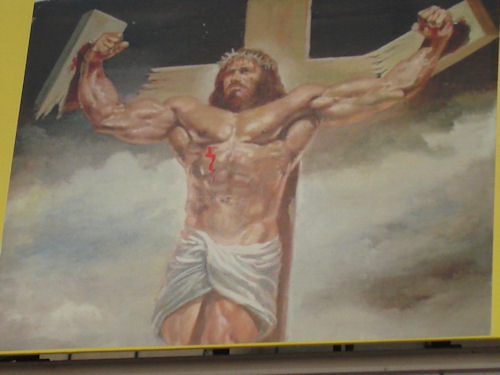
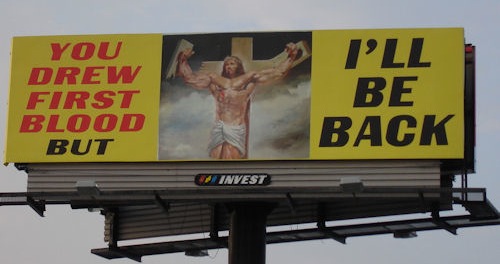
These images have been floating around on my desktop for a couple of months. It seems appropriate to post them now as an example of how Christians misinterpret the cross, in light of this week’s reading from I Corinthians. Here’s a billboard:

And a close-up:

Here’s Paul:

“For Jews demand signs and Greeks desire wisdom, but we proclaim Christ crucified, a stumbling block to Jews and foolishness to Gentiles, but to those who are the called, both Jews and Greeks, Christ the power of God and the wisdom of God. For God’s foolishness is wiser than human wisdom, and God’s weakness is stronger than human strength.
Consider your own call, brothers and sisters: not many of you were wise by human standards, not many were powerful, not many were of noble birth. But God chose what is foolish in the world to shame the wise; God chose what is weak in the world to shame the strong; God chose what is low and despised in the world, things that are not, to reduce to nothing things that are, so that no one might boast in the presence of God. He is the source of your life in Christ Jesus, who became for us wisdom from God, and righteousness and sanctification and redemption, in order that, as it is written, “Let the one who boasts, boast in the Lord.”

Nothing in that image of a God who is weak, is there?

Martin Luther King

I came across the astounding story that a Pentagon official declared during an MLK event at the Pentagon last week that Martin Luther King, Jr. would have supported the wars in Iraq and Afghanistan. MLK denounced the war in Viet Nam, in part because he was a pacifist but also because he thought it would detract resources and energy from the war on poverty. Here’s a link to a story that talks about the controversy. The full remarks suggest a more nuanced understanding than the early blogosphere outrage suggested.

Apparently, the official in question is a graduate of Morehouse College and was a classmate of one of King’s children. One might forgive him for trying to make a connection between King and the current conflicts. But I find it hard to stomach the notion that King would have “recognized that we live in a complicated world.” King knew that the 1960s were complicated as well. The final sentence of the speech does put it all in a larger perspective:

The irony of next Monday is that Mrs. King’s dream of a national holiday for her husband has become a reality; Dr. King’s dream of a world at peace with itself has not.

This is not the only way in which King’s legacy is being shaped to fit a contemporary narrative. The focus of the celebration tends to be on racial equality and cooperation. But as several people have pointed out today, King was assassinated while he was in Memphis helping organize a sanitation workers’ strike and he was also heavily involved in planning for the “Poor People’s Campaign. The historian Al Raboteau points out the central role of poverty in King’s thinking and efforts. (h/t Jim Naughton at Episcopal Cafe).

It is important to remember the fullness of his witness to the Gospel of Jesus Christ.

The collect for the commemoration of Martin Luther King, Jr., from Lesser Feasts and Fasts. He is remembered in our liturgical calendar on April 4, the day of his assassination.

Almighty God, by the hand of Moses your servant you led your people out of slavery, and made them free at last; Grant that your Church, following the example of your prophet Martin Luther King, may resist oppression in the name of your love, and may secure for all your children the blessed liberty of the Gospel of Jesus Christ; who lives and reigns with you and the Holy Spirit, one God, now and for ever. Amen.

Baptism of Blood

On Saturday, Diana Butler Bass posted an essay in response to the shootings in Tucson. She began by arguing that clergy needed to speak out on the events. Her question was “But who will speak for the soul?” It was a good question and challenged me as I was trying to rewrite my sermon in light of the day’s events.

But the last couple of paragraphs troubled me. Last Sunday was “The Baptism of our Lord” and the gospel reading was Matthew’s story of Jesus’ Baptism by John. As she sought to make a connection between the day’s events and the gospel, she contrasted two types of baptism, the baptism of water which is redemptive and life-giving and the baptism of blood. To illustrate the importance of the latter symbol in American religious history, she quoted Episcopal Bishop Stephen Elliott of Georgia, saying in 1862, “All nations which come into existence . . . must be born amid the storm of revolution and must win their way to a place in history through the baptism of blood.”

At the time, I prepared a blog post that was critical of this move. I thought better of it and deleted it before posting. I’ve continued to think about it, and I continue to be troubled by it. The baptism of (or by) blood has a long history in the Christian tradition, going back to the early church, where martyrdom was understood to be a baptism of blood. In Catholicism to this day, an unbaptized person, who makes a confession of faith in Jesus Christ, and is martyred, is saved by that confession and by the baptism of blood without water baptism.

Then I came across this enlightening post by Daniel W. Crofts on The New York Times. Croft wrote about the lead-up to the Civil War. His column is about a speech on January 12, 1861, by William Henry Seward, New York Senator, and soon to join the Lincoln administration. In that speech, he sought compromise in order to avoid what seemed like imminent war. While many were critical, abolitionist (and Quaker) John Greenleaf Whittier wrote:

If, without damage to the sacred cause
Of Freedom and the safeguard of its laws —
If, without yielding that for which alone
We prize the Union, thou canst save it now
From a baptism of blood, upon thy brow
A wreath whose flowers no earthly soil have known,
Woven of the beatitudes, shall rest,
And the peacemaker be forever blest!

What did Whittier mean by using this imagery?

The rhetoric of both North and South was filled with violent religious imagery, including “baptism of blood.” One need only think of The Battle Hymn of the Republic. It didn’t end with the Civil War. Such imagery returns with every war as we have seen in the last nine years. It’s not unique to America, either. I’m sure one can find similar language in the rhetoric of German pastors during World War I and World War II, or English pastors in the same wars, or ….

Bass is absolutely correct to see a preoccupation with blood in American religiosity. As I child, I sang “There’s power in the blood.” It may be especially prevalent in the South. Sometimes, it’s rather amusing like the fountain that used to be outside the mansion of a mega-church pastor in Spartanburg, SC. At night, the fountain’s water was bathed with red light, to remind passers-by of “the fountain filled with blood. But it’s not just the South. Think of Mel Gibson’s gory spectacle, The Passion of the Christ.


In spite of the excesses, it’s important to remember that the notion of “baptism of blood” can be, and often has been, life-giving and redemptive, especially for those Christians facing persecution. That it has been and is perverted is hardly surprising.

Reaching for the sacred when there is no holy ground

The memorial service in Tuscon was fascinating, moving and disturbing at the same time. Set in a gymnasium at the University of Arizona, it began as a combination pep rally and marketing effort for the University, as the University President tried to cast the institution as a locus of community, healing and hope. Those in attendance did what spectators at basketball games do. They applauded the team, whooped and hollered. As at all sporting events, the university provided t-shirts.

At first, the turn to scripture, Hebrew and Christian, was jarring, but as President Obama began speaking, he wove a tapestry of scripture, reflections on the lives of the dead and wounded that helped all of us think in new ways about the tragedy and about the future of our nation. His prepared remarks are available here. His words made the place, and the service itself, sacred.

Better scholars than I will be able to place this event in the context of the continuing evolution of civil religion in America. There’s been a great deal of discussion over the last few days about the decline of political rhetoric. All of that may be true. But it seems to me that President Obama was able to give a speech that placed the events in the historical context of the United States and to offer a trajectory of hope.


My Son, My Beloved–A Sermon for the Baptism of Our Lord, January 9, 2011


The horrific shootings in Arizona of Congresswoman Giffords, Judge Roll and the others shocked and dismayed me, as I’m sure it did you. How did we get to this point? The anger and rhetoric have finally boiled over in this country, so that in addition to having economic and other problems that are seemingly intractable, we have a culture, a media and political environment that have devolved into violence.

I don’t know about you, but I am almost in despair. When I look out at our nation, our culture, and our world, I see nothing hopeful. I only see increasing conflict over fewer resources and a national, no, a worldwide leadership, fiddling while the Titanic sinks. For a preacher at a time like this, the question of what to say, or rather, of what the good news is, becomes both urgent and perplexing.

We are at the second Sunday of New Year’s. We should still be enjoying ourselves, looking forward to the NFL playoffs, ready to root for a Packer victory. The New Year is supposed to usher in a time of new hope and new possibility. We make New Year’s resolutions that we hope will help us change behaviors. We promise to exercise and eat right, to learn something new, or to treat those we love in new ways. Of course, usually, within a few weeks or months, if we’re lucky, often within a few hours or days, we’ve broken those resolutions and are back in our old habits.

Perhaps instead of all of that, it’s time for a season of national soul-searching; a time to reflect on what binds us together as Americans and as human beings, instead of focusing as we tend to, on what divides us. Perhaps as Christians, it’s time for us to take stock of ourselves as well, and ponder how we might foster understanding and good will, being instruments of God’s peace.

In the lectionary, the cycle of readings that we follow from week to week on Sunday mornings, today is always “the baptism of our Lord,” the Sunday when we hear the story of Jesus’ baptism by John. It’s one of the more abrupt transitions in our liturgical cycle, because after twelve days of Christmas, two weeks during which we sing Christmas carols, reflect on the incarnation, and focus on Jesus’ birth, we suddenly jump ahead thirty years, to his adulthood. The intervening years are passed over in silence by Matthew and Luke, the only two gospels to say anything about Jesus’ birth. At least Luke tells one story about Jesus’ childhood, his visit to the temple with his parents when he was twelve. Matthew omits even that.

Jesus’ baptism by John is one of the key events in the gospels’ narrative of Jesus’ life. In the synoptic gospels of Matthew, Mark, and Luke, it stands as the beginning moment of Jesus’ public life. Matthew takes it a step further, though, because this is the first moment in his gospel that we see Jesus acting. So for him to come to John, seeking baptism, is saying something important for Matthew.

We can be certain that Jesus’ baptism by John constituted something of a problem for early Christianity. We can be certain that it is one of those things that was common knowledge, and also that it was something of an embarrassment. In fact, although mentioned by all four gospels, it receives little discussion elsewhere in the New Testament. Peter’s reference to it in today’s reading from Acts is one of the very few times it is mentioned other than in the gospels.

More than an embarrassment, the story of Jesus’ baptism was an opportunity for each gospel writer to reflect on the meaning of the event. It’s a good question—why does Jesus need to be baptized? As they sought to answer it, they filled out the story with theological content. Matthew does this in several ways. For one thing, he tells the story in such a way to lead his readers back to the Hebrew Bible, to the lesson from Isaiah that we heard today. The voice from heaven that says, “This is my son, the beloved, in whom I am well pleased, alludes to the words that open Isaiah 42 “Here is my servant, whom I uphold, my chosen, in whom my soul delights. I have put my spirit upon him…”

There is another important theme in Matthew’s version of the baptism. In the conversation between Jesus and John, after John asks the question we ask, “why do you come to me to be baptized?” Jesus responds, “Let it be so now; for it is proper for us in this way to fulfill all righteousness.” So Matthew connects Jesus’ baptism to righteousness. It’s one of those biblical words we don’t use very often any more, and we don’t really know what it means. We probably have some idea that it has to do with God and being good, but more than that is a question.

Righteousness is an important and rich concept in the biblical traditions, in both the Hebrew Bible and the New Testament. The Greek word includes connotations of uprightness, correctness, justice, innocence, and redemption. Matthew has used the word earlier in the gospel. When describing Joseph’s reaction to learning that Mary was pregnant Matthew writes, “but being a righteous man, and unwilling to expose her to public disgrace, Joseph planned to dismiss her quietly. Here, it would seem that Matthew wants to underscore Joseph’s behavior, that he is a good Jew who knows what Torah, the Law demands in such cases.

In the gospel we read next Sunday, the term righteousness appears again. In the beatitudes, Jesus says, “Blessed are those who hunger and thirst after righteousness, for they will be filled. Righteousness is not simply a matter of internal disposition, being in right relationship with God; it is also about bringing one’s actions in accordance with those internal dispositions. Thus to be righteous is to behave as one thinks or believes.

Jesus was baptized by John to fulfill all righteousness. It wasn’t a necessary act, in that he needed to be baptized—to be purified and cleansed him of his sins. But it was an act that put him in line with who he was and who he was meant to be. And it was an act that the gospels tell us, confirmed who he was. The voice from heaven said, “This is my son, the beloved, with whom I am well pleased.”

I wonder about the two characters in this story. John the Baptizer, who didn’t understand what he was doing, but knew that what he was doing, baptizing Jesus, didn’t make any sense. Did he also know that soon after baptizing Jesus, he would be arrested and ultimately killed for speaking out against the power of Herod? I wonder, too, about Jesus. In Mark’s version of the story, it seems that the voice from heaven speaks only to him, telling him that he is the son of God, the beloved. In Matthew, the voice says different words, speaks to the audience, but did Jesus know, could he have known what would happen?

For us, baptism is little more than a cute ritual. I doubt many of us believe that without baptism, we are condemned to hell, or the limbo of the un-baptized. We don’t think it matters much; we certainly don’t believe it is a matter of eternal life and death. I’m not going to try to disabuse you of that notion if you hold it, but I do think it is a matter of great import.

In Jesus’ baptism, he and others learned something about him. There was a miraculous voice that identified him. It told him, and those around him, who he was. It’s a powerful statement, isn’t it? It’s a statement we hear when we are baptized, but do we ever really believe it?

When Presiding Bishop Katharine Jefforts Schori came to the diocese last October, she met with clergy. During her time with us, she asked us to reflect on that statement that came from heaven. She asked us to repeat it to ourselves, to reflect on what it means for us, “You are my child, my beloved.”

Those words that came from heaven to Jesus at his baptism come to us at ours. A priest speaks them, not some heavenly voice, but they are true, no matter their origin. In baptism, we become God’s children; we are God’s beloved.

They are words with which many of us might struggle at times. We hear, from so many directions, a very different message. Sometimes, it comes from parents or loved ones. Sometimes the message was drilled into us decades ago, by parents long dead. Sometimes, the message is immediate; the wounds it makes still fresh, as in the case of the bullying that often goes on in our schools.

To know that we are God’s beloved in these circumstances, when all around us says otherwise is hard enough. But it’s not enough. As Jesus did in so many ways, as Jesus said repeatedly, we also need to share that message with others, to love them as God loves us. And yes, to love even our enemy, and our neighbor. I don’t know what this year has in store for our nation, our community, or for Grace Church. But it is my hope and prayer that Grace can be a beacon of hope and an agent of reconciliation in this dark and troubled time.

 

Roman Catholic Archdiocese of Milwaukee declares bankruptcy

Numerous media outlets are reporting this story, with details to follow.

According to Archbishop Listecki, the bankruptcy reorganization is intended to help the archiocese “to compensate victims and survivors while also allowing the church to continue its mission.”

In the past decade, several Roman Catholic dioceses have declared bankruptcy because of the financial fallout from the clergy sex abuse scandal, and at least two other archdioceses–Portland, Oregon and San Diego. The Archdiocese of Boston apparently avoided bankruptcy only by a massive sell-off of assets.

It’s a sad day for the Roman Catholic Church, the latest development in the long history of the scandal; but it’s a sad day for Christianity in general, and can’t make the work of reaching out with the love of Christ to those who don’t know him.