“What’s a church’s economic worth?”

Thanks to the Call and Response blog, an article discussing a study that has attempted to assess the economic worth of 12 congregations in the Philadelphia area. Total estimated value: more than $50 million. Some of this is conjecture of course, like the $375 “for teaching social values” to a child. But some of it is real, like the economic impact of salaries, outreach efforts, and building repairs. The range in values for different churches is quite wide, from $1.4 million for a Presbyterian congregation (with an annual budget of $265,000) to $22.4 million for a Roman Catholic parish that has 7,000 congregants, a school, and a community center.

One of the study’s directors said:

The study shows the contribution of religious congregations “to be 20 to 30 times bigger than we knew,” said director Jaeger. It “will give congregations dozens of new ways to articulate their value, broaden their constituencies, and survive and grow.”

I wonder where Grace would come out? I wonder, too, whether attempts like this to quantify economic impact of a congregation do help “give congregations ways to articulate their value, broaden their constituencies, and survive and grow.”
 

Incomprehensible Theology

Michael Jinkins challenges the “dumbing-down of theology, taking off from the following research:

Last fall “The Economist” reported on new research by Daniel Oppenheimer, a Princeton University psychologist, which suggests that if you want people to learn something “make the text conveying the information harder to read.” “The Economist” comments that one of the perennial paradoxes of education “is that presenting information in a way that looks easy to learn often has the opposite effect. Numerous studies have demonstrated that when people are forced to think hard about what they are shown they remember it better.”

Money quote:

This is the great adventure of theological education. I’m talking about the kind of theological education we do in our congregations, in Sunday schools, and in our homes, and not only the kind we do in graduate theological schools. It invites us to comprehend that which cannot be comprehended, to interrogate that which provokes ever new questions, to engage with our whole hearts and minds the God who created us out of nothing, though of course we have no real conception of what it means to say “out of nothing.” There’s no way to appreciate the fact that God numbers every hair on our heads without appreciating the endless expanse of a universe that is a Tinker Toy to God.

It kind of reminds of one of the greatest compliments paid me by a student (though I doubt she meant it that way): “Dr. Grieser, your class makes my head hurt. I have to think too hard.” And that was at the end of an hour of Intro to Biblical Literature.

God chose what is weak in the world

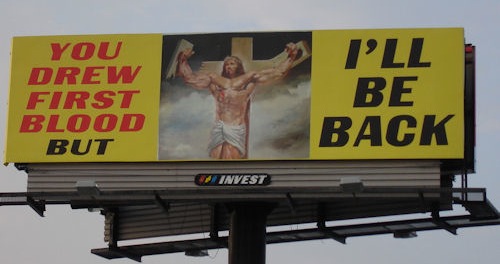
These images have been floating around on my desktop for a couple of months. It seems appropriate to post them now as an example of how Christians misinterpret the cross, in light of this week’s reading from I Corinthians. Here’s a billboard:

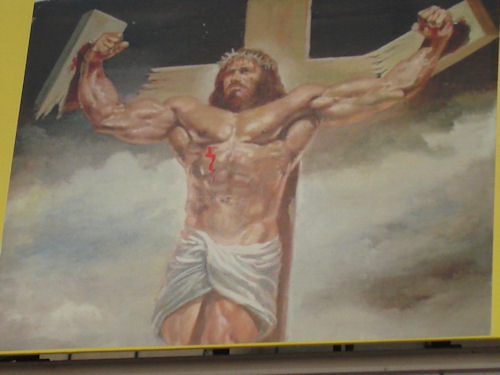
And a close-up:

Here’s Paul:

“For Jews demand signs and Greeks desire wisdom, but we proclaim Christ crucified, a stumbling block to Jews and foolishness to Gentiles, but to those who are the called, both Jews and Greeks, Christ the power of God and the wisdom of God. For God’s foolishness is wiser than human wisdom, and God’s weakness is stronger than human strength.
Consider your own call, brothers and sisters: not many of you were wise by human standards, not many were powerful, not many were of noble birth. But God chose what is foolish in the world to shame the wise; God chose what is weak in the world to shame the strong; God chose what is low and despised in the world, things that are not, to reduce to nothing things that are, so that no one might boast in the presence of God. He is the source of your life in Christ Jesus, who became for us wisdom from God, and righteousness and sanctification and redemption, in order that, as it is written, “Let the one who boasts, boast in the Lord.”

Nothing in that image of a God who is weak, is there?

The Church of Apple

I’ve been a devotee for a long time. You can blame it on Sewanee. When we arrived there in 1994, just after Windows came out, Sewanee was an all Mac campus. I never recovered. I never got used to Windows and found keyboard commands and functionality on Macs more user-friendly, intuitive, and quicker.

But that’s as far as my brainwashing went. Others are more deeply inducted into the cult. There’s Andy Crouch, who argues Steve Jobs has offered hope in an increasingly despairing world. The Ipod appeared in October 2001, just after 9-11 and the Ipad was introduced in January of 2010, in the depths of the recession and in a month when unemployment hit 10%.

On Jobs, Crouch writes:

But the genius of Steve Jobs has been to persuade us, at least for a little while, that cold comfort is enough. The world—at least the part of the world in our laptop bags and our pockets, the devices that display our unique lives to others and reflect them to ourselves—will get better. This is the sense in which the tired old cliché of “the Apple faithful” and the “cult of the Mac” is true. It is a religion of hope in a hopeless world, hope that your ordinary and mortal life can be elegant and meaningful, even if it will soon be dated, dusty, and discarded like a 2001 iPod.

But Andrew Sullivan goes even further:

This is certainly why my own conversion to Apple, and my deep loyalty to the company and its products, somehow felt comforting in the last decade. Their style elevates me, their power and reliability I have come to take for granted. Their stores have the innovation and beauty that a renewed Christianity would muster in its churches, if it hadn’t collapsed in a welter of dogma and politics.

While I appreciate the convenience of the Apple Store and am deeply indepted to their knowledgeable staff, entering one gives me the willies. It’s especially scary at the tables set up for little children where you can see kids barely able to walk punching buttons, mesmerized by video screens. There may be innovation there, but I see no beauty, and nothing of the sacred.

It’s January 10, the commemoration of William Laud

I said my piece last year on this date, so instead of rehashing that, I will point readers to Affirming Laudianism.

Its primary aims are:

  • The wearing of copes at the Holy Communion;
  • The application of Laudian frontals to Altars;
  • The use of silver candle sticks and incense at divine worship, in accordance with the principles of The Parson’s Handbook;
  • Bowing at the Holy name and during the Gloria Patri

Laudable, I’m sure.

Lord, make us instruments of our peace

Lord, make us instruments of your peace.
Where there is hatred, let us sow love.
Where there is injury, pardon.
Where there is doubt, faith.
Where there is despair, hope.
Where there is darkness, light.
Where there is sadness, joy.
O Divine Master,
grant that we may not so much seek to be consoled, as to console;
to be understood, as to understand;
to be loved, as to love.
For it is in giving that we receive.
It is in pardoning that we are pardoned,
and it is in dying that we are born to Eternal Life.
–a prayer attributed to St. Francis (though unattested before the twentieth century)

Charles Simic on “Winter’s Philosophers”

Beautifully-written reflections on thinking in winter.

There is something profound about the weather in January in the north. I went back through sermons I wrote for the season after Epiphany, and every year, I had something to say about it. After thirty-five years in the north, the move south was a cultural shift, not least because in the south, one doesn’t have to get ready for winter. In South Carolina, one rarely needs to “get ready” to go outside in January, other than throwing on the closest jacket. I’ve always linked that to other cultural patterns, including patterns of thought. If Simic can’t name a cold-weather philosopher, how about one from temperate climes?

It only took me one year living in Germany, though, to suspect that one possible explanation for Kierkegaard was that he lived even further north, and in grayer skies in Denmark.

Simic concludes:

“No philosopher has ever influenced the attitudes of even the street he lived on,” Voltaire was reputed to have said. That’s not what I believe. With deep winter upon us and the weather growing colder, even the wood smoke out of the neighbors’ chimneys could be described as philosophizing. I can see it move its lips as it rises, telling the indifferent sky about our loneliness, the torment of our minds and passions which we keep secret from each other, and the wonder and pain of our mortality and of our eventual vanishing from this earth. It’s a kind of deep, cathedral-like quiet that precedes a snowfall. One looks with amazement at the bare trees, the gray daylight making its slow retreat across the bare fields, and inevitably recalls that Emily Dickinson poem in which she speaks of just such a winter afternoon—windless and cold, when an otherworldly light falls and shadows hold their breath—and of the hurt that it gives us for which we can find no scar, only a closer peek inside ourselves where the meanings and all the unanswered questions are.


Roman Catholic Archdiocese of Milwaukee declares bankruptcy

Numerous media outlets are reporting this story, with details to follow.

According to Archbishop Listecki, the bankruptcy reorganization is intended to help the archiocese “to compensate victims and survivors while also allowing the church to continue its mission.”

In the past decade, several Roman Catholic dioceses have declared bankruptcy because of the financial fallout from the clergy sex abuse scandal, and at least two other archdioceses–Portland, Oregon and San Diego. The Archdiocese of Boston apparently avoided bankruptcy only by a massive sell-off of assets.

It’s a sad day for the Roman Catholic Church, the latest development in the long history of the scandal; but it’s a sad day for Christianity in general, and can’t make the work of reaching out with the love of Christ to those who don’t know him.

2010 in review

The stats helper monkeys at WordPress.com mulled over how this blog did in 2010, and here’s a high level summary of its overall blog health:

Healthy blog!

The Blog-Health-o-Meter™ reads Fresher than ever.

Crunchy numbers

Featured image

The average container ship can carry about 4,500 containers. This blog was viewed about 14,000 times in 2010. If each view were a shipping container, your blog would have filled about 3 fully loaded ships.

In 2010, there were 236 new posts, growing the total archive of this blog to 422 posts. There were 34 pictures uploaded, taking up a total of 3mb. That’s about 3 pictures per month.

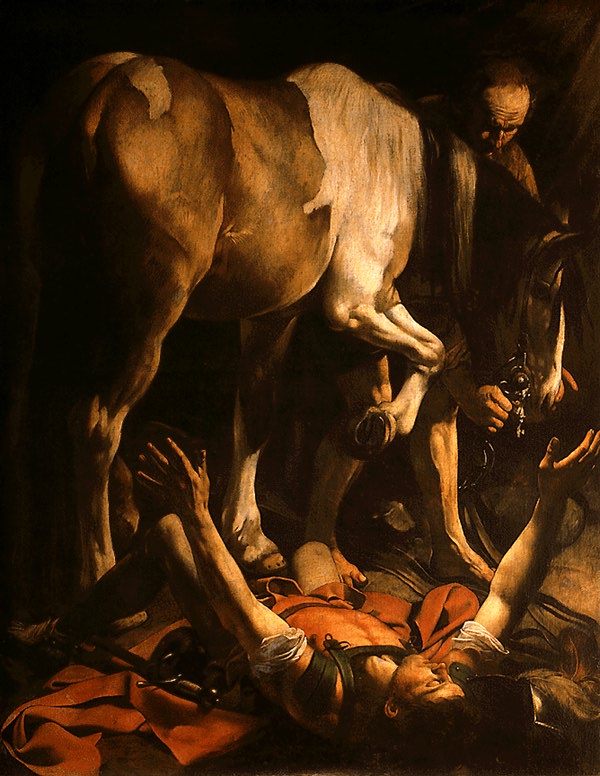
The busiest day of the year was April 19th with 113 views. The most popular post that day was The Conversion of St. Paul (or another excuse for posting a Caravaggio image).

Where did they come from?

The top referring sites in 2010 were graceec.org, facebook.com, blogger.com, en.wordpress.com, and thedailypage.com.

Some visitors came searching, mostly for caravaggio, bible verse tattoos, bible tattoo verses, conversion of st. paul, and conversion of st paul.

Attractions in 2010

These are the posts and pages that got the most views in 2010.

1

The Conversion of St. Paul (or another excuse for posting a Caravaggio image) January 2010
1 comment

2

Caravaggio’s “Madonna of the Loreto” January 2010

3

The Prodigal Son–A Sermon for the 4th Sunday in Lent March 2010

4

Martha, Mary, and the Better Part: A Sermon for the 8th Sunday after Pentecost (Proper 11, Year C) July 2010

5

Sermon for the Third Sunday in Lent, March 7, 2010 March 2010

New perspectives on medieval warfare

A recent archaeological find has upended traditional views of medieval warfare (and medieval culture, too). Discovery of a mass grave in Towton, England, that dates from the Wars of the Roses has allowed scholars to learn a great deal about warfare and even living conditions. Contemporary accounts estimate 28,000 men were killed in the battle that occurred in December 1460 and a modern scholar estimates that as many as 75,000 men fought that day, 10% of the country’s fighting-age population.

Among the discoveries: the first use of lead shot in England, and perhaps a fragment of the first handgun. More interestingly was the extent of injuries to the dead. In addition to evidence of wounds from earlier battles, many of those killed were struck multiple times.

Most interesting to me was this:

Yet as a group the Towton men are a reminder that images of the medieval male as a homunculus with rotten teeth are well wide of the mark. The average medieval man stood 1.71 metres tall—just four centimetres shorter than a modern Englishman. “It is only in the Victorian era that people started to get very stunted,” says Mr Knüsel. Their health was generally good. Dietary isotopes from their knee-bones show that they ate pretty healthily. Sugar was not widely available at that time, so their teeth were strong, too.

That leads to a reassessment of the late-medieval standard of living, at least in England. BTW, 1.71 m is roughly 5’7″. And the savagery puts paid to the notion of gallantry and chivalry in medieval warfare.

The full story is here.