Reflections on Palm Sunday

Holy Week is going to be interesting. I probably didn’t articulate it to myself or to anyone else, but my approach coming into Grace was to experience worship and then to make changes to reflect my own theological and liturgical concerns. My predecessor gave me a very clear road-map and when talking to worship leaders and altar guild, it seemed that they were expecting something of the same of me.

Instead, I wanted to experience it. Part of that has to do with the people, their gifts, assumptions, and needs, but a great deal of it has to do with the space. One of the questions that I ask repeatedly is “How do we best worship in this space?”

But I’m also interested in shaping the liturgy in ways that I find meaningful. There were already some last-minute changes. Someone pointed out to me the rather obvious starting point of the Guild Hall for our Palm Sunday procession, rather than the undercroft. It made sense, both for those of our parishioners who have trouble climbing stairs, and because it was a beautiful day.

There’s the other challenge, the one created by the hybrid nature of Palm Sunday/Passion Sunday. How do you move effectively from the joy and celebration of Blessing of Palms and Procession to the Passion?

What I want to know is how to use the church’s space to help make that transition.

Stay tuned.

The Great Litany, 2010

I posted on the Great Litany last year and wondered whether there was anything interesting and new to say about it. Whether it’s new or interesting, I don’t know, but I have been reflecting throughout the day on my experience of it. Part of it is doing liturgy in a new and very different context. Madison’s Capitol Square is a radically different place than Piney Mountain Road in Greenville, SC. I was very conscious as we were chanting it today how a newcomer or visitor might have reacted. It’s not user-friendly, it’s very much niche marketing (I suppose there are those to whom the traditional language, piety, and chanting might appeal, but that can’t be a large demographic).

In the nearly 20 years I’ve been attending Episcopal churches, I can’t recall a single one where the first Sunday of Lent didn’t include the Great Litany and I was preparing for the service today, I didn’t give its inclusion in both services a second thought. Still, I wonder about its utility and meaning in the twenty-first century.

At the same time, I’m quite aware that our worship is counter-cultural on almost every level and in a way it is appealing for that very reason. We don’t construct our worship to get an audience; we worship the way we do because it is a bond with Christians throughout history. The sursum corda, “Lift up your hearts,” goes back to the very earliest extant Christian worship. In the same way, the Great Litany is part of the unique Anglican tradition of liturgy, with its origins in Thomas Cranmer’s work in the 1540s. For that reason alone, it may be worth dusting off every year.

Moreover, it may be that the catalogue of petitions is appropriate from time to time. We seem to pray for everything and everyone, and that in itself is a reminder of our place in God’s universe, and our dependence on God. The repetition of the petitions and the congregation’s response, “Good Lord, deliver us” and “We beseech thee to hear us Oh, Lord” help us to understand our relationship to God more profoundly than many other liturgical actions.

Sermon post-mortem

I’m never quite sure whether I pull off what I’m working on. Yesterday, given the constraints of other commitments, I wasn’t happy with the final shape of the sermon. But some of what I was groping toward must have come through. A parishioner called me today and said lovely things about my sermon yesterday.

That’s not why I’m writing. Instead, I’m writing about two other things. First, a series of conversations at coffee hour about our decrepit dishwasher and how we should proceed. We can get it fixed. The problem is, it doesn’t do what we need it to do. It constrains our ministry because our kitchen is not adequate for the purposes to which we put it, or could put it, with the proper equipment. Our food pantry can’t re-package bulk food for example.

Then, I saw a post on the Episcopal Cafe that led me to this. There’s much here with which I disagree but it seems to me that the right questions are being asked. I especially like the parable of the life-saving station. I’d heard it before but it had slipped my mind. In some ways, it captures the history of Christianity in America. The full parable is here.

I was involved for a couple of years in a parish that was a fairly recent church plant. It was successful at the level of bringing people in, but I don’t think it was particularly at shaping and forming disciples.

I do think on one level that it is all about liturgy or worship. The old Anglican/Episcopal mantra was lex orandi, lex credendi, praying shapes believing. We have a gift to offer the larger church and the world–a gift of an experience of God rooted in beautiful music, beautiful language, and at Grace, a beautiful space. We need to find ways of sharing that.

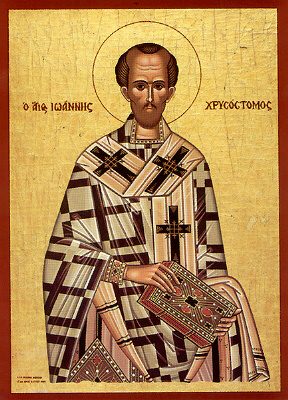
St John Chrysostom, January 27

St. John Chrysostom, whom we remember today, was one of the great theologians and bishops, and perhaps the greatest preacher in the early centuries of Greek Christianity. Born in Antioch in 349, he spent some years as a monk and apparently practiced extreme ascetism. Ordained a deacon in 381 and a presbyter in 386, his preaching brought widespread fame. Because of his renown, he was made Archbishop of Constantinople in 398. In Constantinople he repeatedly aroused the wrath of the imperial court and was banished twice and died in exile in 407.

He is most famous for his sermons, of which many survive. He attacked the ostentatious show of wealth and repeatedly urged his listeners to care for the poor. Here is an excerpt from a homily on Matthew 14:

For what is the profit, when His table indeed is full of golden cups, but He perishes with hunger? First fill Him, being an hungered, and then abundantly deck out His table also. Dost thou make Him a cup of gold, while thou givest Him not a cup of cold water? And what is the profit? Dost thou furnish His table with cloths bespangled with gold, while to Himself thou affordest not even the necessary covering? And what good comes of it? For tell me, should you see one at a loss for necessary food, and omit appeasing his hunger, while you first overlaid his table with silver; would he indeed thank thee, and not rather be indignant? What, again, if seeing one wrapped in rags, and stiff with cold, thou shouldest neglect giving him a garment, and build golden columns, saying, “thou wert doing it to his honor,” would he not say that thou wert mocking, and account it an insult, and that the most extreme?

Let this then be thy thought with regard to Christ also, when He is going about a wanderer, and a stranger, needing a roof to cover Him; and thou, neglecting to receive Him, deckest out a pavement, and walls, and capitals of columns, and hangest up silver chains by means of lamps. Homilies on the Gospel of Matthew, 50, (from http://www.ccel.org)

He is also famous for a series of sermons directed against Jews, the full texts of which can be found here.

In addition to his sermons and many other writings, The Liturgy of St. John Chrysostom continues to be used by Orthodox Churches. An English translation is found here.

The “Prayer of St. Chrysostom,” which appears in The Book of Common Prayer, is a late-medieval addition to the Liturgy of St. John Chrysostom and was not written by him.

Collect for the Third Sunday of Advent

I love this collect for its powerful imagery and especially for its opening petition”Stir up your power, O Lord, and with great might come among us”

Stir up your power, O Lord, and with great might come among us; and, because we are sorely hindered by our sins, let your bountiful grace and mercy speedily help and deliver us; through Jesus Christ our Lord, to whom, with you and the Holy Spirit, be honor and glory, now and for ever. Amen.

Popular books discussing Christmas and Advent often mention that the Third Sunday of Advent was known in England as “Stirrup” Sunday because of the two opening words of the prayer. Whether that is true, I have no idea. In its current form, it is largely the work of Cranmer’s translation, who placed it as the collect for the Fourth Sunday of Advent. In fact, the Sarum Missal had four prayers on the Sundays preceding Christmas that began with the Latin “Excita”–“Stir up.”

The use of “Stir up” puts me in mind of the opening verses of Genesis:

In the beginning when God created* the heavens and the earth, 2the earth was a formless void and darkness covered the face of the deep, while a wind from God* swept over the face of the waters.

But “stirring up” has many other parallels in scripture. Among the most interesting is in John’s story of Jesus healing the lame man at the Pool of Siloam; he was waiting in vain for some one to help him into the pool when the water was stirred up (John 5).

As an Advent collect, the emphasis on God coming among us in power, is obvious. But like the collect for the preceding Sunday, this one, too, asks for God’s grace to deliver us from our sins. God’s power, with the potential to destroy, can also save.

Collect for the Second Sunday in Advent

Merciful God, who sent your messengers the prophets to preach repentance and prepare the way for our salvation: Give us grace to heed their warnings and forsake our sins, that we may greet with joy the coming of Jesus Christ our Redeemer; who lives and reigns with you and the Holy Spirit, one God, now and for ever. Amen.

According to Hatchett, this collect is based on that for the Third Sunday in Advent in the Book of Common Worship of the Church of South India, although it expresses ideas similar to those for the Third Sunday in Advent from the 1662 Book of Common Prayer.

What I like about it is that it begins by invoking “merciful God” and it puts a positive spin the prophets preaching repentance. But all of the action is in God; first, with God’s mercy and God sending prophets. But it continues in the same vein, with a petition for God’s grace that we might hear the message of the prophets, amend our lives, and greet Christ’s coming with joy.

Collect for the first Sunday of Advent

Almighty God, give us grace that we may cast away the works of darkness, and put upon us the armor of light, now in the time of this mortal life in which thy Son Jesus Christ came to visit us in great humility; that in the last day, when he shall come again in his glorious majesty to judge both the quick and the dead, we may rise to the life immortal; through him who lives and reigns with thee and the Holy Spirit, one God, now and for ever. Amen.

The prayer book collects are a wonderful spur to reflection. Having said them over the years, they strike me anew each time with power. That is especially true of the collects for the Sundays in Advent. I mentioned in my sermon the contrast between the candles we light on the Advent Wreath and the growing darkness of the season. This collect draws on that imagery, too. It’s been running through my head all week.

According to Hatchett, Commentary on the American Prayer Book, this collect was composed for the 1549 Book of Common Prayer. The juxtaposition of dark and light, as well as the emphasis on the contrast between now “in the time of this mortal life” and “the last day” remind us of the poles of our existence. They remind us, too, of the sharply different times in which we live, this present time, and God’s time, or eternity.

The beginning of Advent marks the beginning of the liturgical year, which takes us each year from the expectation of the birth of Jesus Christ, through his death and resurrection, to the birth of the Church at Pentecost. That annual remembering of the story with its incessant yearning for us to return to those events, to participate in them is challenged by another powerful force in the Christian message–the urge to look forward to the second coming. Those are two very different attitudes towards time, and occasionally they leave Christians feeling schizophrenic. Where should our real focus be? On the past, or the future?

Perhaps our focus should be somewhere else entirely. God exists outside of time and created time in the process of creating all things.

Lancelot Andrewes (1555-1626)

Lancelot Andrewes ended his career as Bishop of Winchester, after holding two other sees earlier. A famous preacher and biblical scholar, he was a member of the committee that produced the translation that came to be known as the King James Version, and thus his language came to have an immeasurable impact on the English language, on Anglo-Saxon culture and on spirituality. He was a scholar of Greek, Hebrew and Latin, and so proficient in all three that the private devotions he wrote for himself were written in those Biblical languages, not in his mother tongue. The Private Devotions were published after his death, and translated into English. Here is one of his prayers:

PRAISE

Up with our hearts;
we lift them to the Lord.
O how very meet, and right, and fitting,
and due,
in all, and for all,
at all times, places, manners,
in every season, every spot,
everywhere, always, altogether,
to remember Thee, to worship Thee,
to confess to Thee, to praise Thee,
to bless Thee, to hymn Thee,
to give thanks to Thee,
Maker, nourisher, guardian, governor,
preserver, worker, perfecter of all,
Lord and Father,
King and God,
fountain of life and immortality,
treasure of everlasting goods.
Whom the heavens hymn,
and the heaven of heavens,
the Angels and all the heavenly powers,
one to other crying continually,—
50and we the while, weak and unworthy,
under their feet,—
Holy, Holy, Holy
Lord the God of Hosts;
full is the whole heaven,
and the whole earth,
of the majesty of Thy glory.
Blessed be the glory of the Lord
out of His place,
For His Godhead, His mysteriousness,
His height, His sovereignty,
His almightiness,
His eternity, His providence.
The Lord is my strength, my stony rock,
and my defence,
my deliverer, my succour, my buckler,
the horn also of my salvation
and my refuge.

(from http://www.ccel.org)

Notes on the lectionary

Early in the summer, our lessons from the Hebrew Bible focused on the early history of the Israelite monarchy. We heard of the selection of Saul as King, then of his fall and replacement by David. We also heard snippets of the story of Solomon, his ascent to the throne and the building of the temple.

In recent weeks, we had the only reading from the Song of Solomon that appears in the three-year lectionary cycle. And now we have several selections from the book of Proverbs. Both of these books were traditionally attributed to Solomon, because of his reputation as the wisest of kings. Contemporary research has tended to discount his authorship, on linguistic and historical grounds. Proverbs belongs to Wisdom literature, which appears throughout the Ancient Near East. In fact, a large section of Proverbs (22:17-24:22) is very closely related to the Egyptian Instruction of Amenenope. Wisdom literature is characterized by its approach to the world. It seeks to provide the reader with a way of approaching life. Most striking is the almost complete absence of any reference to sacred traditions and history–the Exodus, covenant, etc.

Our Epistle readings come from the Letter of James. We will continue hearing throughout the month of September. Although it probably achieved its final form late in the first century, its core may indeed derive from James, who was a leader of the church in Jerusalem in the first decades after Jesus’ death and resurrection. Its emphasis is that of Jewish Christianity, a high value on ethical action and much moral advice. Perhaps the most notorious comment on the letter in the History of Christianity was Martin Luther’s judgment that it is a “straw gospel.”

Throwing food to the dogs–Proper 18B

Today we are welcoming into the community of Grace Church Alexander Wesley Taylor who is being baptized. Traditionally, baptism was a private, a family event, but it has become in recent decades a celebration for the whole congregation to enjoy, and to participate in. And in fact we, all are all more than observers here. We all have a role to play. During the baptism itself, we will all reaffirm our baptismal vows and equally important, we will all make a promise to do all that we can to participate in Alexander’s growth in the Christian faith.

These vows we make today may seem somewhat strange, even inappropriate if you have never participated in an Episcopal baptismal service. But they are important. They remind us of what we are about as individual Christians, as a parish, and as a Church. If taken seriously, and what vow should be treated lightly, these vows we make each time we witness a baptism, serve as a reminder of what we should be about as Christians. In short, they are our job description.

  • Will you continue in the apostles’ teaching and fellowship, in the breaking of bread and in the prayers?
  • Will you persevere in resisting evil, and whenever you fall into sin, repent and return to the Lord?
  • Will you proclaim by word and example the Good News of God in Christ?
  • Will you seek and serve Christ in all persons, loving your neighbor as yourself?
  • Will you strive for justice and peace among all people, and respect the dignity of every human being?

That’s what you will agree to do in a few minutes, that’s what you’ve agreed to do, every time you have attended a baptismal service in the thirty odd years since this Book of Common Prayer has been in use. Perhaps some of you, thinking this is not what you expected when you came to church this morning, will sneak out the back. Perhaps some of you, will try to weasel out of it by not responding when I ask these questions. Fortunately, I’m new enough that I might not recognize who is walking out, in fact I would rather you left, than have you stay here and agree to things you have no intention of doing.

We have all, in our own ways, and to our own abilities, agreed to follow Jesus Christ. We are all, in our different ways, and to the limits of our own abilities, Jesus’ disciples. It’s not that some of us have what it takes and others don’t. Rather when we confess our faith in Jesus Christ, we are making a commitment to follow him, to try to see the world with his eyes, to do what he would have us do, to love our neighbor as ourself, to seek justice, and respect the dignity of every human being.

Part of our struggle with how to follow Jesus comes from the sense we have that the demands Jesus makes of us are far beyond our ability to achieve. Jesus was God after all, and his disciples were chosen by him, so when Jesus made some high moral or ethical demand of himself or his followers, it was easy for them. It’s not for us. But such a view is a far cry from the Jesus and the disciples depicted in the gospels. Paying attention to the text reveals a rather different dynamic—a Jesus who was human, just like us in every respect, and disciples who struggled, just like we do. There’s no better example of this than in today’s gospel.

One of the things I most like about the Gospel of Mark is the mystery in it. While Mark’s gospel is enigmatic throughout, it may be that there is no part of it that is as deliciously ambiguous as the story we have in front of us today. Let’s begin with the geographical setting. None of us had a map of Palestine in front of us while we were listening to Deacon Carol in the gospel, so we probably assumed that if you wanted to go from Tyre to the Decalopis, the town of Sidon was on the way. Far from it. Sidon is twenty miles north of Tyre; and the decapolis, the ten cities were to the southwest of Tyre—perhaps fifty miles. Given that Jesus and his disciples were walking, to go from Tyre to the Decapolis via Sidon is, oh I don’t know something like driving from Madison to New York City via Denver.

Then there’s the story of the encounter between Jesus and the Syro-Phoenician woman. What I love about this is the interchange between the two. Jesus seems to be trying to conceal his identity; in fact, he doesn’t want to do ministry in this place, but this woman comes to him asking for his help. She is a Gentile, a Syro-phoenician, whose daughter is possessed by a demon. She behaves as she should, bowing down before him submissively. Jesus’ rejects herm comparing her to a dog, an unclean animal, by the way. His statement, “Let the children be fed first, for it is not fair to take the children’s food and throw it to the dogs” implies that he shouldn’t be bothered by such requests, that her needs, and those of her daughters, were no concern of hers.

But the surprising thing is that she doesn’t settle for this response. She turns his “dis” of her, back onto him. “But even the dogs under the table eat the children’s crumbs.” With that, she conquers Jesus in a little contest of wordplay.

This brief interchange sounds remarkably offensive. In a nutshell, Jesus responds to someone who has come to him asking for help with an offensive putdown. She, in turn, accepts the term for herself and turns it back on him. OK, call me a dog, but dogs eat the food that falls from the table. Jesus turns around with an equally surprising response. You’re right, and because you’re right, because you’ve won this contest, your child is well.

The story seems to depict Jesus in a very bad light; that he seems not to know he should reach out to Gentiles as well as to Jews. He seems to respond to human need as callously as we might brush off a panhandler on State Street.

In fact, this story is a turning point in Mark’s gospel. Up to this point, Jesus had ministered only to, and among his own Jewish people. Mark emphasizes the rather bizarre geography to make the point that Jesus has left the traditional homeland of Jesus and is traveling in Gentile territory. In the course of that journey, he begins to minister to Gentiles as well as to Jews, and this encounter with the Syro-Phoenician woman seems to be the impetus for that ministry. After that, he heals a deaf man, also in Gentile territory, and the people acclaim him as the one who can make the deaf hear, and the mute to speak.

For Mark, it was this woman, a Gentile, pleading with Jesus to heal her daughter, who brought Jesus to understand that his ministry extended to Gentile as well as Jew. Whether it happened just that way is not the point. What matters is that Jesus reached out to Gentile as well as to Jew, and that Mark wanted to tell the story in just the way he did. For Mark, the encounter with this woman changed Jesus. It changed the way he thought about himself. This is not the only such point in the gospel. There are other times when Jesus seems to learn something new about himself—his baptism and Gethsemane, for example.
I don’t want to address the theological implications of this; they are profound, and one of the reasons the early church struggled with the question of just who Jesus was. For us, there is a different struggle and a different set of implications. The baptismal covenant, as I said, is a job description for Christians, but it does not describe what we are or what we do. Rather it provides us a vision of who we ought to be, what we ought to do. It is hard, and lies beyond our capabilities. The gospel reminds us that occasionally even Jesus had difficulty adhering to it. That should give us comfort, but it should also challenge us. Thanks be to God.