
Lectionary Reflections, Advent 4, Year B: Occupy Bethlehem?

This week’s readings.

Our readings bring us ever closer to the coming of Christ, and it is easy for our attention to focus on Mary this week, with the story of the Annunciation as the gospel reading and the Magnificat as an option for the Psalm. But we shouldn’t let our expectation of Christmas divert our attention from the other readings. In particular, the reading from 2 Samuel is fascinating on its own, and meaningful too in its lectionary context, with God’s promise to David that “your throne shall be established forever.”

The passage from 2 Samuel occurs just after David has gained control of the monarchy and has begun the building projects that every victorious ruler undertakes–to demonstrate their power and symbolize their reign. David has built a “house of cedar” for himself, and gets the idea to build a temple for Yahweh. Nathan the prophet supports him in this effort, saying “The Lord is with you.”

Apparently Nathan wasn’t paying attention, because Yahweh speaks directly to David, asking him where he got this bright idea and whether Yahweh had ever asked to have a temple built. In fact, the Hebrew suggests that Yahweh has walked alongside and with the Israelites. For all of the effort in 1 and 2 Samuel to offer a defense of David’s rise to power and of his monarchy, there remains in the text considerable antagonism toward monarchy in general. This seems to be one example of that.

The lectionary editors no doubt wanted to focus our attention on the promise that David’s house would last forever and that his throne would be established forever, a prophecy of the coming of the Messiah. But there’s another connection between this reading and our other texts. Yahweh tells David that “I took you from the pasture, from following the sheep to be prince over my people Israel; and I have been with you wherever you went, and have cut off all your enemies from before you; and I will make for you a great name.” In the Magnificat, Mary sings:

He has shown the strength of his arm, *
he has scattered the proud in their conceit.
He has cast down the mighty from their thrones, *
and has lifted up the lowly.
He has filled the hungry with good things, *
and the rich he has sent away empty.
He has come to the help of his servant Israel, *
for he has remembered his promise of mercy,
The promise he made to our fathers, *
to Abraham and his children for ever.

Just as Yahweh lifted up the lowly David and made him king, Mary sings that God casts down the mighty from their thrones and sends the rich away empty. There’s a connection here, not just the genealogical connection with David that Matthew and Luke want to emphasize. We are invited to compare the rule of David, perhaps the rule of Rome, too, with the rule, the reign of God, and the coming of the Messiah. To put our hopes in the power and justice of human rulers and institutions is to hope falsely, for 1 Kings goes on to describe how Solomon, the wisest of all kings, oppressed the people. His son Rehoboam promised to do even worse, a promise that was met with rebellion and led to the division of the Northern and Southern monarchies.

As Advent nears its end, this season in which we prepare for the coming of Jesus Christ and reflect on his coming to us in Christmas and in the Second Coming, we do well to remember that God’s power is greater than that of any human agency or institution, and that Mary’s song praises a God who upends power relationships, reverses the status of rich and poor, and feeds the hungry. These latter are especially important to keep in mind with all the news of Occupy Wall Street, the 99%, and Republican efforts to lower taxes on the wealthiest of our citizens.

Lectionary Reflections on Advent 3, Year B

This week’s lectionary readings.

The contrast between the presentation of John the Baptizer in Mark and the Gospel of John’s portrayal of him is striking. For one thing, in the fourth gospel, John doesn’t actually baptize Jesus. In addition, Jesus begins his public ministry before John’s arrest. There are other differences, too.

In this week’s gospel reading, we learn about who John is not. He is a witness, or testifier to Jesus Christ, but when asked who he is, whether he is the Messiah, or a prophet, or Elijah, he replies, “I am not.” Later in chapter 1, when John sees Jesus, he points to him and says twice, “Behold the Lamb of God.”

The gospel writer is concerned to heighten the difference between John the Baptizer and Jesus, to make clear that John is less important, but by writing in this way, he presents us with questions that, in a sense, we struggle with as Christians. Who is Jesus Christ? For all of the doctrinal formulations that attempted to fix and define Jesus Christ’s identity for all time, the question of who he is, for us as individuals and for our congregations presses itself on us.

How do we experience Jesus Christ? How does he come to us? How do we encounter him in our lives and in our world? We are often tempted, just like those who defined the doctrines of Jesus Christ’s nature, to fit him into a certain philosophical or theological framework. We are tempted, like those who asked John who he was, to try to fit our experience of Jesus Christ into certain pre-defined categories or terms. That’s the case all of the time, but it may be particularly true in this season, when we look for Jesus Christ’s coming in a manger in Bethlehem, and ignore other ways in which Jesus Christ comes to us.

The Gospel of John consistently asks, “Who is Jesus Christ?” As often as not, those who ask Jesus the question, “who are you?” have questions asked back of them, or experience Jesus shattering the categories they use to ask him.

Who is Jesus Christ? To ask that question in Advent is to invite two very different, and in some ways contradictory responses. He is the babe who is born in Bethlehem, but he is also to one who will come to usher in a new age. Those two answers force us to open ourselves up to contradictory and unsettling ways in which Jesus Christ comes to us. To be open to his coming, however it is he chooses to come, is one of the disciplines of Advent.

The Good News Begins in the Wilderness: Lectionary Reflections for Advent 2, Year A

This week’s readings.

I love the beginning of Mark’s gospel. It’s simple and clear and nevertheless raises many questions: “The beginning of the good news of Jesus Christ, Son of God.” Now, I suppose professional commentators would tell us that Mark 1:1 is really just a title or introduction to the work as a whole (I don’t know, I didn’t check), but what always strikes me about this verse is the audacity of the gospel writer in beginning this way, and the abrupt transition from v. 1 to the story of John the Baptizer.

Mark doesn’t give us the biographical details that Matthew and Luke provide; he doesn’t give the theological background that John does. He simply begins, inviting us to ask questions: What is the good news? Who is this Jesus Christ? Those are the questions we will ask throughout the gospel, and the questions that will remain at its end, because the ending is as abrupt as the beginning.

This year, as I reflect on the juxtaposition of Isaiah 40 and Mark 1, I’m intrigued by the role of the wilderness. The story of the good news Jesus Christ begins in the wilderness (with John the Baptizer) just as the prophet proclaims the way of the Lord in the wilderness. In the Isaiah passage, written from exile in Babylon, the promise of comfort to a ruined and desolate Jerusalem comes by way of a procession through a wilderness that is made hospitable and a journey made easy.

The idea of wilderness captures our imagination even if we rarely directly experience such places. The desert of the ancient Near East was a foreboding place, threatening existence with its sparse food and water. It was a barren place, a place of exile and a place where civilization and culture were absent. Still it beckoned to those who lived in cities and towns; it could offer refuge for those on the run, and it could be a place of innovation. The crowds came to hear John in the wilderness, perhaps as a curiosity, but also, likely, because many believed religious truth could be found there.

In later centuries, Christians would go repeatedly into the wilderness in their search for God. The monastic movement began with the flight to the desert of Anthony the Great and ever since, monastic communities have sought and found God in the desert, far away from culture and civilization.

Our lives often seem to us to be deserts or wildernesses, places of loneliness and barrenness, places where we cannot find nourishment. And they can be that. But as scripture and great spiritual teachers tell us, deserts can be places where we encounter God, where we can hear the good news of Jesus Christ.

Sometimes it is only when our lives are stripped bare of all essentials, when we are left completely alone in a dry and barren place, that we can encounter and experience God. Sometimes though, even when we are in those places–at our wits’ end–we seem abandoned even by God. Sometimes the promise of comfort rings hollow and meaningless.

In those times, being open to the possibility of God’s presence can be difficult, even almost impossible. The desert can be both forbidding and beautiful and our perspective can allow us to experience something new and powerfully creative in what might seem, from a different angle, nothing at all.

Advent invites us to explore and experience in new ways the wildernesses and deserts in our lives. It invites us to look for good news and comfort in difficult and forbidding places and invites us to rejoice that God is coming to make things new. And that means, even our lives!

Thanksgiving, 2011

Giving thanks in difficult times.

The Lectionary for Thanksgiving, Year A

We have a noon Eucharist at Grace on Wednesdays. Typically we follow the calendar of commemorations in Holy Women, Holy Men although I am rather free in my adaptation of the calendar. I begin by looking at the commemoration of the day, and then if that doesn’t strike my fancy, I look further afield. In part, I look for a figure about whom I can say something with a minimum of research, so that means I’m more likely to draw on traditional figures than on some of the new (and trial) figures.

November 23 is Clement of Rome and for a few minutes I pondered whether I might go there. Then my mind turned to Thanksgiving. The richness of the texts beckoned to me. I went back through my files, looking for sermons I preached on Thanksgiving, or on its eve, and came across the one I gave in 2008. Reading even the first paragraph was shocking:

Our national mood is very different this November than it has been in the previous few years. The global financial crisis in which we find ourselves has created tremendous anxiety, even fear. No one knows how bad things are going to get and no one knows how long it will last.

We are anxious and fearful, but as a nation many of us are also wondering whether our best years are behind us. In addition to the financial crisis, there is the meltdown in the auto industry and the shock this summer and fall when gas prices topped $4.00 a gallon. We wonder whether we will ever again enjoy the lavish and profligate lifestyles most of us led only a few months ago. There is belt-tightening all around. We are in a somber mood.

As I read that, I was surprised both by the negative tone with which I began, and by the fact, that three years later, our national mood is, if anything, even more somber.

How can we give thanks in such a context? The lessons for Thanksgiving in year A don’t ask that question directly, but when their contexts are considered, that question may be at the heart of the lections. In the first place, Deuteronomy: first written centuries after the events it recounts, it is a call to faithfulness, a reminder of the covenant with God, of God’s promises to God’s chosen people, and of the response to those promises that God demanded. They were given a rich and fruitful land but their possession of it was dependent on their faithfulness to God.

Deuteronomy reached something of the form we have it today in the Exiliic period, when the descendants of the Israelites were living in Babylon after the destruction of Jerusalem and the defeat of Judah. They no longer possessed the land and they were having to rethink their faith in God. It would have been easy to abandon Yahweh in that context, but instead they developed a theology that explained their plight and offered hope for a different future.

In the gospel, we hear the story of the cleansing of the ten lepers. It’s a wonderful story, full of drama and puzzling detail. The miracle itself takes place off-stage. Jesus does nothing except tell the ten to present themselves to a priest, in keeping with Mosaic law. As they go, they discover that they are cleansed. One turns back and thanks Jesus. It turns out, he’s a Samaritan. The wonderful bit of this story is that while we are led to believe he turns back out of faith and gratitude, a moment’s reflection reminds us that he had no place to go. As a Samaritan, it didn’t matter if he was cleansed of leprosy, and no priest would certify him so. As a Samaritan, whether or not he was a leper, he was profoundly unclean in the eyes of Jews.

We have a great deal for which to give thanks and these lessons remind us, that whatever our circumstances, it is appropriate, even necessary, to be thankful to God. In these difficult times, we need to remember that God has given us so very much, that it is because of God’s love that the universe was created and us in it, because of God’s love that his Son’s love has restored us to right relationship with one another and with God, that all we have comes from God, and that in the end, all we can do, is be thankful.


Advent 1, Year B: Let’s celebrate the Gospel of Mark!

This Sunday’s Lectionary readings

November 27 is the First Sunday in Advent and the first Sunday in the new liturgical year. That means we are reading from the Gospel of Mark for the next year (except for lengthy digressions into John).

I love Mark. It was probably the earliest Gospel to be written, so in a sense, Mark invents the genre of Gospel. It’s a challenging and puzzling gospel and not just for 21st century readers. We can tell that Matthew, who usually follows Mark quite closely alters some of Mark’s most difficult passages and seems to misunderstand or deliberately reinterpret him at some points.

Mark is challenging for the 21st century reader familiar with the other gospels because we want to fill out his story with details from the others. But we should avoid that temptation. Mark lacks an infancy narrative and concludes with the empty tomb (the earliest and best manuscripts all end at 16:8). Those two facts in themselves challenge our understanding of Jesus, invite us to explore what Mark is getting at. Even more strange is the Jesus who emerges from this gospel. That is something I will have a great deal to say about in the coming year.

Mark is strange, other. To preach the Gospel of Mark faithfully means confronting and being confronted by that otherness. We have to ask what is the good news for God’s people today conveyed by this text from a radically different context, written for a radically different audience. Because of its otherness, Mark resists attempts to domesticate it or make it more accessible.

Before embarking on our year-long reading of Mark, it might be useful to read the whole gospel in its entirety. Here’s a link to chapter 1 (with links to the other chapters).

Lectionary Reflections for Christ the King Sunday

This week’s lectionary readings.

Next Sunday is the last Sunday of the liturgical year, known as Christ the King. Next Sunday, the first Sunday in Advent, begins a new lectionary cycle. Advent will begin with a focus on the coming of Jesus Christ—both his first coming and his second. Today’s lessons also focus on Christ’s second coming and our lessons emphasize Christ reigning in majesty and his reigning as a judge. This gospel reading is not only our last for this year. It is also the last substantive teaching that Jesus gives his disciples before his crucifixion. So, for Matthew, apart from a few commandments Jesus gives his disciples—the institution of the Eucharist and the Great Commission—this story is Jesus’ last words to his disciples.

So it’s an important story, not simply because it’s a favorite of those who see the Gospel message as primarily one of outreach to the needy. It’s important for Matthew, too.  It’s an apocalyptic vision. Jesus is describing what the Parousia—the coming of the Son of Man will be like. First, he uses royal imagery. He will come in glory and sit on his heavenly throne. But immediately, that imagery is combined with another image, that of the shepherd. He will separate the people like a shepherd separates his flocks, the sheep from the goats.

This image may draw us back to the reading from Ezekiel, where another visionary sees God coming like a shepherd, judging between the fat sheep and the lean sheep, rescuing them from wherever they have been scattered, feeding them, binding up the injured. We might find it odd that these two images—the shepherd and the king—are linked together in the biblical tradition. As the reading from Ezekiel makes clear, one reason for that linkage is the tradition that the founder of the Davidic monarchy—King David, was a shepherd. But for Christians, when shepherd imagery is used of Jesus, it is almost always used to emphasize Jesus’ care for us and his intimate love for us.

Yet here in Ezekiel, the shepherd is a judge who culls his flocks, separating the fat from the lean sheep. So too in the gospel, the Shepherd King is a Judge who divides the sheep from the goats. In the Ezekiel passage the contrast between the care and tender concern the shepherd shows for the lean sheep and the harsh words with which he judges the fat.

The same is true in the gospel. The king judges harshly, unequivocally between the sheep and the goats. Christ appears to us here as a shepherd-king, but there are two other important images of Christ in the gospel. One is the obvious one. When the king says, inasmuch as you did it to one of the least of these my brothers and sisters, you did it to me, identifies the presence of Christ in the naked, the prisoner, the hungry, the sick. The third image is less obvious. The text begins with a reference to the Son of Man. In Matthew, when Jesus uses that title of himself, it almost always is in reference to his crucifixion. Christ the King is also the Crucified One and the least of these.

We are called to hold these three images together, we might think of them as three facets of a prism that together refract the light. If we ignore one of them, the other two become less brilliant. Emphasizing one over the other is a common temptation for Christians, but the gospel itself warns against it. We might prefer one image over the other. Some might want to encounter Christ only in the face of the poor and hungry; others only in an image of the Crucifixion. There are even those who can conceive of Christ only as the judge who comes on a cloud of thunder and reigns in majesty.

Each image taken by itself will lead to a distortion of our faith. Those who focus only on the crucifixion will see Jesus only as the one who offers forgiveness for our sins. Those who focus on Christ in Majesty will think only about the second coming and making sure that they are on his right side. Those who focus only on outreach to others turn the Christian message into a social service agency.

The judge separates sheep from goats, those who reached out to the needy and those who didn’t. The surprising thing here is that all are surprised. Neither group knew that Christ was present in the naked, the stranger or the prisoner. So for those whom the King welcomed into the kingdom, their actions in reaching out to the needy were not a conscious response to Jesus’ teachings or the result of acting out of duty or in order to gain their salvation. Their actions were an unconscious, unknowing part of who they were as Jesus’ disciples.

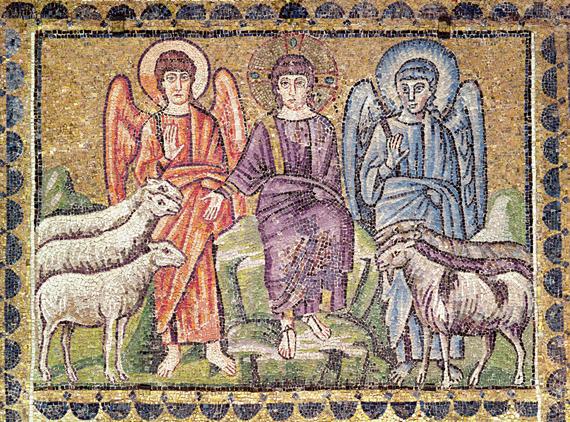
Each year as Christ the King Sunday approaches my mind turns to the marvelous mosaics in the churches of Ravenna, Italy, created in the sixth century on behalf of Byzantine emperors. There are two that are especially appropriate on this occasion. The first is from the Mausoleum of Galla Placidia, depicting Christ as the Good Shepherd:

The second is in S. Apollonare Nuovo, showing Christ separating the sheep from the goats:

Lectionary Reflections: Proper 28 Year A

The Hebrew Bible reading for Proper 28 in the semi-continuous reading is Judges 4:1-7. I was surprised to learn that this is the only reading from Judges in the entire three-year lectionary cycle. That means some of the great stories of the Hebrew Bible might not be encountered by ordinary churchgoers–the Samson cycle, for example, or the story of Gideon.

Judges belongs to a larger historical work that spans the books of Joshua through II Kings (not including Ruth). They’ve given it the tongue-twisting name of the Deuteronomic History, because it tells the history of Israel and Judah from the conquest to the destruction of Jerusalem and the Exile in the 6th century BCE. It was written during the Exile to explain why the Exile happened.

Judges plays a central role in this story. It’s a collection of stories, some of them stories of heroes, others occasionally seeming like folktales. Each episode follows a similar pattern. A judge dies (judges are as much military rulers as judges in the contemporary sense) and the land falls into chaos with the Israelites suffering from foreign invasion and abandoning the worship of God. They cry out and God raises up a new judge who defeats the enemy and establishes a period of peace; but when he (or she) dies, the cycle repeats itself. The book helps to explain why monarchy was needed, but there is also something of a critique of the Israelites, had they been faithful to God, they would not have needed the strong hand of a monarch. The last verse in Judges expresses it well: “In those days there was no king in Israel; all the people did what was right in their own eyes (21:25).

So the question becomes, why of all the possible stories in Judges, is this one included? That’s a puzzle of its own, for it really isn’t a story at all, but the beginning of a story involving two women, both of them also involving military victory. Deborah is a judge and prophetess, who leads the Israelites (with Barak) into battle. Interestingly, of all the judges mentioned in the book, it is only Deborah who is shown actually “judging:” “She used to sit under the palm of Deborah between Ramah and Bethel in the hill country of Ephraim; and the Israelites came up to her for judgment” (4:4)

Nestled between this scene and the actual battle is another story–the assassination of the Canaanite general Sisera by Jael a woman who, after offering him hospitality, kills him with a tent peg. The Deborah story concludes with what may be the oldest part of the Bible, the Song of Deborah (5:2-31). In it, Deborah is called “mother of Israel.” The story concludes with the observation that “the land had rest forty years” (5:31).

No doubt, this story is included in the lectionary because it shows a powerful and important woman, Deborah, a judge and prophetess, and calls us to remember that God calls both men and women to leadership roles. The nature and exercise of authority is a theme that has run through the Hebrew Bible readings from the story of Moses to this point and it will continue to dominate the history of the Israelites throughout the monarchy.

It’s an issue for contemporary Christians as well. Shaped by our culture and historical context, models of authority from politics and the corporate world contribute to our notions of the proper exercise of authority in the church. On the other hand, in the gospels, Jesus offers a very different model of authority: “I am among you as one who serves” (Lk 22:27).

Choose you this day whom you will serve: Lectionary reflections on Proper 27, Year A

This Sunday, we will be observing All Saints, so our scripture readings will not be a continuation of the texts we’ve been reading. That’s a shame, because all three of them are rich. Both I Thessalonians and the Gospel reading have to do with the Second Coming, while the reading from Joshua 24 is the culmination of that book. All of the readings are available here.

I can’t read Joshua’s speech without thinking of our house in South Carolina.

We purchased our house from fundamentalists. Even though we liked the location, the layout, etc, there was one detail that almost broke the deal. On one of the living room walls was stenciled in large letters: “As for me and my house, we will serve the Lord.”

Now you may think there’s nothing problematic about that verse, that it is a worthy sentiment. But think about it for a moment. Joshua has given the Israelites an ultimatum: “Choose this day whom you will serve.” And to buck them up, to set an example, he continues, “as for me and my household, we will serve the Lord.” Do you get it yet? He is making that decision, not just for himself, but for everyone who lives with him—his wife and children, and any slaves. A worthy sentiment? Perhaps, but only if you think the only views that matter are those of the senior adult male.

The first thing we did after closing was paint over that stenciled verse; it took two coats, and still Corrie really wanted me to perform an exorcism on the entire property. After all, underneath that paint, those words remained. Our discomfort with them wass no accident, not just an example of the centuries and the cultural changes that separate us from the book of Joshua. For in their original setting, they were meant to bring discomfort to those who heard them first.

Joshua is largely unfamiliar to us today and the primary reason is that it tells a story that is deeply disturbing to many twenty-first century Christians. It records a version of the conquest of the promised land—with gory details of battles, and perhaps even worse, it records God taking initiative in those battles and demanding the complete destruction of the native population. It resonates uncomfortably with our own nation’s history of settling the continent of North America, defeating and destroying native populations in response to a belief that this land, like Canaan was given us by God. It also raises uncomfortable questions about waging war in the belief that God is on our side.

In fact, there is much more to the book of Joshua than the conquest, and even there the story it tells is much more complex than a quick skimming would suggest. The Israelites did not succeed in displacing the native population, as the later books of Judges, Samuel, and Kings relate, throughout the period of the monarchy, Israel lived among other peoples, and probably over time assimilated many of those people into their nation.

In these last verses of Joshua, we have the culmination of that story of conquest and settlement. This reading is extracted from a larger story, a dramatic covenant ceremony. Much of what was omitted was a recounting of the history of the Israelites—from Abraham and Jacob, through their slavery in Egypt, and the conquest of Canaan. After recounting those mighty acts of Yahweh, Joshua presents the people with an ultimatum: choose to serve Yahweh, or the gods of Mesopotamia, or the gods of the Canaanites. This story hearkens back to the events at Sinai, when Yahweh appeared to the Israelites and gave them the law.

In a way, it’s an odd story, because it implies that the Israelites’ commitment to Yahweh was less than total. In fact, it suggests that it is only now, after entering into and possessing the promised land, that Yahweh demands they give up their allegiance to other gods. But on another level, it is a reaffirmation of that faith, coming about at the end of a lengthy struggle, and centuries of unfulfilled promise. Yahweh had promised Abraham, Isaac and Jacob that they would possess this land; Yahweh had promised Moses and the Israelites as they suffered under Egyptian oppression, that they would be given a land flowing with milk and honey, and now finally, it was theirs.

The authors and editors of Joshua were writing the history of Israel from a vantage point hundreds of years after the fact, and hundreds of miles removed from the promised land. They were writing in Babylon, exiled after the destruction of their homeland, and they were trying to understand those events and to reflect on them theologically. So they developed a theology of promise and fulfillment, of a covenant made at Sinai, reaffirmed here at Shechem, but broken by centuries of unfaithfulness. Yet they hoped for a return to Jerusalem, their faith in Yahweh allowed them to imagine a future back in a restored kingdom.

Lectionary reflections on Proper 26, Year A: Entering the Promised Land

This week’s readings are here.

We’ve been using the semi-continuous readings from the RCL this summer, which have taken us from God’s promise to Abraham that he would possess the promised land, up to now, Joshua 3, when the Israelites finally cross the Jordan and enter the land. I’ve not had the opportunity to do much more than allude to the readings from the Hebrew Bible in my sermons over the past few months. I won’t be preaching on Sunday, and if I were, I probably wouldn’t say much about Joshua, but this dramatic scene, and the one which precedes it, deserve attention.

In last week’s reading from the last verses of Deuteronomy, we heard of Moses’ ascent of Mt. Nebo, his first and only sight of the Promised Land, and his death. It’s impossible for me to read this text and not think about the speech given by Martin Luther King, Jr., on the night before his assassination.

The book of Joshua carries the story forward. In this week’s reading, the Israelites cross the Jordan River. At the same time, it resonates deeply with earlier stories, especially the crossing of the Red Sea. There are thematic and linguistic parallels–the rare Hebrew word used in v. 13 describing the waters as standing “in a single heap” is also used in the Exodus account of the Red Sea, to give just one example.

Joshua is a problematic text on many levels. It tells the story of the Israelite conquest of Canaan, and of God’s ruthless demands that the Israelites utterly destroy their enemies (and God’s punishment when they don’t). It has been used over the centuries to rationalize other conquests, such as the American conquest of Native Americans (witness the number of place names from Joshua used by settlers for towns in the US). The story, however, is more complex than that, for in fact the Israelites did not utterly destroy and displace all of the land’s inhabitants. Many survived and thrived, and the book of Judges offers evidence of the continuing presence of non-Israelites in the land. Still, it is worth pondering the influence of Joshua’s portrayal of the Promised Land and Holy War on the American psyche.

There are other important theological themes present in Joshua, among them the succession of authority from Moses to Joshua, that provide food for thought for contemporary Christians.

veils, mirrors, and faces

I’m working on my sermon for this Sunday, the Last Sunday after the Epiphany. The gospel is always the story of the Transfiguration. This year we hear Luke’s version, which is notable because it does not use the word transfiguration. Luke says only that “the appearance of his face changed, and his clothes became dazzling white” (Lk. 9:29). While Luke refers to Jesus’ face, both Exodus and Paul talk about a veil. Moses needs a veil to protect himself when he approached and talked with God. Paul uses that image to draw a contrast between the direct experience of the believer with God.

It puts me in mind of another image from Paul. In I Corinthians 13:12: “For now we see in a mirror dimly, but then we will see face to face.”

I’ve been reading Thomas Traherne’s Centuries of Meditation. Traherne was a seventeenth-century Anglican priest who wrote extensively. Little of what he wrote was published in his lifetime and manuscripts have been found within the last decade. The Centuries of Meditation were discovered in a used bookshop in the late nineteenth or early twentieth century.

I came across this in the Centuries yesterday:

O let me so long eye Thee, till I be turned into Thee, and look upon me till Thou art formed in me, that I may be a mirror of Thy brightness, an habitation of thy Love, and a temple of Thy glory. That all Thy Saints might live in me, and I in them: enjoying all their felicities, joys and treasures.” 63

I hope to write more extensively and seriously on Traherne at some point, but I’m intrigued by that statement “O let me so long eye thee till I be turned into thee.”