Update on homelessness in Madison

First, an update on the day shelter on E. Washington (from a letter written by the director, Sarah Gillmore, to neighbors (h/t Brenda Konkel):

Greetings Neighbors,

As Week 7 begins, I want to share information and request that if anyone has comments, observations, questions, and/or compliments, to please share them back.

We have been averaging around 125 people/day.

Over this period of time, with this volume of people, we have contacted MPD for assistance 5 times:

First call (mid-December) was to report that a new-to-us guest hit another guest. Our justice team got the “hitter” out of our building within seconds, and contacted MPD to make report.

The other four calls to MPD were for assistance in helping four separate guests obtain medical help.

Our volunteer team continues to do patrols of the neighborhood; we have added litter pick-up to this task, as well.

We have needs for volunteers to conduct workshops in: child programs, adult art/crafts, adult computer literacy, and tax preparation.

Thanks for working together with us. There are about 12 more weeks left with us as your neighbors

I won’t compare those statistics with the average number of calls to 911 from the Drop-In Shelter…

At our most recent First Monday meal, I was struck by how guests actively responded to problems. Guests are beginning to take responsibility for making sure others behave appropriately.

News has finally broken about the efforts of Occupy Madison to purchase a building on Madison’s north side that may ultimately provide single room occupancy for homeless people. The article from Madison.com is here. Isthmus coverage here.

I’m sure this will be a contentious issue as well but for all the NIMBY’s out there, a recent study suggests that homeless facilities may increase neighboring property values

An Article on the Daytime Shelter and Sarah Gillmore

Pat Schneider is effusive in her praise.

From the article:

day-to-day tasks to keep the center running — from greeters to food service to clean-up — are performed by volunteer users of the center. An advisory council of shelter users gives feedback on operations, and a community justice group discusses how to minimize conflicts.

Having a role in running the operation is important, Gillmore told me.

“The idea of someone being able to contribute their skills is so powerful. We’re based on building a sense of empowerment to increase self-worth and make life changes,” she said. By being involved with running the center, as well as participating in support groups and connecting with local service agencies, shelter users make steps toward more stable lives.


A New Era? Changing attitudes and approaches to homelessness in Madison

There seems to be a revolution taking place in Madison and Dane County. Thanks to a number of factors and the efforts of a remarkable group of people, new initiatives are beginning and there is evidence of changing attitudes among our political leadership and wider community. I’m excited to be a witness and in a small way a participant in these changes.

One change, the Warming Center, which finally opened a couple of weeks ago on E. Washington Ave. The first day it opened, 57 people made use of it. It’s a temporary solution with a permanent facility funded by Dane County in the works. I received a plea from Scott McDonnell (chair of the County Board of Supervisors) in which he lists the shelter’s needs. You can download that letter here: McDonnell_letter.

Some of my excitement is due to the work of Tami Miller and her group “Feeding the State Street Family.” The Cap Times recently profiled Miller who began volunteering on her own a couple of years ago. Miller and her group reach out to homeless people where they are instead of expecting homeless people to seek them out. They provide meals, make midnight drop-offs of food and supplies. She is also experimenting with new programs, like a one-on-one mentoring program that may begin as early as January. She and I had a great conversation on Tuesday about how Grace can support her efforts. We also talked about some of the unmet needs in the city and the county.

One impact she and others have had is to shift the approach of the politicians. Mayor Soglin who has come off as very heavy-handed and tone deaf about homelessness over the last months, has been much more conciliatory in the last weeks. And County Executive Joe Parisi, who has made several mis-steps himself, is making similar efforts to reach out. Here’s an article about that.

The focus now from the City of Madison is on figuring out where the gaps in services are. It’s interesting that the 2011 annual report on homelessness in Dane County has finally appeared, just a few weeks before the end of 2012. That document is here: 2011 Annual Report revised

It makes for interesting reading. The statistics come primarily from social service agencies and shelters. It’s interesting to note that for all demographic groups, most people in the shelters were residents of Madison or Dane County before becoming homeless. What it doesn’t seem to track is the number of people who are homeless but don’t use the shelter system. Tami Miller puts that number at 400. On Monday, I talked to a couple of guys who are regulars at our First Monday meal. They sleep outside. One of them said he’ll go in the shelter when it’s really cold, another said he never uses the shelter. When I asked them about it, they brought up the usual issues and complaints I hear. The reality is that the shelter isn’t appropriate for everyone, and with shelter as with almost every other issue facing homeless people, it’s important to develop solutions based on the particular needs of individuals. Of course that takes more financial and human resources, but if the goal is to get someone into a stable living situation, those resources are necessary and produce results.

A video about the plight of homeless teens in Madison is here:

In short, these are interesting and exciting times and I look forward to future developments.

First Monday: Food, socks, and fun

It’s become a tradition at Grace. The First Monday in December, our regularly scheduled dinner with entertainment for guests of the Drop-In shelter and community, is St. Nick’s Day. We make sure there’s great food; Christmas carols and Holiday songs sung by our Sunday School kids and adult choir and St. Nick himself appears to hand out new warm winter socks for our guests.

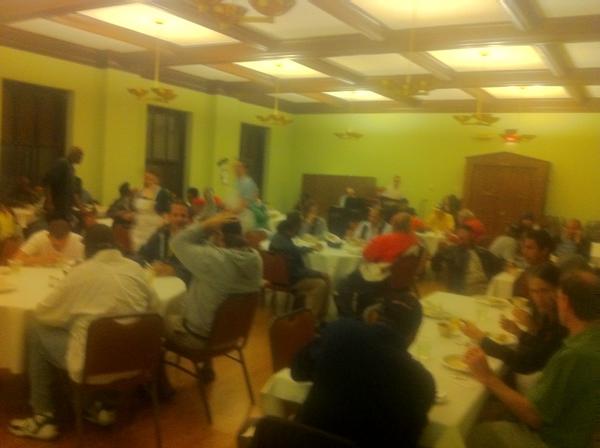
The menu was ham, macaroni and cheese, green beans, and cupcakes. Helping us serve were youth from Grace and St. Andrew’s as well as many of our regulars. We planned for 150 but probably had somewhere around 110 or so. It was 64 outside when we began to serve and I suspect many of those who might have joined us if the temps were more seasonal decided to stay outside for the night and forage for food. A couple of pics:

photo(2)photo(1)photo


As always, the guys were very appreciative of both the food and fellowship. Because of the relatively leisurely pace of the evening, there were lots of opportunities to sit down and visit with the guests, hear their stories and make a human connection with some of them. It was especially neat to see the intergenerational interactions and to watch how newcomers to volunteering with us jumped in both to help serve and to take the time to listen to those they were serving.


The Winter Day Shelter is open!

As of 8:00 am today. It’s located on E. Washington and operated by Porchlight. It’s been a long struggle and kudos to all those who have kept pressure on the city and the county. Thanks too to the County Board of Supervisors who overwhelmingly voted in favor of its funding. Linda Ketcham of Madison Area Urban Ministry has been one of the leaders of the effort and deserves a shout out.

The work is not done. The shelter is looking for volunteers to help with staffing and they also need a lot of donated items.

Here’s the job description if you are interested in volunteering: volunteeringatthewinterdayshelter

And here’s the list of items they need: Warming day shelter wish list

Warming Center Approved

The Dane County Board of Supervisors approved the warming center last night

My testimony:

I speak in support of the warming center. This is a long overdue and much needed addition to the services provided for homeless people in Madison and I look forward with excitement to the possibility of a permanent daytime resource center. The fact of the matter is without such space this winter, homeless people will look throughout the city for other places to keep warm and when they are turned away from private property like stores or office buildings, they will huddle in doorways and no doubt some will die.

No one in this room knows better than I the frustrations, nuisance, and potential danger posed by the presence of homeless people around one’s property. At Grace, we deal with it every day. Just this fall, we have found feces in our stairwells, vomit on the sidewalk, not to mention petty harassment from panhandlers.

You probably know, or could, guess that people are released from prison or jail and sent directly to the shelter at Grace—in the clothes they were wearing when they were arrested, even if that was in July and it’s now November. I doubt many in this room realize that people are discharged from our hospitals directly to the homeless shelters—all of our hospitals, including the VA. I don’t know how often it happens but it seems like every few weeks I’ll encounter someone who has been brought to Grace from a hospital before the shelter opens for the night. It’s happened in hot weather; it’s happened in cold weather. It happened on Christmas Eve last year. Where is such a person to go to wait until the shelter opens that evening? Where is he to go in the morning, especially if, as is often the case, he’s barely ambulatory?

There are significant gaps in our services to the homeless. Some of them are problems like addiction, mental illness, or the healthcare system that have no easy or obvious solutions. Others are relatively straightforward like providing shelter from the elements. For too long we relied on institutions like the Central Library to provide that shelter during the day, to the detriment of its core mission and its users. We have an opportunity now to make a small step in the right direction, to offer warmth, a place to sit, perhaps some services. I hope this step will be followed up with a permanent facility soon.

Is the proposed location the ideal site for a daytime warming center? Probably not. Here we are in mid-November with no viable alternative. I believe that with the staff proposed for the center and the plans for neighborhood outreach and security, many of the problems that plagued the neighborhood last year can be prevented. And I am happy to offer whatever help I can to the service providers and to the neighborhood to see that problems are resolved quickly and with satisfaction.

I am passionate about ministry to the homeless because I am passionate about the Gospel of Jesus Christ that has at its heart ministry to the downtrodden, the widow and orphan, the homeless and hungry. I am also passionate about ministry to the homeless because how society treats the downtrodden is a reflection of its values. I hope that I live in a city and a county that seeks to make sure no one dies on the street because of exposure, that no one lacks a place to sleep, or food to eat.

I urge you to support this important initiative.

It’s November 14th? Do you know where homeless people can stay warm on cold winter days in Madison?

I don’t either; at least, not yet. This has been quite the political football or hot potato. I won’t go into the history of efforts to provide a day shelter for Madison’s homeless population this winter but here we are with temperatures in the 30s and there’s still no concrete plan in place.

But hope springs eternal. Joe Tarr is reporting that there is money in Dane County’s 2013 budget for a permanent day shelter, which they hope to open next summer. In the meantime, we’ve got another Wisconsin winter to get through. The County has been working very hard to find space and money for a temporary shelter of some sort, and right now attention is focused on property on E. Washington Ave. The county has already allocated money for its operation through March; there’s a plan in place for staffing and security.

Opposition to the proposed location comes from the Tenney-Lapham Neighborhood Association which had to deal with the poorly planned and organized day shelter last year and have legitimate complaints. In addition, the proposed property is adjacent to an agency that works with families and children dealing with abuse. Obviously putting a day shelter in close proximity to abuse victims is not an ideal situation and it will be crucial to have adequate planning and procedures to address the neighbors’ concerns.

I am much heartened by the County’s willingness to step forward to provide both a short-term solution, and more exciting still is the prospect of a permanent facility that will connect homeless people with necessary services like laundry, showers, and storage, as well as a central location to connect with agencies and programs that can help them find more stable living situations.

Of course, there’s always the City of Madison. Mayor Soglin has opposed the county’s earlier efforts to site the day shelter. According to reports last week, the Common Council put $25,000 toward a day shelter but I don’t know if that line remains in the city’s budget.


What is the mayor thinking? A free ride out of town for the homeless

Mayor Soglin has made the eye-popping suggestion to include $25,000 in the city budget to buy tickets to put homeless people on buses to their hometown. Former Mayor Dave Cieszlewicz calls him out on it here.

Soglin is convinced that Madison is a magnet for homeless people from across the country or at least across the state (or maybe Dane County).

Thinking dispassionately about the proposal and about what little Soglin has said about what he intends, raises at least several issues. First off, who would administer it and how? What would the administrative costs be? He proposes contacting relatives in the “hometown” before issuing tickets, and right there the complications would arise. There would have to be some sort of vetting process, some sort of communication between here and the proposed location, including social services, to make sure it was more than sending someone to the bus station in Chicago or Milwaukee.

If the mayor were serious about such a proposal, I would think it might require paying a professional social worker for at least a half-time job, given the numbers of homeless and the amount of necessary follow-up. And how much would a half-time salary cost? Way more than $25,000. Without that administrative structure, his program is nothing more than a free ride out of town.

Winter is getting closer, so that means the debate over homelessness is ramping up again

So the county has proposed a day shelter for Madison’s eastside, a site picked apparently out of the blue and with no input from the neighborhood. Mayor Soglin is outraged because the city wasn’t consulted and is having none of it. What frustrates me is that we’ve come down to the last minute again. Here it is early October and there are no definite plans in place for providing day shelter in the winter. No doubt the powers that be are hoping the problem will just go away and that when the library reopens next year, the seasonal fuss will die down.

Soglin is convinced that Madison is a magnet for homeless people from across the region:

“I have made it clear that the city of Madison does not have the resources or the responsibility to take care of Dane County’s and Wisconsin’s homeless population,” Soglin wrote.

Has he noticed that it is a magnet for people with homes as well? For students and young adults?

In fact, on Sunday I met a homeless man who asked me if I could make some copies of his resume. He is in Madison because he came here from a small town elsewhere in the state, not in hopes of mooching off of Madison’s largesse, but because he’s looking for work. The unemployment rate is much lower here than elsewhere in the state, lower than most of the small towns that dot the countryside.

The debate over a day center is not about providing a hang-out. It is about basic human needs–providing shelter from inclement weather–and about providing services as efficiently as possible. Rather than forcing people to traipse across the city lugging their possessions while they search for food, laundry facilities, a shower, as well as a job, a day center would put most of those services in a single place and staff it with human service professionals who could help people negotiate the labyrinthine bureaucracy of city, county, state, and federal services.

Madison.com coverage of the day center controversy is available here.

Chris Rickert writes here about Mayor Soglin’s position.

Meanwhile, we fed about 100 people last night at First Monday: meatloaf, potatoes, green beans, ice cream. Music ranged from Leonard Cohen to Opera and was very well received. There were men and women, including one family who enjoyed our hospitality:

Teaming up to end homelessness

An interesting piece on The New York Times Opinionator about an innovative program to end homelessness (targeted specifically at homeless vets).

A couple of key stats from the article: nationwide, there are 67,000 homeless vets; it costs society approximately $40,000/yr per homeless person (for temporary shelter, er, jail, etc).

Here’s some of what was attempted:

The challenge has largely succeeded. Four cities housed more than 100 homeless veterans in 100 days.  Others came close, and nearly all reported that they had found new ways of working that would speed things up in the future. Some of the changes were improvements to the process:  Atlanta, for example, had previously counted on the chronically homeless to go out and find apartments on their own.  Unsurprisingly, this strategy was not working. So the city hired a third-party provider to help the veterans find a place to live and to act as a fiscal agent for moving costs and security deposits. Veterans Affairs in Atlanta divided caseworkers into teams, which competed to house the most veterans.

But key to the success of the program were the relationships among agencies and homeless service providers:

“Relationships count from the very first touch with a veteran on the street, all the way through the system,” said Patricia Leslie, who is the chairwoman of a broad community group that focuses on ending homelessness in San Diego. “The more we know each other, the better troops we make.”

More on the 100,000 homes campaign here.

I wonder if something like this would work in Madison?