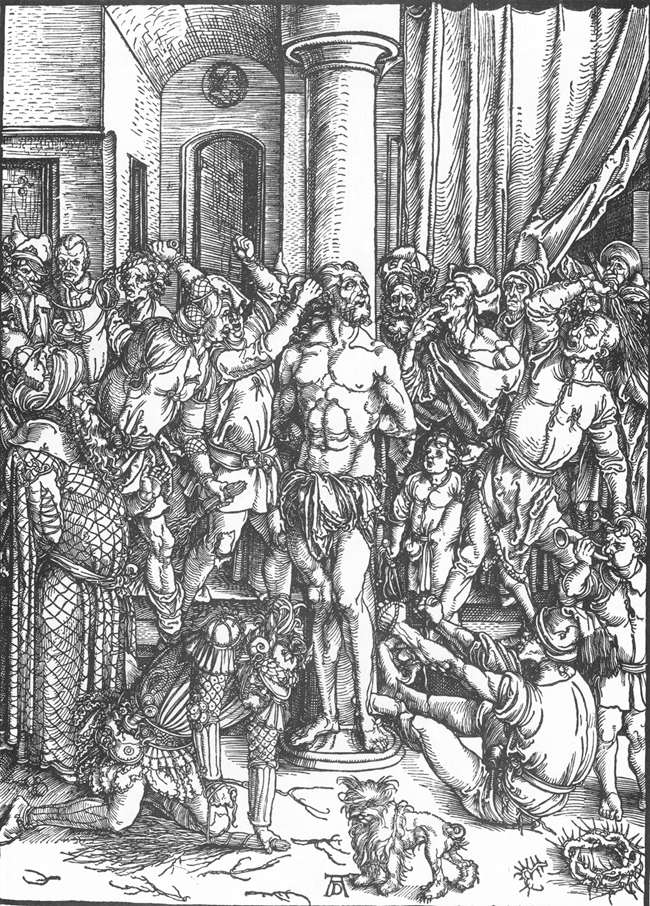
Wednesday in Holy Week

03largepAlbrecht Dürer, The Flagellation of Christ (The Large Passion)

The Collect

Lord God, whose blessed Son our Savior gave his body to be whipped and his face to be spit upon: Give us grace to accept joyfully the sufferings of the present time, confident of the glory that shall be revealed; through Jesus Christ your Son our Lord, who lives and reigns with you and the Holy Spirit, one God, for ever and ever. Amen.

Tuesday in Holy Week

04largepAlbrecht Dürer, Ecce homo (from the Large Passion)

The Collect.

O God, by the passion of your blessed Son you made an instrument of shameful death to be for us the means of life: Grant us so to glory in the cross of Christ, that we may gladly suffer shame and loss for the sake of your Son our Savior Jesus Christ; who lives and reigns with you and the Holy Spirit, one God, for ever and ever. Amen.

Monday in Holy Week

385px-Albrecht_Dürer_-_Christ_Carrying_the_Cross_(NGA_1941.3.3)Albrecht Dürer, Christ Carrying the Cross

The Collect for Monday in Holy Week

Almighty God, whose most dear Son went not up to joy but first he suffered pain, and entered not into glory before he was crucified: Mercifully grant that we, walking in the way of the cross, may find it none other than the way of life and peace; through Jesus Christ your Son our Lord, who lives and reigns with you and the Holy Spirit, one God, for ever and ever. Amen.

Holy Saturday

Lord God our Father, 
maker of heaven and earth: 
As the crucified body of your dear Son 
was laid in the tomb 
to await the glory that would be revealed, 
so may we endure 
the darkness of this present time 
in the sure confidence 
that we will rise with him. 
We ask this through your Son, 
Jesus Christ our Lord, 
who lives and reigns 
with you and the Holy Spirit, 
one God, now and forever. 
Amen.

From an Ancient Homily:

“What is happening? Today there is a great silence over the earth, a great silence, and stillness, a great silence because the King sleeps; the earth was in terror and was still, because God slept in the flesh and raised up those who were sleeping from the ages. God has died in the flesh, and the underworld has trembled.

Truly he goes to seek out our first parent like a lost sheep; he wishes to visit those who sit in darkness and in the shadow of death. He goes to free the prisoner Adam and his fellow-prisoner Eve from their pains, he who is God, and Adam’s son.

The Lord goes in to them holding his victorious weapon, his cross. When Adam, the first created man, sees him, he strikes his breast in terror and calls out to all: ‘My Lord be with you all.’ And Christ in reply says to Adam: ‘And with your spirit.’ And grasping his hand he raises him up, saying: ‘Awake, O sleeper, and arise from the dead, and Christ shall give you light.

‘I am your God, who for your sake became your son, who for you and your descendants now speak and command with authority those in prison: Come forth, and those in darkness: Have light, and those who sleep: Rise.

‘I command you: Awake, sleeper, I have not made you to be held a prisoner in the underworld. Arise from the dead; I am the life of the dead. Arise, O man, work of my hands, arise, you who were fashioned in my image. Rise, let us go hence; for you in me and I in you, together we are one undivided person.

‘For you, I your God became your son; for you, I the Master took on your form; that of slave; for you, I who am above the heavens came on earth and under the earth; for you, man, I became as a man without help, free among the dead; for you, who left a garden, I was handed over to Jews from a garden and crucified in a garden.

‘Look at the spittle on my face, which I received because of you, in order to restore you to that first divine inbreathing at creation. See the blows on my cheeks, which I accepted in order to refashion your distorted form to my own image.

‘See the scourging of my back, which I accepted in order to disperse the load of your sins which was laid upon your back. See my hands nailed to the tree for a good purpose, for you, who stretched out your hand to the tree for an evil one.

`I slept on the cross and a sword pierced my side, for you, who slept in paradise and brought forth Eve from your side. My side healed the pain of your side; my sleep will release you from your sleep in Hades; my sword has checked the sword which was turned against you.

‘But arise, let us go hence. The enemy brought you out of the land of paradise; I will reinstate you, no longer in paradise, but on the throne of heaven. I denied you the tree of life, which was a figure, but now I myself am united to you, I who am life. I posted the cherubim to guard you as they would slaves; now I make the cherubim worship you as they would God.

“The cherubim throne has been prepared, the bearers are ready and waiting, the bridal chamber is in order, the food is provided, the everlasting houses and rooms are in readiness; the treasures of good things have been opened; the kingdom of heaven has been prepared before the ages.”

A Sermon from the Early Church Father Epiphanius is available here.

A reflection by Richard Beck.

Good Friday at Grace

Our service was scheduled for 12 noon. At 11:00, there were three repairmen in the building. The copier guy was trying to fix the jam (unsuccessfully, we had to have the remainder of the Easter service bulletin copied out of house); the sound system was being worked on, and someone was here to fix the internet connection for the homeless shelter.

That isn’t a recipe for a successful Good Friday liturgy. But, wow! Thanks to lots of help from Deacon Carol Smith, Greg Upward, Pat and Matthew Pollock, Steph Childs, the people who read the Passion according to John, and Max Harris’s powerful sermon; the service went off without a hitch and with great power and meaning. Thanks especially to Rachel Eve Holmes for her solos (you can hear the aria from Bach Cantata #21 at her website: http://www.racheleveholmessoprano.com/live/ (It’s worth a listen).

Stabat Mater dolorosa

At the Cross her station keeping,
stood the mournful Mother weeping,
close to her Son to the last.

Through her heart, His sorrow sharing,
all His bitter anguish bearing,
now at length the sword has passed.

O how sad and sore distressed
was that Mother, highly blest,
of the sole-begotten One.

Christ above in torment hangs,
she beneath beholds the pangs
of her dying glorious Son.

Is there one who would not weep,
whelmed in miseries so deep,
Christ’s dear Mother to behold?

Can the human heart refrain
from partaking in her pain,
in that Mother’s pain untold?

For the sins of His own nation,
She saw Jesus wracked with torment,
All with scourges rent:

She beheld her tender Child,
Saw Him hang in desolation,
Till His spirit forth He sent.

O thou Mother! fount of love!
Touch my spirit from above,
make my heart with thine accord:

Make me feel as thou hast felt;
make my soul to glow and melt
with the love of Christ my Lord.

Holy Mother! pierce me through,
in my heart each wound renew
of my Savior crucified:

Let me share with thee His pain,
who for all my sins was slain,
who for me in torments died.

Let me mingle tears with thee,
mourning Him who mourned for me,
all the days that I may live:

By the Cross with thee to stay,
there with thee to weep and pray,
is all I ask of thee to give.

Virgin of all virgins blest!,
Listen to my fond request:
let me share thy grief divine;

Let me, to my latest breath,
in my body bear the death
of that dying Son of thine.

Wounded with His every wound,
steep my soul till it hath swooned,
in His very Blood away;

Be to me, O Virgin, nigh,
lest in flames I burn and die,
in His awful Judgment Day.

Christ, when Thou shalt call me hence,
by Thy Mother my defense,
by Thy Cross my victory;

While my body here decays,
may my soul Thy goodness praise,
Safe in Paradise with Thee.

Translation by Edward Caswall
Lyra Catholica (1849)

The Atonement: Some links

The Atonement continues to be a lively issue in Christianity. For many lay persons, it is one of the Christian doctrines with which they struggle the most. There’s been a great deal of interest in rethinking the doctrine in recent years. Right now, Patheos has several articles on it.

Tony Jones has a new book on the atonement and has blogged about it. Entries are here. A summary of his views is here.

For my part, it’s clear. I’m not interested in a God who needs to bargain with the Devil, or in a God who is bound to a legal system, no matter how just it seems to us. The crucifixion was the single most pivotal event in the history of the cosmos. In it, we see that the true character of God is love. God loves with an immensity that is hard to fathom. So much, in fact, that he forsook much of that divinity in order to find solidarity with you and me.

Greg Love also has a new book, and an essay:

I concur with the sharp critics of penal substitution. God is non-ambivalent and nonviolent, loving us with an unqualified love, one not surrounded by threats of condemnation, violence, rage, and death. Yet I also concur with the tradition: Burdened underneath the weight of sin, suffering, and tragedy, we human beings need a savior. And the gospel news is that we are saved by One outside ourselves—Jesus. This third approach entails the keeping of tensions present within the gospels’ stories of the cross. God is holy, but the holiness of God is present most in the mercy of God. What happens on the cross saves the world, and it ought not to have happened. The way Jesus died saved the world, but so did the way he lived. In Jesus’ work, salvation is a finished act, yet it is not one that happens “over our heads.” It inspires the human response of personal and social transformation. Jesus saves, and the Holy Spirit saves.

Today, on Tuesday in Holy Week, I’m thinking about the gospel for the day, and the verse that has become a theme for me this week: “And I, when I am lifted up from the earth, will draw all people to myself.” (Jn 12:32)


Monday in Holy Week: The Anointing

The Gospel for Monday in Holy Week is John 12:1-11. John’s version of the story of the Anointing, it differs in significant ways from the story told in Mark’s gospel and read as part of the Passion Narrative in yesterday’s services. In both gospels, the story takes place in Bethany, but John puts it in the home of Lazarus, Mary, and Martha, while according to Mark it is in the home of Simon the Leper. John identifies the woman who anoints Jesus as Mary, the sister of Lazarus and Martha, while in Mark she remains anonymous, though Jesus says of her: “wherever the good news is proclaimed in the whole world, what she has done will be told in remembrance of her.” Even the timing is off. In Mark, it takes place two days before the Passover; in John six. In Mark, she anoints his head; in John his feet.

Each author shapes the story to his purposes (for contrast compare the version in Luke 7:36-50). But in spite of those differences, Mark and John interpret the story similarly. For both, her act of anointing is connected with Jesus’ burial. As I read, and then listened to the Passion Narrative yesterday, I was struck again by the importance of the women in Mark’s story. Here is one, ministering to Jesus, foreshadowing his death and burial. At the cross, women looked on from afar. Mark says that “These used to follow him and provided for him when he was in Galilee; and there were many other women who had come up with him to Jerusalem.”

Again, at the burial. Mary Magdalene and and Mary the mother of Joses looked on.

The dramatic act of anointing of Jesus captures our imagination as it captured the imagination of the gospel writers. We want to fill the story out, give it some deeper meaning. So Luke’s identification of the woman as a sinner ultimately led to the tradition’s identification of this woman as Mary Magdalene, the repentant prostitute. But in Mark’s story, there’s none of that. And in John, it is Mary of Bethany, one of Jesus’ closest and dearest friends.

As powerful as the notion of a repentant sinner anointing Jesus, I find the idea of a female disciple, a follower of Jesus doing the anointing even more compelling. Those women disciples in Mark continued to follow Jesus to the cross and to his burial and were witnesses of the empty tomb.

Holy Week invites us to enter into the drama of Jesus’ last days. We do it on Palm Sunday as we wave our palms and shout “Hosanna.” We do it as we listen to the story of the passion and take part as members of the crowd. We do it day by day, as we remember the last week of Jesus’ life, re-enact the first Eucharist and the footwashing, the crucifixion and burial.

The story and its re-enactment invites us to enter into it, to take our place in the story. But it also asks us how we will participate, which roles we will take on. Will we flee and abandon Jesus like the twelve and the young man who ran away naked? Will we watch from afar as Jesus dies and is buried? Will we take our place at Jesus’ feet, anointing them for burial today, and washing them on Maundy Thursday? Where will we stand? Where will we walk? Where will we kneel?

Godforsaken–A Homily for Palm Sunday, Year B

April 1, 2012

“Eloi, Eloi, Lama sabachthani!” “My God, My God, why have you forsaken me?” As I reflect on Mark’s version of the passion narrative that we just heard, I marvel at the enigma with which Mark presents us. Mark gives us little to work with, and what he does give us is profoundly unsettling. In Mark, there is nothing of the familiar Christian understanding of the cross as Jesus dying for our sins, there is no mention of sacrifice, no substitutionary atonement. Instead, Mark challenges the careful reader and the thoughtful Christian to wrestle with the tragedy and the horror of the crucifixion.

“Eloi, Eloi, lama sabachthani!” “My God, My God, why have you forsaken me?” If we are to understand what the crucifixion meant for Mark, we need to begin here, with this question. According to Mark, these are the last words Jesus spoke on the cross. How were they meant? Did Jesus speak them in anger, or resignation, fear or despair?

How are we to understand them? For Christians who know anything about the faith, interpreting these words literally is nonsensical. How can God forsake Jesus? After all, Jesus is God. Remember though, Mark was writing without the benefit of 2000 years of theological baggage, before the centuries of debate and speculation that eventually led to our understanding that Jesus was both human and divine.

Mark meant those words absolutely literally. They are the culmination of the passion narrative, because for Mark, Jesus dies utterly alone, abandoned by all of his disciples. Most of the disciples fled at his arrest, and Mark dramatizes their flight by a puzzling mention of a young man whose robe is torn him from as he tries to run, and he ends up fleeing naked. Peter made it to the courtyard of the High Priest’s house before deciding that “the better part of valor was discretion,” denied he knew Jesus and fled the scene. So at the cross, in Mark’s gospel, Jesus was alone, surrounded only by his executioners. There were, according to Mark, women, female disciples, watching on from a distance, and they would be the first to return.

Jesus dies utterly alone, abandoned by his closest friends, and for Mark, that is precisely the point. Thus the question, “My God, My God, why have you forsaken me?” dares us to wonder whether Jesus felt abandoned by God.

But Mark answers that question immediately by giving to the centurion the famous line, “Truly this man was God’s Son.” And again, Mark leaves no room for debate or discussion. He says quite clearly that the centurion was looking directly at Jesus and that it was because of the way in which Jesus died that led him to make that confession. By the way, it is the first time in Mark’s gospel that a human being confessed that Jesus was the Son of God.

A few weeks ago, we heard a passage from earlier in Mark’s gospel where Jesus told his disciples that he would go to Jerusalem and be crucified and that if they wanted to be his disciples, they needed to take up their cross and follow him. That’s the message of Mark’s gospel, that’s the meaning of the cross. For Mark, Jesus death is the awaits those who would follow him. It was a death brought about by Jesus’ challenge to the political and religious authorities of his day.

That message is hard to hear; it was hard to hear in the first century, and because of that when Matthew wrote his version of Jesus’ crucifixion, he toned it down considerably. But it has been hard to hear throughout the history of Christianity and for that reason we have over the centuries developed alternative interpretations, many of them.

My God, my God, why have you forsaken me? We, the readers of Mark know the answer to the question Jesus asks God. God vindicates Jesus by raising him from the dead. But the resurrection for Mark did not lessen the power of Jesus’ death. It gave it meaning. If he had not been raised from the dead, Jesus would have been no different from the countless thousands of others that Rome crucified over the centuries.

My God, my God, why have you forsaken me? Those words of despair and abandonment will accompany us this holiest of weeks. We will hear them again, on Maundy Thursday, as the altar is stripped. We will say them then, as we read together Psalm 22. And again, on Good Friday, we will say them together as we remember and reflect on the crucifixion.

Jesus’ question cries out to us across the centuries. It challenges our faith and devotion; it challenges our experience of Holy Week. We think we know what it all means. Christians have wrapped it all up in a tidy package to make sense of it. But that question, if asked seriously, challenges it all, turns our lives and our faith upside-down and inside out.

This week, we are invited to walk with Jesus as he walks toward the cross. He has bid us to take up our crosses and follow him. To walk with Jesus toward the cross is to accept his vision for the world, his vision of the kingdom of God. To walk with Jesus toward the cross is to be faithful to that vision, to reach out in love to all, come what may. As we make our way through Holy Week this year, I pray that all of us experience anew and with power Christ’s love for us and that we share that love with the world.

Does a definition of religion necessarily involve belief? Ritual and Religious Experience

When I used to teach Intro to Religion, and even when I taught Intro to Bible, one of the exercises I would give my students on the first day was to ask them to define religion in a sentence or two. Invariably, the overwhelming majority would include “belief” in their definition. I would then give them a collection of definitions from scholars over the last century and a half, showing the wide range of thinking about the nature of religion, including many that made no reference to belief or faith.

I bring this up because the British philosopher John Gray has reviewed Alain de Botton’s recent book, Religion for Atheists: A Non-Believer’s Guide to the Uses of Religion. Gray capsulates de Botton’s argument in this way:

Most people think that atheists are bound to reject religion because religion and atheism consist of incompatible beliefs. De Botton accepts this assumption throughout his argument, which amounts to the claim that religion is humanly valuable even if religious beliefs are untrue. He shows how much in our way of life comes from and still depends on religion – communities, education, art and architecture and certain kinds of kindness, among other things. I would add the practice of toleration, the origins of which lie in dissenting religion, and sceptical doubt, which

very often coexists with faith.

But in the course of his essay, Gray points out that most of the world’s religions have had at their core the practice of a way of life, rather than assent to a sent of doctrinal beliefs, and that there are strands within Hinduism, Buddhism, and even Christianity, “that deny that spiritual realities can be expressed in terms of beliefs at all.”

Gary Gutting attempts to offer a philosophical challenge to Gray’s argument about religion. But his argument is dependent upon a slightly different definition than Gray’s. Gutting begins with a different starting point, not a definition that attempts to encompass a wide variety of religions, but a narrower one that focuses on salvation. He cites Islam and “mainline” Christianity as prime examples.

Then he tests Gray’s argument with the problem of evil.  The only plausible answer for a theist is that God is beyond our capacity to understand; but if that’s the case, we can’t be certain that God will act to save us:

Once we appeal to the gap between our limited knowledge and God’s omniscience, we cannot move from what we think God will do to what he will in fact do.

I was reminded of this debate thanks to something a lunch companion said this week. We were talking about the Book of Common Prayer’s power to shape us as Christians, as its language and liturgy becomes ours over time, and comes to shape our experience and understanding of God.

We are approaching Holy Week when we will enter into the drama of the last days of Jesus’ life, participating as individuals and as communities in those ritual re-enactments. We enter into the stories, become the stories. We participate as well as observe. For many of us, the drama of Holy Week, experienced over a period of years or decades, have shaped us in ways we can’t even articulate.

Am I able to articulate a theologically-sound doctrine of the atonement? Hardly. Do I experience the saving love of Jesus’ death on the cross? Of course! And never more powerfully than while participating in the liturgy of Good Friday.