
Poetry for Maundy Thursday: Mary Oliver and Mary Karr

Gethsemane
Mary Oliver
The grass never sleeps.
Or the roses.
Nor does the lily have a secret eye that shuts until morning.
Jesus said, wait with me. But the disciples slept.
The cricket has such splendid fringe on its feet,
and it sings, have you noticed, with its whole body,
and heaven knows if it ever sleeps.
Jesus said, wait with me. And maybe the stars did, maybe
the wind wound itself into a silver tree, and didn’t move,

maybe,the lake far away, where once he walked as on a
blue pavement, lay still and waited, wild awake.

Oh the dear bodies, slumped and eye-shut, that could not
keep that vigil, how they must have wept,
so utterly human, knowing this too
must be a part of the story.
Descending Theology: The Garden
Mary Karr
We know he was a man because, once doomed,
he begged for reprieve. See him
grieving on his rock under olive trees,
his companions asleep
on the hard ground around him
wrapped in old hides.
Not one stayed awake as he’d asked.
That went through him like a sword.
He wished with all his being to stay
but gave up
bargaining at the sky. He knew
it was all mercy anyhow,
unearned as breath. The Father couldn’t intervene,
though that gaze was never
not rapt, a mantle around him. This
was our doing, our death.
The dark prince had poured the vial of poison
into the betrayer’s ear,
and it was done. Around the oasis where Jesus wept,
the cracked earth radiated out for miles.
In the green center, Jesus prayed for the pardon
of Judas, who was approaching
with soldiers, glancing up—as Christ was—into
the punctured sky till his neck bones
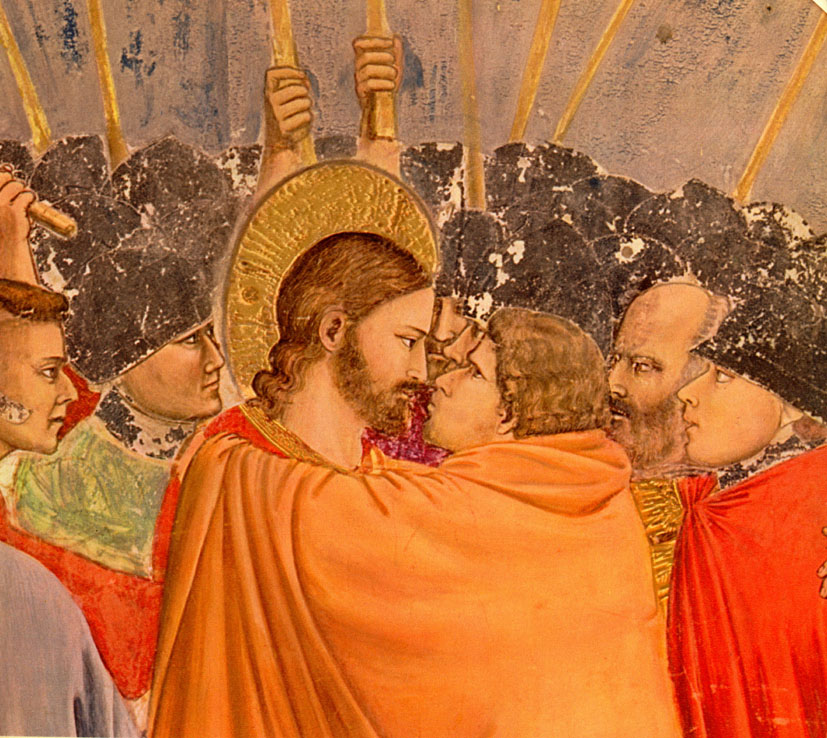
ached. Here is his tear-riven face come
to press a kiss on his brother.

Poetry: Wednesday in Holy Week by Christina Rossetti

Wednesday in Holy Week

by Christina Georgina Rossetti
Man’s life is death. Yet Christ endured to live,
Preaching and teaching, toiling to and fro,
Few men accepting what He yearned to give,
Few men with eyes to know
His Face, that Face of Love He stooped to show.

Man’s death is life. For Christ endured to die
In slow unuttered weariness of pain,
A curse and an astonishment, passed by,
Pointed at, mocked again
By men for whom He shed His Blood—in vain?

Poetry for Monday in Holy Week

Denise Levertov: On a Theme from Julian’s Chapter XX

Six hours outstretched in the sun, yes,
hot wood, the nails, blood trickling
into the eyes, yes—
but the thieves on their neighbor crosses
survived till after the soldiers
had come to fracture their legs, or longer.
Why single out the agony? What’s
a mere six hours?
Torture then, torture now,
the same, the pain’s the same,
immemorial branding iron,
electric prod.
Hasn’t a child
dazed in the hospital ward they reserve
for the most abused, known worse?
The air we’re breathing,
these very clouds, ephemeral billows
languid upon the sky’s
moody ocean, we share
with women and men who’ve held out
days and weeks on the rack—
and in the ancient dust of the world
what particles
of the long tormented,
what ashes.

But Julian’s lucid spirit leapt
to the difference:
perceived why no awe could measure
that brief day’s endless length,
why among all the tortured
One only is “King of Grief.”

The oneing, she saw, the oneing
with the Godhead opened Him utterly
to the pain of all minds, all bodies
—sands of the sea, of the desert—
from first beginning
to last day. The great wonder is
that the human cells of His flesh and bone
didn’t explode
when utmost Imagination rose
in that flood of knowledge. Unique
in agony, Infinite strength, Incarnate,
empowered Him to endure
inside of history,
through those hours when he took to Himself
the sum total of anguish and drank
even the lees of that cup:

within the mesh of the web, Himself
woven within it, yet seeing it,
seeing it whole. Every sorrow and desolation
He saw, and sorrowed in kinship.

Holy Saturday

“… does the precise locus of this Saturday, at the interface between cross and resurrection, its very uniqueness as the one moment in history which is both after Good Friday and before Easter, invest it with special meaning, a distinct identity, and the most revealing light? Might not the space dividing Calvary and the Garden be the best of all starting places from which to reflect upon what happened on the cross, in the tomb, and in between? The midway interval, at the heart of the unfolding story, might itself provide an excellent vantage point from which to observe the drama, understand its actors, and interpret its import. The nonevent of the second day could after all be a significant zero, a pregnant emptiness, a silent nothing which says everything.” Alan Lewis, Between Cross and Resurrection: A Theology of Holy Saturday (Eerdmans, 2001).

Good Friday, 1613, Riding Westward–John Donne

GOOD-FRIDAY, 1613, RIDING WESTWARD.
by John Donne

LET man’s soul be a sphere, and then, in this,
Th’ intelligence that moves, devotion is ;
And as the other spheres, by being grown
Subject to foreign motion, lose their own,
And being by others hurried every day,
Scarce in a year their natural form obey ;
Pleasure or business, so, our souls admit
For their first mover, and are whirl’d by it.
Hence is’t, that I am carried towards the west,
This day, when my soul’s form bends to the East.
There I should see a Sun by rising set,
And by that setting endless day beget.
But that Christ on His cross did rise and fall,
Sin had eternally benighted all.
Yet dare I almost be glad, I do not see
That spectacle of too much weight for me.
Who sees Gods face, that is self-life, must die ;
What a death were it then to see God die ?
It made His own lieutenant, Nature, shrink,
It made His footstool crack, and the sun wink.
Could I behold those hands, which span the poles
And tune all spheres at once, pierced with those holes ?
Could I behold that endless height, which is
Zenith to us and our antipodes,
Humbled below us ? or that blood, which is
The seat of all our soul’s, if not of His,
Made dirt of dust, or that flesh which was worn
By God for His apparel, ragg’d and torn ?
If on these things I durst not look, durst I
On His distressed Mother cast mine eye,
Who was God’s partner here, and furnish’d thus
Half of that sacrifice which ransom’d us ?
Though these things as I ride be from mine eye,
They’re present yet unto my memory,
For that looks towards them ; and Thou look’st towards me,
O Saviour, as Thou hang’st upon the tree.
I turn my back to thee but to receive
Corrections till Thy mercies bid Thee leave.
O think me worth Thine anger, punish me,
Burn off my rust, and my deformity ;
Restore Thine image, so much, by Thy grace,
That Thou mayst know me, and I’ll turn my face.

Knowing that … he got up from the table, took off his robe: A Sermon for Maundy Thursday

I still remember vividly the first Episcopal Maundy Thursday service I attended. It was probably in 1992. I had begun attending an Episcopal Church in a city north of Boston earlier that year and for whatever reason I decided to check out the service that Thursday. I’m glad I did. Together with the Great Vigil of Easter that I attended two nights later, that experience of Holy Week made me an Episcopalian. Continue reading

10largep

Albrecht Dürer, Christ taken Captive (The Large Passion)

The Collect

Almghty Father, whose dear Son, on the night before he suffered, instituted the Sacrament of his Body and Blood: Mercifully grant that we may receive it thankfully in remembrance of Jesus Christ our Lord, who in these holy mysteries gives us a pledge of eternal life; and who now lives and reigns with you and the Holy Spirit, one God, for ever and ever. Amen.

Wednesday in Holy Week

giotto7


Lord God, whose blessed Son our Savior was betrayed, denied, and abandoned by his friends: Give us grace to accompany him on his journey to the cross and to share in his resurrection; through Jesus Christ your Son our Lord, who lives and reigns with you and the Holy Spirit, one God, for ever and ever. Amen.–An alternative collect for Wednesday in Holy Week

Wednesday in Holy Week is traditionally known as Spy Wednesday, so-called because it is remembered as the day when Judas betrayed Jesus.

As I listened to the passion narrative from Mark’s gospel, I was struck by his depiction of Judas in relation to the other disciples. For some reason, I was surprised by Mark’s description of the Anointing at Bethany, where the criticism of the woman’s actions was put in the mouths of anonymous people at the meal (In Matthew, it’s the disciples; in Luke and John, it’s Judas). Mark immediately follows the anointing with Judas seeking out the chief priests and scribes, but doesn’t link the two events at all.

As the passion narrative builds, the theme of Jesus’ abandonment by his disciples becomes ever more important. Interestingly, Mark does not have Jesus identify Judas as his betrayer at the Last Supper. Instead, Jesus predicts one of them will betray him. A few verses later, as they begin the walk to Gethsemane, Jesus tells them they will all desert him, the occasion for him to predict that Peter will deny him.

Then comes the kiss, the betrayal and arrest, and Mark’s insertion of the story of the disciple who fled from the scene naked. Given that all of the disciples will abandon him, that Peter denied him, that Jesus cried from the cross in despair, “My God, My God, why have you forsaken me?” Judas’ betrayal of Jesus, far from being the worst sin ever committed, is on one end of a continuum that includes the actions of all of the disciples (and perhaps, God).

By John’s gospel, that’s no longer the case. He still doesn’t quite understand why Judas betrayed Jesus. He offers at least two explanations, that he was a thief (John 12:6) and that Satan entered him (John 13:2, 27). Over the centuries, Christians have come to view Judas in increasingly negative terms. One need only look at images of Judas from the Middle Ages or Renaissance to see the point clearly. He is depicted with animal-like features, demonic, or as the most Jewish-looking of the disciples. Giotto’s depiction of Judas is a good example of this.

What that demonization of Judas has done is let us (and the disciples) off the hook. Holy Week, the passion narratives invite us to imagine ourselves in the story, to see ourselves as one of the characters. A demonic Judas resists our efforts to see ourselves in that role as one who betrayed or abandoned Jesus, as one who was disappointed by Jesus and sought to force his hand. For all our faults, sins, and shortcomings, we can’t imagine ourselves the embodiment of evil like Judas has become.

But we should remember. Judas was a follower of Jesus, he did share in the last supper, receive the bread and wine. Even in John 13, where it’s possible to interpret Jesus’ actions in taking up the towel and basin as a response of his knowing that Judas would betray him, Jesus washed his feet just he washed the feet of all the disciples.

We do need to see ourselves in Judas, as followers of Jesus who betray him in small and large ways, seeking our own glory, not his, expecting him to conform to our expectations of what a Messiah should be, demanding that he share our prejudices and values, giving him up to the powers and principalities of this world.

I wonder if there’s a message to us in John’s final juxtaposition of Judas’ departure and Jesus’ words: “I give you a new commandment, that you love one another. Just as I have loved you, you also should love one another. By this everyone will know that you are my disciples, if you have love for one another.”

Jesus demonstrated his love for his disciples and the world. Having loved his own who were in the world, he loved them to the end. As his disciples, are we called to love Judas as Jesus did, and as Jesus loves and forgives the Judas in us?

Tuesday in Holy Week

04largepAlbrecht Duerer, Ecce Homo, (from the Large Passional)

The Collect for Tuesday in Holy Week

O God, by the passion of your blessed Son you made an instrument of shameful death to be for us the means of life: Grant us so to glory in the cross of Christ, that we may gladly suffer shame and loss for the sake of your Son our Savior Jesus Christ; who lives and reigns with you and the Holy Spirit, one God, for ever and ever. Amen.