
Ecclesiological Reflections on recent developments

I mentioned in my last post that I view the papacy as the product of a historical development, not the mark of the true church. It may be helpful to make some more comments on this matter.

The history of the church in Rome in the first and early second century is shrouded in obscurity. While it is clear that there was by the late first century an emerging sense of a coherent and cohesive body of Christians in Rome (the letter of I Clement testifies to that), it is not at all clear that there was a “bishop” of Rome, let alone that the bishop exercised authority outside of the city of Rome.

In the second and third centuries, other churches were equally powerful–Carthage in the West, and certainly the bishoprics of Alexandria and Antioch. Rome became most important in the west, because it alone of all the western churches, could claim apostolic foundation. As early as c. 200, Tertullian, writing in Carthage, recognized that Carthage’s claim to apostolicity rested, not in having been founded by an Apostle (as Rome, Alexandria, and Antioch, could claim) but in its teaching being consistent with that of the Apostles.

But a half-century after Tertullian, Cyprian, Bishop of Carthage, could challenge papal teaching and authority. For Cyprian, bishops working together in a synod were more important than a bishop who could claim direct apostolic succession. It is pretty clear that Rome’s supremacy in the church is a product of two things: 1) its unique status in the west as an apostolic foundation, and 2) the importance of Rome as the Imperial capital (the latter explains why Constantinople eventually overtook Antioch, Alexandria, and all other apostolic foundations to become the most important patriarchate in the East).

In the Protestant Reformation, the true church was defined as that community where “the word of God was truly proclaimed and the sacraments rightly administered.” Again, it was largely for historical reasons that the Church of England insisted on the apostolic succession of the episcopacy as one of the marks of the true church. It was a powerful weapon in the conflict with Calvinist polity, but it conceded a great deal in the conflict with the papacy.

It seems to me that one of the key issues for Anglicanism is to articulate a clear ecclesiology that doesn’t merely distinguish it from the Roman Catholic church, but provides a positive rationale for its existence. I’m wondering whether the heart of our current problem isn’t a definciency in ecclesiological reflection.
Grace’s Past

I’ve been delving into Grace’s history in the last week or so. There were two ostensible reasons for this. One was that I read The Deacon, by Robert Gard, who taught theatre at the University of Wisconsin and was a Deacon at Grace Church for many years. Written in 1979, at a time of incredible change in society and the church, The Deacon is a novel about a plan to sell the land on which Grace stands and build a more modern facility in the suburbs. Gard has a fascinating voice, for while he is deeply elegaic about Grace’s magnificent building and history, he is also well aware that cultural and religious change has a profound effect, good and ill, on people and institutions. For example there’s a chapter in which he discusses the ordination of women, and offer measured criticism of it while recognizing the gifts that women bring to the priesthood.

We’ve also been doing some historical research into the cookbooks of Grace. 2009 marks the 125th anniversary of the publication of The Capital City Cookbook, published by the women’s guild and the first cookbook published in Wisconsin. We’ll be having a celebratory coffee hour on November 1 to honor that anniversary, the women who over the years have published other cookbooks, and have offered extravagant hospitality to Grace and to the community.

William Tyndale

Yesterday was the commemoration of William Tyndale. He was executed for heresy on this day in 1536 in Antwerp, Belgium. Tyndale is of enormous significance for the history of Christianity in England, and indeed for the history of the English language.

At a very early age, he took it upon himself to begin translating the New Testament into English. In England, unlike the continent, it was illegal to translate the Bible into English, or to possess an English translation. Tyndale made his way to Wittenberg in the early 1520s where he came under Luther’s influence. His translation of the New Testament, which was published in 1525, included English translations of Luther’s prefaces to the books of the New Testament.

Quickly, Tyndale moved away from Luther theologically, to a position that emphasized the importance of the divine law, and of human actions (good works). It may have been through Tyndale’s influence that the English Reformation was shaped more by Calvin than by Luther

Tyndale was a polemicist and engaged with Thomas More in a lengthy polemic that showed neither of them at their best. Ironically, both were executed in 1536–More by Henry VIII and Tyndale by Catholics in Belgium.

It is said that at least 80% of Tyndale’s translation made its way into the King James Version of the Bible, published in 1611.

Lancelot Andrewes (1555-1626)

Lancelot Andrewes ended his career as Bishop of Winchester, after holding two other sees earlier. A famous preacher and biblical scholar, he was a member of the committee that produced the translation that came to be known as the King James Version, and thus his language came to have an immeasurable impact on the English language, on Anglo-Saxon culture and on spirituality. He was a scholar of Greek, Hebrew and Latin, and so proficient in all three that the private devotions he wrote for himself were written in those Biblical languages, not in his mother tongue. The Private Devotions were published after his death, and translated into English. Here is one of his prayers:

PRAISE

Up with our hearts;
we lift them to the Lord.
O how very meet, and right, and fitting,
and due,
in all, and for all,
at all times, places, manners,
in every season, every spot,
everywhere, always, altogether,
to remember Thee, to worship Thee,
to confess to Thee, to praise Thee,
to bless Thee, to hymn Thee,
to give thanks to Thee,
Maker, nourisher, guardian, governor,
preserver, worker, perfecter of all,
Lord and Father,
King and God,
fountain of life and immortality,
treasure of everlasting goods.
Whom the heavens hymn,
and the heaven of heavens,
the Angels and all the heavenly powers,
one to other crying continually,—
50and we the while, weak and unworthy,
under their feet,—
Holy, Holy, Holy
Lord the God of Hosts;
full is the whole heaven,
and the whole earth,
of the majesty of Thy glory.
Blessed be the glory of the Lord
out of His place,
For His Godhead, His mysteriousness,
His height, His sovereignty,
His almightiness,
His eternity, His providence.
The Lord is my strength, my stony rock,
and my defence,
my deliverer, my succour, my buckler,
the horn also of my salvation
and my refuge.

(from http://www.ccel.org)

The Staffordshire Hoard

There’s a remarkable story in the BBC about the discovery in England of a large collection of items from the seventh century. Found by an amateur with a metal detector, it is one of the most significant archaelogical finds in modern times. Much of what we know about the Anglo-Saxon period comes from the Venerable Bede’s Ecclesiastical History of the English People, written in the early eighth century but over the years there have been also a number of important archaeological discoveries, most notably at Sutton Hoo.

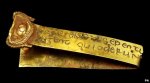
This find seems to come from the Mercian kingdom, about which Bede had relatively little to say, because they remained pagan. But among the discoveries is this item which has engraved on it, in Latin, “Rise up O Lord, and may thy enemies be dispersed and those who hate thee be driven from thy face.”

Here’s an image of it:

image1

Historians and art historians will have much to ponder.

Candlemas

Today, February 2, is the Feast of the Presentation in the Temple. It is one of the most ancient commemorations in the church calendar, and has undergone significant transformation over the centuries. It honors the story in Luke 2 in which Joseph and Mary bring the infant Jesus to the temple. This was a practice in Judaism of the day when a mother would come to temple on the 40th day after birth, to offer sacrifices and be ritually purified. In the Luke story, Mary brings two turtledoves, the sacrifice specified for poor women. One of the focal points of the story is the song of Simeon, which he sings after seeing Jesus. Known as the Nunc Dimmitis, it begins “Master, now you are dismissing your servant in peace, according to your word, for my eyes have seen your salvation….”

In earlier centuries, this feast day was known as Candlemas. It was the day when the priest blessed the beeswax candles that would be used in the church in the coming year, and laypeople could bring their candles for blessing as well. Mary’s coming to the temple on the fortieth day after giving birth in keeping with Jewish observance had an a significant impact on medieval religious practice. In most of western Christianity, a similar rite “The Churching of Women” was observed on the 40th day. It remained in the prayer book until the 1979 revision. In the sixteenth century, when continental Protestants attempted to do away with it as “popish superstition” they met strong resistance from women, for the celebration had become an important rite of passage and reintegration into the community after childbirth.

Candlemas is a feast day rarely observed by contemporary Episcopalians—we don’t often even use beeswax candles any more. At St. James, most of our candles use oil rather than wax but it had cultural as well as religious significance. One of the legends in England said that a wintry Candlemas would make for a late spring, which is probably the origin of the idea of Groundhog Day.

Perhaps the most important part of the gospel story is Simeon’s song of praise, which is regularly used in the liturgy, especially in the daily office, at evensong or compline. The prayerbook version reads:

Lord, you now have set your servant free

To go in peace as you have promised

For these eyes of mine have seen the Savior,

Whom you have prepared for all the world to see:

A Light to enlighten the nations,

And the glory of your people Israel.

Theodora’s robe

In my sermon yesterday, I mentioned a mosaic in the church of San Vitale, Ravenna. The two mosaics to which I alluded show the Emperor Justinian and Empress Theodora bringing forward the elements for communion. Here is Theodora:

theodora1

Here is Justinian:

justinian1

Here’s an image from an early Christian (4th century?) sarcophagus (tomb), showing them wearing Phrygian caps

800px-early_christian_magi1

What’s a Saint?

Someone asked me to explain the place of the saints in the Episcopal Church. First, a little background. In the New Testament, “saints” was a generic term, used to refer to Christians, members of the body of Christ. Quickly though, some Christians began to receive particular honor, especially after their death, and especially if they were martyred. In the Early Church and in the Middle Ages, whether someone became a saint or not was largely a product of the initiative of those who were devoted to them. Over time, however, the Catholic Church began to develop a process for determining whether someone was a saint. Now that process involves a fairly rigorous investigation that includes medical and scientific analysis of alleged miracles.

In the sixteenth century, the saints came under fire. Most Protestants saw devotion to the saints as misguided or as downright idolatry. In the English Reformation, many of the local and obscure saints were removed from the calendar. The Roman Catholic Church elevated no one to sainthood for most of the sixteenth century.

In Anglicanism, “sainthood” isn’t really an official label. We call people saints, like the Twelve Disciples, or Mary, or prominent church figures from the Early Church and Middle Ages, like St. Francis. We tend not to call people “saints” who have been elevated to sainthood by the Roman Catholic Church since the sixteenth century unless we are very Anglo-Catholic.

The Episcopal Church, and indeed the Anglican Communion, no longer elevates people to sainthood. However, in the Book of Common Prayer, there is a calendar that provides dates to commemorate not only the saints of the New Testament and Church History, but also people who have led exemplary lives in more recent times. The daily office calendar provides biographies of these people. You can find it here. Additions to the calendar are made by General Convention.

Samuel Seabury and the Anglican Communion

Today, we commemorated the consecration of Samuel Seabury as the first bishop of the Episcopal Church in America. As I was preparing for this evening’s Eucharist, the appropriateness of his story for our current situation struck me. Before the American Revolution, Anglicans in the colonies were under the authority of the Bishop of London, which meant that all clergy for the American church came from England, and there was no direct episcopal care of the faithful in the colonies. On top of that, the Book of Common Prayer was the 1662 Book of Common Prayer of the Church of England, which included prayers for the king.

In my old parish in Newburyport, MA, we had the prayer book of the priest who served that parish during the Revolution, Edward Bass, who would later become the first bishop of Massachusetts. He crossed out all of the prayers to the king in his prayer book and wrote in prayers for the Congress. In New England, Anglicans like him were viewed with suspicion by most revolutionaries, because they tended to be supporters of the crown.

After the peace was signed, Seabury was sent by a group of Connecticut clergy to seek episcopal ordination in England. After waiting a year, he abandoned his efforts in England, because he would not vow allegiance to the British crown, and the English bishops would not consecrate him without that vow. So he went to Scotland, where the bishops of the Scottish Episcopal Church were not kindly disposed to English rule. They agreed to consecrate him if he would agree to seek the American Church’s adoption of the Scottish Book of Common Prayer.

From the perspective of the twenty-first century, a vow of allegiance to the British crown seems a minor thing to hold up the consecration of a bishop. I wonder what Anglicans in the twenty-fourth century will make of our current controversies?

God and Empire

I was able to attend one of John Dominic Crossan’s presentations at Furman’s Pastors’ School this week. Crossan, a retired New Testament professor at DePaul University, has been at the forefront of New Testament scholarship for many years. He made a name for himself as one of the leaders of the Jesus Seminar and has published many books on the historical Jesus and early Christianity. He was prominently featured on the PBS documentary “From Jesus to Christ” which I often use when teaching Bible.

Given what I took to be his radical approach to the historical Jesus, I was curious to see what he would have to say to an audience of pastors. The presentation I heard was largely taken from his most recent work, God and Empire. His main focus was on the role of violence in human civilization and the way in which the Bible supports and undermines that culture of violence. He contrasted two notions of divine justice in the Bible. One is retributive in which God is understood to punish evildoers. The other is distributive, in which there is a vision of God offering equality to all. One of his tag phrases was “God does not punish, but there are human consequences for our actions.” He used the example of someone sitting down on an interstate highway. If they die, it is not because of God’s punishment, but because of their choice to behave in that fashion.

In the later presentations I’m sure he went on to argue that Jesus’ proclamation was one of distributive justice; that is to say that the Kingdom of God as envisioned by Jesus included all people and treated all equally. He further argued that because Christians view Jesus as the incarnate word of God, his vision ought to be the criterion by which we judge other biblical (and non-biblical) notions of justice. In other words, while there are two understandings of divine justice in the bible, one distributive and one retributive, one non-violent and one violent, because Jesus articulated the former, Christians have the obligation to view that one as authoritative.

It was an interesting, challenging, and humorous presentation. Look for a Discovery Channel documentary featuring him to play at Christmas.