“The Archbishop of Canterbury condemns Henry VIII to hell!”

Well, not really. He preached a sermon at the Charterhouse, where in 1538, 14 Carthusian monks who refused to submit to Henry’s reforms, most importantly the Act of Supremacy and the dissolution of the monasteries. In 1611, the Charterhouse became the site of an Almshouse, which it remains. In recent years, there has been an annual commemoration of the martyrs’ and an effort to use the event as rapprochement between Catholics and Protestants. Williams’ sermon explores the connection between the suffering of Christ on the cross and the suffering of martyrs. He argues that as long as there is suffering in the world, Christ is in agony as well.

Williams points out that rulers more ruthless than Henry sought to destroy Christianity, but that they have been unsuccessful. The cross stands as a witness to the brutality of evil, but it also is a symbol of God’s ultimate triumph, the triumph of justice.

The money quote:

We treasure with perhaps a particular intensity the martyrdom of the contemplative, because the contemplative who knows how to enter into the silence and stillness of things is, above all, the one who knows how to resist to resist fashion and power, to stand in God while the world turns. In that discovery of stillness lies all our hope of reconciliation, the reconciliation of which John Houghton spoke in this place, this place where we are met to worship, before the community gave its answer to the King’s agents.  A reconciliation of which he spoke (as do so many martyrs) on the scaffold, a reconciliation which is not vanquished, defeated, or rendered meaningless by any level of suffering or death. If Henry VIII is saved (an open question perhaps) it will be at the prayers of John Houghton.  If any persecutor is saved it is at the prayers of their victim. If humanity is saved, it is by the grace of the cross of Jesus Christ and all those martyrs who have followed in his path.

It’s difficult to face the very human and fallible origins of Anglicanism, in the sixteenth century and in the seventeenth. But as hard as that is, we also need to face the same in our present church. The last two sentences of the quotation above remind us of our complicity in persecution, in every age.

The full sermon is here.

Thinking about History

I’ve been thinking about the uses of history. Perhaps, there’s something remaining from the post in which I talked about the burden of tradition that I sense troubles the Archbishop of Canterbury. Then I came across this essay by Diana Butler Bass, excerpted from her book A People’s History of Christianity.

I will grant that most contemporary Christians know little about the history of Christianity. My experience teaching college students was that for Evangelicals, the two thousand years that separated themselves from the world of the New Testament didn’t exist. Trying to get them to understand the very different historical context of the first century was inordinately difficult and getting them to take interest in the lives of Christians in the intervening centuries was almost impossible. With the demise of denominationalism, few of them were even curious about the historical origins of different understandings of the sacraments and other practices.

Bass seems to link the waning interest in history to the Enlightenment and modernity and sees mainline denominations as especially tempted to do away with it altogether. Certainly the Enlightenment bears some responsibility as seventeenth and eighteenth century thinkers tried to break away from the burdens of the past.

I wonder whether the problem isn’t so much ignoring the past as it is constructing a useful past. History is very much contested. In recent months we’ve had controversies over the changing Texas schoolbook standards with their purging of progressive voices and even those aspects of the past that don’t fit in with a conservative Christian reading of American history (like Thomas Jefferson). We’ve had Southern governors honor Confederate History Month with nary a mention of slavery. For many churches, for many Christians, the past isn’t useful because it drags up too much baggage. That’s true for progressive Christians, Evangelicals, and Roman Catholics.

Tradition can be a burden. The stories we tell help to define us individually and as communities, but it is our responsibility to those communities, today and in the past, to tell those stories honestly. I wonder if that’s not part of what burdens the Archbishop of Canterbury.

Gregory the Great, March 12

Today is the commemoration of Pope Gregory the Great, one of the shapers of medieval Christianity. A member of an old senatorial family who rose to the top of the imperial hierarchy in Rome, he withdrew from public service, founded a monastery in one of his family’s homes in Rome. But his education and diplomatic expertise pressed him into service as a papal legate to the Emperor in Constantinople. He returned to Rome and was acclaimed pope in 591.

Among his achievements: the mission of St. Augustine of Canterbury to England, liturgical revision (the common name for medieval chant “Gregorian” chant bears his name). He was  profound theologian, exegete, and pastor. His On Pastoral Care shaped the ministry, his Moralia in Job a model of biblical scholarship for centuries. He used his family’s wealth to feed the Roman people during famine and pestilence, and his administrative skill secured papal primacy in the west.

Among the most popular legends of Gregory in the later Middle Ages was the story that once as he was celebrating mass, he heard someone deny transubstantiation. Praying for a sign to prove the reality of the bread and wine becoming Christ’s body and blood, suddenly an image of the crucified Christ appeared before him and all the people. Here’s artist’s rendering of that legend:

More on Holy Women, Holy Men

I’ve continued to think about my reaction to Holy Women, Holy Men. My earlier post is here. It was initiated on Friday when I went on Episcopal Cafe and found no mention of the Martyrs of Japan and instead a quotation from a work on Anne Hutchinson. I think I’ve figured it out. I’ve not read it carefully. It’s not available in print and I haven’t been interested enough to go back to the materials presented at General Convention. So, my only exposure to it is through Episcopal Cafe.

Speaking to the Soul provides no historical context for Williams and Hutchinson, no discussion of what influenced them. There’s nothing that would help a non-expert make any sense of their relation to Anglicanism, why they are worth commemorating, and how their commemoration might enrich our current life as a communion.

To me, that reeks of arrogance–assuming that anyone who is of interest religiously or spiritually is inherently worth recognizing by Anglicans and worth coopting.

Granted, I come to this as someone from an outsider background whose academic specialty was religious outsiders. Still, I think it more hubris than humility to pay lipservice to the diversity within Christianity without acknowledging it, and without acknowledging the deep differences that persist between the Anglican tradition and others, like the Baptists, of whom Williams was one of the leading lights.

The Martyrs of Japan, 1597

February 5 (in the “old” calendar of the Episcopal Church) commemorates the Martyrs of Japan, Franciscans who were crucified in an act that marked the beginning of the end of the remarkable expansion of Christianity in sixteenth-century Japan.

Few American Christians, especially non-Catholics, are aware of the missionary expansion of Christianity across the world in the sixteenth century. Perhaps that expansion is best exemplified by St. Francis Xavier, a Jesuit who was one of Ignatius Loyola’s first companions and who took up the missionary enterprise when Ignatius himself was unable to do so. He traveled first to the Portuguese colony of Goa in India, then to the Philippines, and finally to Japan. He died as he was preparing a voyage to China.

Christian missionaries met with great success in Japan. It’s estimated that by the end of the sixteenth century, there were some 300,000 Christians. Unfortunately, competition between the religious orders and conflict between Spain and Portugal contributed to the ultimate rejection of Christianity by the Japanese state and Christianity’s virulent suppression. Part of the story is told brilliantly in the novel Silence, by Shusaku Endo.

Perhaps most remarkably, in spite of intense persecution, Christianity went underground and survived in Japan. Indeed, when Japan was forced open in the 1850s and European missionaries arrived, they encountered small groups of Christians who had maintained their faith through the centuries. Some of them adopted the Christianity they now encountered, others maintained the faith and practice that had evolved during the centuries of persecution. Their story is told in a moving documentary Otalya: Japan’s Hidden Christians.

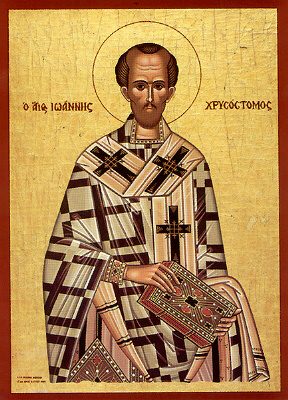
St John Chrysostom, January 27

St. John Chrysostom, whom we remember today, was one of the great theologians and bishops, and perhaps the greatest preacher in the early centuries of Greek Christianity. Born in Antioch in 349, he spent some years as a monk and apparently practiced extreme ascetism. Ordained a deacon in 381 and a presbyter in 386, his preaching brought widespread fame. Because of his renown, he was made Archbishop of Constantinople in 398. In Constantinople he repeatedly aroused the wrath of the imperial court and was banished twice and died in exile in 407.

He is most famous for his sermons, of which many survive. He attacked the ostentatious show of wealth and repeatedly urged his listeners to care for the poor. Here is an excerpt from a homily on Matthew 14:

For what is the profit, when His table indeed is full of golden cups, but He perishes with hunger? First fill Him, being an hungered, and then abundantly deck out His table also. Dost thou make Him a cup of gold, while thou givest Him not a cup of cold water? And what is the profit? Dost thou furnish His table with cloths bespangled with gold, while to Himself thou affordest not even the necessary covering? And what good comes of it? For tell me, should you see one at a loss for necessary food, and omit appeasing his hunger, while you first overlaid his table with silver; would he indeed thank thee, and not rather be indignant? What, again, if seeing one wrapped in rags, and stiff with cold, thou shouldest neglect giving him a garment, and build golden columns, saying, “thou wert doing it to his honor,” would he not say that thou wert mocking, and account it an insult, and that the most extreme?

Let this then be thy thought with regard to Christ also, when He is going about a wanderer, and a stranger, needing a roof to cover Him; and thou, neglecting to receive Him, deckest out a pavement, and walls, and capitals of columns, and hangest up silver chains by means of lamps. Homilies on the Gospel of Matthew, 50, (from http://www.ccel.org)

He is also famous for a series of sermons directed against Jews, the full texts of which can be found here.

In addition to his sermons and many other writings, The Liturgy of St. John Chrysostom continues to be used by Orthodox Churches. An English translation is found here.

The “Prayer of St. Chrysostom,” which appears in The Book of Common Prayer, is a late-medieval addition to the Liturgy of St. John Chrysostom and was not written by him.

Wolf Hall update

Finished it and have been reflecting on it ever since. I’m still not sure about the title, but of course the Seymours would loom large over the next stage of Cromwell’s life. I also liked the constant presence of Mark Smeaton, foreshadowing events to come as well. The final scenes of the novel were quite powerful. In the end, I found the depictions of both More and Cromwell utterly believable.

As I thought about the novel, I also thought more about my perspective on the 1530s, that first phase of the English Reformation. I suppose it’s safe to say my scholarly judgement was largely shaped by my own Protestant upbringing. In addition, my undergraduate senior thesis focused on the early English reformers’ attacks on the wealth of the church. In researching that project I read almost everything written in the 1520s and 1530s against the Catholic establishment and I gained a deep appreciation for the theological and ethical commitments of the early reformers like Tyndale, Frith, and Latimer. They had a vision of a church and state that were very different from the institutions that existed, and the ones that emerged in the course of the English Reformation.

Cromwell used those reformers to support his efforts to dissolve the monasteries. Of that there is no doubt. That the reformers’ ideals were not realized is also true. But somehow over the last 150 years or so, the Protestant side has tended to get the blame for what happened.

But between More and Cromwell, I suppose I would still choose Cromwell. For all of Cromwell’s faults, I find More’s choices, and his theological positions, deeply troubling.

It’s interesting finishing that book over the holidays when the attempted bombing of a Northwest flight is in the news and there is again talk about the use of torture in the media. Andrew Sullivan’s blog, as always, keeps a close watch on all of the outrageous statements by politicans and pundits. More’s problem, from my perspective, was his absolute sense of certainty. That’s always a danger, because if you know you are right, than any means you use will be justified.

Religion’s return to the historical profession

Until recently, I was a historian. I suppose I still am, though I’ve not done any serious historical research in quite some time. But for fifteen years, I taught the History of Christianity in Religion departments. During that time, I worked closely with colleagues from History Departments and my own research was more interdisciplinary than purely “religious” in content. Still I struggled to carve a niche for myself and my discipline both within the Religion Department, and over against medievalists and early modern historians in History Departments. It was actually amusing at times when we were team-teaching Humanities courses to divvy up the lectures.

A recent survey put out by the AHA has gotten considerable press because “Religion” is now the most popular topic for researchers. What most of the articles don’t point out is that it received a total of 7.7% of the responses, beating out “Cultural History” by 0.2%. That’s hardly earth-shattering. One blog post discussing this is here.  I’m especially amused by the quotation from David Hollinger:

Religion is too important to be left in the hands of people who believe in it. Finally, historians are coming to grips with this simple truth.

That’s quite beside the point. What matters is how one approaches religion, what kinds of questions one asks, what methodology one uses. And how do you assess belief? How do you interpret claims of the supernatural, claims of revelation? These are questions that scholars of religion have struggled over for more than a century. Their answers are not particularly satisfying, but it would be helpful for historians to have some sense of that tradition so they can avoid making the same mistakes.

All this puts me in mind of a plenary session of the Sixteenth Century Studies Conference a decade or so ago where participants were anguished over the decreased investment by institutions in early modern history. Any number of people stood up to say how important it was to teach the Protestant and Catholic Reformations so students could understand where their faith traditions came from. These arguments came exclusively from people trained in social history and teaching in history departments. In fact, that was a primary reason I chose to do my degree in Religious Studies rather than History, so questions of faith could be addressed in the classroom.

Wolf Hall

I’ve been reading Hilary Mantel’s Wolf Hall over the holidays. It’s a marvelous book. There was a time when I could have rattled details of the English Reformation off the top of my head; I still could do it, I suppose. Cromwell is rarely depicted by historians as a sympathetic figure. Certainly not in recent years as revisionism has set in. Mantel makes him a human being–ruthless, power-hungry, acquisitive, to be sure, but with deep affection for his family, for Wolsey, and for those young men who have been given over to his care.

She also fleshes out Thomas More. At least since A Man for All Seasons if not for centuries earlier, More has been depicted as a gentle man of letters and deep religious faith. He was both of those things but he was also a ruthless hunter of religious dissidents and a tireless, and humorless polemicist against William Tyndale. For those who know him only as the author of Utopia and someone who died for his faith, a few hours spent reading his attacks on Tyndale will shed very different light on him.

I’m not quite done with the book which ends with More’s execution. It’s not clear why one would choose this particular period of Cromwell’s life on which to focus–from the fall of Wolsey to the execution of More. In some respects, the years immediately following More’s execution are even more interesting, with the execution of Anne Boleyn, the dissolution of the monasteries, and ultimately Cromwell’s fall.

For another interesting take on Cromwell, I would recommend the mystery novels of C. J. Sansom which are vivid portrayals of the religious and political turmoil in the 1530s and 1540s.

By the way, either is a much better portrayal of the period than the recent TV series The Tudors.

20th Anniversary of the Fall of the Berlin Wall

I suppose I need to write about this, if only because I experienced a tiny bit of the German Democratic Republic in 1980, and visited Berlin in 1991, after reunification. When I studied in Marburg in 1979 and 1980, one of the stark realities I immediately confronted was the Cold War. I remember walking in the countryside not far from the border with East Germany and having “tank traps” pointed out to me by my hosts. I remember conversations with a dorm-mate who was an officer in the Bundeswehr reserve. His unit’s mission was to hold the line for twenty minutes in case of Soviet invasion, to give the Amis ample time to shoot off their nuclear missiles. I remember living through NATO exercises, the daylong drone of tanks driving on the autobahn through Marburg.

Most memorable of all was the week-long visit to East Germany. We toured Dresden, Leipzig, and some of the countryside. It was gray, depressing, and lifeless. Everyone we talked to spouted regime propaganda, and we had two tourguides whose job was to make sure they each stayed in line.

I followed events in 1989 with great interest and was excited about the prospect of experiencing the final events of reunification in 1990. We took the train from southern Germany to Berlin in February of 1990 and were fascinated by what we saw. Reunification meant people purchased cars and satellite dishes, but buildings remained in disrepair. It reminded us a great deal of travelling through the South where one might see a satellite and brand-new car outside of a derelict house trailer.

One of my lasting memories is pulling into a train station in the East–it might have been Jena, but I don’t remember. On the platform opposite were lots of people standing waiting for another train. They had piles of stuff; luggage, trashbags full of personal items, furniture. I even saw a toilet commode. As Corrie and I watched a train pulled in. It was marked with the insignia of the Soviet Army. Apparently, it was families of Soviet soldiers waiting for the train that would return them home. As we later learned, Soviet soldiers and their families stripped their bases of everything that was moveable.

When we got to Berlin, the changes were obvious. There were only a few places where the wall still stood. Checkpoint Charlie, which I remember passing through in 1980 was no longer used. It was as if history was being erased in front of our eyes.

For a few months in 1989 and early 1990, there was a sense that something new might emerge from the wreckage of the Soviet Bloc. That was true in Czechoslavakia as well as in East Germany. Unfortunately, it didn’t happen. At the time, many referred to reunification as “Anschluss” the term Hitler used to refer to the integration of Austria into the Third Reich.