
Antony the Great

Today is the commemoration of Antony the Great in our liturgical calendar. Here’s a homily I prepared on him a couple of years ago:
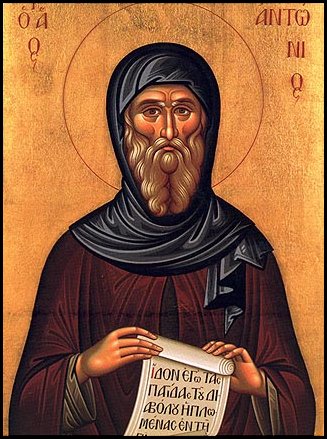
Antony is one of those saints who has been a fixture in the liturgical calendar for centuries. And rightly so.  Antony is one of the most important figures in the birth of monasticism. Antony lived in the third and fourth centuries. We’re not exactly sure of his dates, but the best guess is that he lived from 250 to 350 or thereabouts. He lived in Egypt, was the child of wealthy Christian parents, and after their death, while he was still a young man, he heard the gospel for today read and decided that was what he wanted to do. He put his sister in a convent, gave away his money, and went off into the desert to seek intimacy with God. Over the years, he moved further and further away from civilization, but wherever he went, he was pursued by curiosity seekers and by would-be disciples. Occasionally he would return to the city. We know that when he was a very old man, he went to Alexandria, which was the Egyptian metropolis, and the leading center of Christianity in the region, at least twice, and conferred there with bishops.

The flight from the city into the wilderness was not unique to Christianity in Antony’s day. Wealthy people had begun to abandon the city for the countryside, where they could live in leisurely quiet. Poor people fled the city to seek food, shelter, and protection. What set monasticism apart was the certainty that the city was an evil place, that the wilderness was more suited to the pursuit of God.

This tension between city and wilderness is deeply ingrained in our own culture and in the cultures that gave rise to the biblical writings. It’s been a very long time since we in America saw urban life as the ideal.. We may not prefer the wilderness to the city, but we certainly tend to distrust the city, and all that it represents. Longer ago, the distrust of the city and even the town ran much deeper. When I was a boy, my mother read the books of Laura Ingalls Wilder to my sisters and me. If you remember them, you remember that Pa was always on the move further west, further into the wilderness; as soon as he could see the smoke from a neighbor’s chimney, he was ready to find somewhere new to live.

Antony did much the same, and indeed throughout the Middle Ages, monks settled in the wilderness, in places as remote as possible. There’s something of an irony here, however, for wherever monks went, laypeople quickly followed them. Antony’s biographer, Athanasius, said of Antony that “he made the desert a city.” By that he meant two things; first: Antony and the monastic ideal were so popular that perhaps thousands followed him into the desert; second, that in their communities, the monks created a new kind of city, focused on the worship of God.

The wilderness also plays a role in the story of Jesus. Jesus was baptized by John, who lived in the wilderness, dressed in camel’s hair, and ate locusts and wild honey. People came out into the wilderness to see him. He seems to have been something of a curiosity, but the encounter with John changed people’s lives. In the weeks to come, we will hear of Jesus’ own journey into the wilderness, where he will be tempted by Satan.That encounter with Satan in the wilderness seems to be a turning point. It comes immediately after his baptism, and after the baptism, Jesus returns to Galilee and begins his public ministry.

Usually when we think of the image of wilderness, we think of wasteland, of danger and violence. In the language of spirituality or religious life, the wilderness is often used as a metaphor for a period of intense struggle, or perhaps a feeling of alienation from God. For Antony and the other Egyptian monks, the wilderness or desert was not a place of alienation from God. Rather, it was a place that enabled intimacy with God. Stripped bare of everything but the essentials, the monk could focus only on what really mattered—his or her relationship with God.

Compared to Antony, of course, our lives are much more complex. The idea of throwing it all away for the opportunity to focus on one’s relationship with God may seem appealing occasionally, but few of us would ever act on that impulse. We all have those times in our lives when it seems as if we are in a desert, when the old way of doing things, our lives and lifestyles, seem difficult or meaningless. Sometimes, in those deserts, we seem to be all alone, abandoned even by God. That feeling of abandonment was not foreign even to those monks and nuns of the early centuries of Christianity. They left behind stories of their struggles with temptations and their struggles to deepen their relationships with God. Antony’s example reminds us that even there, in the wilderness, God is present.

Antony’s life and lifestyle may seem completely alien, perhaps even bizarre to us. Few of us would ever contemplate, at least for more than a moment, throwing everything away in our pursuit of God. That’s exactly what he did, and we might wonder about the impact of that decision on those around him—on his sister who he put in a convent. But his example is also a lesson that we respond to the call of God in very different ways. Today’s gospel led Antony into the wilderness. The very same words of Jesus, nearly 1000 years later, spurred St. Francis to begin a very different form of the religious life, focused on poverty, on preaching, and reaching out to those in need. The question for us is how do we respond, authentically and passionately, to the call of Jesus today?
Blood Libel

It’s not often that concepts from Medieval or Early Modern history enter contemporary political discourse, but “blood libel” did today. The term refers to the myth that Jews ritually murdered Christians, especially children, and especially at Passover. The first example is from twelfth-century England, where the accusation was made after a young boy, William of Norwich, went missing and was later found dead. He became the object of religious devotion. The story eventually found its way into Canterbury Tales.

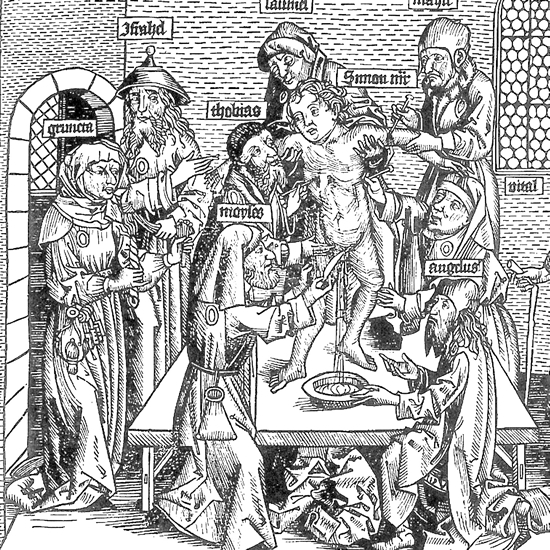
The Blood Libel had a long history after that. Among the most famous was Simon of Trent, in 1475. R. Po Chia Hsia wrote a book-length study placing this event in the larger historical and religious context. The Myth of Ritual Murder is worth reading.

There have been several discussions of the historical meaning of the term in today’s media.  Salon provides background, including quotes from Hsia.

Here’s a contemporary woodcut of Simon of Trent:

The Blood Libel persisted long after trials ended around 1600 (they were repeatedly denounced by both secular and religious authorities in Europe). In fact, there was an accusation in New York state in the early twentieth century.

While completely baseless, the myth of the Blood Libel points to the depths of Christian anti-Judaism, and later to Antisemitism. And it continues to resonate.

Reading a little Aelred of Rievaulx

Tomorrow is his commemoration. Here’s what I wrote last year. Aelred (1132-167) was an English Cistercian Abbot during the golden age of the Cistercian order. He is noted for his writings on friendship and love, but today  I reread part of his pastoral prayer. He prays to Jesus Christ on behalf of the monks under his care:

My understanding and speaking, my leisure, my activity my doing and thinking, my good and ill fortune, life and death, health and sickness–let absolutely all that I am, experience, feel and understand be employed and expended for them, for whom you yourself did not scorn to expend your very life. And so I pray you teach your servant, Lord, teach me by your Holy Spirit how I may spend my substance for them. Grant, Lord, by your grace, that I may bear patiently with their frailty, sympathize kindly and support with tact. Let your Spirit teach me to console the sad, strengthen the faint-hearted, raise the fallen; to be weak with the weak, indignant with the scandalized and to become all things to all men, that I may win them all.

His prayer is a powerful reminder to all of us with the cure of souls, of the importance of praying on behalf of those in our care. He prays for their material needs, but also for their spiritual needs:

pour your Holy Spirit into their hearts that he may keep them in unity of spirit and the bond of peace, chaste in body and humble of mind. May he himself be with them when they pray and inspire the prayers it pleases you to grant. May the same Spirit abide in those who meditate, so that, enlightened by him, they come to know you and fix in their memory the God whom they invoke in their distress and look to in time of doubt. May that kind comforter be swift to succour those who struggle with temptation and sustain them in the trials and tribulations of this life.

These quotations are from The Cistercian World: Monastic Writings of the Twelfth Century (Penguin Classics), translated and edited by Pauline Matarasso.

It’s January 10, the commemoration of William Laud

I said my piece last year on this date, so instead of rehashing that, I will point readers to Affirming Laudianism.

Its primary aims are:

  • The wearing of copes at the Holy Communion;
  • The application of Laudian frontals to Altars;
  • The use of silver candle sticks and incense at divine worship, in accordance with the principles of The Parson’s Handbook;
  • Bowing at the Holy name and during the Gloria Patri

Laudable, I’m sure.

The Archbishop of Canterbury on the Bible

In his New Year’s message this year, the ABC used the 400th anniversary of the King James Bible as a starting point:

Perhaps someone some time has said to you that you shouldn’t hide your light under a bushel. Or told you to set your house in order. Maybe you only survived a certain situation by the skin of your teeth. Perhaps it’s time you listened to the still small voice within.

All those everyday phrases come from one source – a book whose four hundredth anniversary we celebrate this coming year, the King James Bible – or the Authorised Version as it’s sometimes called.

He points out the important role the KJV had in shaping the language and the vision of the English-speaking world; that it provided generations with a story in which they could locate themselves. It may not play that role any longer, but Archbishop Williams went on to say that we all need some such story with which to orient our lives.

The full text of his message is here: Scroll down below the video and the summary for the full text.

A couple of things to point out. First, he acknowledges that the language of the KJV was already somewhat archaic by 1611 and purposely so; to add gravitas, no doubt. What he doesn’t point out was that the translation was both a political and religious act. King James VI, recently crowned king of England, wanted a version that would supplant the “Geneva Bible” preferred by Puritans.


New perspectives on medieval warfare

A recent archaeological find has upended traditional views of medieval warfare (and medieval culture, too). Discovery of a mass grave in Towton, England, that dates from the Wars of the Roses has allowed scholars to learn a great deal about warfare and even living conditions. Contemporary accounts estimate 28,000 men were killed in the battle that occurred in December 1460 and a modern scholar estimates that as many as 75,000 men fought that day, 10% of the country’s fighting-age population.

Among the discoveries: the first use of lead shot in England, and perhaps a fragment of the first handgun. More interestingly was the extent of injuries to the dead. In addition to evidence of wounds from earlier battles, many of those killed were struck multiple times.

Most interesting to me was this:

Yet as a group the Towton men are a reminder that images of the medieval male as a homunculus with rotten teeth are well wide of the mark. The average medieval man stood 1.71 metres tall—just four centimetres shorter than a modern Englishman. “It is only in the Victorian era that people started to get very stunted,” says Mr Knüsel. Their health was generally good. Dietary isotopes from their knee-bones show that they ate pretty healthily. Sugar was not widely available at that time, so their teeth were strong, too.

That leads to a reassessment of the late-medieval standard of living, at least in England. BTW, 1.71 m is roughly 5’7″. And the savagery puts paid to the notion of gallantry and chivalry in medieval warfare.

The full story is here.

David Hall on Puritans and Thanksgiving

According to his Op-Ed in the NYTimes today, the first Thanksgiving undoubtedly included turkey. More importantly, Hall, a professor at Harvard Divinity School, attempts to set the record straight on the misconceptions we have about the early New England colonists.

Hall stresses the political legacy of the Puritans. They were suspicious of hierarchy, both political and religious and sought to keep rulers on a short leash. Their congregational polity invested power in the laity, not in the clergy. Politically, they required annual elections and required that any law needed the consent of the governed to be valid.  In 1648, the Mass. Bay Colony published the first code of laws in the Anglo-American world.

According to Hall, they also sought the common good:

Contrary to Hawthorne’s assertions of self-righteousness, the colonists hungered to recreate the ethics of love and mutual obligation spelled out in the New Testament. Church members pledged to respect the common good and to care for one another. Celebrating the liberty they had gained by coming to the New World, they echoed St. Paul’s assertion that true liberty was inseparable from the obligation to serve others.

Another reminder of the importance at getting history right.

The Resurgence of Calvinism

The Episcopal Cafe points to a lengthy article in the Christian Science Monitor that discusses the increasing appeal of Calvinism among some contemporary Christians. The article appeared some months ago and focuses on the appeal of certain Calvinist tenets for contemporary Americans seeking deeper religious experience and formation.

I first encountered this phenomenon some years ago when I was living and teaching in upstate South Carolina. One of the local papers did an article on the controversy between 5 point (TULIP) and 7 point Calvinists that was leading to division within denominations, especially among Baptists. The CSM article claims that as many as 1/3 of recent Southern Baptist seminary grads identify themselves as Calvinist.

The article also observes that this development, however strong it may be, goes against two other powerful strands in contemporary American religion. One is the “prosperity Gospel” of many Evangelicals. The other is the flattening out of religious difference and the fact that according to the Barna survey, only 9% of Americans hold to what the survey calls a “biblical worldview.”

What interests me most is the reference to this article at this late date on the Episcopal Cafe, and to the comment thread that has ensued. It was correctly observed that despite the presence of Martin Luther in Holy Women, Holy Men there is no commemoration for Jean Calvin, even though Calvin exerted a much greater influence on the development of the Protestant Reformation in England.

Most of the comments decry Calvin’s influence in Anglicanism and in larger Christianity. I’m no Calvinist, by any means, and I don’t find his theology particularly compelling, either in its take on Christianity or as an intellectual exercise. Still, he was a brilliant theologian, and it is fascinating to follow his logic to its conclusions.  And I should think that if we commemorate all those other folk in our church calendar, there ought to be room for him.

Rebels and Traitors

I just finished reading Lindsey Davis’s Rebels and Traitors. It’s a historical novel set during the English Civil War of the 1640s and 1650s.

I’m a huge fan of her Marcus Didio Falco mystery series, set in the Roman Empire during Vespasian’s reign. They are wonderful reads, funny, engaging and full of historical detail.

Unfortunately, Rebels and Traitors misses on the first two of those. It is full of historical detail, overly full, reading much of the time as academic history, though without the footnotes. Sometimes it seems as though she felt compelled to provide much more detail than was necessary to propel the plot forward. Or perhaps it was that the civil war and the protectorate was the story she wanted to tell, and could think of doing it in no other way than through historical fiction.

Only rarely does the comedic genius she shows in the Falco novels come to light and the characters are almost all wooden, their dialogue stilted.

Still, there are some interesting bits. She attempts to provide as broad a view of the historical canvas as possible, telling the story through the eyes of participants who fought on both sides, and including characters who were Levellers and Ranters as well as the more likely Cavaliers.

Here’s an example, though, where history may be more interesting than fiction.

“What did Jesus do?” by Adam Gopnik

Gopnik writes a solid summary of the current scholarly consensus (such that there is one) concerning the gospels and the historical Jesus. It’s well worth a read. It’s also quite dense so it bears close attention.The article is here.

I find his assessment of Bart Ehrman especially amusing:

The American scholar Bart Ehrman has been explaining the scholars’ truths for more than a decade now, in a series of sincere, quiet, and successful books. Ehrman is one of those best-selling authors like Richard Dawkins and Robert Ludlum and Peter Mayle, who write the same book over and over—but the basic template is so good that the new version is always worth reading.

If one thing seems clear from all the scholarship, though, it’s that Paul’s divine Christ came first, and Jesus the wise rabbi came later. This fixed, steady twoness at the heart of the Christian story can’t be wished away by liberal hope any more than it could be resolved by theological hair-splitting. Its intractability is part of the intoxication of belief. It can be amputated, mystically married, revealed as a fraud, or worshipped as the greatest of mysteries. The two go on, and their twoness is what distinguishes the faith and gives it its discursive dynamism.