The 125th Anniversary of the Vilas Window

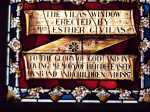
When precisely Grace Church’s oldest stained glass window, the “Resurrection” Window, was dedicated, is unclear. Various historical accounts claim it was on Holy Innocents’ Day, December 27, 1887. Then as now, however, Holy Innocents was observed on December 28. My guess is given that it was in memory of Esther Vilas’s husband and five of her children, the connection with Holy Innocents is correct and an error down the line turned the 28th into the 27th.

The Vilas family was among the most important families in Madison in the second half of the nineteenth century. Mrs. Vilas’ husband, Levi, served as Madison’s mayor and their son William was a US Senator, Postmaster General, and Secretary of the Interior under President Grover Cleveland. William’s daughter Cornelia is memorialized in Grace’s Vilas Guild Hall and his son Henry by the Henry Vilas Zoo.

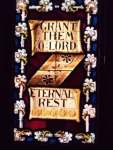
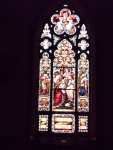
The window was made by Cox and Sons of London, England. The window’s colors are rich and deep and it is especially beautiful when it refracts the afternoon and early evening sun. Commonly called the “Resurrection” window, the window depicts three stories from the gospels’ accounts of Jesus’ resurrection. The large central image shows the women at the tomb hearing the angel say, “He is not here, he is risen.” The two images to the left and right are of Jesus on the road to Emmaus and Mary Magdalene’s encounter with the risen Christ in the garden. The window was restored in 2005 as a memorial to Mrs. Betty Kurtenacker with funds raised by the Episcopal Church Women.

Some photos of the window are here:

First Monday: Food, socks, and fun

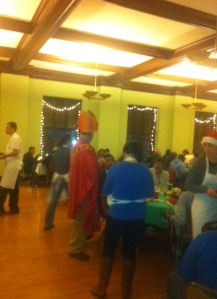
It’s become a tradition at Grace. The First Monday in December, our regularly scheduled dinner with entertainment for guests of the Drop-In shelter and community, is St. Nick’s Day. We make sure there’s great food; Christmas carols and Holiday songs sung by our Sunday School kids and adult choir and St. Nick himself appears to hand out new warm winter socks for our guests.

The menu was ham, macaroni and cheese, green beans, and cupcakes. Helping us serve were youth from Grace and St. Andrew’s as well as many of our regulars. We planned for 150 but probably had somewhere around 110 or so. It was 64 outside when we began to serve and I suspect many of those who might have joined us if the temps were more seasonal decided to stay outside for the night and forage for food. A couple of pics:

photo(2)photo(1)photo


As always, the guys were very appreciative of both the food and fellowship. Because of the relatively leisurely pace of the evening, there were lots of opportunities to sit down and visit with the guests, hear their stories and make a human connection with some of them. It was especially neat to see the intergenerational interactions and to watch how newcomers to volunteering with us jumped in both to help serve and to take the time to listen to those they were serving.


2012 Rector’s Report

Our Annual Meeting, my fourth as Rector of Grace Church, took place yesterday.

Here are excerpts of my report to the parish:

“Where Anglican tradition engages the contemporary world, Grace Church opens its doors on Madison’s Capitol Square, inviting all to join us in sharing the love of Jesus Christ in worship and in outreach to our neighbors and the world.”

Our new mission statement, appearing above and on the Annual Meeting agenda received final approval from the vestry at its October meeting. The statement was almost three years in process of development with input from vestry members, staff, and parishioners. Even Bishop Miller weighed in. The lengthy process of formulation reflects the seriousness with which those who participated in its crafting took the task, but a mission statement is not an end goal, an accomplishment. It is the articulation of who we believe we are called to be as Grace Church on Capitol Square. Now comes the greater task, living into and embodying that mission as we seek to live out and proclaim the gospel.

If there is a dominant theme in my ministry at Grace, it has to do with adapting to the rapidly changing context in which we live, both the larger culture, and more importantly, within Christianity and most particularly, within the Episcopal Church. The old certainties have given way and we are charting new territory. It’s tempting to look at the stone walls of Grace Church that have stood for more than 150 years on this corner of Capitol Square, the oldest building still standing on the square, and imagine that Grace will be here in 150 years as well. But members of our Buildings and Grounds Committee can tell you that the foundation on which those walls stand is not permanent.

The Master Plan process is one way of helping us move into the future. It is a courageous, even daring, move into the future. Our physical plant was designed with the ministry and mission needs of the nineteenth and twentieth century in mind. It no longer suits our purposes or needs. More importantly, it limits how we might engage the future and our neighborhood. It has shaped how we live in our community. The remark we so often hear from passers-by, “I walk past this building every day, but I’ve never been inside,” is more than sad; it reflects the priorities we have had—that this building exists for us and not for the city. Think about all of those marathoners or tri-athletes or visitors to Taste of Madison or Art Fair on the Square, who run or walk by the closed doors of Grace while we complain that there’s no parking. How can we connect our congregation’s life to the lives of all those who live, work, and play downtown? How can we share the good news of Jesus Christ on the sidewalks of Capitol Square, not just inside our red doors? The Master Plan and whatever renovations result from it will be a failure if we do not ask those questions as well as questions about accessibility, functionality, and attractiveness of our space.

While we work to strengthen and enhance the physical spaces of Grace Church, we also need to work on strengthening the ties of community that bind us together. Those of us involved in the Master Planning process were overwhelmed by the response and involvement of so many people in the early stages of providing input. That’s a sign of the vibrant life of our community. But we need to do more. We need to find ways of building opportunities for fellowship within the parish that go beyond coffee hour. We also need to work at deepening our relationships with Jesus Christ.

I was surprised to discover from the survey we handed out during worship services in September that more than 40% of those who responded have been attending Grace for less than five years. What are we doing to incorporate them into our parish? How are we providing opportunities to become disciples of Jesus Christ? These are urgent questions that come up again and again as I meet with newcomers who are looking for ways to get involved at Grace. I hope this will become one focus of the vestry’s activity in the coming year.

The full report (pdf) is available here: Rector’sReport_2012

The Widow’s Mite: A Homily for Proper 27, Year B

November 11, 2012

Today is our Annual Meeting. I wouldn’t say it’s the highlight of the year but it is an opportunity for us to gather in fellowship, to reflect on the past year, and to begin planning for the next year. Today may be more anticipated than in other years because we will be joined today by architects who will share with all of us what they’ve learned about Grace Church, our ministries and our building over the last months as they work toward the development of a master plan for the future.

We are at the end of a week that has seen great excitement here in Madison and around the country. The election is finally over but there are serious issues facing our country and, more ominously, Republicans are already beginning to jockey for position in the 2016 race. Whatever we discuss today at our Annual Meeting, whatever our mood, our excitement and worry about the future of Grace Church, are overshadowed by these larger concerns and issues. A few of us will also have noticed that today is Veteran’s Day, for an earlier generation, Armistice Day. Some of us will be thinking of loved ones who served and perhaps died in the military; others may be thinking of their own service and those with whom they served.

The election laid bare some of the deep divisions in our society; divisions between rich and poor, progressive and conservative, divisions of race and ethnicity. Perhaps most tragically, the deep religious divide in our country seems to have widened and become more bitter. Although President Obama did have a small Catholic majority who voted for him, Roman Catholic Bishops and many prominent conservative Protestants threw their support behind Governor Romney. At the same time, Obama won a huge majority among the religiously unaffiliated.

We may want to think such trends have no affect on our congregation at Grace. Unfortunately, that’s not true. To the extent that our culture increasingly views Christianity as beholden to one political point of view and that the number of those who claim no religious affiliation is growing, our attempts to proclaim a gospel of God’s love and inclusion will fall on deaf ears. Our work will be more difficult.

Our lessons today confront us with the reality that God’s Word stands in judgment of our culture and society, our national conversations about the role of Christianity, our values concerning the poor and needy. I know that sounds presumptuous but to take these words seriously is to call into question all of what we value. The gospel first. We are in the last week of Jesus’ life. Mark gives a clear chronology and progression of what happens in these days. On the first day, Jesus enters Jerusalem to hosannas and palm branches. He goes to the temple, looks around, then leaves Jerusalem to spend the night in Bethany. The next days he spends in the temple, teaching, but also with a series of confrontations with the religious and political leadership of Jerusalem and the Temple.

In today’s Gospel, Jesus makes a comment about the scribes. They were the official interpreters of the law: consummate insiders “who like to walk around in long robes, and to be greeted with respect in the marketplaces, and to have the best seats in the synagogues and places of honor at banquets! They devour widows’ houses and for the sake of appearance say long prayers.” The contrast with the widow is obvious. While the scribes paraded around, she brought in two copper coins, all that she had. We could hold up these two brief stories as diametrically opposed opposites, the widow’s exemplary behavior over against the hypocritical scribes.

There’s another way of thinking about these two stories that derives from the context in which they appear. Jesus has been teaching in the temple; he has been confronting, and has been confronted by, representatives of the religious and political elite. He has just pointed out the hypocrisy of much of that religious leadership. He has castigated their pride and arrogance, alluded to their wealth. Immediately after the story of the widow’s offering, Jesus and his disciples leave the temple. As they go, the disciples remark on massive size and Jesus predicts its destruction. The widow’s offering, though praised by Jesus, could also be seen as an example of the temple’s oppression of the people. Impoverished, she still gave what she had as an offering.

The mosaic law, the Torah, insist that society take care of its weakest members—the widow and the orphan. The scribes, Jesus said, “devour” literally, “gobble up” widows’ houses. Whatever the scribes’ commitment to Torah, they were disobeying one of its central values.

In the story of the Book of Ruth, we see another example of the plight of widows in Hebrew society. We hear only a small part of that wonderful book in today’s reading; the celebration after a bountiful harvest and the marriage of the widowed Ruth with the wealthy Boaz.

It is a story about love and loss, about friendship and commitment, and about our responsibility to provide for the weak and defenseless.

A man and his wife move from Bethlehem to the neighboring country of Moab during a time of famine. They have two sons, and the sons marry Moabite women—one is named Ruth, the other Orpah. The man dies, leaving his wife, Naomi, a widow. Ten years later, the two sons die, leaving their wives childless. Naomi decides to return to Bethlehem since the famine is over, in hopes of finding refuge with relatives. She tells her daughters-in-law to remain behind, but one of them, Ruth refuses. The words she says are among the most familiar in all of biblical literature: “Wherever you go, I will go, wherever you lodge, I will lodge, your people shall be my people, and your God my God.”

So the two widows return to Naomi’s home of Bethlehem and try to scrape together enough food to help them survive. Naomi schemes to find Ruth a husband. We see that scheming in today’s reading. In fact, it’s almost an attempt at entrapment. Boaz doesn’t fall for it. This brief summary does little justice either to today’s reading or to the whole book of Ruth but it’s enough to underscore both the vulnerability of widows in the ancient world, and the biblical insistence on their protection.

We have heard a great deal in this election season and before about the 1% and the 99%; or the 47% who are takers, not makers. After the results became clear Tuesday night, outraged conservative pundits complained that we are now an America, a society, where the majority demands handouts.

I don’t care how you voted, if you voted on Tuesday. I don’t care if you celebrated or mourned the results of the election. What I care about, what the gospel cares about are the weak, widows and orphans, those left behind and ignored by our society and our economy. The God we encounter in Jesus Christ, the God who came to us in poverty and walked the dusty roads of Palestine, bringing hope and healing to those he encountered, calls us to minister to those who are in need, broken-hearted. Jesus Christ calls us to embrace those whose bodies and lives are broken by the unjust systems and economy in which we live. He calls us to see in those people, in the widow, orphan, homeless, and hungry; God calls us to see in their faces the face of Christ and to extend to them our love, a loaf of bread, and the hope of the world.

What is church membership?

It seems no one knows.

A new study from Grey Matter Research indicates that 33 percent of worshipers surveyed believe their church does not offer any sort of membership, while 19 percent said they were not sure. This means that less than half of respondents know about membership offerings in their church. More here.

Given our focus on membership and attendance statistics in tracking congregational vitality and growth, this statistic is worrisome. But then again, in the Episcopal Church, we’re not quite clear on membership–is it baptism, confirmation, communicant in good standing?

My guess is that most members of health and fitness clubs are certain both of their membership and of what benefits they get from membership. Is it a clear message or is it because they have to pay in order to become a member?

In any case, here’s what we say at Grace about membership:

How do I become a member of Grace Church? Grace is a parish of the Diocese of Milwaukee, of the Episcopal Church. Becoming a member is both very easy and relatively difficult. Easy, in that your baptism, regular attendance at worship, and financial contributions will make you a member in our eyes, at least for the official records. You may become a member simply by letting the office know that you would like to join; if you know the date and place of your baptism we will record it. If you have been a member of another Episcopal congregation, it is helpful both for them and us to request a letter of transfer. Just let us know the name and location of the church, and we will do the paperwork.

That’s the technical side of membership but membership is much more than a certificate, a letter, or a line in a church register. It is a commitment to be a part of the body of Christ in this place, to share with one another in worship, prayer, study, and service to others, to seek to incarnate Christ’s love here and in the world. It also involves a commitment to support the work of Grace with your prayers and your financial gifts. There are no litmus tests or doctrinal tests to be a member of Grace. We welcome everyone, wherever you are on your spiritual journey, to walk with us for a few months, a few years, or the rest of your lives.

That’s pretty clear, isn’t it? Oh, and if you’re interested in membership, or learning more about Grace and the Episcopal Church, we’ll be having classes in October.

Radical Hospitality, Radical Mission

Yesterday was a remarkable day at Grace Church. On an August Sunday, two weeks before the start of school, we had attendance that rivaled our average Sunday attendance. There were visitors from out of town as well as newcomers and church shoppers. There were also visitors from other Episcopal churches who joined us before participating in the Capitol Pride march.

After our 8:00 and 10:00 services, we introduced members and visitors to the master planning process on which we are about to embark and invited them to dream about the future of Grace Church, how, as I like to put it, we might become sacred space for our whole community.

While we were talking, people gathered for Capitol Pride. Some of our members joined the parade at its start; others joined after participating in the conversations we were having inside the building. I was struck by the juxtaposition of the two events. We were talking about mission in our neighborhood, while thousands gathered and marched outside. Here’s a photo from the parade (from Fred-Allen Self):

And I thought about something else, the way our building enables and limits our mission. I’m linking below to a couple of blog posts that challenge us to rethink the way we do mission or evangelism. It’s not enough to claim to be welcoming, our to assert our radical hospitality, we have to go out into the community and into the square, talk about our faith and invite people to encounter Jesus Christ with us.

Reaching Out to the Unchurched – Dr. James Emery White Christian Blog.

In today’s paper, there were probably dozens of ads for new cars.  If you read the paper, did you notice them?  It’s doubtful – unless you are in the market for a car.  (These days, it’s doubtful you even read a newspaper – but let’s play this out).

If you’re not in the market for a car, it doesn’t matter to you if a dealer is having a sale, promises a rebate, has a radio on-site broadcast, hangs out balloons, says they’re better than everyone else, promises that they will be different and not harass you or make you bargain over the price, or sends you a brochure or push email.

Why?  You’re not in the market for a car.

It’s no different with a church.  People today are divorced from seeing it as a need in their life, even when they are open to and interested in spiritual things.  They no longer tie that to the need to find a particular faith, much less a particular church.

And:

So how do you grow a church from the unchurched?

I’ll assume you know the “pray like mad” part.

Here’s step two:

Crawl underneath the hood of any growing church that is actually growing from the unchurched and you will find that the number one reason newcomers attend is because they were invited by a friend.

Churches grow from the unchurched because their members and attenders talk about it to their unchurched friends.  It comes up in their conversations like the mention of a good movie, a favorite restaurant, or a treasured vacation spot.

There is a culture of invitation.

Earlier, Scott Benhase said similar things in A Theology of Attraction:

Our churches ought to be places of pure welcome and grace. We truly ought to be communities of “radical hospitality” to the stranger.

And yet, the theology behind this practice, however right and good, has tended to mask something else that we need to acknowledge and address. For the sake of argument, I would call the theology behind the movement of “radical hospitality” a “Theology of Attraction.”

Such a theology holds that if we’re just open and welcoming enough people will naturally be attracted to us and want to come and join our churches. So, with this theology we declare that all people are welcome and we will offer them “radical hospitality” when they come into our churches.

Instead, he advocates a Theology of Mission:

We need a “Theology of Mission” like the early church had, in which modern day “apostles” (literally “ones who are sent out”) leave the friendly confines of our church buildings and go to where people are. We need to go to where people are because they are not coming to us, no matter how attractive we might be.

September 16 is Back to Church Sunday

Eating Flesh and Drinking Blood–the Mission of the Church: A Sermon for Proper 15, Year B

August 19, 2012

As most of you know, Grace Church has embarked on a master planning process. I hope you will stay after services today to learn more about that process and begin imagining what our congregation might look like in five years. As I have said before in several contexts, this process encourages us to ask the questions: Who is God calling us to be as a congregation in the coming years? What is our mission in our particular context of Madison’s Capitol Square? Continue reading

Abundant Bread–A Sermon for Proper 12, Year B

July 29, 2012

The feeding of the five thousand. It is one of the very few miracle stories that appears in all four gospels. As is almost always the case with John, the way the story is told here helps us understand better and more deeply that gospel writer’s unique perspective on Jesus and what he wants us, his readers to understand and experience. Continue reading

All religion is local: the sacraments of space and place

Amidst all of the back and forth over General Convention, the commentaries and the rebuttals, I came across several pieces that help to refocus our attention on what really matters. The story of mainline denominations, of Christianity in America, can be told in different ways. There are the long-term trends of course that can be detected from a birds-eye view or from a historical perspective. Such analysis has its place. Indeed, it helps us understand what’s happening in the larger world and how those larger trends are shaping our immediate experience.

But there is also the local, the particular. Many of those who responded to the weeping and gnashing of teeth pointed to experiences in parishes and in the lives of people who have been transformed by the gospel. Tip O’Neill famously quipped that “all politics is local.” In spite of the fact that the Episcopal Church is spread across sixteen countries and bound together to a greater or lesser extent with the worldwide Anglican Communion, at its heart is the local church, the congregation that meets together to worship, to celebrate the Eucharist, to love God and our neighbor. For most people, their experience of church, of being in the Body of Christ, takes place almost entirely in the local congregation. It is there that they experience and see Christ, and seek to follow him.

By focusing on the local, the incarnational, we might avoid some of the political debates that we find ourselves in. At least that’s what David Finch thinks. Writing in Christianity Today about The Sacraments of Place, he argues that Christianity in America has become more ideology than faith:

Unfortunately, the church in North America is now defined more by what we are against than who we are or what we are for. This kind of ideology happens all the time in our churches. We notice it when someone says, “Oh, that church is the Bible-preaching church—they believe in the Bible,” implying that the others don’t. “That church? They’re the gay church and that one is the church that is anti-gay. We’re the church that plants gardens and loves the environment”; and, “Oh, by the way, you’re the church of the SUVs.” On and on it goes as our churches get identified by what we are against. We get caught up in perverse enjoyments like “I am glad we’re not them!” or “See, I told you we were right!” In the process we get distracted from the fact that things haven’t really changed at all, that our lives are caught up in gamesmanship, not the work of God’s salvation in our own lives and his work (mission Dei) to save the world. This cycle of ideologization works against the church. It is short-lived and breeds an antagonistic relationship to the world. In the process we become a hostile people incapable of being the church of Jesus Christ in mission.

He argues that the remedy to ideology, both for evangelicals and progressives, is to refocus on the local:

I suggest we can do this by “going local.” We can resist the ideologizing of the church by refocusing our attention on our local contexts. In going local, we inherently refuse to organize around what we are against and instead intentionally gather to participate in God’s mission in our neighborhoods, our streets, among the people that we live our daily lives with. Here we gather not around ideas extracted from actual practice in life that we then turn into ideological banners, but around participation in the bounteous new life God has given us in Jesus Christ and his mission. We participate in his reign, the kingdom, by actually practicing the reconciliation, new creation, justice, and righteousness God is doing and made possible in Jesus Christ. Here we become a people of the gospel again. It is only by doing this that God breaks the cycle of the ideological church.

Andrew W. E. Carlson agrees. In A Sense of Place, he writes about his experience in a church on Aurora Ave in Seattle and reflects on his experience using Flannery O’Connor’s writing:

Jesus mingled with the socially demoralized, living alongside them in their present state of reality. The challenge of our work, which centers itself on that story of incarnation, is that we have to learn how to balance the neighborhood as it is with our hope for the way things one day will become. Our church community has found that committing to remain in this tension between those two ways of seeing the world is surprisingly radical. It deviates from the well-intentioned imperialist dreams of those who wish to drive out the “problems” in order to, as representatives of the city would say, “revitalize Aurora.” But one of the first things Ben clarified when he got this community in motion is that we are not out to impose our view of what a redeemed Aurora should look like, rather we’re attempting to discover that redemption together with our neighbors. Ben says we are searching for the marks of incarnation in Aurora under the assumption that, despite the general public’s perceptions, “a faithful and loving God is already at work. We simply wake up to what the Spirit is already doing.”[2]

Tripp Hudgins moves from the local space of neighborhood to the even more local space of the church building. He asks important questions:

Is architecture a worthy artform? Does it convey the Holy? Can it? Or do the present-day economics of architecture preclude a healthy faithful expression of awe, wonder, and expectation? Do these symbols (steeples, education wings, etc) actually speak of economic excess? These may be helpful questions for us to ask for they ask us whether or not our relationship with our sacred spaces is indeed ethical as Sandlin challenges us. Have we let our appreciation of beauty and wonder morph into a false sense of entitlement or (more gently) sentimentality? Are our spaces capable of serving the Risen Lord who is and was Jesus the Christ who had no place to lay his head?

I think the answers to his questions lie in the relationship of the building and the congregation that gathers in it with the neighborhood that surrounds it. How is the building “sacred space”–not just for the worshiping community, but for the whole neighborhood? How does it make the sacred present for those who walk by? How does it incarnate Jesus Christ for its neighbors?

One of the things that has struck me since becoming the Rector of Grace Church three years ago, after working and living in very different environments for many years (primarily academic communities), is the complicated relationship of an urban church to its surroundings. Grace provides an oasis of beauty to the community primarily through our garden. At the same time, our food pantry and the homeless shelter that we house provide services and occasionally an experience of the sacred to those who come to us. Many of the same people who enjoy Grace’s beauty complain about the eyesore of a line of men waiting to enter the shelter on a cold winter’s night.

One of the challenges facing us is how to make our space “sacred space” for our community and neighbors, offering a place of respite, peace, and grace in the midst of an urban landscape that is partisan battleground, instrumentalized for profit, and a playground for the wealthy and the young. Yes, it would be cheaper to do our ministry elsewhere (although where better to have a homeless shelter than in the middle of a downtown, and if not us, who would provide that space).

But we have a building that is more than 150 years old. Other churches have moved off Capitol Square over the decades, and our urban landscape is less interesting, less beautiful, poorer as a result. Those of us in urban churches have to wrestle with the question of our ministry and mission, in the context of our neighborhood, and in the context of our space.