Proper 17, Year C

I don’t know how much attention you pay to what’s going on in the news these days. I suppose some familiarity is unavoidable, for we are bombarded on the internet and on TV with the shrill voices of those who seem to be advocating a radical break from American values of religious tolerance and openness to immigrants. There’s the terrible outcry over the Islamic community center that has been proposed for a location a few blocks away from Ground Zero. There’s also the demand from apparently many on the right for an end to the promise of birth-right citizenship enshrined in the 14th Amendment to the constitution. The list could go on right to the attacks on President Obama’s citizenship and his Christian faith.

Continue reading

A Sermon for Proper 14, Year C

August 8, 2010

There’s a temptation when hearing or reading gospel passages like the one we just heard, to do one of two things. Either we begin to feel guilty for not responding to Jesus’ clear command to give away our possessions and share them with the poor. Or, because the demand is so radical, we dismiss Jesus’ words as irrelevant to our lives and our world. As I said last week, we are working through a section of the gospel of Luke in which Jesus and his disciples are on the way to Jerusalem, and Jesus is teaching them about discipleship. Last week, we heard the parable of the rich fool; today we hear more words from Jesus about wealth.

Jesus tells his disciples: “Sell your possessions, give alms. Make purses for yourselves that do not wear out, an unfailing treasure in heaven, where no thief comes near and no moth destroys. For where your treasure is, there your heart will be also.”

We are facing two enormous gaps today. One is the gap between our selves and the poor of this world. The other is the gap between our lives, our priorities, and the priorities of the gospel and of the biblical texts we read. The Gospel and Isaiah seem to be speaking to another world, another people, even though we acknowledge their authority by reciting “The word of the Lord.” The Gospel of the Lord.” But none of us live according to these priorities.

In the lesson from Isaiah, the prophet reminds us of where our priorities should lie, in helping the oppressed and widow. He says not that worship is unimportant, but rather, that if all we care about is worship, we are not ordering our lives properly. Here, too, the words seem to hit the mark. We are worshiping in this beautiful space, listening to beautiful music, I’m wearing beautiful vestments, but a few feet away from us are homeless people sitting on benches on Carroll Street, or searching for food.

Today’s lessons, all of them, challenge us to our core. They compel us to examine our faith and question our priorities. They confront us with the mysteries of who we are and what it means to be in relationship with God, and with the Incarnate Word, Jesus Christ.

The lesson from the Hebrews includes those beautiful words, “Faith is the assurance of things hoped for, the conviction of things not seen.” We hear these words and assume they mean that we should hang our brain up at the door when we walk into church. We think they meant that faith is blind, that it is absurd, that it is the opposite of reason, or of science, or even of questioning and doubt. But in fact, that assumption is based not only on a faulty dichotomy between faith and reason, but also on an inadequate translation of the words of Hebrews. What the NRSV translates “Faith is the assurance of things hoped for, the conviction of things not seen” doesn’t convey what the author is trying to express. First, the word translated as assurance here is elsewhere translated as being. The best translation might be “faith is the reality of things hoped for.”

Likewise, the word translated as conviction in “conviction of things not seen” ought better read “proof.” What the author seems to be saying is not that faith ought to be contrasted with empirical evidence, but rather that it is part of a process that faith moves toward understanding, realizing that which is now beyond demonstration. “Faith seeking understanding” to use a phrase made famous by St. Anselm.

The author gives us then the example of Abraham. By faith Abraham obeyed when he was called to set out for a place that he was to receive; not knowing where he was going; by faith he stayed in the land he had been promised, as in a foreign land, living in tents. By faith he received power of procreation even though he was too old and Sarah was barren.” Then we are left with that majestic vision: All of these died in faith without having received the promises, but from a distance they saw and greeted them. They confessed that they were strangers and foreigners on the earth, … But as it is, they desire a better country, that is a heavenly one.”

This language and imagery may itself seem strange to us. It relies on an understanding that assumes the true reality is the one that lies beyond us, beyond our senses, in the spiritual realm. While we may pay lip service to this view, by and large we live by another standard—what we perceive with our senses, what we can touch, and taste, and smell, is more real, than anything in our mind.

Don’t worry, I am not going to digress into metaphysical speculation. This is neither the time nor the place for that. But I think if we take that idea from Hebrews, that our true home, our reality is that for which we yearn through our faith in Jesus Christ, we can help make sense of what our faith is calling us to. When we hear in the gospel Jesus telling his disciples to “be dressed for action and have your lamps lit” he is telling them, and us, where our priorities need to lie.

To have Abraham’s faith does not mean following blindly, unwillingly into the unknown. Having Abraham’s faith means resting in the confidence that God is with you, that God has called you. It means being willing to be transformed, being ready for change. It means over the course of a life’s journey, to shape one’s priorities more and more into the priorities of the gospel. Later today, as I baptize Grace and anoint her with chrism, I will say, “You are sealed with the Holy Spirit in baptism and marked as Christ’s own forever.” Those words are a powerful assurance that Jesus Christ has incorporated us into his body, and should be a reminder that whatever befalls, we belong to him.

Jesus tells his disciples “Do not be afraid little flock, for it is your father’s good pleasure to give you the kingdom. To live by the priorities of the Kingdom of God means to allow the words of Jesus to become our beacon and guide, to let them set our priorities. To live that way is to live like Abraham, responding to God’s call, and taking hold of God’s promises. No, we might not see the kingdom of God reign on earth, but like Abraham, we might see glimpses, as we reach out in love to the world.

Another update

I received an apology from the Isthmus this afternoon. It turns out that the illustrator did use an image of Grace downloaded from the web as inspiration. Here is an excerpt from my reply:

Thank you. I appreciate your willingness to follow up with this matter. I don’t want you to get the wrong impression, given my reaction now to this second cover of Isthmus that references Grace. I’m quite willing to absorb the shots, when they are fair …. I am also well aware that religious institutions deserve much of the criticism they receive in our culture and that it is up to those of us in leadership positions and in the pews to work hard to gain the larger culture’s trust.

We are a long distance from the times when churches and religious institutions were at the heart of our culture and highly respected. The article behind the cover illustration is evidence of that. Still, it’s easy to take cheap shots at churches and religious institutions from the outside and for insiders who have a beef with their leadership to turn to the media for ammunition in their internal struggles. Outside criticism often has a negative effect, circling the wagons if you will.

Grace has experienced all of that over the years. Just as it’s important to defend our image, it is also important to admit to our failures publicly and to accept apologies when offered.

Madison, like all of American culture, needs a robust and watchful press to serve the public interest. Here’s hoping for a productive and challenging relationship with the Isthmus and with all of Madison’s media.

Money Changes Everything: A Sermon for Proper 13, Year C

Proper 13_YrC

Grace Church

August 1, 2010

One of the things I love about being back home in the Midwest is driving through the countryside. I grew up in a small town in northwestern Ohio; the church of my childhood was set in the middle of cornfields. Only after I moved away did I realize the spiritual power for me of those endless rows of corn and soybean fields, punctuated by big red barns and tall silos.

Corrie and I were driving through Wisconsin’s countryside this week and those same thoughts came back to me. Something has changed in the nearly thirty years since I left the Midwest, however. Back then, it was still the case that most barns had recent paint jobs, there were few that were in disrepair or crumbling. Now, it’s different. One can easily tell the active, successful farms from those barns and silos that are no longer in use. Many of the latter are decrepit; they look like just one strong wind might blow them over. Often these barns that are falling apart are relatively small, ill-suited to contemporary agribusiness, and crumbling for that reason. But there are others, that were clearly once the pride and joy of wealthy, successful families who had large acreage and herds.

We can see something of the history of rural America in that landscape. We see the prosperous and not so prosperous farms of a few generations ago. We also see the prosperous and not so prosperous farms of today. It’s easy to speculate about the families who lived and worked there, about their hopes and dreams. We can also see something of the widening gulf between rich and poor in rural America, for dotted among those prosperous farms are the house trailers and tumbledown houses of the poor. Continue reading

Grace in the press

If you follow this blog, you know that Grace got some negative press in February over conditions in the shelter that is housed in the basement of our education wing. A couple of weeks ago, there was an article in the Capital Times that mentioned there is no air conditioning in the shelter. I am more than willing to accept criticism when it’s valid and appropriate. Conditions in the shelter are not ideal, and it’s true there’s no A/C in it, but then there’s no A/C in our sanctuary either. What I don’t appreciate is criticism, even implicit, that focuses on Grace.

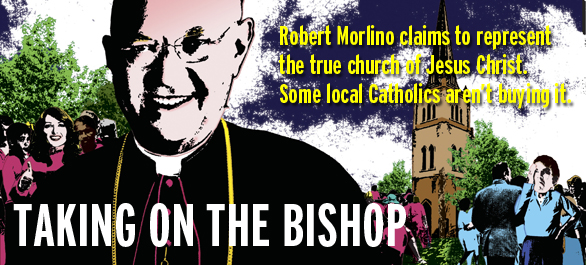
So in tomorrow’s Isthmus, the cover article concerns the Roman Catholic Bishop of Madison, and growing criticism from progressive Catholics about his leadership. For some reason, the Isthmus thought it appropriate to include in the cover photo Grace’s steeple. The image is here. Now, I suppose one might argue that the steeple of Grace Church is an iconic image of Madison, indeed of Christianity in Madison. But so far as I know, Bishop Molino has never crossed the threshold of Grace, although he’s welcome any time he would like to visit.

More importantly, Grace is not a Catholic church. Far from it. We are Episcopal and we represent much of what Bishop Molino and traditional Catholics oppose. We ordain women. We welcome any baptized Christian to our services and to receive communion, including those who have been divorced and those who might have remarried. We welcome gays and lesbians. We welcome all who seek a closer relationship to God through Jesus Christ.

Don’t misunderstand me. I am not criticizing Bishop Molino. He and I may have very different views, but we are both seeking to live out our faith in Jesus Christ and to share that faith with others. My criticism is with the Isthmus.

I suppose I wouldn’t be so annoyed by Grace’s steeple appearing on the front cover of the Isthmus if we hadn’t bought an ad, welcoming people to Madison area Episcopal churches, that includes in it the image of Grace’s steeple.

Lord, Teach us to Pray: A Sermon for Proper 12, Year C

July 25, 2010

Clergy have a complex relationship with clerical collars. We can all tell stories of times when we harassed or harangued by people who had a grudge against the church. Some priests resist wearing a collar except on the most liturgical of occasions. One reason I wear one as often as I do is because wearing the collar opens up all kinds of possibilities and leads to encounters that might otherwise not happen. Continue reading

The ABC on Religion and Secularism

There’s an interview with Rowan Williams, Archbishop of Canterbury, in The New Statesman. It shows him at his best: thinking hard about Christianity and contemporary culture and about the overall role of religion in society. He seems a bit to ready to me to argue for the importance of religion in shaping moral arguments but I do think there is something in his statement that religious language and imagery deepens our human reflection. He is also asked about the declining importance of religion in England, and the declining role played by the Church of England. Money quote:

There are bits of human experience and ­suffering that have to go somewhere, and ­secular society simply doesn’t have the
spaces, the words or the rituals. This does not translate into conventional church attendance and orthodox belief – and perhaps it seldom has in history, if the truth be told; but it still takes for granted a body/community/place where a person can feel related to something more than the sum of their own anxieties and their society’s normal patterns of talk and behaviour.

He’s on to something there but of course he’s not the first to say it. One could argue he is echoing Mircea Eliade’s notion of the sacred. He is also describing something I’ve detected when talking and observing people who come into Grace Church on Saturday mornings.

Beating the Heat

There was an article in today’s paper about the challenges facing homeless people during heat waves. Of course, one of the issues raised was the fact that there is no air conditioning in the shelter at Grace. While I’ve never been homeless, I have lived in cities without AC. I know how hot it can get in third floor apartments. When I lived in Boston in the 80s, I quickly learned where to go to beat the heat. It wasn’t easy back then, because most of Harvard’s buildings lacked AC. Sure bets were movie theaters and super markets. For $2.50, you could get a double feature in the somewhat effective air-conditioned space at the Harvard Square theater. I saw lots of movies in the summer.

Yes, it would be expensive to put AC in the shelter at Grace. Even more expensive would be the bill from MGE. What people don’t know, even most members of Grace, is that while Porchlight does pay us rent for the space, we pay for utilities. We don’t know how much of our utility usage comes from the shelter, but it’s likely to be substantial. Our annual budget for utilities is a little less than 10% of our total operating budget. That’s a chunk of change.

There’s no AC in the shelter. We do have it in the offices, but we don’t have it in the church itself, the guild hall, and the kitchen. It gets hot in all of those places, too, unbearably so in the kitchen.

Martha, Mary, and the Better Part: A Sermon for the 8th Sunday after Pentecost (Proper 11, Year C)

Whenever I hear the story of Mary and Martha, I find myself thinking about two of my aunts—my dad’s sisters—who in an earlier age were called old maids. I think especially of my dad’s oldest sister. She was the oldest daughter in a family of 11 children. She only went to high school for a year, because getting there proved to be just too difficult (it was six miles away). She spent her life taking care of her younger siblings. Then as they left the home, she continued to care for her parents, and the one sister and brother who remained on the farm. Of course, she also took care of us—her nieces and nephews when we came to visit. When her mother and brother died in the space of a year and a half, Dorothy suddenly was left without much to do.

Continue reading