Blessing of the Animals–Photos

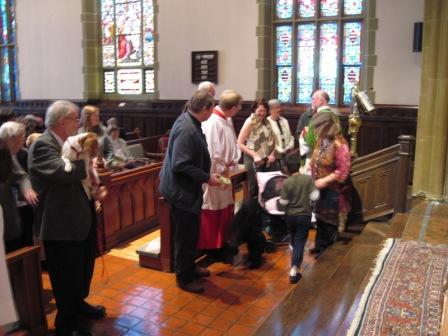
On Sunday, October 3, we had a Blessing of the Animals as part of our 10:00 service. Here are some pictures:


Figaro wanting to join the procession


That's "Prada" in the cage


The full gallery is available here:

To be honest, I decided to do the Blessing at the main Sunday service on the spur of the moment. I’ve usually done it on Saturdays or on the weekday, wherever the Feast of St. Francis falls. And I was regretting my decision when I woke up at 3:00 am on Sunday morning catastrophizing all of the possible things that could go wrong–from no one bringing their pets to the prospect of total chaos breaking out.

In the end, it went very well. The pets were very well behaved as were the people who accompanied them. We had a great time. Several people remarked on how wonderful the service was, so I suppose we’ll be doing this regularly from here on out.

Homily for the Blessing of the Animals

Francis in the 21st Century

October 3, 2010

Tomorrow is the Feast of St. Francis, marking the saint’s death 784 years ago. St. Francis is among the most beloved and most familiar of all the saints of western Christianity. He is beloved today as he has been for nearly 800 years, In the contemporary world, St. Francis remains among the most beloved figures in the Christian tradition. His love of animals and of God’s creation have made him an icon of the environmental movement. His joy, playfulness, and child-like faith offer an alternative to a Christianity that often seems to take itself too seriously.

There was much more to St. Francis, though. He preached to human beings as well as to birds and he showed in his lifestyle a serious and radical commitment to the imitation of Christ. For him, following Christ meant trying to live exactly as Jesus and his disciples did. He demanded of his followers that they own no property whatsoever. One of his slogans was: “naked to follow the naked Christ.” He took that quite literally. One of the key moments in his story is that when he renounced his share of his family’s wealth and threw himself on the mercy of the church, he stripped nude in the city square of Assisi in front of his parents and the bishop.

Equally dramatic was his identification with Christ. Francis is attributed with setting up the first crèche (nativity scene). Near the end of his life, after he had given up control of the religious order he had founded and retreated into a life of solitude, he is believed to have received the stigmata—he bore on his hands and feet the wounds Jesus Christ received on the cross. It is the first recorded example of that phenomenon in the history of Christianity. His reception of the stigmata is evidence of his total identification with his Lord. It is also an example of another trend to which Francis gave impetus. Although the suffering of Christ was already an important focus of Christian piety by the time Francis came on the scene, his devotion to it helped make it wildly popular in the later Middle Ages.

Today offers us the opportunity to reflect on Francis, on his legacy, his faith, and his significance for today. It’s a curious thing that with all of what Francis meant, that the way we honor him most often in the twenty-first century is with the blessing of the animals. It’s curious because there’s little evidence that Francis related to animals in quite the way we tend to relate to our pets. Oh, he loved them, preached to them, and in the case of the wolf of Gubbio, he turned him into a pacifist and a vegetarian. But he certainly didn’t treat animals like family members, which is the way many of us treat our pets.

Indeed, one of the reasons I like the blessing of the animals is because it is one small way to acknowledge the important role our pets play in many of our lives. If you don’t have no, or never have had a pet, this may be hard to imagine, but for those of us who include animals among our household, they truly are often like members of the family. Indeed, it’s not an exaggeration to say that some people have closer and deeper relationships with their pets than they have with other humans.

That may sound shocking, but it shouldn’t be. Our pets are utterly dependent on us, –yes, that’s true even of cats, no matter what they might think, and whatever attitude they might have at the moment. And they share love and devotion with us. Now, I’m not about to say that all dogs go to heaven; that’s not my call, but I do know that for many of us, our spiritual lives are also experienced and deepened through our relationships with animals.

So it’s appropriate to bring our pets with us to church at least once a year, and on that day, to ask God’s blessing on them and on our relationships with them. Yes, it may be a little disruptive, and perhaps even a little unseemly. Nonetheless, to acknowledge the role our pets play in our lives is also to acknowledge our full humanity, in all of its messiness and unseemliness.

And if there’s anything that St. Francis was about, it was that. His ministry was among the poor and the downtrodden. He and his followers sought to help those who were sick and dying and he brought the gospel to places it was rarely heard or experienced. His life was preaching the gospel. As is often attributed to him, he said, preach the gospel, if you have to, use words.

Our culture, indeed, our religious sensibilities, often lead us to disparage the concrete and the real. We want our spiritual lives to exist in some nebulous ether up there, far from the down and dirty of daily life. But Francis was just the opposite. He sought to lead others, through the concrete and real to know Jesus Christ. That’s what led him to create the first nativity scene, for it is in the incarnation, when Jesus became human, that we see God most clearly.

Francis sought to embody the love of Christ. Following Christ for him did not mean the abstract, either, but the literal. Some of what Francis did we may find humorous, silly, or even offensive. But when he gathered a group of men around himself, and organized them, he took his model from Jesus’ sending his disciples out into the world two by two. So as Jesus said in Matthew, they were dressed in tunic and sandals with a rope for a belt. They had no money or possessions.

In the end, Francis’ identification with Christ became so complete that he received the stigmata—his body bore on it the wounds of the crucified Christ. If nothing more, that identification should remind us of what it means to follow Christ, to seek to form ourselves and our lives in the image of Christ.

We have been hearing a great deal about discipleship as we have been reading from the Gospel of Luke. The call to discipleship, to follow Jesus is clear. What Jesus means by following him also seems clear—hard sayings like “none of you can become my disciple if you do not give up all your possessions.” What doesn’t see clear is how to follow Jesus in the twenty-first century, in our world which is so very different than first-century Palestine, and in our lives, which are so very different from the lives of first-century peasants.

That’s one way the saints can be of help. In the Anglican tradition, we regard the saints primarily as models of faith. Their lives and their faith should inspire and challenge us to deepen our own faith and discipleship. They were human beings like us, with shortcomings and faults like ours, who received the grace to follow Christ more closely and to experience God more deeply than most of us. Francis followed Jesus in a way that was completely consistent with the gospel, and perfectly suited to the early twelfth century. It is our job as faithful Christians, to shape our lives similarly, consistent with the Gospel, adapted to the present.

In this present day, there may be no more urgent message we need to hear than the one carried by the presence of animals in our worship. For they remind us that our relationship with God is not just about us and God. It includes all of creation. Creation proclaims the glory and love of God and in an age of climate change and environmental degradation, to see our responsibility to the earth as part of what it means to follow Jesus, may be the most important thing of all.

Blessing of the Animals

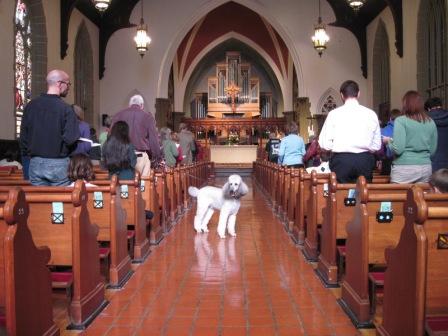
I woke up in the middle of the night last night, asking myself why I decided to have a Blessing of the Animals at the 10:00 service today. I could have done it yesterday; I could have done it this afternoon; I could have done it tomorrow. As I stared at the ceiling, I imagined all the ways the service could go wrong–animals out of control; humans outraged; no animals whatsoever.

In the end it was great, all of it. Sure the service went a little long, but it was fun, joy-filled, and well-attended. There were animals: stuffed ones, some ashes, several photographs and digital images. There were real animals, too: dogs, cats, hamsters, and a rabbit named Prada. The joy for me was not only seeing all of those animals, and acknowledging all of the love in these relationships; above all, the joy was in seeing the joy on the faces of everyone in the congregation as we celebrated God’s creation together.

I think we’ll do it this way in future years, too.

Proper 21, Year C: September 26, 2010

I know what you’re thinking. You’ve listened to the lesson from I Timothy and the Gospel of Luke, and you’re saying to yourself, “Do we have to listen to scripture about wealth and poverty and money again? Another sermon about wealth and poverty and money?” Well, the answer is, yes. I’ve got no choice because I preach the gospel and we’re working our way through the Gospel of Luke. On the other hand, we’re Episcopalian, so we don’t come to church every Sunday, and we’ve missed some of those sermons…. Continue reading

NY Times article on financial shortfalls among churches

The Episcopal Cafe points to a New York Times article that highlights the financial concerns of churches and other religious organizations. The article highlights congregations as diverse as a Conservative Jewish synagogue in New Jersey, an African-American church in NY and a hispanic congregation in Brooklyn, and mentions financial problems at churches like the National Cathedral in DC and the Crystal Cathedral.

Although it doesn’t provide much detail or analysis, the article highlights other factors besides the recession that affect giving. For example, baby boomers give about 10% less than the parents did.

Nick Knisely comments at the Cafe that churches are experiencing the same sort of challenge that newspapers have been going through. Old “business models” are no longer applicable given changes in the way people relate to religious institutions and changing demographics.

Sobering thoughts as we begin our stewardship campaign.

http://www.nytimes.com/2010/09/25/us/25religion.html

Proper 20, Year C

September 19, 2010

Our gospel today is another one of Jesus’ parables and this one, The Dishonest Steward may be the most puzzling of all. A rich man has a steward, an employee, and he finds out this employee has been embezzling from him. So he tells him, all right, we’re going to do an audit. The employee knows his time is up, so what does he do? Does he try to repay the amount he took? Does he hit the road? No, he goes back to the customers, and tries to cut sweetheart deals for them, thinking that maybe they’ll be kind to him after he’s thrown out by his boss. So now he’s cheated his boss twice. And what does the boss do? He says, “Good job, you’re quite a sly fellow.”

Any questions? Well, I have one, a big one, what is this about? Continue reading

Tribal Church

I’ve been reading Tribal Church: Ministering to the Missing Generation by Carol Howard Merritt. According to Merritt:

A tribal church has certain characteristics. It understands and reaches out to the nomadic culture of young adults. This church responds to the gifts and needs of adults under forty by taking into account their physical, social, and spiritual circumstances. The term ‘tribal’ reflects (1) a gathering around a common cause, (2) a ministry shift to basic care, (3) the practice of spiritual traditions, and (4) a network of intergenerational encouragement. (p. 8)

I’ve read a lot of sociology of religion over the years and a great deal of congregational development material as well. I’ve rarely had the kind of “Eureka” moment I had while reading the following:

When a young person walks into a church, it’s a significant moment, because no one expects her to go and nothing pressures her to attend; instead, she enters the church looking for something. She searches for connection in her displacement: connection with God through spiritual practices, connection with her neighbors through an intergenerational community, and connection with the world through social justice outreach. (p. 17)

Having worked in a church in Boston in the 1980s, I already had sensed then that young adults were no longer coming to church (Of course, those young adults who didn’t come to church in the 80s are now in their 40s and 50s). It’s even more true today and much more true in Madison than it was in the South. But I had always interpreted it in negative terms–the only young adults who came to church were deeply needy (usually emotionally and psychologically). Merritt helped me to see that in a new way, as a wonderful possibility, as an attempt to make connection and reach out beyond themselves. She goes on in the book to talk about ways churches need to change to meet these needs and how pastors need to change as well.

We are doing some of this at Grace but we could do much more. We also need to change our expectations. She had some very interesting things to say about creating intergenerational community that involves people from across the lifespan and doesn’t segregate them out by age cohort.

Proper 19, Year C

September 12, 2010

Let’s set the scene. Jesus is on his way to Jerusalem. In the synoptic Gospels of Matthew, Mark, and Luke, Jesus’ ministry takes place first in Galilee, which is north of Jerusalem, and the territory of Jesus’ hometown of Nazareth. At some point in the narrative, Jesus switches from wandering around Galilee and begins a journey with a destination. He is on his way to Jerusalem. Luke says, “Jesus set his face to go to Jerusalem.” As he goes, he teaches. Luke, following Mark and Matthew, puts much of Jesus’ teaching about discipleship, about what it means to be following him on this journey, in the context of this journey. Along the way, Luke also includes most of the parables that Jesus told.

Continue reading

Can Church be hip?

Andrew Sullivan’s blog, which is one of the best–most diverse, most challenging, wrestling with the important questions–recently asked “Can Church be hip?” Here’s the wrap on the lengthy conversation, which could have mirrored the worship wars, but instead raised interesting questions and had some hilarious moments. The underlying question of “authentic” v. “wannabe” raised by author Brett McCracken has presented itself in slightly different terms throughout the History of Christianity (one example the suspicion that faith healings are faked). Some of the responses in the thread are rather suspicious.

One suspects this video is tongue-in-cheek:

But then, this is pretty priceless, too:

http://andrewsullivan.theatlantic.com/the_daily_dish/2010/09/can.html

Grace Church won’t be hip anytime soon; all we can hope for is being authentic and reaching people with our authenticity.

By the way, if you don’t know Sullivan’s blog, you should check it out. He’s provocative politically, religiously, and culturally. A gay Catholic in a lengthy relationship (now marriage), libertarian, former editor of the New Republic, supporter of Obama; he would identify himself as a Thatcherite conservative (he’s English). How’s that for some contradictions?

Proper 18 Year C: September 5, 2010

It used to be Labor Day marked the end of summer. Perhaps it still does, in a way, but things have changed. School is back in session, both for colleges and for elementary, middle school, and high school students. After a hot and humid summer, there’s a bit of fall in the air. But still, Labor Day gives us another day to enjoy a little bit of summer. Many people are away this weekend, relishing another weekend on the lake or in the mountains. Others of us have plans for cook-outs and other get-togethers. And around us today is once again the Taste of Madison. Continue reading