Waiting for God: A Sermon for the Third Sunday in Advent, Year A

Grace Episcopal Church

December 12, 2010

Today’s readings

There’s one of those British comedies that is often re-run incessantly on Public Television called “Waiting for God.” Set in what we would call a retirement community, it tells the stories of the antics of several irascible elderly people who fight against the community’s administration, their fellow residents, and injustice in their small town. The humor relies on the indomitable spirit of characters caught in situations over which they have no control. The title says it all. “Waiting for God” implies that their lives are over and they are only passing the time until they die.

Waiting for God may be a metaphor for people nearing the end of their lives, but it is also an appropriate image for the Season of Advent. We are waiting for the coming of Christ, and as we wait, we prepare in all kinds of ways for that coming.

In today’s gospel, we encounter John the Baptist, who like those characters in the sit-com, is waiting for the end of his life. Imprisoned by Herod, he must know that he will soon be executed. But he is waiting for God in another way. Having proclaimed the coming of the Reign of God, and the coming of the Messiah, John must be wondering whether his message was the correct one, whether he should be waiting for God.

Today’s gospel reading is one of the most interesting in all of Matthew. In the middle of the gospel of Matthew, Jesus is confronted by several of John the Baptizer’s disciples. John has sent them to Jesus to ask a question: “Are you the one who is to come, or are we to wait for another?”

Matthew puts this episode at in interesting point in his gospel. It’s one of those places where we see the gospel writer at work, very carefully shaping his image of Jesus. In Mark’s gospel, Jesus’ public ministry begins with a series of healings and miracles. While Mark provides a summary of Jesus’ preaching message, he does not give any detail, or show Jesus teaching in his first chapter. By contrast, Matthew moves directly from Jesus’ baptism and temptation in the wilderness to Jesus’ preaching. The first public event of Jesus’ ministry is the Sermon on the Mount which extends from chapters 5 through 7. Only after that, does Matthew show Jesus healing people.

These healings are very carefully constructed as well. There are three sets of three in chapters eight and nine. First, Jesus heals a leper, the centurion’s servant, then Peter’s mother-in-law. Then he crosses the lake, where he stills the storm, casts out a demon and heals a paralyzed person. After calling Matthew, there are three more healings. Jesus raises a girl from the dead, restores sight to two blind men, and gives speech to someone who is mute.

Only then do John’s disciples come with their question: “Are you the one who is to come, or are we to wait for another?”

It’s a puzzling, even surprising question. After all, if anyone should know that Jesus is the Messiah, it ought to be John the Baptizer. According to the gospel of Luke, John and Jesus are cousins, nearly the same age, John is six months older than Jesus. So like any good cousins, they had to have played together as children. Probably, since John’s parents were so old at his birth, they probably even shipped him off to Joseph and Mary during school vacations and summers so they could get some much needed rest.

Then, of course, he baptized Jesus, and according to the Gospel of Matthew, identified him as the Messiah, he saw the dove and heard the voice from heaven announcing, “This is my beloved son.” So how is it that after all of that, John still wonders whether Jesus is the one who is to come? If anyone ought to know who Jesus is, if anyone ought to know that Jesus is the Messiah, surely it’s John the Baptizer. Nonetheless, it is he who poses the question of Jesus, “Are you the one who is to come, or are we to wait for another?”

This little episode, hardly noticeable in the gospel accounts is very revealing. In spite of everything John the Baptizer knows, he retains some uncertainty. And in spite of everything John the Baptizer should know, Jesus addresses John’s questions directly. He does not ridicule his uncertainty, he does not respond as he so often responds to those who misunderstand him or misinterpret him. He does not say, “Oh ye of little faith!” No he answers the question directly: “Go and tell John what you hear and see: the blind receive their sight, the lame walk, the lepers are cleansed, the deaf hear, the dead are raised, and the poor have good news brought to them.”

In other words, Jesus clearly answers the question and relates it back to the prophecies in Isaiah that we heard in today’s first lesson, and also in the word’s of today’s Psalm: the lame walk, the deaf hear, the blind see. There’s something about the way in which Jesus answers the question that is important. Note his language: the lame walk, the deaf hear, the blind see. He is not emphasizing his own role in these miracles. Instead, Jesus emphasizes what has been done. It is as if he points away from himself, toward God, toward God’s powerful presence in the world through him. By acknowledging that the lame walk, the blind receive their sight, and deaf hear, we, and John, recognize the presence of God in our midst.

But it’s not enough. It’s not enough for John, and it’s not enough for us. There’s another image in today’s readings that I find of great help. In today’s epistle reading, we are reminded to be patient, to wait the coming of the Lord. As a farmer or gardener must wait for the crops they planted to bear fruit, so too are we told to be patient.

Of course patience is a hard thing to come by at any time of the year, but it may be most difficult in the season of Advent. We all know how eager children are for Christmas. We adults may be equally eager, if only to get it all over with. But there is more to it. In the midst of the hectic pace of Christmas, the shopping, the parties, the planning, we come to church and hear the simple words of the letter of James: “Be patient, therefore, beloved, until the coming of the Lord. The farmer waits for the precious crop from the earth, being patient with it until it receives the early and the late rains. You also must be patient. Strengthen your hearts, for the coming of the Lord is near.”

It’s a message that is important to hear, and not only during Advent. To wait for God is a very difficult thing to do. It means to allow God to act in the way, and when God wants to act, to allow God to answer our questions, to answer our prayers, in the fashion and at the pace that is God’s time, not ours. The letter of James was written at a time when early Christians were asking the question why the Second Coming hadn’t taken place; that delay was enough to challenge the faith of many. We see John the Baptizer in something of the same position in today’s gospel. For some reason, Jesus’ actions, his ministry did not quite fit the expectations John had of it. So he began to wonder, is Jesus really the Messiah, or should we wait for another?

To wait for God means also to open oneself up to the presence of God. God is here, in the world, God is present in our lives, yet too often we fail to see God’s presence, we fail to sense it. We don’t take the time we need, we don’t take the time that God needs to make that presence real.

But it’s also easy to mistake the presence of God for something else. John had a set of expectations about what the Messiah would be and do. And apparently, those expectations were not met by Jesus’ actions or teachings. The disconnect between the two led to his uncertainty. The same is true for us. There is a cacophony of voices around us in the world, laying claim to being the authentic voice of Christianity and of Christmas. There are shouts that Christians are persecuted in contemporary secular culture, that we have abandoned the truth of the faith in favor of being politically correct.

As Advent moves toward Christmas, as the pace of holiday activity increases, I pray that all of us find time in our daily lives to wait for God, to listen for God’s presence, to look for the signs of God’s coming in our midst. But most importantly, let us allow God to come to us in the fashion and manner, and at the speed, God chooses.

 

Now that’s a St. Nicholas Day celebration!

On the first Monday of each month, Grace Church provides a meal to the guests who stay in the Men’s Drop-In Shelter, and to anyone else who might want to join us.

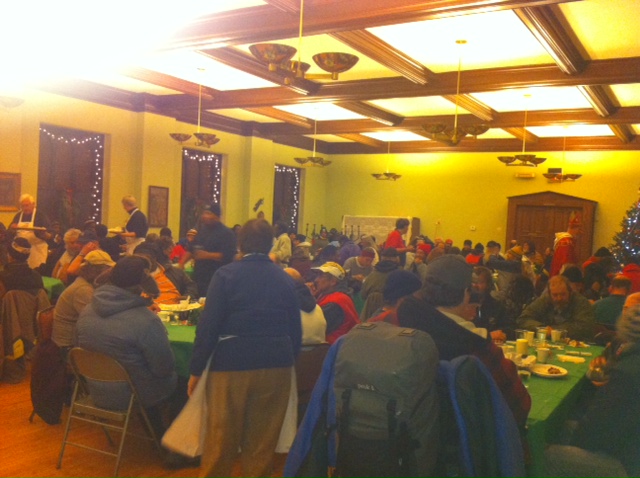
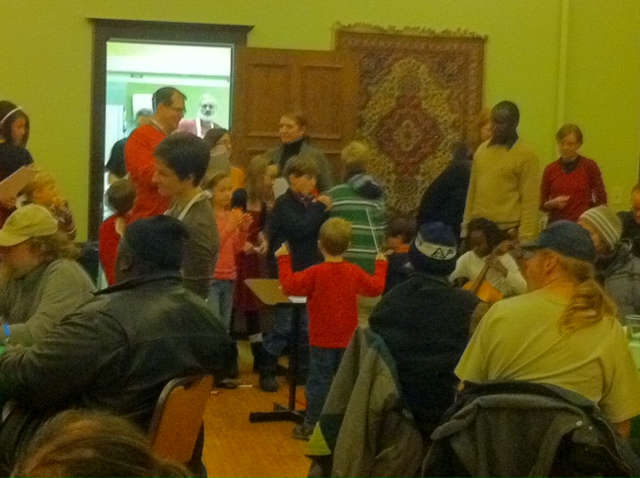
Today is St. Nicholas Day, so we decided to use that as our theme. The Guild Hall was decorated for the holidays, complete with Christmas tree (all thanks to the hard work of Ginny Shannon and her crew); members from our choir sang, as did our kids. The menu was ham, potatoes gratin, green beans, and lots of Christmas cookies. We collected socks and gave a couple hundred pairs away to our appreciative guests.

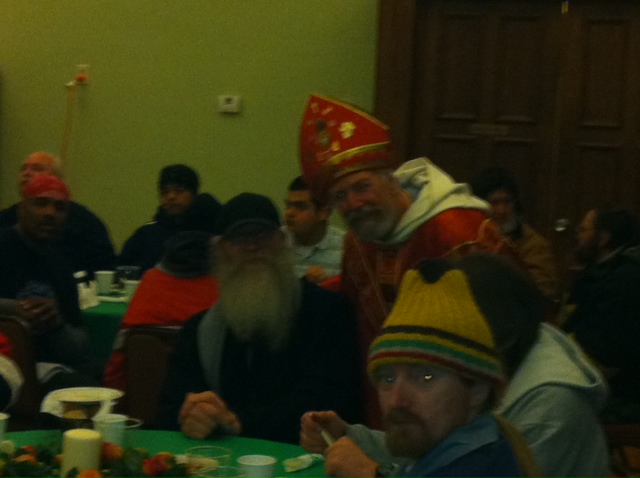
St. Nicholas Day needs an appearance from the bishop himself, so he came to pass out chocolate and socks.

A few pictures from the gala:

Here’s St. Nick, comparing beards:

Here’s a shot of Guild Hall:

Here are the kids with their kazoos:


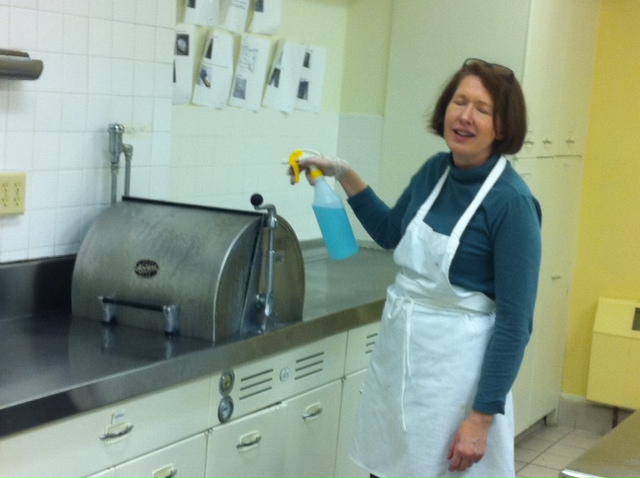
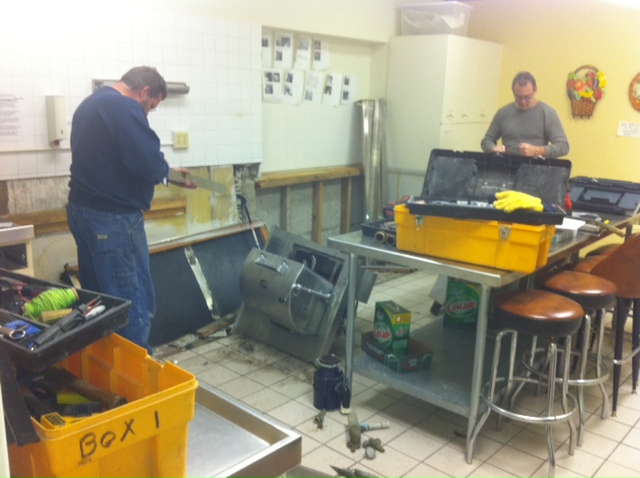
And tonight may have been the final performance of our 50-year old Hobart dishwasher. The last time we tried to get it repaired, when the guy called in for parts, the home office had to search for the parts book in their archives. We hope to have a new one installed by our next shelter meal on January 3.

Thanks to everyone who helped with the meal tonight: the volunteers, the cooks Wolfgang and Christian, the shelter meal committee, and to all those who helped preparing food and cookies in advance, and the Rector’s Guild, who donated money toward the holiday ham.

Advent II

December 5, 2010

“May the God of hope fill you with all joy and peace in believing, so that you may abound in hope by the power of the Holy Spirit”

Sometimes, I think Advent suffers from bi-polar disorder. The lesson from Paul’s letter to the Romans ended with those words, but in the Gospel, we heard words from John the Baptizer that promised doom and destruction, fire from heaven.

What are you hoping for? What is your deepest desire, your greatest wish? Advent is a season of hope as we look forward to Christmas. Children are hoping for a big haul under the Christmas tree. Some of us are hoping for other things—that the pain we live with will go away; that we will have enough money to make it through the month; that the relationship with our spouse or partner will pass through the rough patch and find more stable footing. Are your hopes only about yourself and your family? Do you harbor hope for Grace Church, for this community, our nation and the world? Or are those things just too much to ask for in our time, with a difficult economy and a poisonous political culture?

Paul’s hope encompassed all of those things. His expression of hope comes at the end of a passage that began with him pleading to his readers to be at harmony with one another, and moved from the immediate community to Christ’s work of reconciling human communities with one another—Jew and Gentile, and with God.

Paul stresses that the community, the church, is the primary place for hope, and for the expression of reconciled community in chapter 16. He does it explicitly by naming individuals in the church at Rome, 26 of them. They encompass the diversity in society and the church. There are rich and poor, slave and free—we know that there were some Roman Christians who voluntarily sold themselves into slavery in order to provide for the needy in the congregation. He also named women who were leaders in that community; indeed, he named one woman Junia, who was an apostle.

Paul’s vision of this new community came up against the reality of human nature. He was writing to a church at Rome with which he had no direct connection. In fact, many scholars believe that he conceived the letter to the Romans as something of a letter of introduction. Paul would be coming to Rome, and wrote this to let the church in Rome know who he was and what he was about. But Paul knew well the reality of people living together. He himself experienced bitter conflict with churches that he had founded, in Corinth for example. But that conflict did not temper his faith in God. Nor did it shake his belief that the church was the body of Christ, and his hope for the church and for the world. He believed strongly that God was at work in the world, making all things new.

Contrast that vision of a hopeful future with today’s gospel. The second Sunday of Advent is always dedicated to John the Baptist, that enigmatic figure who in all four gospels is linked to Jesus, but whose depiction in each of the gospels raises questions about who he was and about his relationship to Jesus. John is clearly depicted as the last of the prophets, one pointing forward to the coming of the Messiah. By describing him clad in camel’s hair and a leather belt, Matthew places him in the line of Hebrew prophets that stretches back to Elijah and Elisha.

He seems to be something of a celebrity, or at least a figure of curiosity, someone people might check out as they do today. The crowds come to see him, and he preaches to them the coming of the Kingdom of Heaven, and calls for them to repent of their sins in preparation for its arrival. Eventually, even the members of the leading Jewish groups—the Pharisees and the Sadducees come to see what the fuss is all about. His message to them is somewhat different, much more threatening: He calls them a brood of vipers and warns that fire from heaven will come down to destroy them.

I’ve always suspected that John spoke those words of condemnation with at least a little glee. Here he was, out in the desert, preaching and baptizing, sensing with immediacy a coming change, a cataclysmic intervention of God in history. He preached against the comfortable, the wealthy, and the powerful. And now, they were coming out to hear him, too. The kingdom of heaven may have been at hand, but like so many other prophets of disaster, John may also have been looking forward to seeing the destruction of his enemies.

The gospels agree that there was more to his message than gloom and doom. Whether historically accurate or not, the gospels all have John proclaiming the coming of the Messiah, the coming of the man who the gospel writers, and we, believe to be the Christ, the Savior of the World. Matthew has him proclaiming Jesus’ coming with the same certainty that he had about the coming of the Kingdom of Heaven, and the descent of divine fire upon God’s enemies.

What I find most interesting is that despite the certainty we see here, at the end of the day, John was not certain at all. Later in the gospel, after he’s been arrested by Herod, John sends some of his disciples to Jesus, to ask of him whether indeed he was the one they were waiting for, or whether they needed to continue to wait, and hope. He died without knowing whether the one he hoped for had come. He died in uncertainty. Did he have hope?

In today’s readings, we have two images of hope. Isaiah paints a picture of a world in which there is no anger, enmity, or violence, where natural enemies play and rest together. John offers a different image of hope, yes a hope of the kingdom of heaven, but also hope for vengeance upon the enemies of God. But the two images share something. Both are vast, cosmic, in proportion. Both prophets look for drastic, thorough-going change, where the world as we know it is transformed into something new.

Is our hope of that caliber? Rarely, if ever. The most that we hope for is usually a better life for ourselves and our children. Ours is a vision that normally encompasses not the universe, but our little worlds. Such hope is valid as far as it goes, but it is a hope that is tiny compared to the God in whom we proclaim our faith. Isaiah painted a picture of a world transformed by God, removed of its violence and suffering. He hoped for a king who would transform the human community in which he lived. In Romans 8, Paul writes that all creation groans in labor pains, waiting for its coming redemption.

Our temptation is to view our relationship with Christ, our faith, in deeply and only, personal terms. The coming of Christ that we celebrate this season tends to be viewed as a coming only to save us from our sins, to help us, as individuals, to get right with God. But that is only part of the story. Advent’s emphasis on the second coming is a necessary reminder that we need to broaden our vision to include all of creation.

What are we hoping for? A pretty and expensive stash of gifts under the tree? A good life for us and for our children? Perhaps, like John, that God will rain down fire on our enemies? Advent, the coming of Christ, should inspire us to hope for bigger things, for a transformed cosmos, a renewed creation, for a human community in which there is justice, and peace and equity, “where the wolf shall live with the lamb, the leopard shall lie down with the kid, the calf and the lion and the fatling together, and a little child shall lead them.”

How can we, as individuals, and as a community, be a beacon of hope in a dark and troubled world? How can we experience for ourselves the cosmic reach of Isaiah’s vision? How can we share that experience and that vision with others? How can we create in Grace Church a spirit of hope that embraces all who come near in a community of hope? Those questions should give us plenty to ponder during this season of Advent as we await the coming of Christ.

Friday in I Advent

Since arriving at Grace last year, I’ve been intrigued by the possibilities and limitations presented by Grace’s location and physical space. The church itself is quite beautiful and its high-profile location are incredible pluses. But there are challenges as well–parking, for example, is one and the presence of the homeless shelter makes security an issue, too. Still, I have wanted to offer a robust schedule of weekday services, to reach out to our neighbors.

Several lay people have mentioned over the past few months that they would appreciate the opportunity to attend and to officiate at Evening Prayer, and after talking to a number of people, I thought it would be an interesting experiment to try it during Advent.

After one week, I can say that it has been an interesting experiment. The numbers have not been been overwhelming, but I’ve not had to say it alone. What has surprised me is the effect on me of saying Evening Prayer in a lighted church as evening darkens. The season of Advent is all about light shining in the darkness. Turning the lights on at Grace after 5:00pm, and lighting candles in the nave to prepare for the service, are reminders of the coming of the light of Christ into the darkness of the world.

But more than that, there’s something about saying the familiar words of evening prayer, as the evening darkens, as people make there way home after a workday, and while the men are lining up to enter the shelter on the other side of the courtyard.

Tonight we read Psalm 22–that powerful, gut-wrenching Psalm that Jesus quoted on the cross, and that we recite on Maundy Thursday during the stripping of the altar. To read that Psalm now, in the midst of our anticipation of the coming of Christ, is a jarring reminder of how this story ends. The hope and anticipation of Advent ends, it seems, in a body broken, shattered, dying on the cross.

Of course, that’s not the end. Still, to celebrate Advent in the light, not only that shines in the darkness, but in the light of crucifixion and resurrection, challenges everything we understand about the season.

There’s also something about praying while the world walks by. Perhaps I’ll have more to say about that another time.

Wake Up! Advent I, Year A

November 28, 2010

“Wachet auf, ruft uns die Stimme. Der Waechter sehr hoch auf der Zinne. Wach auf du stadt Jerusalem.” Today is the first Sunday of Advent and for me, Advent must begin with that Bach chorale, with the words by Philip Nicolai. We will sing them at the 10:00 service today—in English, of course. It’s not simply that this is a favorite hymn of mine, or that it’s an Advent hymn. No, this is one of those cases where the hymn writer expresses beautifully one of the key themes of the season. Continue reading

A Sermon for Christ the King, Year C

November 21, 2010

We have come to the end of the liturgical year. We have also, in the gospel reading come to the end of Jesus’ long journey to Jerusalem. We have reached the culmination of both of those journeys and today, we hear again the words we heard last Spring on Palm Sunday when the whole of Luke’s passion narrative was read. The power and emotion of the passion narrative is such that it is difficult to pay attention to the details of the story in the midst of the overwhelming emotions of that important day.

One might think it rather odd to close the church year with this particular gospel reading, the account of Jesus’ death. Particularly odd, perhaps, given that the last Sunday of the liturgical year is known as Christ the King. That title conjures up images of majesty and power. The hymns we sing reinforce such images on a day like this. And for us at Grace, each time we worship, our eyes are drawn to the wooden Christus Rex, Christ the King that hangs from the ceiling behind me. Although it shows an image of Christ on the cross, the Christ who is depicted is not in agony, but rather is triumphant, having vanquished his enemies.

The gospel tells a very different story. Jesus is on the cross and the inscription on it, the charge leveled against him and for which he was executed—King of the Jews. But a crucifixion has very little to do with power and majesty. Instead, we think of Jesus on the cross as weak and powerless.

Luke’s story of Jesus’ crucifixion diverges markedly from the story told by Mark and Matthew. The question is not whether one version is closer to the truth or not—none of the gospel writers were present at the scene. What’s important is what each writer is trying to convey by telling the story in the unique way they do. Only Luke includes the interchange between Jesus and the two robbers. Only Luke has Jesus say, “Father, forgive them, for they know not what they do.” In Luke as well, the centurion who oversees the execution says, “Truly this man was innocent.” This contrasts with the confession that Jesus was the Son of God, as Mark and Matthew have it.

Luke tells the story in this way to underscore several of the themes he has emphasized throughout his gospel and in the Book of Acts as well, which he wrote in conjunction with the gospel. One of those themes has to do with forgiveness of sins. Repeatedly in the gospel, more often than in either Matthew or Mark, Jesus forgives the sins of those he encounters. It’s not just that Jesus hangs out with bad guys or demands repentance. Rather, to sin, in the ancient world was to be profoundly outside of the community. By forgiving sins, Jesus is restoring people to community, especially those, who by definition were sinners and excluded.

The second important theme for Luke is that this new Christian community of which he writes presents no threat to the Roman Empire. Time and again in the gospel and in Acts, Luke underscores the point that these Christians, no matter what they might be accused of, hold no desires of overthrowing Rome. Thus the centurion’s words, “Truly this man was innocent” are meant to stress that Jesus was not guilty of the crime with which he was charged—namely inciting revolt against Rome.

Typically, when we hear today’s gospel, we put ourselves in the shoes of bystanders who know what’s going on. The story of the crucifixion is so familiar to us, its meaning for our lives and for the world so often repeated, that to hear the story with fresh ears is exceedingly difficult. Jesus is crucified, by Romans and by Jews either because they think his talk of the kingdom of God constitutes some sort of political and military threat to the Roman Empire or because he challenges the religious power of the Jewish leadership.

In such a reading, the Romans, and perhaps the Jewish leaders got it wrong because they didn’t quite understand that Jesus’ kingdom was not in the here and now, it was the Kingdom of Heaven, as Matthew puts it, an internal, spiritual kingdom to which we all have access whatever our political affiliation. There is some truth in that view, but it misses the point.

There are two dramatic statements in today’s gospel. On the one hand there is the kingship to which the soldiers and the onlookers refer when they mock Jesus, telling him to save himself, and when they ridicule him for the inscription, or charge laid against him “King of the Jews.” On the other hand, there is the kingdom to which the one criminal refers when he pleads with Jesus, “Jesus, remember me when you come into your kingdom.”

While the irony of the soldiers’ mocking of Jesus is clear, one wonders about what Luke, or the criminal might have meant by these words. What kingdom is possessed by a man dying on the cross? Luke’s gospel presses that question. It is a question we must ask ourselves as well.

The answer to that question is clear. The image of someone, his body broken, scourged, mocked, crumpled on a cross in a hideous crucifixion, is also the image of Christ the King. But lest we are tempted to say, “Christ’s kingship is not of this world” we need to remember one thing. Jesus was crucified because he was a king. He was crucified because the Romans did perceive him as a threat to their rule. Jesus’ kingdom may be of a very different sort than the Roman Empire, but it is a kingdom nonetheless.

To proclaim Christ as King is to proclaim the reign of God. But no matter how seductive all the trappings of earthly kingship and power might be, in the end, the reign of God is just what Jesus said it was, a community in which there is radical love and the King comes among us as one who serves. The reign proclaimed by Jesus Christ does present a challenge to the powers and principalities of this world. It proclaims that what matters is not wealth or power or success, but rather “the least of these,” the poor and the oppressed, the destitute and downcast. And it proclaims that Christ’s kingdom comes not in a blaze of glory or the destruction of its enemies, but in love and peace.

We humans lack imagination. When we attempt to think about the power and majesty of God in Christ, we fall back to imagery that is thousands of years old, imagery that draws on millennia of violence, power, and emphasizes the rich trappings of monarchy rather than the poverty in which most humans have lived. Today of course, to talk about kings and queens is almost meaningless; they are no more important than any other celebrity, and like other celebrities, what chiefly interests us are their lifestyles, their wealth, and their fame.

What we don’t see are the ways in which such imagery creates a certain attitude in us. Pomp and majesty are not just about the splendor and power of the ruler. They are also intended to keep the rest of us in our place. The trappings of empire are with us still. Did you know that most of the vestments we clergy wear have their origins in the costumes of the Roman imperial classes? The Roman Empire is with us still.

Jesus beckons to us with the promise of a different kingdom, a reign that begins not in power and majesty, but in a manger in Bethlehem. In one sense, it ended on Calvary. But in another way, Calvary is the clearest expression of Christ’s kingship. He rules, not by coercion or force, but by self-giving love.

To confess Christ as King is to confess, above all, that our primary allegiance and commitment is to God in heaven, not to anything in this world, whether it be a nation, our family, fame or fortune. To confess Christ as king, means that we seek to live as he lived, to give ourselves in service to human and to our fellow humans. To confess Christ as king commits us to seeking to realize his values, his message, his love in the world. Only then can we, with the criminal on the cross, plead, “Jesus, remember me, when you come into your kingdom.”

Proper 28, Year C

November 14, 2010

Today, after the 10:00 service, we will hold our annual meeting. It is an opportunity to look back on the past year, make some assessment of what we have accomplished over these twelve months. It is also a time to look ahead to the New Year. We’re somewhat out of synch with our larger culture and will continue to be so for the next month or so. For it’s not just that we are planning ahead for next year with respect to our finances and planning, but our worship is also coming to the end of one year and looking forward to a new one. The liturgical year does not begin on January 1 but rather on the first Sunday of Advent, which is two weeks from today.

Our lessons, coming at the end of a year of reading the Gospel of Luke, have us looking ahead in some profound ways. The gospel and the reading from Isaiah are both are eschatological, in that both have something to say about the age to come. They are sharply different in tone, however. Isaiah’s vision is a hopeful one; while the gospel promises Jesus’ listeners that they will suffer for his sake.

Today’s gospel comes from the section of Luke where Jesus is teaching in and around the temple. It is just a few days before his arrest and execution. It also comes immediately after the story of the widow’s mite—when Jesus observes a poor woman giving an offering in the temple and praises her generosity, giving all that she had, while other rich people gave out of their abundance.

Luke is writing his gospel at least a decade, perhaps longer after the destruction of the Jerusalem temple. It was a cataclysmic event—catastrophic for the Jewish people who had to radically reconceive what it meant to be Jewish, and how to practice their faith, in the absence of the temple, the place where God dwelt and sacrifices were performed. It was cataclysmic as well for the early Christian community, most of whom came out of Judaism and still considered themselves to be profoundly Jewish, in spite of their belief that Jewish was the Messiah, the Savior of the World.

One can sense the anguish of both communities in the words Jesus says: “Not one stone will remain upon another, all will be thrown down.” He prophesies wars and insurrections, but cautions his listeners not to imagine that they are signs of his coming. He warns them that they will be persecuted for his sake. These are powerful words that are meant to evoke powerful emotions. Language like this permeates the New Testament and has contributed significantly to those strands of Christianity that look for signs of the second coming.

Of such signs there is no dearth. We live in an age of war and insurrection. Natural disasters like the earthquake in Haiti, Tsunami, and volcanic eruptions in Indonesia, hurricanes, drought and the like, seem ever more prevalent. We worry about global warming, famine and more. In our context, words like Jesus says in our gospel today contribute to a pervasive mood among many, Christians and non-Christians, that the world as we know it is coming to an end; that global catastrophe may be just around the corner.

Such language may increase our fearfulness and dread about what lies in the future. But Jesus’ words were not intended that way. Luke is using them quite differently, to reassure his readers that in spite of and in the midst of the troubles they were facing, God was acting in history. It is the same message we sang in the canticle, Isaiah’s song, “Surely it is God who saves me, trust in him and be not afraid.” Often such words seem meaningless in light of the enormous problems we face. And those problems may be intensely personal—a medical condition, grief at the loss of a loved one, unemployment. But the problems are also immense—war, climate change, a nation that doesn’t seem on the right track. It may be difficult, impossible to detect God’s working in the world.

This week, someone came to see me in desperation. Her life had fallen apart and she had lost everything. She wasn’t sure she could go on, that there was any reason for going on. It’s a story I occasionally hear; the surprising thing perhaps is that I don’t hear it more often. Feeling God’s presence in her life was impossible; all she could feel was pain and loss—the loss of friends and family, the loss of a future, her life, any hope.

While her situation was extreme, most of us have experienced at least something of that desperation, pain and loss. When we are there, words of encouragement sound empty and meaningless, even God seems to have abandoned us. But that’s not the case. The gospel reader reminds us that God is in the midst of our pain and suffering, God is present in history, and in our lives.

The reading from Isaiah offers a powerful challenge to any hopelessness we might feel, for ourselves or for the world. Isaiah’s vision is completely new—Yahweh will create new heavens and a new earth; Jerusalem will be transformed into a city in which there will be no tears; no infant will die before her time, people will live long lives. Even the natural world will be transformed into a place of peace and serenity. It’s a vision of a creation restored to what God had intended for it; a created world, at peace and harmony. The only hint of something else are the words, and the serpent, he shall eat dust. It’s a reminder of the Garden of Eden, of the curse Yahweh placed there on the serpent. But now the serpent is subjugated, excluded permanently from this new Eden.

This vision may seem far from the world in which we live, but it is a vision we see in faith, a vision of the universe as God intends it, and as God is working it out even now. Our faith proclaims that God is present in this world and in our daily lives, no matter what evidence there is to the contrary. It is a vision that should not only sustain us in our hope, but show us how we need to participate in God’s unfolding love of the world. Amen.

For All the Saints: A Sermon for All Saints Sunday, 2010

One of the questions I often get from newcomers to the Episcopal Church, especially if they are coming from more Protestant backgrounds, has to do with the meaning of the saints. There’s a view among some Protestants, and it goes back to the Protestant Reformation, that devotion to or commemoration of the saints, is not quite biblical. Often these questions turn to whether, if someone joins the Episcopal Church, they need to start praying to the saints. Other times, though, there’s a bit of an edge to such questions, not unlike the time a former student once blurted out during a discussion on the Virgin Mary’s significance in the Christian tradition, “What’s so special about Mary?” My response? “She’s the Mother of God.” Continue reading

Sermon for Proper 23, Year C

Your faith has saved you
Proper 23, Year C
Grace Church
October 10, 2010

I have a confession to make. I hate talking about stewardship. I hate thinking about stewardship, I hate preaching about stewardship. OK? I hate doing it as your rector. I hated it when I was on your side of things and sat in the pews listening to sermons and stewardship appeals and the like. It’s one of those things that come around every year and makes us uncomfortable in so many ways. We feel guilty for not pledging, or not pledging enough. We may feel guilty because we think we ought to be tithing and we know in our hearts that’s never gonna happen because we live from paycheck to paycheck with never quite enough money for the necessities of life, let alone to give to those worthy organizations that need our support, and to give to our church. A pledge is one of those obligations, those duties, one of those things I think I need to do. So I tend to put my annual pledge in the basket with feelings of guilt and often resentment. Continue reading