Some photos from the scene on N. Carroll this afternoon. It is hot out!
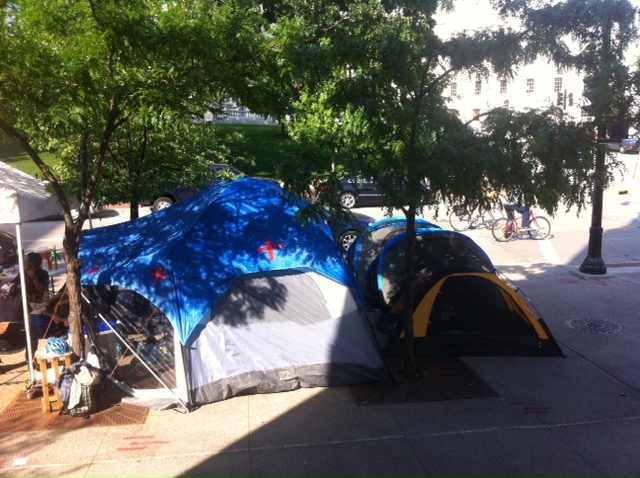
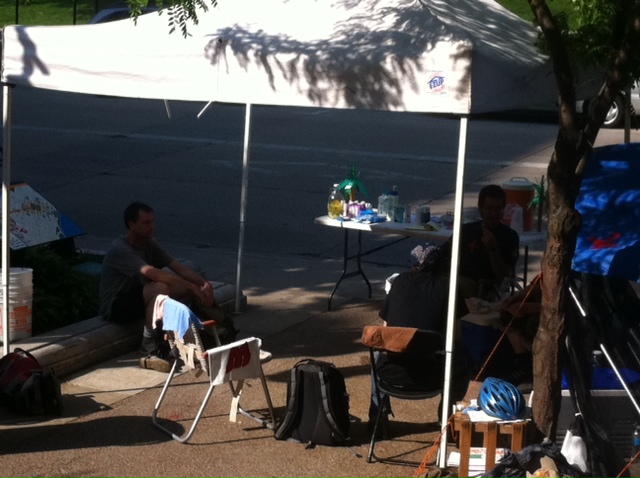
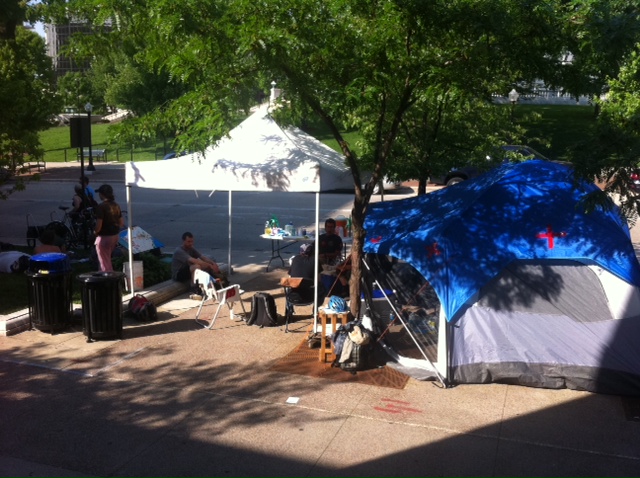
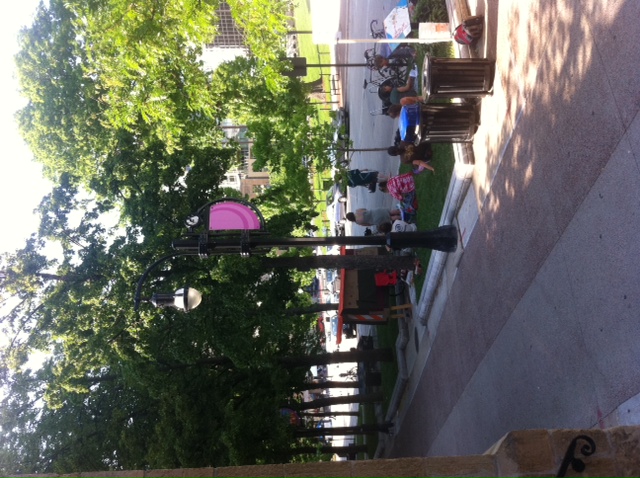

Some photos from the scene on N. Carroll this afternoon. It is hot out!
June 5, 2011
This has been one of those weeks where being a priest seems a whole lot like being a victim of whiplash. Four parishioners are dealing with the deaths of parents, either in the last week, or in the past few weeks, and chance encounters with them, or planned meetings became occasions for making room for the presence of God in the midst of grief. Someone else is dealing with an unexpected diagnosis of cancer but uncertainty as well until there are further tests. And one of the children in our parish is looking forward to hospitalization and possible pacemaker surgery. For all of these people, and their loved ones, the world they knew no longer exists—they are entering uncharted territory. Continue reading
Here’s what was going on at Grace this morning during the Farmer’s Market. Members of the Camerata String Quartet played to pitch for the upcoming Bach Dancing and Dynamite Society (if you’re in Madison, their season is not to be missed).
Here is a photo:

We’ll see what the sidewalk outside our doors looks like tomorrow.
Oh, and by the way, apparently the city of Madison does value a church as much as an empty storefront; it turns out both of the other locations where 24-hour tents are permitted are in front of vacant commercial space.
Here’s what we know now:
-Overnight tent camping areas: They were allowed three areas where they could set up 24-hour tents: On N. Carroll St. in front of Grace Church; in front of 14 W. Mifflin (they will try to keep to unoccupied storefront) and in front of 2 E. Mifflin St. All tents must be attended at all times.
There are other details as well. Hopefully the disruption to us will be minimal. We shall see. I would make a comment about Grace being equivalent in the city’s understanding to an unoccupied storefront, but the third location, 2 E. Mifflin, is a multi-story office building.
I’m looking forward to meeting our new neighbors, inviting them to services, and to volunteer in their free time at our food pantry.
Word is coming out that the permit for Walkerville has been approved, but there are restrictions. For one thing, tents will be allowed only overnight (from 9:00 pm-7:00 am, with an earlier departure on Saturday to accommodate the Farmers’ Market). There are other restrictions related to the placement of food, medical supplies, and information. Although the permit was approved, an additional campground permit will be required.
I’m disappointed in these results–disappointed for the city, for downtown residents and businesses, and for the ministry and mission of Grace Church. We’ve been placed in a very difficult position by the organizers of the protest, who didn’t take the time or deem it necessary to discuss their plans with us or with the others who would be most affected by it. We opened our doors to the protesters repeatedly in February and March and occasionally our hospitality was abused.
I posted last night about my relief that Mayor Soglin had cancelled the August Ride the Drive event. Then I woke up this morning to news about Walkerville, a proposed tent city, that, you guessed would be pitched right outside the doors of Grace Church beginning Saturday. I received emails from parishioners expressing their concern and talked to our neighbor business owners who are concerned about the impact on their livelihoods.
I made phone calls and sent emails to various elected officials and city bureaucrats. We’ll see what happens. Again, as I’ve said before; it’s not that I’m opposed to the protests. As one businessman said in frustration, “I’m a Democrat!” This is the same issue for me as it is with the marathon or Ride the Drive. Organizers of such events pay little attention to the effects of their events on those who live and work in their midst. Yes, such events may bring business, but they also create enormous inconvenience. For example, I doubt very much whether many of our elderly members will want to make their way to church through a gauntlet of protestors. I should think regular conversations about such matters would go a long way to allaying concerns and even give rise to accommodation or compromise. That the organizers of the event didn’t bother to communicate with us before I began expressing my concern is troubling indeed.
Getting to church on Sunday was an adventure. We knew that we would not have access to the parking spaces in our alley because of the Madison Marathon. I decided to take the bus. It became clear to me after a lengthy detour through the UW hospitals and several calls to the dispatcher, that the bus driver wasn’t clear on how she would get over to the eastside of Madison. When she came to a stop, forced by the advancing marathoners, I asked to be let out. It was the corner of Marion St. and W. Johnson. I too had to deal with the marathon course, but by the time I made it to W. Washington, the vast majority of runners had passed me and I was able to pick my way through the stragglers.
Attendance was awful, about a third of what we usually get on a Sunday. Most people didn’t try to make it, and those who did arrived quite late. It was the second of three consecutive Sundays on which parts of Capitol Sq. would be closed. This coming Sunday, June 5, is “Ride the Drive.” Street closures, parades, art fairs, are all part of the price of being located on the Square, but all of that means that our worshiping community shrinks on such occasions. But as one parishioner said to me, he felt rather sheepish complaining about a few blocks’ walk to church when he thought of what Christians in previous centuries had to do to worship together, and what they suffered for the faith.
On one level, such difficulties are another sign of the peripheral role played in culture by religion. We are not consulted about street closures or asked whether we are inconvenienced. Some years and with some events, it is impossible to learn before the day of the event itself, whether or how we will be impacted.
So I received the news that Madison’s new mayor, Paul Soglin, has cancelled the second “Ride the Drive” event with mixed feelings. I’m all for getting people downtown, especially on a Sunday, and I am eager to think creatively about how we might engage people who have come for such events. But at the same time, they create enormous inconvenience for many of our members, especially the elderly, who need to park in close proximity to the church, and are in special need of the relationships and human contact that they find in church each week.
My issue is not with the events themselves, but with the organizers who do not seem interested in how those who live, work, and worship in the downtown might be affected by their events, and especially the cumulative effect on morale and quality of life of week after week filled with such activities.
May 15, 2011
I’m sure that most of you have figured out by now that I am fascinated by the changing scene of religion in America. I have been for many years but the transition from the Christ-haunted South, as Flannery O’Connor put it, and Madison, where Grace Church is practically neighbors with the Freedom from Religion Foundation, has given me much to reflect on, intellectually and pastorally. We live in an increasingly secular world, where, in spite of the prominence of Christian rhetoric in the political sphere, religious language and religious institutions, a religious world-view, is on the wane. More people identify themselves as non-religious, and many of those who still claim religious affiliation, are less and less connected to communities of faith. And then I read about the study that was published in the last couple of days that claimed to prove that to be human is to be religious, that is to say, that human beings, everywhere and always, have had religious quests.
One of the fun things for me about having a doctorate in the History of Christianity and being an Episcopal priest is musing over the historical background of particular customs or even canons. Bishop Miller’s visit to Grace has been the occasion for some not-so-serious reflection on the history of Episcopal visitations.
The visitation was introduced in the late middle ages as an effort at reform. First targeting monastic houses, reform-minded bishops and church organizations began visitations of parishes as well. One of the early, and most famous, visitations was that of Electoral Saxony (Luther’s home) in 1528. Eventually, the requirement for regular visitations was enshrined for Roman Catholics at the Council of Trent. When I was working on my doctorate, visitation records were all the rage. Visitors (not bishops, but state or church bureaucrats) would go to all of the parishes and inquire about the religious life and faith of the community, asking as well about the priest or minister. From these records, we gain insight into the level of religious commitment, religious practice, and other things like magic, witchcraft, heresy, and clerical malfeasance. The visitors often had a set of very detailed questions to ask, and they also demanded that people do things like say the 10 Commandments or creed.
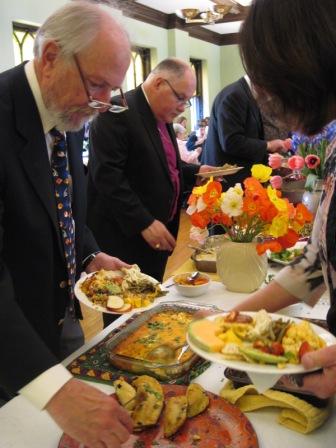
In the Episcopal Church, the Bishop’s visit is usually the occasion for confirmation. Such was the case for us, but unlike visitors of yore, Bishop Miller did not query confirmands on their catechism (good thing!). After confirmation, as is the custom in many places, we had a reception. Here are some photos:

Thy table now is spread
The Bishop and the Senior Warden analyzing the situation
There was music as well:
From the children:

And from Los Soles:

In addition to celebrating the confirmands and all of our mothers, we belatedly celebrated the Rev. Pat Size’s ministry among us. She retired at the end of 2010.

Mary Ray Worley gives Pat a scrapbook of her ministry with the Hispanic community
The menu was ham (again from Weber’s Meats in Cuba City–They’re the best!) and macaroni and cheese (one guy said it was the world’s best, another said it was better than his momma made), biscuits, green beans, and pound cake with strawberries. Music was provided by the Kat trio. They were great!
We served about ninety last night. The total number of shelter guests is down because of summer hours, but we had a line of people waiting for dinner who weren’t staying in the shelter. Many of them had eaten with us in previous months and remembered the good food and the good times.
What’s especially exciting to see is the emergence of real community among the volunteers. We’ve got a core of folks who come every week, some of them from Grace, some of them from the community, and as we work together, we are developing camaraderie and deepening relationships. That’s picked up on by newcomer volunteers who want to come back after their first time.
Here are a couple of photos:

That’s the Kat Trio

The joy of last night was tempered this afternoon when a guy came by the church looking for me. I don’t remember if he was at the meal last night, but I know he was at last month’s, because he was drunk and maudlin and asked to talk with me privately for a time. Today, he was drunk again, and he wanted me to help him get to detox. He said he hadn’t eaten in two days. I called the cops to transport him and off he went. I hope it goes well for him.
 Preaching Grace on the Square