Here it is. What do you think?
Episcopal News Service article on Wisconsin
Reply

Here it is. What do you think?
I’m working through James Davison Hunter’s To Change the World: The Irony, Tragedy, and Possibility of Christianity in the Late Modern World.
I’ve been carrying it around in my bag for the last few weeks, in hopes of cracking it open. I finally did today. It’s quite interesting. Hunter is a Professor at the University of Virginia. The book is an analysis and critique of the ways in which Christians, left and right, have approached cultural change. Hunter argues that change in culture occurs largely by means of networked elites, i.e., top-down, rather than bottom-up. He points out that for all of their efforts in the second half of the twentieth century, Christians were unable to effect much cultural change at all. Take a hot-button issue like same-sex marriage. Recent polls suggest that in spite of all of the efforts against it, a majority of Americans now support it in some form.
I’m not all the way through, but it’s clear where Hunter is headed. He starts, not with Jesus’ teachings, but with creation: “In the Christian view, then, human beings are, by divine intent and their very nature, world-makers.” He argues against the politicization of Christianity, either by left and right, and seeks to place Christianity’s role in “faithful presence.” I will say more about this idea in a later post.
It’s interesting reading in the context of what is taking place in Madison right now. I have made the case that Grace Church, by its very presence on the square, is an actor in the current drama. Whatever we do or don’t do sends a message. Hunter, I’m sure, would agree, because of his perception that politics (power) has become all-pervasive in our culture. Yet what should I or Grace do?
We have opened our doors, welcoming in those who are protesting in the streets, offering hospitality, a place to warm up and rest. As we open our doors, we offer something else, too. Grace is a beautiful space. As I’ve said here before, people sense its beauty, experience it, and for many who enter, they have never experienced anything quite like it before.
This weekend we will be doing a couple of other things. First, we will make more room for prayer. I don’t know how many people will come in tomorrow, but we will offer our chapel as a place where those who seek silence and prayer can find it.
Serendipitously, we will also be offering two musical experiences that will also evoke the beautiful. The first is a concert Saturday night by Seraphic Fire. The second is a performance in the liturgy at 10:00 on Sunday morning of a missa brevis by Haydn. Each will be an opportunity to encounter beauty. Whatever else we might do this weekend, we can do that. We can invite people to encounter beauty, and through beauty, to encounter God.
I don’t mean this as a distraction from what’s taking place on the streets. Rather, it seems to me that beauty can put everything else into its proper perspective, and by helping us touch the divine, help to ground us when all around seems to be chaos.
It really is becoming surreal. After the arrival and departure of the concrete barriers, access to the Capitol remains very limited. Even former Democratic congressmen can’t get in.
Democratic members of the Assembly have taken their desks outside and meet with constituents there.
There are voices of moderation. One is that of Republican State Senator Dale Schultz, who also happens to be Episcopalian. Here are excerpts from a recent interview. It’s well worth watching, wherever your political sympathies lie:
Here’s a link to a thoughtful piece by Paul Grant, a doctoral student at UW Madison, in which he talks a little bit about the unique culture of Wisconsin, going back to the 19th century.
Ash Wednesday is just a week away. One of the casualties of the Budget crisis in Wisconsin has been my Lenten preparations. Oh, we got started on the right foot. We had a liturgy meeting on the first Sunday in February and began planning for our worship in Lent and Holy Week. I had high hopes then of having all of our planning done, both for the Lenten programs and our Lenten worship, well before Ash Wednesday. It shouldn’t have been a problem, with Ash Wednesday coming so late.
But it was not to be. Caught unawares by the developing protests, and needing to respond quickly to events as they developed, much of the work of the church had to become lower priorities. Among that work was Lent.
Today I got some space, a little at least, to begin thinking about what’s going to be happening next week, to begin thinking as well, about my observance of Lent. One of my questions is how to make our Lent a time that allows us to reflect on what is taking place around us, to consider our complicity and participation in the structures of society and in our interpersonal relationships that are life-denying rather than life-giving.
We tend to focus in Lent on our individual sins and experiences, to see Lent as a time to get right with God, to practice some spiritual discipline more intently, or to try to find ways of deepening our spirituality. I came across this wonderful reflection on Lent by Marilyn McCord Adams, in which she describes us, even believers as “spiritually autistic.” She argues that Lent should be a time when we should try to “restructure our personality to center on lived partnership with God.”
She says Lent should be a time when we break down the defenses that separate us from other human beings, but also break down the defenses that prevent us from experiencing God.
It’s a thought-provoking piece, well-worth reading. For me, in this time, it reminds me that with everything that is going on around us, with the noise that intrudes on our work from time to time, and the palpable anxiety that we encounter in the streets and when we interact with our neighbors on the square, finding space, time, and energy to do the work that Lent calls us to, will be a monumental task, perhaps a Lenten discipline of its own
I really did try to take a day off today. I also tried to stay away from the Square, and the Church, but I couldn’t resist coming down to see what was going on.
Some interesting images. First off, when we got there around 3:30, we saw workers unloading concrete barriers on West Washington Ave. It was surreal and evoked images of the security steps taken in the days after 9/11. It wasn’t at all clear what the barriers were for. Even after they were set up around the W. Wash. entrance to the Capitol, I couldn’t figure out why they were needed and what they were protecting.
Here’s a picture of them unloading the barriers:

Here’s a photo of the W. Washington entrance to the Capitol from the steps of Grace Church. Shortly after this was taken, the crowd here moved to the left, to the State Street entrance, on the theory that the noise they made could disrupt the Governor’s budget speech:
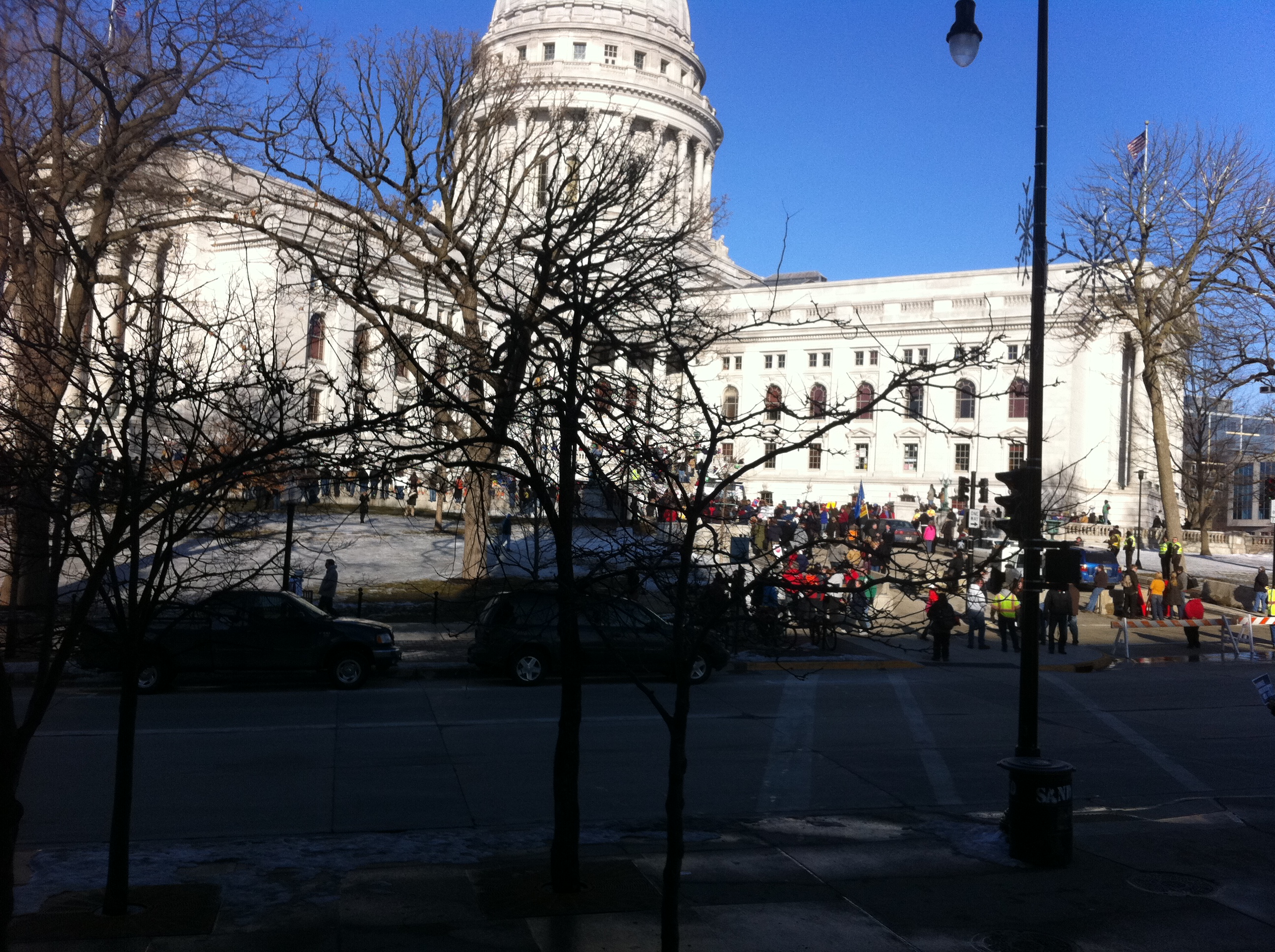
We went home after an hour or so, and passed another stark image. To get to our car, which was parked in the alley next to Grace Church, we had to pass through the line of guys waiting for the doors of the Men’s Drop-In Shelter to open so they could get a meal and a place to sleep for the night.
I had read about some of the cuts Governor Walker is proposing, and as I chatted with the guys in line, I wondered how many more people would end up on the street if the cuts went through, how many people would die because they couldn’t get access to health care or housing or mental health care.
Most of the protesters are union members–teachers, public service workers, police and firefighters. There were representatives from other unions as well. They have a great deal to lose, of course, but the stakes are even greater for the poor, the sick, the mentally ill, and the other marginalized members of society.
Our doors were open today, as they will be every day this week. Thanks to the volunteers who are providing hospitality. Not many people came in today, but then, there weren’t many people around Capitol Square, either. My guess is tomorrow will be busier, with several rallies planned as well as the governor’s budget speech. If you’re around and need to get warm, use a restroom, or pray, drop in and say hello.
I walked around the Capitol a couple of times today. I stood with the group at the King St. entrance where people were being prevented from entering. As the day went on, the numbers grew.
As I walked from the King St. entrance around toward State St., one protester who was banging a drumstick against a metal garbage can lid (or something of the sort) made his way up the stairs and on to the portico. I was near a couple of sheriff’s deputies at the time, and I heard one say to his buddy, “I’m not going to do anything about that unless I’m ordered to.”
Seeing my collar, several people suggested the cops might let me in. I didn’t test the theory, but I might later in the week if this continues.
I’m not sure how long this will continue but enormous damage has been done to our state and our common life. I’m beginning to think of the aftermath–what can we as a community of faith do to foster reconciliation?
As we have for the past two weeks, Grace Church will continue to open its doors this week for all who seek a place of prayer, warmth, and respite on Capitol Square. Thanks to parishioners who have agreed to serve as hosts on Monday and Tuesday. If you’re in the square drop by Grace to warm up and say hello. We’d love to meet you.
We’ve been struggling throughout the last two weeks to keep up with events and most of the time we’ve been reacting; dealing with situations after they’ve already begun to develop. We don’t know what’s going to happen this week, but we’ve been overwhelmed by the positive response to our efforts to extend our hospitality.
We know how difficult a time this is for many people. It’s been difficult for us, as well. Addressing the situation on the ground while we are also trying to go about the regular work of the church–finalizing budgets, preparing service bulletins, trying to get everything organized for Shrove Tuesday, Ash Wednesday, and Lent. Well, we’ve been overwhelmed.
I’m grateful to our staff who have been gracious in their flexibility; grateful to to parishioners who didn’t say anything about the dirty floors of the nave today, and have been supportive of our efforts to reach out in these past weeks.
I’m also deeply appreciative to the leadership of Bishop Steven Miller and my clergy colleagues who have offered their support and prayers.
Keep praying for us, for all of us in Madison’s Capitol Square, across the country and the world who are seeking to speak out for justice in the name of God.
What? Me Worry?
Eighth Sunday after Epiphany
February 27, 2011
I took a call this week from someone who was totally frantic. He was facing homelessness for the first time, due to circumstances outside of his control, and he didn’t know what to do. The fear and anxiety came through as he spoke. I spent some time trying to calm him down, and then I walked him through the steps he could take to address the situation in which he now found himself. I was also able to help him with one of his immediate needs, as well provide a little orientation to the Men’s Drop-In Shelter here at Grace.
I’ve had several such conversations this winter with men who are in a completely new situation, often in a place that they know nothing about. They are completely disoriented, both geographically, and with regard to their lives. They don’t know what to do; they don’t know where to turn for help. By the time they come to me, they are often at wit’s end. All I can do is help get them oriented to the homeless shelter and hope that they can survive in a cold winter with no personal resources and few social services available to help them.
I’m increasingly aware of the anxiety that seems to be pervasive in our world these days. You can sense it when you walk around Capitol Square—police officers from out of town who aren’t sure what’s going on and why they’re here; protesters who are deeply frightened about what might happen; state workers who are concerned about what’s going to happen to them. Workers in the restaurants and other businesses that line the square are frazzled too. For many of them, every day brings another crowd of customers. They’re happy for the money and the tips, of course, but they also need a rest.
We may be feeling it more dramatically here than elsewhere in America, but there’s no question that we are an anxious people right now. We are worried about our own livelihoods, our personal family futures, and the future of our country. Many of us are also deeply concerned about the future of our planet. Worry seems to be a constant in our lives. We do all sorts of things to reduce our anxieties. We take medications, some of us self-medicate. We search for distractions. We may try to wall ourselves off from our neighbors and the world by turning off the tv. We may seek to insulate ourselves with wealth, and luxury. In the end, nothing can secure us from our angst.
To hear today’s gospel with such a background is startling. The incongruities are piling on. In the last weeks, we have heard Jesus make radical statements like if you call your brother or sister a fool, you are liable for hellfire, someone who lusts in their heart has already committed adultery, and if someone hits you on your right cheek, turn your left and allow them to hit you on your left. These statements, commandments really, are so far away from our personal experience and perspectives that most of us cannot imagine living according them. When do see someone who lives in that way, people like Gandhi or MLK, we quickly are inclined to revere them as saints or something more than human.
Today’s gospel seems to be in the same vein. How can we not worry? How can we not plan for tomorrow? To do otherwise would seem to be irresponsible. All of the worries that swirl around in our minds, compounded by the events that occurring around us in Capitol Square, all of those worries are certainly legitimate. They are very human responses to the lives we are living and the situations in which we find ourselves.
But is there good news in these words from the gospel? Are there words that can help us get necessary perspectives on our lives and on our world and experience the grace of God? We might be tempted to say that “God will take care of everything” or just pray, or trust in God, and it will all work out. But many of us no all too well that such statements ring hollow and false in the face of the real challenges we face—whether it’s our economic well-being, our health, whatever.
To answer these questions, it might be helpful to look back to other texts we heard today, in particular, the reading from Isaiah and the Psalm. The reading from Isaiah clearly dates from the period of the exile, when the elites of Jerusalem and Judah had been forced into exile by a victorious Babylonian empire. It begins with the prophet promising deliverance to a disheartened people, assuring them that they will return to Jerusalem, and that God will take care of them on that difficult journey. Yahweh speech ends with a statement that God has comforted God’s people and had compassion on those who suffered.
These words rang hollow to the exiles as well, who replied to these promises by saying that God had forsaken them. To this, the prophet replied, using a surprising metaphor: “Can a woman forget her nursing child, or show no compassion for the child of her womb?” Comparing God to a nursing mother, the prophet reminds God’s people that a mother’s love is a powerful bond that unites her with her child.
That same image is picked up in the Psalm, which some scholars think was written by a woman who is describing her own experience. It begins with a stunning reversal of the sursum corda, the words we sing or say at the beginning of our celebration of the Eucharist. In the Instead of “We lift our hearts unto the Lord” the NRSV translation of the Psalm reads, “My heart is not lifted up.” For whatever reason, the Psalmist cannot praise God. But the psalm continues, saying that in spite of all the trouble that may be taking place:
I still my soul and make it quiet
Like a child upon its mother’s breast
My soul is quieted within me
We might think, from our translation, that the Psalmist is using precisely the same imagery here as the prophet did in Isaiah. That’s not the case. Where Isaiah likened God to a mother nursing her child, the force of the Hebrew in the Psalm implies the child has been weaned. No longer dependent on her mother for all nourishment and protection, we can imagine a toddler, eager to explore the world, yet often in need of comfort.
Two slightly different, yet equally comforting images of a God, who like a mother, loves and cares for her child. To remember those images, the notion that God is like a mother who loves, nourishes, and comforts her child, helps us put Jesus’ words about not worrying in proper perspective. Instead of hearing them as instructions on how to live our life, plan for tomorrow, or even plan for the rest of our lives, Jesus is reminding us that our lives are ultimately held within God’s loving embrace.
To hear those words, and to experience that embrace can give us the assurance that in the midst of a difficult and uncertain world, with all sorts of concerns and worries swirling around in our heads, our lives are in God’s hands. We may continue to struggle to find security in our lives by accumulating status and wealth, by grasping for security. Some of us may respond to our uncertainty, and our fears, by protesting. In the midst of all that, in the midst of the chaos, confusion, and conflict that surrounds us, let us remember God’s loving embrace, taking comfort in that love, and drawing strength for the journey that lies ahead.
Video of Bishop Miller at the rally today:
. Thanks to Shannon Kelly.
I didn’t see Bishop Miller today. I was in Grace as the clergy assembled and my guess is he was either outside the church or couldn’t make it through the crowd.
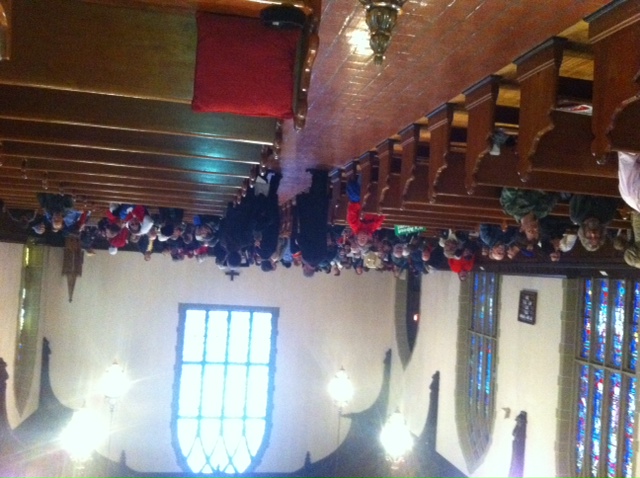
One amusing note: clergy and protesters behave like everyone else when they enter a church. They crowd the back and leave the front half of the church completely empty.
I went up to the church this morning after learning that the steps of Grace Church would be a gathering point for another Interfaith rally. When Corrie and I got there, and realized how cold it was, we decided we had to open the church. I was there from 10 to 5. I made it out onto the steps of Grace for a few minutes to soak in the atmosphere. People came in to warm up all morning and early afternoon, but by 2:15, we had a crowd inside.
This is what religion looked like at 2:15:
Here a few Grace members:
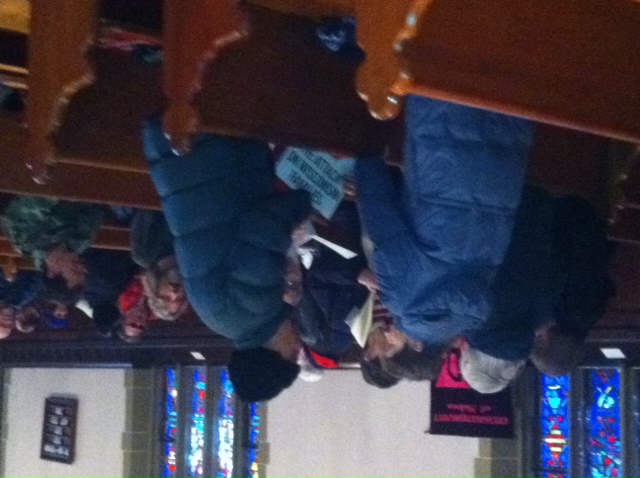
Here’s what religion looked like at 4:00:

I didn’t follow the group as it went around the square. I stayed back at Grace, keeping our doors open for those who were looking for a warm space and somewhere to rest their feet.
We were a sanctuary. In the course of the day, I had interesting conversations with lots of people. It was a long, exciting, and rewarding day. Thanks to all of those Grace people who helped today.
 Preaching Grace on the Square