A day shelter for Madison?

I’ve written about this before but an article in this week’s Isthmus addresses both the efforts on behalf of a day shelter and the forces arrayed against it. Here is the letter I’ve written to Mayor Soglin, County Executive Parisi, Madison alders, and the Dane County board.

A few weeks ago as I was leaving Grace in the middle of the afternoon, I noticed a man sitting on the stone wall in our courtyard garden. I greeted him and asked him if he needed anything. He told me that he had been released from the VA hospital earlier in the day and sent here. He asked me about the shelter–when it opened, what the policies and procedures were. I told him that the shelter wouldn’t open until that evening but that it would be best if he waited on the grounds of the Capitol or somewhere else.

I realize that this brief vignette raises all sorts of questions about our society–our treatment of veterans, our healthcare system are both implicated in this man’s plight. What I would like to focus on, however, is that this man had nowhere to go. Staff at the VA could only tell him about the shelter, a place to stay that night, but there was nowhere for him to sit comfortably, his possessions secure, while he waited for the shelter to open.

His is not an isolated incident. Madison’s hospitals discharge patients directly to the men’s shelter; the jails and prisons do as well. And there are those who find themselves homeless for the first time. They have no idea where to go or what to do. If they’re lucky, someone tells them about the shelter. If they’re really lucky, when they check in, they find someone who will show them the ropes, help them negotiate through the night, and tell them how to keep themselves and their possessions safe. I can’t tell you how many times I encounter someone who’s been in the shelter several days or even weeks, and has never seen a representative from a social service agency or been directed to places and people that might be helpful.

The effort to establish a day resource center for homeless people is one of the few hopeful signs I see in Madison’s approach to homelessness. I’ve lived here for three years. When I arrived, I was shocked to discover that homeless services here seemed to lag behind what I had observed in Boston twenty-five years earlier. Even Greenville, SC, where I had lived and worked most recently, and hardly a center of progressivism, has facilities where homeless people can come during the day to receive a nutritious meal, get a shower, do laundry, receive mail, and stow their possessions. More importantly, there is an array of services offered, including GED classes and the like.

The reality for most homeless people is that most of their energy is spent trying to survive on the street, making sure they know where they will spend the night, where they will get a meal, where they might find a warm (or cool) spot to spend the day. There is little physical or emotional energy left to negotiate the system in order to access resources necessary to find permanent housing, a job, or to get training or education.

A day resource center, or day shelter is just such a place. It an bring together all sorts of resources not only to provide protection from inclement weather, but to provide the infrastructure and services that can help someone move off the street and into a more stable living situation. The fact that Madison lacks an adequate facility of this sort is an outrage.

I urge the Mayor, County Executive, members of the Madison Common Council and Dane County Board to support this effort financially. Such a center is not a bandaid, it offers concrete solutions to the problem of homelessness. It offers hope to the hopeless.


Radical Hospitality, Radical Mission

Yesterday was a remarkable day at Grace Church. On an August Sunday, two weeks before the start of school, we had attendance that rivaled our average Sunday attendance. There were visitors from out of town as well as newcomers and church shoppers. There were also visitors from other Episcopal churches who joined us before participating in the Capitol Pride march.

After our 8:00 and 10:00 services, we introduced members and visitors to the master planning process on which we are about to embark and invited them to dream about the future of Grace Church, how, as I like to put it, we might become sacred space for our whole community.

While we were talking, people gathered for Capitol Pride. Some of our members joined the parade at its start; others joined after participating in the conversations we were having inside the building. I was struck by the juxtaposition of the two events. We were talking about mission in our neighborhood, while thousands gathered and marched outside. Here’s a photo from the parade (from Fred-Allen Self):

And I thought about something else, the way our building enables and limits our mission. I’m linking below to a couple of blog posts that challenge us to rethink the way we do mission or evangelism. It’s not enough to claim to be welcoming, our to assert our radical hospitality, we have to go out into the community and into the square, talk about our faith and invite people to encounter Jesus Christ with us.

Reaching Out to the Unchurched – Dr. James Emery White Christian Blog.

In today’s paper, there were probably dozens of ads for new cars.  If you read the paper, did you notice them?  It’s doubtful – unless you are in the market for a car.  (These days, it’s doubtful you even read a newspaper – but let’s play this out).

If you’re not in the market for a car, it doesn’t matter to you if a dealer is having a sale, promises a rebate, has a radio on-site broadcast, hangs out balloons, says they’re better than everyone else, promises that they will be different and not harass you or make you bargain over the price, or sends you a brochure or push email.

Why?  You’re not in the market for a car.

It’s no different with a church.  People today are divorced from seeing it as a need in their life, even when they are open to and interested in spiritual things.  They no longer tie that to the need to find a particular faith, much less a particular church.

And:

So how do you grow a church from the unchurched?

I’ll assume you know the “pray like mad” part.

Here’s step two:

Crawl underneath the hood of any growing church that is actually growing from the unchurched and you will find that the number one reason newcomers attend is because they were invited by a friend.

Churches grow from the unchurched because their members and attenders talk about it to their unchurched friends.  It comes up in their conversations like the mention of a good movie, a favorite restaurant, or a treasured vacation spot.

There is a culture of invitation.

Earlier, Scott Benhase said similar things in A Theology of Attraction:

Our churches ought to be places of pure welcome and grace. We truly ought to be communities of “radical hospitality” to the stranger.

And yet, the theology behind this practice, however right and good, has tended to mask something else that we need to acknowledge and address. For the sake of argument, I would call the theology behind the movement of “radical hospitality” a “Theology of Attraction.”

Such a theology holds that if we’re just open and welcoming enough people will naturally be attracted to us and want to come and join our churches. So, with this theology we declare that all people are welcome and we will offer them “radical hospitality” when they come into our churches.

Instead, he advocates a Theology of Mission:

We need a “Theology of Mission” like the early church had, in which modern day “apostles” (literally “ones who are sent out”) leave the friendly confines of our church buildings and go to where people are. We need to go to where people are because they are not coming to us, no matter how attractive we might be.

September 16 is Back to Church Sunday

All religion is local: the sacraments of space and place

Amidst all of the back and forth over General Convention, the commentaries and the rebuttals, I came across several pieces that help to refocus our attention on what really matters. The story of mainline denominations, of Christianity in America, can be told in different ways. There are the long-term trends of course that can be detected from a birds-eye view or from a historical perspective. Such analysis has its place. Indeed, it helps us understand what’s happening in the larger world and how those larger trends are shaping our immediate experience.

But there is also the local, the particular. Many of those who responded to the weeping and gnashing of teeth pointed to experiences in parishes and in the lives of people who have been transformed by the gospel. Tip O’Neill famously quipped that “all politics is local.” In spite of the fact that the Episcopal Church is spread across sixteen countries and bound together to a greater or lesser extent with the worldwide Anglican Communion, at its heart is the local church, the congregation that meets together to worship, to celebrate the Eucharist, to love God and our neighbor. For most people, their experience of church, of being in the Body of Christ, takes place almost entirely in the local congregation. It is there that they experience and see Christ, and seek to follow him.

By focusing on the local, the incarnational, we might avoid some of the political debates that we find ourselves in. At least that’s what David Finch thinks. Writing in Christianity Today about The Sacraments of Place, he argues that Christianity in America has become more ideology than faith:

Unfortunately, the church in North America is now defined more by what we are against than who we are or what we are for. This kind of ideology happens all the time in our churches. We notice it when someone says, “Oh, that church is the Bible-preaching church—they believe in the Bible,” implying that the others don’t. “That church? They’re the gay church and that one is the church that is anti-gay. We’re the church that plants gardens and loves the environment”; and, “Oh, by the way, you’re the church of the SUVs.” On and on it goes as our churches get identified by what we are against. We get caught up in perverse enjoyments like “I am glad we’re not them!” or “See, I told you we were right!” In the process we get distracted from the fact that things haven’t really changed at all, that our lives are caught up in gamesmanship, not the work of God’s salvation in our own lives and his work (mission Dei) to save the world. This cycle of ideologization works against the church. It is short-lived and breeds an antagonistic relationship to the world. In the process we become a hostile people incapable of being the church of Jesus Christ in mission.

He argues that the remedy to ideology, both for evangelicals and progressives, is to refocus on the local:

I suggest we can do this by “going local.” We can resist the ideologizing of the church by refocusing our attention on our local contexts. In going local, we inherently refuse to organize around what we are against and instead intentionally gather to participate in God’s mission in our neighborhoods, our streets, among the people that we live our daily lives with. Here we gather not around ideas extracted from actual practice in life that we then turn into ideological banners, but around participation in the bounteous new life God has given us in Jesus Christ and his mission. We participate in his reign, the kingdom, by actually practicing the reconciliation, new creation, justice, and righteousness God is doing and made possible in Jesus Christ. Here we become a people of the gospel again. It is only by doing this that God breaks the cycle of the ideological church.

Andrew W. E. Carlson agrees. In A Sense of Place, he writes about his experience in a church on Aurora Ave in Seattle and reflects on his experience using Flannery O’Connor’s writing:

Jesus mingled with the socially demoralized, living alongside them in their present state of reality. The challenge of our work, which centers itself on that story of incarnation, is that we have to learn how to balance the neighborhood as it is with our hope for the way things one day will become. Our church community has found that committing to remain in this tension between those two ways of seeing the world is surprisingly radical. It deviates from the well-intentioned imperialist dreams of those who wish to drive out the “problems” in order to, as representatives of the city would say, “revitalize Aurora.” But one of the first things Ben clarified when he got this community in motion is that we are not out to impose our view of what a redeemed Aurora should look like, rather we’re attempting to discover that redemption together with our neighbors. Ben says we are searching for the marks of incarnation in Aurora under the assumption that, despite the general public’s perceptions, “a faithful and loving God is already at work. We simply wake up to what the Spirit is already doing.”[2]

Tripp Hudgins moves from the local space of neighborhood to the even more local space of the church building. He asks important questions:

Is architecture a worthy artform? Does it convey the Holy? Can it? Or do the present-day economics of architecture preclude a healthy faithful expression of awe, wonder, and expectation? Do these symbols (steeples, education wings, etc) actually speak of economic excess? These may be helpful questions for us to ask for they ask us whether or not our relationship with our sacred spaces is indeed ethical as Sandlin challenges us. Have we let our appreciation of beauty and wonder morph into a false sense of entitlement or (more gently) sentimentality? Are our spaces capable of serving the Risen Lord who is and was Jesus the Christ who had no place to lay his head?

I think the answers to his questions lie in the relationship of the building and the congregation that gathers in it with the neighborhood that surrounds it. How is the building “sacred space”–not just for the worshiping community, but for the whole neighborhood? How does it make the sacred present for those who walk by? How does it incarnate Jesus Christ for its neighbors?

One of the things that has struck me since becoming the Rector of Grace Church three years ago, after working and living in very different environments for many years (primarily academic communities), is the complicated relationship of an urban church to its surroundings. Grace provides an oasis of beauty to the community primarily through our garden. At the same time, our food pantry and the homeless shelter that we house provide services and occasionally an experience of the sacred to those who come to us. Many of the same people who enjoy Grace’s beauty complain about the eyesore of a line of men waiting to enter the shelter on a cold winter’s night.

One of the challenges facing us is how to make our space “sacred space” for our community and neighbors, offering a place of respite, peace, and grace in the midst of an urban landscape that is partisan battleground, instrumentalized for profit, and a playground for the wealthy and the young. Yes, it would be cheaper to do our ministry elsewhere (although where better to have a homeless shelter than in the middle of a downtown, and if not us, who would provide that space).

But we have a building that is more than 150 years old. Other churches have moved off Capitol Square over the decades, and our urban landscape is less interesting, less beautiful, poorer as a result. Those of us in urban churches have to wrestle with the question of our ministry and mission, in the context of our neighborhood, and in the context of our space.

The night before the recall

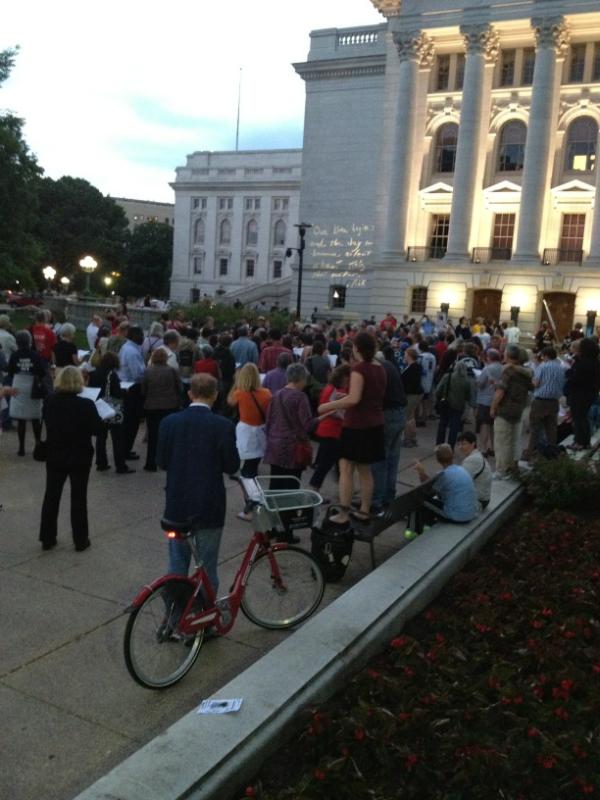
As the day went on today, Capitol Square began to show signs of tomorrow’s election. Once again, media descended. I passed one reporter filing a story from the median on W. Wash. I’m told MSNBC and Fox News are here again, as well. No doubt there are others, but I didn’t walk the square to see. As evening came, car horns played the rhythm of “This is what democracy looks like.

Still, life on the square continued as it does on an early summer evening. It’s First Monday, so we opened our doors to feed shelter guests and community residents. I left early, hoping there would be enough food, because it was obvious that there would be a large number of people dining with us who wouldn’t be staying in the shelter (where numbers have been averaging around 60 since the first of June.

It may have been quiet except for the homeless on our side of the square, but on another corner, things were picking up. Here’s a photo, retweeted by The Daily Page (originally from Judith Davidoff), of the gathering at the King St. entrance:

Who knows what tomorrow will bring? Those I talk with express their concern and anxiety and as I mentioned in my sermon on Sunday, whatever happens tomorrow, we will still need to work together toward the common good (even if some don’t see that as value or goal).

I’m pondering a pastoral response in these days, what to say and do. At this point, besides voting, I suppose the only actions I can take besides voting are to pray and to continue to make Grace Church a sacred presence on the square. We will have noonday prayer tomorrow and Eucharist on Wednesday (both at 12:10 pm) and the church will be open before and after those times for people to come in.

I read as a concluding collect in Sunday’s prayers of the people the following:

Grant, O God, that your holy and life-giving Spirit may so move every human heart [and especially the hearts of the people of this land], that barriers which divide us may crumble, suspicions disappear, and hatreds cease; that our divisions being healed, we may live in justice and peace; through Jesus Christ our Lord.

Amen. (BCP p. 823)


Nurturing Community in the City

Here’s an essay on Fresno, CA, that describes the pattern of development and sprawl that characterizes many American cities. Fresno’s history is set against the backdrop of the collapse of relationship in the author’s family even as they became successful economically.

One effort, by clergy in Las Vegas, to create community across the divide of religion (well, at least Christianity (h/t Episcopal Cafe).

Nick Knisely, pointing to an article in The Atlantic, ponders the change to cities, and to churches, by demographic shifts and the increased reliance on bicycles for transportation:

The reason this is worth mentioning is that it’s the first direct consequence of the massive demographic shift underway as young and old adults are returning the city center again. Salon has a piece on how even places like Cleveland and Pittsburg are starting to burst with new young residents around the city centers again. (H/T to bls). High fuel prices, dense urban living and a desire to something differently are all contributing. And now churches are going to have to respond.

What a great problem to have! As the neighborhoods around our historic buildings are being revitalized, we have got to think of ways to make our buildings more accessible for the people in our neighborhoods. (Which is why most of them were built in the first place after all.)

Nurturing community in a city–what is the church’s role? What is Grace’s role? Do we have enough bike racks?

Update on the Porchlight fire and the response from St. Francis House

Here’s today’s article from the Wisconsin State Journal.

Here’s the letter my colleague Andy Jones wrote to Madison’s Common Council yesterday.

In fact, it looks like we will be welcoming the Porchlight residents tomorrow. Porchlight, Madison Property Management, and our staff scrambled today to get the space ready and deal with security issues. The WSJ has info on how to donate money and items to those in need.

This week in homelessness in Madison

An update from Dan Simmons of the Wisconsin State Journal on the day shelter in Madison. When he visited on January 2, the coldest day of the year so far, 92 people were using the facilities. Obviously, the shelter is meeting a need.

The article downplayed one significant development–the death a couple of weeks ago of a homeless man. I asked around about it today and learned from my sources some background. The man who died was a regular fixture on Capitol Square, often sitting on the bench on the corner of W. Washington and S. Carroll St. He had significant medical issues. He rarely spent the night in the Drop-In shelter and was found dead in a stairwell in a downtown building.

Another homeless man, a regular in the shelter and around Grace–he often helped us out when we needed an extra hand or some muscle, had a heart attack on Monday and is in the hospital. I’ll try to visit him tomorrow but I know his friends haven’t been able to see him.

One of the people interviewed in the article talked with me on Monday night at First Monday. He’s trying to find housing while living on SSI disability. I’m hopeful he’s been able to connect with the agencies I suggested to him that night.


First Monday, 2012

Friends and members of Grace, and followers of this blog, know that on the first Monday of each month, Grace is responsible for providing the evening meal to shelter guests and others from the community who might find their way to our doors. Today was the first Monday in January, it was also the day of the Rose Bowl. We were worried that we wouldn’t have enough volunteers to help, and hopeful that because of the game, we would have fewer guests. Neither of those things happened. We had lots of volunteers, including a contingent from Madison Mennonite Church.

The meal was excellent, a baked pasta dish, with green beans on the side. The ice cream  came to us via the Fire Department. Musical entertainment was provided by Fungus Humongous who shared their music with us last year.

Three photos from tonight:

Other members of Grace will be at the church early tomorrow morning to cook breakfast for shelter guests, and most of us will be back next month, to provide another meal. Corrie and I didn’t stay throughout the meal and for clean-up, so I can’t report on how many people we served, but the shelter had been averaging right around 150 guests last week.