The 400th Anniversary of the King James Version

2011 marks the 400th anniversary of the Authorized Version which dominated English-speaking Christianity, shaped the English language and literature well into the twentieth century. There are numerous efforts to mark the date. Ben Myers points to several recent books and offers his own reflections.

Some years ago, I wrote a review of an earlier batch of books on the KJV. You can access it here: Grieser_kjvreviews.

Here’s an essay by Carol Rumens on Psalm 23 that reflects on its poetry (in the KJV translation). She also compares that translation to some other English translations, including Tyndale’s.

Trinity Institute: Day II

Today begin with Mary Gordon’s talk and a lively discussion, both on the panel at Trinity and among us in Madison. Gordon sad that there are three elements that pervade the stories of Jesus. First, that he has an intimate relationship with his Father; second that the gospels show Jesus was actively involved in people’s lives; and third that he suffered grotesquely and died, but that resurrection demonstrates that his suffering had meaning. On this third point, she quoted Simone Weil to the effect that the genius of Christianity is not that it offers a “supernatural cure for suffering, but that it offers a supernatural use for suffering.” Later, she said also that one cannot uncouple the readings or interpretations of the gospels from the actions those readings produce.

Gerald West led the group on-site and world-wide through the method of “contextual bible study” that he and his colleagues developed in South Africa and in conversation with people in Brazil and the Philippines.

I didn’t have particularly high hopes for the conference. I expected Brueggeman to entertain and provoke. He did so. I expected Gordon’s eloquence. Not knowing anything about the other two scholars and with a passing familiarity with liberation and post-colonial interpretations, I thought the conference would probably disappoint. But it didn’t. It was exciting.

There were two things that struck me. One was the level of discourse on the panel. It was clear that there were deep differences among the panelists. Perhaps the deepest were between the two Catholics. Sister Teresa Okure, who repeatedly appealed to the magisterium in positive ways, citing Vatican II documents as well as documents produced at the African Synod. Gordon spoke often and eloquently about the pain she and others suffer at the hands of the institutional church. But the conversation, in spite of those differences, was though-provoking and civil. The second thing was the stress by several of the speakers on the importance of the community coming together to read scripture.

Episcopalians aren’t very good at reading scripture together. In my experience, bible studies are poorly attended and often degenerate into individualistic reading into the text of one’s own issues and concerns, rather than allowing the text to speak to one’s situation. But time and again, the speakers urged us to find ways of reading and interpreting in community and in conversation between the trained and the less well trained or educated. But I wonder. Reading has become such a solitary activity and relatively uncommon at that. Is it possible to come together as a community to read and interpret together?

Trinity Institute: Reading Scripture through other eyes

I just got home from the first day of the Trinity Institute’s conference “Reading Scripture through other eyes.” Thanks to Brad Pohlman and Franklin Wilson of Luther Memorial who provided the downlink and invited my participation again this year.

The conference speakers today were Walter Brueggeman, emeritus professor of Old Testament at Columbia Theological Seminary in Decatur, GA and Sister Teresa Okure of the West African Catholic Institute. I enjoy the conference because it is one of the few opportunities I  have to engage theological scholarship in community, even if a large part of that community is virtual. Brueggeman and Okure both asked hard questions in their talks. Brueggeman gave an overview of the development of biblical interpretation in the last five hundred years, making use of Paul Ricoeur’s concepts of “pre-critical,” “critical,” and “post-critical” interpretations, the latter involving what Ricoeur called a “second naivete.”

He also stressed the important developments in biblical interpretation in the past thirty years, mentioning the rise of rhetorical criticism, ideology critique (including liberation theology, feminism, and post-colonialism), and the growing appreciation of Jewish approaches. He challenged us to ask questions of the text that let the text come close to people’s experience, and said in the panel discussion that truth claims have to be tested in the presence of pain. He pointed out Freud’s discovery that the self is “thick, layered, and conflicted,” making the connection between Freud’s use of image and story to help people understand themselves, with the traditional methods of Jewish interpreters who explained a story by telling another story. He extended Freud’s insight to the text and to God. The text of scripture is “thick, layered, and conflicted” and reveals a God who is “thick, layered, and conflicted.” Human beings, he observed, are created in the image of that God.

Okure sought to distinguish between the cultural contexts in which scripture was written and in which it is interpreted and the transcendent truth of the gospel. She spoke passionately both about her particular cultural context in Nigeria, and about her institutional context in the Roman Catholic Church.

Much of the discussion following the presentations, both in the panel conversation, and in our group at Luther Memorial, focused on questions of truth, including the truth of Jesus Christ. There’s an account of today’s proceedings here. More on the Trinity Institute here.

Although we were a relatively small group today, our conversation was lively and deep. To hear scholars struggling with important issues like the cultural contexts of reading scripture, and trying to articulate the relationship between the truths in scripture and the limitations of the human cultures in which scripture was written is exhilarating. There was also a provocative discussion about the role of the preacher/pastor and the community as a hermeneutical community, a community that interprets scripture.

We also heard Steed Davidson’s wonderful sermon on “Reading out loud.” He was working with Acts 8, the story of the Ethiopian eunuch. He pointed the importance of Philip as guide, not as teacher, and asked who was more transformed by the experience, who was baptized, since the Greek isn’t clear.

One of the things I want to do at Grace in the coming months and years is some serious bible study and this conference gave me more impetus to do that.

 

Re-reading Genesis

Jane Williams is publishing a series of essays on the book of Genesis in The Guardian. So far four have appeared. They are available here. In a few short paragraphs, she captures much of the historical and literary context, as well as some of the important theological themes. Worth paying attention to. She’s the wife of Rowan Williams, by the way.

The Archbishop of Canterbury on the Bible

In his New Year’s message this year, the ABC used the 400th anniversary of the King James Bible as a starting point:

Perhaps someone some time has said to you that you shouldn’t hide your light under a bushel. Or told you to set your house in order. Maybe you only survived a certain situation by the skin of your teeth. Perhaps it’s time you listened to the still small voice within.

All those everyday phrases come from one source – a book whose four hundredth anniversary we celebrate this coming year, the King James Bible – or the Authorised Version as it’s sometimes called.

He points out the important role the KJV had in shaping the language and the vision of the English-speaking world; that it provided generations with a story in which they could locate themselves. It may not play that role any longer, but Archbishop Williams went on to say that we all need some such story with which to orient our lives.

The full text of his message is here: Scroll down below the video and the summary for the full text.

A couple of things to point out. First, he acknowledges that the language of the KJV was already somewhat archaic by 1611 and purposely so; to add gravitas, no doubt. What he doesn’t point out was that the translation was both a political and religious act. King James VI, recently crowned king of England, wanted a version that would supplant the “Geneva Bible” preferred by Puritans.


Why I love the Daily Office: Psalm 39 edition

How often have I read or recited Psalm 39 over the years? For some reason this evening, while saying Evening Prayer, the words of Psalm 39 jumped out at me:

1 I said, “I will keep watch upon my ways, *
so that I do not offend with my tongue.

The opening verses are striking in tone, but it was the last verses that really threw me:

13 Hear my prayer, O LORD,
and give ear to my cry; *
hold not your peace at my tears.
14 For I am but a sojourner with you, *
a wayfarer, as all my forebears were.
15 Turn your gaze from me, that I may be glad again, *
before I go my way and am no more.

Verse 13 is clearly a plea to God to attend to the Psalmist’s cries, but what’s going on with verses 14 and 15? On the surface, v. 14 seems to be self-deprecating, but v. 15 is a plea for God to ignore the Psalmist–apparently God’s gaze is oppressive–until the Psalmist’s death.

What profound and unsettling notions of God and human being are packed into those two verses!

“What did Jesus do?” by Adam Gopnik

Gopnik writes a solid summary of the current scholarly consensus (such that there is one) concerning the gospels and the historical Jesus. It’s well worth a read. It’s also quite dense so it bears close attention.The article is here.

I find his assessment of Bart Ehrman especially amusing:

The American scholar Bart Ehrman has been explaining the scholars’ truths for more than a decade now, in a series of sincere, quiet, and successful books. Ehrman is one of those best-selling authors like Richard Dawkins and Robert Ludlum and Peter Mayle, who write the same book over and over—but the basic template is so good that the new version is always worth reading.

If one thing seems clear from all the scholarship, though, it’s that Paul’s divine Christ came first, and Jesus the wise rabbi came later. This fixed, steady twoness at the heart of the Christian story can’t be wished away by liberal hope any more than it could be resolved by theological hair-splitting. Its intractability is part of the intoxication of belief. It can be amputated, mystically married, revealed as a fraud, or worshipped as the greatest of mysteries. The two go on, and their twoness is what distinguishes the faith and gives it its discursive dynamism.

Elaine Pagels on the cultural impact of the book of Revelation

A somewhat disappointing talk by Pagels tonight. I was interested to hear her stress the importance of Judaism as a context for John and Revelation, specifically the Jewish Wars. It’s obvious on one level, of course, with the stress in the book on Jerusalem’s destruction but she seemed to suggest that the author’s Judaism was in some way more important for making sense of the visions than his belief that Jesus Christ was the Messiah.

I think you can do that only if you separate out the letters to the seven churches from the visions. For if the same audience is implied then the most important context is the relationship between Christianity and the empire, not Judaism and the empire. I’m still convinced that the book’s overall message is not only to stand firm in the face of persecution, but to force readers to come to see Rome in the same light as the author does, as the great enemy of God.

That’s one of the points of apocalyptic literature like Revelation–to help the reader see the world in a new way, where there is no gray area, just black and white and as the angel said to the church of Laodicea:

“I know your works; you are neither cold nor hot. I wish that you were either cold or hot. 16So, because you are lukewarm, and neither cold nor hot, I am about to spit you out of my mouth.” (Revelation 3:15-16

On the bodily resurrection (and Bishop Spong)

John Shelby Spong will be speaking at First United Methodist in Madison this weekend. The retired Episcopal Bishop of Newark, Spong has made a name for himself as a fearless of advocate of what he calls “progressive Christianity” and the need to reinterpret scripture and tradition in light of what he understands to be contemporary modern world-view, dominated by science. He also rails against fundamentalists.

I’ve heard him speak over the years,, had a conversation or two, and read at least one of his books. I don’t find his approach or his conclusions particularly helpful or insightful, although I’ve been told by more than a few people that reading Spong has saved Christianity for them.

As an example of what I find problematic, here’s an essay of his from 2003 on the resurrection. He goes through the New Testament evidence for the resurrection, mentioning Paul’s discussion in the opening verses of I Corinthians 15, and the fact that Mark records no resurrection appearance.  He concludes:

When these biblical data are assembled and examined closely, two things become clear. First something of enormous power gripped the disciples following the crucifixion that transformed their lives. Second, it was some fifty years before that transforming experience was interpreted as the resuscitation of a three days dead Jesus to the life of the world.

In order to make that case, he has to claim that Paul never asserts Jesus was raised on the third day. But that’s nonsense. He does it right there in I Corinthians 15, the text Spong cites in favor of some sort of spiritual vision. True, Paul equates his own experience of the Risen Christ with that of the other disciples; that’s his claim to apostleship, but in order to do that he has to assert that his experience of Christ was the same qualitatively as that of the other disciples as well.

Moreover, Paul is using the fact of Jesus’ Christ bodily resurrection from the dead to defend the belief in the bodily resurrection of all believers. To claim that Paul did not believe Jesus Christ was bodily raised from the dead is utterly wrong. We may not like that he did, we may have a hard time believing it, but it is crucial to Paul’s theology, crucial to the faith of the writers of the New Testament, to Christians down through the ages to our own day.

The resurrection, whether we like it or not, believe it or not, accept it or not, is crucial to Christianity, because it says something about human being (that we aren’t just disembodied souls, but enfleshed). It is linked to the Incarnation because we believe God became flesh and dwelt among us. If you want to reject the resurrection, you might as well toss the Incarnation out as well. The resurrection is also ultimately linked to Christian notions of the nature of God and of creation itself, that the material world was created good by God and is capable of and included in, redemption.

More about Spong’s visit to Madison here. I won’t be going, but then I won’t be going to hear  N.T. Wright either (Anglican Bishop of Durham, England and a prominent conservative New Testament Scholar). Info on his talk is here.

I will probably go to hear Elaine Pagels, however.  Not that I’m in any closer agreement with her than the other two. Her lecture is both local and free. Info here.

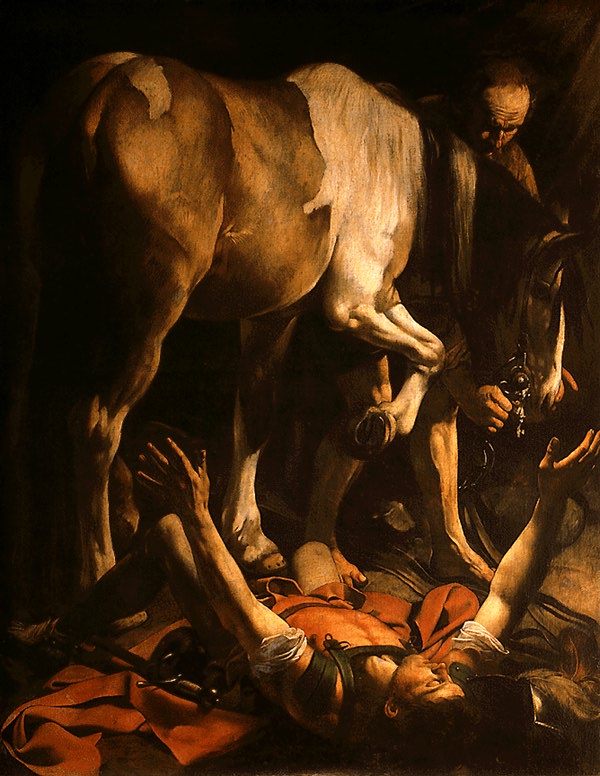
The Conversion of St. Paul (or another excuse for posting a Caravaggio image)

Today is the Conversion of St. Paul. There are at least three versions of this event in the New Testament. The most famous is Acts 9:1-22. From there we have all of the juicy details–Paul’s persecution of the early Christian community, the road to Damascus, his ensuing blindness. Luke gives us another version of the same event in Acts 22:3-16. Paul describes the same event in rather different terms in Galatians 1. Paul’s account describes a different sequence of events following his “conversion,” but more importantly, he doesn’t use language of conversion at all. Instead, Paul writes of being called:

But when God, who had set me apart before I was born and called me through his grace, was pleased 16to reveal his Son to me, so that I might proclaim him among the Gentiles (Galatians 1:15-16)

The notion that Paul’s conversion was a dramatic break from the past is firmly fixed in Christian thought and devotion and there is some legitimacy to it. Paul himself describes a radical break from his past of persecuting Christans. However, in another way, it wasn’t a conversion. He does not see himself “converting” from one religion to another, from Judaism to Christianity.

Still, conversion holds a powerful grip on Christian reflection, and indeed that grip has strengthened over the centuries, especially since the 18th century Evangelical Revival (led by the Wesleys and George Whitefield).

Whatever one thinks of the historicity of Luke’s account, and the utility of viewing the Christian life in terms of conversion, perhaps the most powerful depiction of Luke’s version is that of Caravaggio: