Covenantal Developments

Canon Alison Burnett-Cowan, Directory of Unity, Faith, and Order of the Anglican Communion Office defends the Covenant, arguing that we should read it before criticizing it.

Responses: from the Mad Priest:

From the Episcopal Cafe: “It seems to this writer that people have read it very carefully and are not so willing to gloss over the words as easily as the ACO.”

And from Tobias Haller:

What sense, after all, does it make to turn an ad hoc impairment in communion into something that looks very much like an institutional severance in communion? Since participation in the Instruments is at least in part definitive for membership and participation in the Anglican Commuion, and as the Covenant declares as well, the means by which the members “are enabled to be conformed together to the mind of Christ” (3.1.2), anything remotely resembling permanent suspension by or from those Instruments as a “relational consequence” seems to indicate a serious and debilitating breach in the Anglican Communion and the body of Christ. And the Covenant provides a mechanism to promote it, and little in the way of helping to prevent it. It is the schema for an autoimmune disease in the Body of Christ.

This is a Bad Idea. Please, England, put it down.

And from the No Anglican Covenant blog: A point by point response to some of the more tendentious assertions


Covenantal Commentary

More blogging and op-ed pieces about the Covenant, especially from England. General Synod will be convening soon and this will be high on the agenda.

Paul Bagshaw: “What is the Covenant for?”

Bishop Alan Wilson: “Will the Covenant kill or cure?”

Some statistics on the covenant and other Anglican matters from the Simply Massing Priest

From the Modern Church:

This reveals their main dilemma: how to produce a text which on the one hand is forceful enough impose its demands on the provinces, but on the other will persuade them to sign it. Their solution is to present the Covenant as an entirely voluntary agreement which does not affect a province’s governance or autonomy. Provinces signing it would, as before, act as they wished – so long as no other province objected. Once the Standing Committee upheld an objection, it would impose ‘relational consequences’, which would generally mean treating them like non-signatories.

And more (written for the Church of England)

How would it affect my church?

Is the Anglican Communion imploding of itself?

Events are occurring with great rapidity.

  • The Diocese of Uruguay has petitioned to leave the Province of the Southern Cone. This is in response to a failed proposal to allow the ordination of women in that province on a diocese-to-diocese basis. Mark Harris points out how very different that diocese is proceeding in leaving its province than those dioceses of the Episcopal Church have tried to depart. If their petition is refused, they will appeal to the Anglican Consultative Council. Whatever happens, it’s a reminder that “realignment” works both ways. Fr. Jake points out the irony of a diocese petitioning the Province of the Southern Cone to leave, after the Southern Cone has attempted to poach dioceses from the Episcopal Church
  • Those “flying bishops” who are flying to Rome continue to generate comment. The great historian of English Christianity Diarmaid MacCulloch has written incisively about the absurdity of the original scheme to provide episcopal oversight to those who rejected women’s ordination in the Church of England. Here’s MacCulloch on the perspective this group represents:

They represent one faction, which those of us who enjoy grubbing in historical byways term ‘Papalist Catholics’. For about 150 years this group among High Church Anglicans have performed athletic intellectual gymnastics about what the Church of England actually is. They ignored the fact that it had a Reformation in the sixteenth century, and turned their churches into meticulous replicas of whatever ecclesiastical fashions the Roman Church decided to adopt, while equally ignoring the fact that successive popes considered their clerical status ‘absolutely null and utterly void’. Now they are thrilled to find that the Pope was wrong all along, so they can after all be received on special terms into the ample bosom of the Western Church of the Latin Rite (which is in the habit of arrogating to itself the more general title of the Catholic Church).

  • Another report mentions “50 clergy who are joining the Ordinariate.”
  • And the Anglican Covenant debate is heating up in the run-up to Church of England’s General Synod. Thinking Anglicans has links to the latest entries in the debate. On this side of the pond, the Episcopal Cafe links to presentations past and more recent, by Cheryl H. White, canon theologian for the Diocese of Western Louisiana. From what I can tell, it seems to be arguing that the Covenant is rooted in the Elizabethan Settlement, an attempt to use the Elizabethan Church in support of the Covenant, just as the no-covenant folk use Hooker to oppose it. As I argued with regard to that, let’s debate the covenant on its merits, not on its imputed historical or theological precedents.

Will the Primates meet?

Quite the hubbub over this question. The primates of the Anglican Communion are scheduled to meet in Dublin in January 2011. A report by George Conger puts this meeting in question, and indeed raises issues about the Primates Meeting itself. It is important because it is one of the “four instruments of communion” so often discussed in the last 10-15 years. The meetings have at times been acrimonious, and recent ones have featured, if not outright boycotts, then pointed refusals on the part of some, to participate in joint Eucharists.

According to Conger, who tends to be a reliable source, the Archbishop of Canterbury has proposed smaller meetings of “like-minded” archbishops before the Dublin meeting itself. This report received confirmation from a number of sources. Conger goes on to say that Williams is proposing a restructuring of the meeting itself:

suggesting that an elected standing committee be created and the powers and responsibility of the meeting of the communion’s 38 archbishops, presiding bishops and moderators be delineated.

The problem here is two-fold. How can the primates be an “instrument of communion” if they cannot gather together? The second problem is an ongoing one as the ABC attempts to tinker with Anglican structures and create a more cohesive body. An elected standing committee would seem to further narrow and centralize powers within this group and decrease democratic representation. One can see similar attempts at work in the proposed restructuring of the Anglican Consultative Council–which would increase representation from the Primates, at the expense, as always of the laity.

The structures of the Anglican Communion, the “instruments of communion” are unwieldy. The alternative is to create a centralized bureaucracy that holds all power and makes the decisions. That sounds a great deal like the Vatican to me.

According to late reports, the Anglican Communion Office vehemently denies that the Primates Meeting has been canceled or postponed.

As always, you can follow the discussion on Thinking Anglicans and the Episcopal Cafe.

Resigning Bishops

By some bizarre coincidence, the retirement and/or resigning of bishops has made a great splash in the news. On this side of the pond, Bishop Gene Robinson, whose election and consecration caused so much consternation throughout the Anglican Communion, announced his retirement. His address to the Diocese of New Hampshire is here. The New York Times article is here.

Meanwhile, a number of bishops of the Church of England have announced their resignation. Unable to come to terms with the ordination of women to the Episcopate, they are swimming the Tiber and becoming Roman Catholic. You can follow the discussion at Thinking Anglicans.

Someone more theologically or spiritually astute than me might be able to draw some conclusion from this interesting convergence, but any connection escapes me now.

Perhaps it is only this. Bishop Robinson writes about the toll that the last seven years have taken on him and his partner. No doubt those bishops who are resigning in the Church of England can also say something about the emotional, physical, and spiritual toll that has affected them since the decision to ordain women to the priesthood in the Church of England.

Being a bishop is no easy thing. Being a bishop when it seems the forces of church and culture are arrayed against you must be exceedingly difficult. These bishops may have very different theological perspectives, but no doubt all of them have suffered a great deal. And the Church is diminished by their leaving.

My prayers are with them all.

William Temple, Archbishop of Canterbury, 1944

Today we remember William Temple who died on this date in 1944. He had been Archbishop of Canterbury only since 1942 and it is said that his death was caused by exhaustion due to the strains of his job. The son of Frederick Temple, who was also Archbishop of Canterbury, Temple was a gifted leader and a brilliant theologian. His Christus Veritas is a compelling argument for understanding the Incarnation of Jesus Christ in light of God’s love that created the universe.

He writes:

Creation and Redemption are, indeed, different; but they are different aspects of one spiritual fact, which is the activity of the Divine Will, manifesting itself in love through the Creation, and winning from the Creation an answering love.

This conception undergirds his understanding of the church, the sacraments, the doctrine of the Incarnation, and the Atonement.

For example:

Thus we have the following background of the sacramental worship of the Church: the universe is the fundamental sacrament, and taken in its entirety (When of course it includes the Incarnation and Atonement) is the perfect sacrament extensively; but it only becomes this, so far as our world and human history are concerned, because within it and determining its course is the Incarnation, which is the perfect sacrament intensively—the perfect expression in a moment of what is also perfectly expressed in everlasting Time, the Will of God;…

With regard to the Atonement, he says,  “No doctrine can be Christian which starts from a conception of God as moved by any motive alien from holy love.”

His vision is as inspiring today as it was in the darkest days of World War II, and his theology offers much to ponder today as well.

Reading the notes I took some years ago while reading Christus Veritas, I was struck again by the compelling language and challenging ideas that seemed to jump off the page.

Covenant and Coercion

The Episcopal Lead points to an essay by Savi Hensman that explores the disciplinary regime laid out in Part 4 of  The Anglican Covenant. Beginning with the baptismal vow to resist evil, she asks whether individuals or a church resisting evil (e.g., the oppressive treatment of GLBT persons) must submit if other churches object:

This might imply that member churches seeking to be faithful to their Christian calling, and to experience and reflect the love of the Holy Trinity, should never do anything to which certain other churches strongly object, if those objecting can convince the Standing Committee that the action would be wrong or harmful to unity.

But is achievement of a ‘common mind’ – or appearance of this – and greatest possible degree of communion always the highest good? In a world where evil can often seem plausible, even moral, there are many occasions when this is not so.

She goes on to cite the example of Dietrich Bonhoeffer, who resisted Hitler and was martyred for it. More importantly for her purposes, Bonhoeffer was among the leaders of those German Protestants who refused to participate in the German Christian movement. She quotes the Archbishop of Canterbury writing about Bonhoeffer:

[I]f we ask about the nature of the true Church, where we shall see the authentic life of Christ’s Body – or if we ask about the unity of the Church, how we come together to recognise each other as disciples – Bonhoeffer’s answer would have to be in the form of a further question. Does this or that person, this or that Christian community, stand where Christ is? Are they struggling to be in the place where God has chosen to be? And he would further tell us that to be in this place is to be in a place where there are no defensive walls; it must be a place where all who have faith in Jesus can stand together, and stand with all those in whose presence and in whose company Christ suffers, making room together for God’s mercy to be seen.

That is how Bonhoeffer had already come to the paradox of saying – as he did in 1936 – that unity between Christians could not be the only thing that mattered – if all it meant was good will towards everyone who claimed the name of a believer or everyone who satisfied some limited definition of human decency and fluency in religious talk.

One of the things that I was trying to get at in my previous post on Hooker is the issue of coercion. Coercion operates on many levels. Historically, as in the case of Elizabeth I and the other Tudor monarchs, coercion takes the form of state action to enforce conformity. In contemporary institutional Christianity, state action is not an option. However, there are other means at hand in some churches. The Vatican can suppress dissent by silencing theologians, but in other denominations, excommunication has become a rarity.

Part of the struggle in Anglicanism is a struggle over definition–What is it? Who are the members of the Anglican Communion? Since its beginning in the 19th century, the Anglican Communion has lacked clear boundaries, a clear definition of what it is and what it isn’t. The Covenant is part of a process aimed at defining boundaries, and certainly distinguishing members of the Anglican Communion from those churches that do not belong to it. Defining boundaries and membership involves enforcing conformity, at least on some level. And enforcing conformity requires coercion.

Hensman’s question comes down to “At what cost conformity?” At the cost of resisting evil? Or breaking our baptismal vows to “respect the dignity of every human person?” And here’s where Hooker comes in. Elizabeth and Hooker both were saying to nonconformists that they had to submit to doctrine and practice which they regarded is evil. Conformity was more important than faithfulness to the truth of the Gospel. The disciplinary  measures of the Anglican Covenant make the same argument against those who accept the ordination of Gays and Lesbians (and women, and perhaps the presidency of laypeople at the Eucharist in the Diocese of Sidney).

 

Hooker, Covenant and No-Covenant: Or, the uses and abuses of history

For Anglicans and Episcopalians, the big news this morning wasn’t the election results in the USA but the announcement of a new coalition directed against the Anglican Covenant. Called noanglicancovenant, it has a website, a facebook page, press–at least among bloggers–and its own logo:


Thinking Anglicans announced:

International Campaign Seeks to Stop Anglican Covenant

It wasn’t a coincidence that the announcement came on November 3, the date of the commemoration of Richard Hooker in Anglican calendars:

Susan Russell wrote to members of the Anglican Resistance Movement’s facebook page,

It is no coincidence that today — November 3rd AKA the Feast of Richard Hooker — was chosen to launch an international campagin to oppose the proposed Anglican Covenant.

The new website — No Anglican Covenant: Anglicans for Comprehensive Unity — offers an impressive wealth of resources, background information and context to inform, empower and engage in the process of pushing back on this ill conceived proposal. And I am honored to listed among a truly amazing cloud of witnesses calling our communion to reclaim its foundational value of Anglican comprehensiveness.

Like a wolf in sheep’s clothing, the current proposal is coercion in covenant clothing. Scripture and tradition tell us to value the ideal of Covenant. Reason tells us to reject this proposal lest we throw out the baby of historic Anglican comprehensiveness with the bathwater of hysteric Anglican politics.
Tobias Haller chimed in: Richard Hooker’s Smiling
Don’t misunderstand me. My sympathies lie with the No-Anglican-Covenant group. I think it’s a bad idea on several levels. My problem is with the attempt to bring in Hooker to support it.
The church and the world in the twenty-first century are very different than they were in the 1590s when Hooker wrote The Laws of Ecclesiastical Piety. To appeal to him for support is misguided. Today scholars debate the extent to which Hooker was Reformed in theology and whether he can be seen as the architect of the via media or of what later came to be called Anglicanism.
What is certain is the immediate context in which he wrote The Laws. In 1593, Parliament was debating a series of laws that would increase penalties against Roman Catholics and introduce new restrictions on radical Calvinists. Hooker wrote The Laws in an attempt to convincing wavering members of the House of Commons that the restrictions against the Radical Protestants (later called Puritans) were necessary and legitimate. In other words, Hooker was writing in support of the Crown’s use of coercion to enforce uniformity.
That shouldn’t surprise anyone. The Church of England was the Established Church (it still is, of course) and Elizabeth demanded outward conformity to the Church from her subjects, while famously admitting that she couldn’t “see into men’s souls.”
We can debate Hooker’s contributions to Anglicanism; we can’t debate the fact that he wrote in support of forced outward conformity.

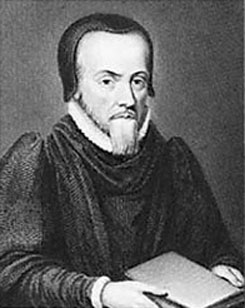
Richard Hooker, 1600

Today we remember Richard Hooker, who died on November 3, 1600. Hookrt is one of the great icons of Anglicanism, although that term was unknown to him, and certain Anglicanism whatever it means today, would be unrecognizable to him.

What established his reputation for later generations is The Laws of Ecclesiastical Polity. Bloggers occasionally like to run contests about books that everyone claims to have read but few people actually have; if there were such a context in the Anglican world, I’m sure The Laws would fare very well. It’s dense reading, in a prose style that is quite alien to modern sensitivities and I can’t imagine there are many people today with the stamina to make it all the way through all five books. Hooker was a man of immense learning and it shows throughout. He draws on patristic sources and on the scholastics, especially, Thomas Aquinas, in making his arguments.

Hooker is credited with originating the “three-legged stool” of Anglicanism, referring to the authority of scripture, tradition, and reason (actually he thinks of the latter more in terms of common sense). The image is not his own, and in his work, the three are not quite equal. Scripture is paramount. Hooker was a Protestant, after all. Reason is used to help elucidate scripture, especially when scripture seems unclear or contradictory. Tradition, too, is largely viewed as an interpreter of scripture.

Hooker’s pre-eminence in later Anglican tradition is largely due to historical developments. As conflict over theology and ecclesiology deepened in the seventeenth century, Hooker’s half-hearted defense of the episcopacy and his moderate Calvinism became weapons in the war against outright Puritanism. Having defended the Elizabethan Settlement, Hooker came to stand for the via media, even as the poles between which the via media balanced shifted dramatically.


Goings-on in Anglican-land

The last few days have seen several developments related to matters Anglican and Episcopal. On this side of the pond, the Diocese of South Carolina has acted to remain in the Episcopal Church, but not of it (or vice versa, precisely what they are trying to do remains unclear). On the other side of the pond, the General Secretary of the Anglican Communion, Kenneth Kearon, has disinvited representatives from the Southern Cone from attending certain meetings because of that church’s boundary-crossing and intervention in North America (no word on Rwanda or Nigeria). And an Anglo-Catholic Bishop has announced his intent to join the Ordinariate being set up by the Roman Catholic Church for disaffected clergy in the Church of England (in other words, he’s swimming the Tiber). In addition, the Diocese of Sidney is going ahead with its long-announced plans to introduce Eucharistic celebration by deacons.

There is plenty of comment on all of these developments and usual, you can follow the hullabaloo at Episcopal Cafe and Thinking Anglicans. For the latter’s coverage of the Ordinariate, click here. For its article on the letter from Kearon, go here.

With the regard to the actions of the Diocese of South Carolina, Bishop Mark Lawrence’s vitriolic letter against the Presiding Bishop is available on-line. So too is a response from Bishop James Mathes of the Diocese of San Diego. A number of commentators, including Bishop Mathes, draw a parallel between this development and the events leading up to the Civil War. I have no idea what precisely is taking place. I know little about that diocese except through encounters with students I had while teaching at Furman. I know they were warned by their clergy about those liberal Episcopalians in the upstate–a warning that amused me to no end.

It is clear to me that realignment of some sort, or perhaps several sorts is underway in the US church, but across the world as well. One thing that has struck me while reading those who fulminate against the Diocese of South Carolina’s actions, is their commitment to the diocese as the basic unit of the church. Granted it has been that for over a thousand years, but it is not necessarily a biblical notion, nor one practiced in the earliest church. In fact, the diocese as such is borrowed from the imperial restructuring that the Emperor Diocletian undertook in the late third and early fourth centuries.

Readers of this blog know I am interested in how Christianity is being affected by contemporary cultural changes, and how those changes will lead to restructuring.  It seems to me that all of these developments are contributing to that restructuring in the Anglican world, and that what will emerge down the line is something very different than the Anglican Communion we have had for the last few decades