Centering the Oneida in the Story of the Episcopal Church in Wisconsin

On May 4, the three Episcopal dioceses of Wisconsin met jointly at the Ho-Chunk Gaming in Baraboo for a convention at which each diocese would vote on the proposal to reunify the three dioceses. I had been involved in the so-called Trialogue and I was curious to see what would happen. But more than the vote on reunification, I was curious about something else, namely how the story of the Episcopal Church in Wisconsin would be told and how that story would contribute to the future identity of the church.  Finally, the moment I was waiting for arrived. No, not the announcement of the voting results, although that was a historic moment of great significance. For me the most powerful moment, a taste of spiritual transcendence, came earlier, during the convention Eucharist. After the post-communion prayer and a brief pause for silence a lone voice was raised to sing the Te Deum in the Oneida language. I had read about the Oneida Singers. I had heard recordings of the Te Deum and I knew of the tradition that the Te Deum was sung at all conventions of the Diocese of Fond du Lac. It was a historic day and the inclusion of the Te Deum sung by descendants of the first Episcopalians to arrive in what is now Wisconsin bore powerful witness to the complicated history of the Episcopal church in Wisconsin and the United States.

As I have reflected on that moving experience and on a day full of excitement and joy, I began to wonder what difference it might make if the story of the Episcopal Church in Wisconsin was centered on the Oneida story rather than on the stereotypical denominational history of arrival, institution-building, and now decline. Unlike most white settlers in Wisconsin, the Oneida came largely against their will, forced from their homes by land speculators and westward expansion. They built the first Episcopal Church in Wisconsin, continued to worship and to pass on their faith to later generations. Deacons and priests were raised up from among them and they carried their faith with them as they moved and were forced to assimilate. The larger Episcopal community honored and protected them, most notably by leading the resistance to their removal from Wisconsin to Indian Territory in the late 19th century. But it is a story that is largely unknown by most Wisconsin Episcopalians. Certainly when I’ve mentioned it to most Wisconsin Episcopalians, they express amazement and wonder to learn of the Oneida connection. A collection of essays sheds important light on the relationship of the Wisconsin Oneida and the Episcopal Church: The Wisconsin Oneidas and the Episcopal Church: A Chain Linking Two Traditions.

To center the Oneida experience in the story of the Episcopal Church in Wisconsin complicates the narrative, exposing all the ways in which Episcopalians participated in settler colonialism and profited from the exploitation and expulsion of Wisconsin’s indigenous peoples. It would emphasize the reality that the church is a flawed, sinful institution, as any human institution is, even as it participates in the perfection and holiness of Christ. To center the Oneida in the Episcopal story in Wisconsin moving forward, it could help us overcome our presentist bias—the assumption that we know better than those who have come before us—and encourage us to build future communities that are better attuned to the limits of our perspective and knowledge. It might also encourage us to center reconciliation and restorative justice at the heart of our work and common life. It might also compel us to seek out other stories that have been forgotten, or suppressed, or ignored over the decades of our history. It might challenge us to consider how our unexpressed assumptions about the identity and mission of the Episcopal Church could be a detriment to the thriving of the Episcopal witness and charism in a rapidly changing nation and world.

Reflecting on the Trialogue and the Reunion of the Wisconsin Dioceses of the Episcopal Church

When I became an Episcopalian in 1992, I had little knowledge of the history and culture of the Episcopal Church. I was already familiar with the Book of Common Prayer, I had had several classmates in Divinity School who were preparing for the priesthood, and of course I knew a great deal about the emergence of the Church of England during the sixteenth century. But I had only the vaguest conception of the denomination, how dioceses were formed, the culture of the denomination, or the significant differences in the church in different regions of the country. 

That all changed when we began teaching at the University of the South (Sewanee), which is owned by the southern dioceses of the Episcopal Church, includes a School of Theology where I taught for a year, and has a distinctive theological and liturgical ethos. Eventually, we would move to South Carolina where the Episcopal Church has its own idiosyncrasies. Over the years, I would hear priests joke about the “biretta belt”—by which they were referring to unspecified dioceses in the Midwest that included Northern Indiana, Chicago, and the dioceses of Wisconsin. By then I also knew about Nashotah House, the seminary in Wisconsin but my impression of it was shaped by the long battles over the ordination of women and the full inclusion of LGBTQ+ people in the life of the church. I had a vague sense of the Anglo-Catholic culture of the Diocese of Fond du Lac. The bishop who ordained me, Dorsey Henderson, had been Dean of the Cathedral of Fond du Lac and was very Anglo-Catholic, and at some point I had heard something about the. Fond du Lac Circus (google it if you’re curious). 

Surprisingly, none of that really changed when I became Rector of Grace in 2009. I’ve only ever been on the campus of Nashotah House once in my fifteen years in Wisconsin. I don’t think I had met any clergy from either the diocese of Fond du Lac or Eau Claire except Bishop Gunther who was on the Board of Directors of the Wisconsin Council of Churches when I began serving. I did know about the failed attempt at the reunification of the Dioceses of Eau Claire and Fond du Lac in 2011 and there were comments from time to time from clergy and Bishop about the future of the Diocese of Eau Claire. 

When the Trialogue was announced in 2021, I was surprised at the initiative and somewhat excited about the project. I volunteered to help with the Trialogue and was assigned to the Task Force on Parish and Regional Engagement. We were assigned to hear from congregations, laypeople, and clergy across the state but it was also an opportunity to develop relationships with clergy and lay leaders from the other two dioceses. Two joint clergy conferences in 2022 and 2024 have also helped deepen those relationships. 

It’s easy to forget that we are part of a larger church, a diocese, the Episcopal Church USA, and the Anglican Communion. Many of us come to the Episcopal Church as adults. We are drawn to the liturgy, looking for a Christian community that shares our values and where we can experience the presence of God in Christ. The larger church rarely enters our consciousness except at times of conflict.  Few of us have participated in diocesan work. Even if we have heard of the Trialogue and of the upcoming vote on reunification, we may not care about it. It seems not to affect our parish life or our own spiritual lives. In addition, the Diocese of Milwaukee hasn’t had a permanent bishop since 2020 and Bishop Lee, who served as our Bishop Provisional, retired (again) last year. Our primary experience of the church is the local congregation and that’s not likely to change.

There is another important matter to consider. We have heard a great deal about the decline of mainline Christianity in the US and then more recently about the decline of Christianity across the board. Increasing percentages of Americans claim no religious affiliation at all and all denominations are reporting declines in attendance and membership. These trends were accelerated by the pandemic. In such an environment, what does the future of the Episcopal Church look like?

Unlike nondenominational churches that have no structural connection to other congregations or churches that have a polity (structure) based on congregational autonomy, we belong to the Episcopal Church. We are not independent. When I was ordained, I vowed obedience to the Bishop who was ordaining me and when I was installed as Rector of Grace Church, I reiterated those vows. We believe that our bishops are in the apostolic succession, an unbroken line of women and men ordained by the laying on of hands going back to St. Peter and to Christ. Bishops are a visible symbol of our participation in the church universal, the Body of Christ that consists of all Christians, living and dead, united by one common faith and baptism.

Still, does it matter whether there are one, or two, or three dioceses in the State of Wisconsin? Perhaps not in the larger scheme of things. At the same time, it’s important to remember that dioceses are required to do certain things canonically—to oversee the ordination process, to have and pay for a bishop. And there are also programmatic things: communications, outreach, congregational development. With limited financial and human resources, the three dioceses of Wisconsin are stretched thin as they try to conduct the business of the church. Reunification might free up some of those resources for new ministries and programs. We might be able to offer stronger support to small congregations that feel isolated. The proposal to have ministry regions and for the bishop to be in residence in each of those regions for several weeks each year might create opportunities for collaboration and connection on a local level that could spark new ideas and programs.

Christianity is undergoing a historical transformation in this country and the Episcopal Church is experiencing that transformation. What the Episcopal Church will look like in fifty years is anyone’s guess. Whether dioceses will even exist or whether the denominational structure that currently exists will survive in any recognizable form are open questions. What we can be certain of is that Christians will continue to gather in community to read and study scripture and to celebrate the Eucharist. Most of all, we can be certain that Jesus Christ will be present in those communities and that people will continue to experience the grace, love, and power of the Risen Christ. Those local communities are and will be a part of a larger reality, the Body of Christ, that unites us across space and time with all faithful Christians living and dead and strengthens us with the love of Christ that binds us all together as one.

A Report to the Episcopal Diocese of Milwaukee on Land Acknowledgement and Native American Relationships

Diocesan Task Force on Land Acknowledgement

Let us pray.

O Great Spirit, God of all people and every tribe,
through whom all people are related;
Call us to the kinship of all your people.
Grant us vision to see,
the brokenness of the past;
Help us to listen to one another,
in order to heal the wounds of the present;
And give us courage, patience, and wisdom to work together
for healing and hope with all of your people,
now and in the future.
Mend the hoop of our hearts and let us live in
justice and peace
through Jesus Christ,
the One who comes to all people
that we might live in dignity. Amen.  (From the Episcopal Church, Resources on the Doctrine of Discovery)

In the US calendar, Monday, October 10 is traditionally known as Columbus Day, the day when Columbus’ “discovery” of the New World was celebrated. In more recent years, and in the State of Wisconsin, it is Indigenous Peoples’ Day, set aside to celebrate and honor the histories, cultures, and resilience of Native Americans and to commemorate the suffering they have endured over the last five hundred years. As we gather for Diocesan Convention this year, we have been challenged to examine our history and our relationships with the people who lived on this land before us and whose descendants live among us now. Last year’s convention passed this resolution: 

That the 109th Convention of the Diocese of Milwaukee direct the Bishop to appoint a task force of no fewer than eight (8) persons to examine the historical and contemporary relationships among the Episcopal Church in Wisconsin and the Indigenous Peoples of the State, with specific attention to restorative actions the diocese and member congregations can enact; and be it further that the task force bring to the 110th Convention a full report, written and oral, including specific attention to policies that the Diocese can enact, and be it further, that the first meeting of the task force take place no later than February 1, 2022. 

As the author (in consultation from several other interested clergy) of the resolution, I invited interested parties to meet via zoom. We met approximately six times in 2022, working on developing a page of resources for the diocesan website, and crafting language around land acknowledgement. In this brief report, I would like to summarize some highlights of that work and introduce the statement we have created. I would also like to offer some recommendations for congregations that want to undertake this work for themselves.

The history of the relations of white settler colonialism and the native populations of the Americas is complex and tragic. It’s estimated that the population of Native Peoples decreased by as much as 80% after European arrival due to disease and conflict. The Doctrine of Discovery, first promulgated by Papal Edicts and reaffirmed in the early 21st century by US Supreme Court decisions, meant that the land on which Native populations had lived for millennia was free for the taking by colonial powers and European settlers. Currently, there are 3.7 million people of Native background living in the US, 1.1% of the total US population; they have lost 99% of the land they once occupied. 

For Wisconsin Episcopalians, our history begins with the Oneida. This year is the 200th anniversary of the arrival of the Wisconsin Oneida, forced to leave their homes in New York State. Many of the first group of Oneida to come to Wisconsin were Episcopalian, and on October 29, there will be a 200th anniversary celebration at Holy Apostles’ Episcopal Church, in Oneida, Wisconsin.

The Episcopal Diocese of Milwaukee covers land that was originally home to Potawatomie, Sac and Fox, Kickapoo, Menominee, and Ho-Chunk peoples. The Potawatomie and Ho-Chunk still have a presence within the area covered by the Diocese of Milwaukee and there are in all twelve federally recognized tribes in Wisconsin.

Land Acknowledgement is a movement to recognize those who lived on the land we now possess, who were forced to cede it, and removed to reservations. In many cases, their descendants continue to live among us and around us, not just on reservations but in our cities and towns. But land acknowledgement is only a first step as we begin to do the hard work of building relationships and recognize all the ways we have benefited from the seizure of land. St. Dunstan’s, Madison shows us one way forward as they committed $5000 as a land tax, offering it to the Wisconsin tribes as an act of reparations. The Wisconsin Council of Churches, working with the Wisconsin Intertribal Repatriation Council is establishing a fund to support all of Wisconsin’s tribes. Congregations and individuals can donate.

Our group came up with the following statement that we share here and encourage you to reflect on:

The Episcopal Diocese of Milwaukee celebrates its 175th anniversary in 2022.  We are also remembering the 200th anniversary of the arrival of Episcopalians in what is now Wisconsin, members of the Oneida tribe who were forced to relocate from their home in upstate New York. As a diocese we celebrate their witness and faithful presence over the years and lament the ways that those in the church descended from European settlers have not lived up to Jesus’ call to love and learn from our Indigenous siblings in faith.

As Episcopalians and as residents of Wisconsin, we live, work, and worship on land that was not ours but belonged to peoples who had lived here for thousands of years: the Potawatomie, the Sauk and Fox, the HoChunk, the Menominee. We confess the Episcopal Church’s complicity in the seizure of land, the abrogation of treaties, and the forced removal of the land’s inhabitants to make room for white settlers. We also confess the Episcopal Church’s participation in the native boarding school system that separated children from their parents, abused and killed students, and sought to purge them of their language, culture, and heritage. We confess as well the generational trauma that indigenous people continue to suffer and a system that continues to oppress them.

The actions of the US government, settlers, and Christian churches, including the Episcopal Church, led to the deaths of many from genocide, poverty, and disease. We honor those elders. We recognize the endurance of their descendants here today and honor the elders of today. We, the descendants and beneficiaries of settler colonialism, owe attention, time, and resources to those from whom we have stolen so much.

We commit to listening and reconciliation and friendship. We commit to being good neighbors to them and to their sovereign nations. We pray that God forgives us and give us courage and strength to take the necessary steps toward reconciliation, healing, and justice.

Exploring Native American History and building relationships in your congregation.

Questions to begin a conversation in your congregation:

  1. When does your official parish history start?
  2. What do you know about how the land where your church stands was used, before the church was started? Who owned it or lived there?
  3. When and how did that land pass into the hands of white settlers? Are there one or more significant treaties that are part of that history? 
  4. What Native peoples lived on the land before that time? 
  5. Do those Native groups still exist? (Some use different names now – for example: Winnebago and Ho-Chunk.) 
  6. Where do their members live now? What can you find out about how they are working to preserve and pass on their culture, language, and heritage? 

Learning more about the Doctrine of Discovery, the tribes of Wisconsin, and the history of the relations among Christians and native peoples.

  1. The Episcopal Church repudiates the Doctrine of Discovery (a brief youtube video)
  2. Patty Lowe, The Tribes of Wisconsin
  3. The Diocesan Resource page includes many other resources. We encourage you to visit it: https://www.diomil.org/resources/land-acknowledgment/
  4. Native-land.ca (Also an app for phones) Who lived on the land before you?

Members of the Task Force include:

The Rev’d Dr. D. Jonathan Grieser, Rector, Grace Madison
The Rev’d Dr. Miranda Hassett, Rector St. Dunstan’s Madison
The Rev’d Monica Burkert Brist, Priest in Charge, St. Paul’s Watertown
The Rev’d Kathy Monson Lutes, Rector, Trinity, Janesville
The Rev’d Deacon Karen Buker
The Rev’d Peter Irvine
Bevra Cole
Diana Lucas
Susan Burch
Marilyn Hamilton
Lynn MacDonald

A brief recap of General Convention

The General Convention of the Episcopal Church met this past week. General Convention is the Episcopal Church’s governing body. It decides our worship (the Book of Common Prayer), our constitution and canons, and the church’s budget. It consists of two houses: the House of Bishops and the House of Deputies. Each diocese elects four clergy and four laypeople as deputies. Resolutions need to be passed by both houses to take effect. 

Delayed a year by COVID, its usual 8-day gathering was reduced to four days with many meetings and hearings occurring virtually before the in-person meeting. I’ve probably been paying attention in some fashion to General Convention since 2000 and followed it closely from 2003-2018, first via various usenet groups and then with the advent of social media, Twitter. Over those fifteen years, a total of six conventions, the dominant issue was the full inclusion of LGBTQ+ people, beginning with the confirmation of the election of Gene Robinson as the first openly gay bishop in a committed relationship. That unleashed more than a decade of conflict internally and with the larger Anglican Communion; giving rise to the splinter denomination the Anglican Church in North America (ACNA) and court disputes that are still being resolved in 2022. 

In contrast to the Sturm and Drang of past General Conventions, the lead up to this year’s was filled with anxiety about COVID and discussions about liturgical revision. The issue that received the most ink and social media attention in the weeks preceding the in-person gathering was a resolution to permit “Communion without Baptism.” In spite of the widespread conversation, the resolution didn’t make it out of committee, so it wasn’t voted on by the House of Deputies.

Perhaps the issue with the greatest significance for local congregations addressed at General Convention was that of Prayer Book revision or liturgical change. The Book of Common Prayer was last revised in 1979. Since then, a number of alternative forms of worship have been approved for trial use. In 2018, the Marriage Rite was significantly altered to adapt to the blessing of same sex marriage and expansive language versions of the Eucharistic Prayers A, B, and D of Rite II were authorized for trial use. But this piecemeal approach to liturgical revision came under attack from those who advocated for a full-scale revision of the Book of Common Prayer. 

This past week, after much discussion and debate, resolution A059 was passed that lays out a process for revision of the prayer book. Because the process will require constitutional changes (that need to be passed by two successive Conventions), the process foreseen is a lengthy one. After the constitutional changes are passed and the necessary canonical changes made in 2024, trial liturgies will be prepared that will be approved in 2027 for use in local congregations for the next three years. Only then would a new Book of Common Prayer be approved for general use. It’s a complicated process. If you want to learn more, there’s a helpful article at Earth and Altar.

On a side note, new versions of Eucharistic Prayer C were also approved for trial use. As soon as they are made available, we will begin using one of the new versions at our 10:00 service to replace the Book of Common Prayer version.

On the last day of convention, the House of Bishops published a “Mind of the House” statement on “Climate and our Vocation in Christ.” It’s well worth a read and should spur us to action on behalf of the planet and future generations of all living things.  p

Of Bibles, Blessings, and Twitter Outrage

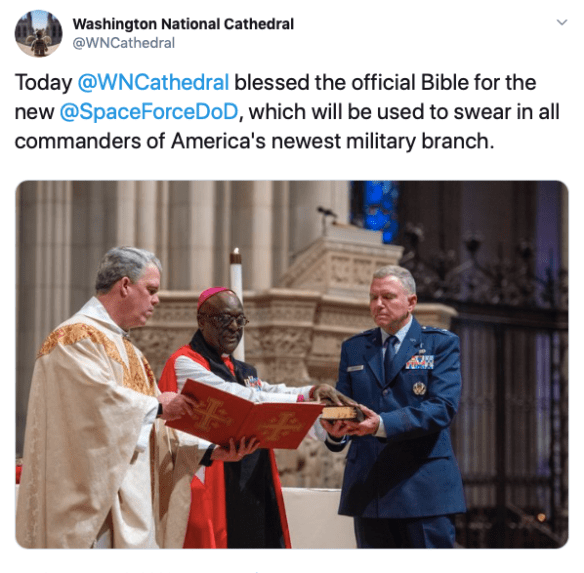
On Sunday, this tweet from the National Cathedral appeared in my feed. There was an immediate response from many who found it and the event it was depicting deeply problematic. Conversation about its significance and appropriateness began immediately and unlike so many such twitter controversies, it has not died down 2 days later. NPR picked up the story as well.

I was deeply troubled by the original tweet as it stated the Cathedral was “blessing the official Bible of the Space Force.” There are serious questions here about what this blessing says about the Episcopal Church’s relationship with the United States and its military, some of which I may address on another occasion. What caught my attention however was the phrase “the official Bible of the Space Force.”

I know little about how the Space Force has developed since President Trump announced its creation; in fact, I assumed it was little more than one of those things the President is prone to say that seem to have little basis in reality. Apparently it is a thing. But I had a number of questions. This official Bible was apparently to be used to swear in all commanders. That raises questions about the role of religion, specifically Christianity in the creation of the military hierarchy, and what role, if any, people who aren’t Christian would have in that hierarchy. Are there also “official” Torahs or Qurans for commanders who might be Jewish or Muslim, or for that matter, what provision is made for people who claim no religious affiliation?

While space has been militarized since the beginning of exploration, the creation of a Space Force seems to me to be a qualitative leap beyond what has occurred to this point. I imagined Space Force conquerors claiming planets as US territory following colonization patterns familiar from past centuries, with missionaries coming behind, Christianizing alien races as the Church of England followed the Empire as it colonized the world and Franciscans and Dominicans accompanied Spanish conquistadors.

The NPR article provides a bit of background and walks back the tweet’s inaccuracies but at the same time introduces some other astonishing and troubling details. The Bible was donated by the Museum of the Bible which is itself mired in controversy regarding its questionable acquisition of items and its ideological perspective. And then there is the prayer that was read at its blessing:

“Almighty God, who set the planets in their courses and the stars in space, look with favor, we pray you, upon the commander in chief, the 45th president of this great nation, who looked to the heavens and dared to dream of a safer future for all mankind.”

There are complex issues involved in occasions such as this. The blessing was performed by Bishop Carl Wright, the Episcopal Church’s Suffragan Bishop for the Armed Forces and Federal Ministries. He oversees chaplains in the Armed Forces, Veterans Administration, and federal prisons. It’s important work and I’m grateful for the Episcopal presence in all of those places. I wouldn’t second-guess any action he took, especially considering I have no direct experience in any of them.

At the same time, I think this event and the reaction to it reflect a much more important issue in the life of the Episcopal Church. Since the founding of the US and the Episcopal Church, we have been the quasi-established Church. It’s no accident that we have a “National Cathedral” that is the site of state funerals like that of George H.W. Bush as well as inaugural prayer services. The difference between this event and the widespread fawning among Episcopalians when President Obama attended Inaugural service es at Episcopal churches is more a matter of degree than of kind.

The fundamental question is this. How can we as a church minister in and to institutions that are deeply oppressive, violent, unjust, and militaristic even as we also seek to call them to account? The blessing of a Bible that will be used in a commander’s swearing-in ceremony implicates the Episcopal Church in whatever command decisions he or she might have to make.

As the percentage of Americans who identify themselves as Christian becomes smaller every year, and as the Episcopal Church itself continues to decline in numbers and influence, it will incumbent on us to develop a public witness that is at once faithful to the Good News of Jesus Christ and recognizes the pluralistic reality of the world in which we live.  We must also acknowledge that the people among whom we minister in those institutions are also struggling to negotiate multiple identities of their own and competing claims for their allegiance. While they are doing this, they are also working with people who  are struggling in the same ways and are often coming from very different religious and cultural backgrounds.

What would it be like if the Episcopal Church, instead of reaching back to traditional symbolism and language or adopting models from established churches, explored new religious forms that recognized the complexity of the world in which we live and sought to honor and strengthen the religious commitments, not just of Episcopalians, but of people who reflect the diversity of America’s and the world’s religions?

All of this requires much greater nuance than is possible in 280 characters.

The Anglican Communion: Why even bother anymore?

In the run-up to the Lambeth Conference 2020, there has been a great deal of consternation and hand-wringing among US Episcopalians about the actions, invitations, and statements from the Archbishop of Canterbury.

For those who are unfamiliar with the intricacies of Anglicanism, the Lambeth Conference is one of the so-called “Instruments of Communion” that connect the various churches that claim affiliation with the Anglican Communion. It is a conference of all Anglican bishops, held every ten years (although delayed this time because of strained relationships over full inclusion of LGBT persons in the life of the Church). All of the bishops gather to build relationships and attempt to make statements on various topics of perceived importance. Traditionally, one of the high points of the conference is tea with the Queen.

The last twenty years have seen increased conflict within Anglicanism over matters of sexuality. The conflict was exacerbated when Gene Robinson was ordained Bishop of New Hampshire in 2003, the first openly gay bishop in a long-term relationship. That precipitated the departure of a number of dioceses and congregations and led to the formation of the Anglican Church of North America. More recently, the Episcopal Church authorized rites for same-sex marriages.

As preparations for Lambeth accelerate, the Archbishop of Canterbury announced that he would not issue invitations to the same-sex spouses of bishops, a decision that aroused the ire of many in the Episcopal Church and led to statements from the Presiding Bishop, the President of the House of Deputies of General Convention, Executive Council, and the House of Bishops.

Another of those “instruments of communion”–the Anglican Consultative Council–is currently meeting in Hong Kong. News was made when the Archbishop of Canterbury declared that the body couldn’t discuss his disinvitation of certain spouses because of British law. Unsurprisingly, this statement was met with outrage by all of the usual suspects.

In addition, Archbishop Welby has invited representatives from the Anglican Church of North America to attend as “non-member observers.” The invitation was met with derision from the leader of ACNA, Foley Beach who wrote in response:

For the Anglican Church in North America to be treated as mere “observers” is an insult to both our bishops, many of whom have made costly stands for the Gospel, and the majority of Anglicans around the world who have long stood with us as a province of the Anglican Communion.

At this point in my life and ministry, I find all of this more amusing than concerning. As a parish priest approaching ten years in my current cure, local issues far outweigh issues of national or international concern. In addition, my closest clergy colleagues are pastors of congregations of other denominations as we work together to address matters that cross denominational boundaries like homelessness, racism, and economic inequity. With the deep political and cultural divisions in our country, with white supremacy running rampant and resurgent anti-semitism expressing itself in killings in synagogues, with the brutal treatment of asylum seekers, refugees, and immigrants, with climate catastrophe, whether the spouses of bishops are invited to a Lambeth conference seem of little importance in the larger scheme of things.

The Anglican Communion is a product of British Empire and colonialism. Its persistence is evidence of the continuing legacy of that history. American Episcopalian continued infatuation with it seems to be as much about the continued appeal of English culture and history, as well as the monarchy. Where our privilege is vanishing before the incessant tide of secularism and Christian nationalism, the fantasy that our church, as small as it is, has global significance because of the “worldwide Anglican Communion” is both persistent and attractive.

Still, I wonder whether it’s time to move on. The Episcopal Church’s relationship with the larger Anglican Communion seems more abusive than life-giving. We want to be accepted as full members. When the Archbishop of Canterbury or some other entity treats us as second-class, we react with outrage. What if we just went our own way?

The “Instruments of Communion” are products of the Age of Imperialism and Colonialism, and the post-World War II efforts to build certain kinds of international institutions. Many of those institutions are showing signs of collapse–the European Union is one prime example.

My question is: In the absence of such formal structures, what might relationships among Anglicans look like? I suspect very much like they look right now on the ground, with work being done by individuals, ecclesial entities, and dioceses across the globe, building relationships of trust and support that are informal but sustaining. Globalization means many things, but one of its products is the ease with which we can connect across the globe via social media and shared interests. Maybe instead of spending all of our energy licking our wounds over our treatment in the run-up to Lambeth 2020, we should work at building those other relationships that aren’t dependent on the Archbishop of Canterbury, gatherings of bishops, or instruments of communion.

Furthermore, in the face of reports that membership in religious bodies has hit an all-time low in the US, maybe it’s time for us to get over the presence of ACNA. There’s a new ACNA congregation in my neighborhood, which I discovered by the postcards they send out before Christmas and Easter. Initially, I felt some anger at the thought of invaders encroaching on our territory. This past Easter, as I was driving home and saw their sandwich board out at the street, I felt gratitude for their witness and prayed silently for their success. With an overflowing crowd at Grace that day, and feeling the exhaustion after Holy Week, I know we can’t reach everyone who is desperate for God’s love in our city, and if my ACNA nieghbors can reach some, I welcome their presence.

And let the litigation begin again.

It seems that the Episcopal Church is in a constant state of litigation. Over the last decade and a half, we’ve seen repeated conflict across the church in response to the moves toward full inclusion of LGBT persons in our life and ministry. Now, millions of dollars later in legal fees, with courts consistently affirming the Episcopal Church’s position that dioceses are not independent of General Convention, another round of such litigation is likely. First, we’ll have to see how things play out within the Church.

This past summer, General Convention passed resolution B012 which mandated that bishops opposed to same-sex marriage make pastoral provisions for couples, congregations, and clergy who sought to solemnize such marriages in their dioceses. Several of the bishops opposed to same-sex marriage have offered such provision, some are still discerning. One, Bishop William H. Love of the Diocese of Albany, announced in November that he would not offer such pastoral provisions.

As was to be expected, an disciplinary proceeding was begun against Bishop Love. Such proceedings, or complaints, can be made by anyone within the Church, so the likelihood that someone or some group would initiate the proceeding was highly likely. Less certain was whether the Presiding Bishop would take any additional action while the disciplinary proceeding was moving forward. Yesterday, Presiding Bishop Curry published his response: to restrict partially and temporarily Bishop Love’s exercise of ministry. Specifically, Bishop Love may not participate in any diocesan disciplinary proceeding against a priest who performs same-sex marriage, “nor may he penalize any member of the clergy or laity or worshipping congregation of his Diocese for their participation in the arrangements for or participation in a same-sex marriage in his Diocese or elsewhere.”

Now, Bishop Love has issued his response to the response. Unsurprisingly, and unfortunately, he will appeal the Presiding Bishop’s restriction on his ministry and vigorous challenge the disciplinary proceeding. He bases his appeal on the definition of marriage in the 1979 Book of Common Prayer:

The official teaching of this Church as outlined in the rubrics of the Marriage Service in the Book of Common Prayer is that: “Christian marriage is a solemn and public covenant between a man and woman in the presence of God.” (BCP 422). Canon 16 of the Constitution and Canons of the Diocese of Albany upholds this teaching and remains in effect until it is either changed by the Diocesan Convention, or it is legally proven to be over-ridden by the legitimate actions of General Convention; none of which has yet taken place.

Now, I’m no canon lawyer, but it would seem to me that because the Book of Common Prayer is itself authoritative because of an act of General Convention, General Convention has the power to rescind or modify anything stated within the BCP. Likely, there’s some fancy canon lawyer parsing of later General Convention actions, that will be the hinge on which any ecclesiastical disciplinary proceeding will depend.

The other key element in Bishop Love’s defense is his appeal to the definition of marriage in the Constitution and Canons of the Diocese of Albany, which he says will remain in effect until changed by Diocesan Convention or legally proven to be over-ridden by the legitimate actions of General Convention. Here Bishop Love is appealing to the familiar, but often proved wrong, argument that dioceses are independent of General Convention. It’s wrong, because General Convention has the power to create and dissolve dioceses.

What’s so unfortunate about all this is that it is avoidable just as all of the earlier litigation and attempts by bishops, other clergy, and congregations to leave the Church. When Bishop Love was ordained deacon, then priest, and consecrated bishop,, he vowed to ” I do solemnly engage to conform to the doctrine, discipline, and worship of the Episcopal Church.’

If he is no longer able to conform to the doctrine, discipline, and worship of the Episcopal Church, he should step down as bishop. It’s really quite simple.

Instead, the Church will expend energy and resources on this internal battle. Should Bishop Love be unhappy with the final result of his appeal and of the disciplinary proceeding’s ultimate outcome, he may choose to pursue his cause in the civil court system as many other bishops and dioceses have done. If he does, it’s likely that more millions of dollars will be expended in the effort.


Episcopal Dioceses and rising geographical inequality

October 13 was the date of the Episcopal Diocese of Milwaukee’s annual convention. It’s not an event I look forward to each year and the longer I serve in my current cure, the less I tend to focus my energies on larger Episcopal entities, whether dioceses or General Convention. Still, it’s an opportunity to connect with other clergy and laity and to hear a bit about what’s happening in other corners of the diocese.

Like so much of the US, Southern Wisconsin is seeing growing inequities among regions and races. Dane County, home of Madison, is in the midst of an economic boom and is home to a growing population. Other parts of the region are struggling economically and losing population. The economic boom affects races quite differently especially in Wisconsin, where racial inequities are among the worst in the nation.

Those inequities are not limited to the secular sphere. We see them in the Church as well. The Diocese of Milwaukee is neither large nor wealthy. Grace Church, with an average Sunday attendance of around 170 and an operating budget of approximately 550,000 is the second largest congregation in the Diocese. Many of our congregations are quite small and are served by part-time clergy. A number of congregations, both urban and small-town, have closed over the last years.

It was with this in mind that I read Richard Florida’s piece on City Lab entitled “America’s Worsening Geographic Inequality.” Drawing on a number of recent studies, Florida points out the disturbing trends:

  • the decline of middle-class neighborhoods and the separation of America into “areas of concentrated advantage juxtaposed with areas of concentrated disadvantage”
  • change in prosperity of neighborhoods (1980-2016); suburban neighborhoods most stable; among urban neighborhoods, more upwardly mobile than downwardly mobile; rural neighborhoods the most volatile
  • up to 1980, geographical inequities declined; since 1980; they have grown
  • Today, median household income for the top 20 percent of America’s counties is more than twice as high as the median household income of the bottom 20 percent, while poverty rates are roughly three times greater in the poorest 20 percent of counties, compared to the most affluent 20 percent.
  • America is not only economically unequal: Its inequality cuts sharply across geographic lines. We are becoming a country of have and have-nots that turns on where we were born or where we are able to live. And this worsening winner-take-all geography is bound up with, and reflects, our long running divides of race and class.  Increasingly, our neighborhood, and our zip code, is our economic destiny.

One sees evidence of such growing geographical inequality in the life of our diocese. It’s not just that a relatively small number of congregations account for much of diocesan revenue, it’s that the diocese in turn offers aid to a significant number of parishes. So, in a sense, there’s a redistribution of wealth taking place among parishes.

It seems to me that we don’t take these larger geographical inequalities into account when we think about our common life as a diocese. I doubt very much whether many dioceses do. We are accustomed to think in terms of racial inequality and regional (North and South; the coasts and flyover country) differences. But geographical inequality is also present within dioceses. Many of our struggling churches are in neighborhoods that are struggling as well. This is true of urban as well as rural or small-town communities.

The Episcopal Church with its geographically-shaped structure may be uniquely situated to address geographical inequities like those cited by Florida. To a degree, we already do this with our funding mechanisms. But I suspect we need to go further and nurture the bonds that tie us together as Episcopalians across the divides that separate us, whether those divisions be class, race, gender, or geography.

General Convention 79: The view from Madison’s Capitol Square

My twitter and facebook feeds are full of posts from real and social media friends who are traveling to Austin, TX for the Episcopal Church General Convention. I’m not among those who will be attending. In fact, I’ve never attended General Convention. As this one approaches, by my calculations the ninth since I joined the Episcopal Church, I am fascinated by how my engagement with this triennial event has changed over time.

Early on, I’m not sure I even knew what it was or cared very much about it. It wasn’t until I entered the ordination process and began getting involved on the diocesan level that I began attention. Coincidentally, that was right around 2003, when the decade-long conflict that began with the election of Gene Robinson as Bishop of New Hampshire, broke out. As that conflict continued and as the debate over same-sex marriage also exploded, I paid close attention to events at General Convention and the discussions and jockeying that occurred in the months leading up to the meetings.

This year feels quite different. It’s not that there are no controversial issues on the table: prayer book revision, several resolutions about marriage rites, and addressing sexual harassment in the Church are all important and likely to gain attention outside the confines of The Episcopal Church.

I know there are many who are passionate about General Convention. It is an important aspect of our Church’s governance and for many it is an opportunity to connect with old friends and make new ones. I’m grateful for both aspects of this gathering, for the work that takes place and for the relationships it nurtures.

At the same time, I find myself less interested in what will take place there. I think there are a couple of reasons for this lack of interest. First, I have been in my current position for nine years. The longer I stay here, the more focused my ministry becomes on my local context. Madison is confronting a number of serious issues: homelessness, of course, which because of the presence of the Men’s Drop-In Shelter here at Grace is always at the top of the church’s and my list of priorities. In addition, Madison, Dane County, and the State of Wisconsin have among the most significant racial inequities of any state in the nation and closely related to that is mass incarceration which affects us through the presence nearby of the Dane County Jail.

In addition, since 2011, we have been at the epicenter of political conflict in our state and by extension the nation. Since the protests that erupted around Governor Walker’s plans to transform the State of Wisconsin into a laboratory for conservative policies, hardly a month goes by without rallies on the streets and sidewalks outside our doors. Just last week, as we were celebrating and blessing a marriage, outside our doors thousands were rallying as part of the nationwide Keep Families Together effort. I have participated in more such rallies in my nine years of ministry here than I did in the previous five decades of my life.

Finally, as I continue to work in Madison, my relationships with clergy of other denominations and my ecumenical engagement have become as important, if not more so, than my relationships with Episcopal clergy and the larger church. I have participated on commissions of the Wisconsin Council of Churches for most of the time I have been here and have been nurtured by relationships formed with clergy colleagues there and in Madison. As denominational structures continue to transform in the wake of the demographic and cultural decline of mainline Christianity, such relationships and ecumenical partnerships may become more important.


I suppose what I’m saying is that context matters. As my tenure at Grace lengthens, the relationships I have built with parishioners and the wider community come to matter much more. The problems and challenges of our city take center stage, and my capacity to engage creatively and effectively with those challenges and opportunities grows. It’s not that the denomination as a whole, nor indeed the worldwide Anglican Communion, no longer matter to me, but rather, I experience those larger entities through a perspective increasingly shaped by my local context.

I am looking at General Convention from the corner of N. Carroll St. and W. Washington Ave., in Madison. So even as the work of General Convention goes on, I will also be doing the work of ministry, administration, and advocacy in this place, grateful for that work and calling, and grateful for all of those others called to do the work of the larger church. My prayers are with and for them.

Some resources for the Daily Office, Bible Study, and the Daily Examen

I led an adult forum at Grace last Sunday during which I offered brief introductions to the Daily Office and the Daily Examen from the Ignatian tradition. I’ve collected some of those resources here, as well as links to the Bible and the lectionary.

The Book of Common Prayer online: https://www.bcponline.org 

The Daily Office (Morning and Evening Prayer, Daily Devotions)

Morning Prayer Rite I BCP 37

Morning Prayer Rite II BCP 75

Evening Prayer Rite I BCP 61

Evening Prayer Rite II BCP 115

Compline BCP 127

Daily Devotions for Families BCP 136

Daily Office online:

http://www.missionstclare.com/english/index.html

This site includes the psalms, readings, and canticles for each office, so you don’t need to look through the lectionary, or have a bible. Daily office app available on itunes or android.

The Daily Office podcast: https://itunes.apple.com/us/podcast/audio-daily-office-the-trinity-mission/id604914110?mt=2

The Bible

For many years, I have used this site: http://bible.oremus.org. It offers a number of different versions, but defaults to the New Revised Standard Version (with British spelling), which is the version we use in worship.

The Lectionary.

If you want to know the readings for Sunday in advance, they are all available at The Lectionary Page: http://www.lectionarypage.net

A great resource for exploring each week’s Sunday readings is Textweek.com.

The Daily Examen

An alternative to the Daily Office is the daily examen. From the Jesuit tradition, meant to offer you an opportunity at the end of the day to look back over your day for signs of God’s presence and grace.

A brief overview:

  1. Become aware of God’s presence.
    2.Review the day with gratitude.
    3. Pay attention to your emotions.
    4. Choose one feature of the day and pray from it.
    5. Look toward tomorrow.

From Ashes to Glory (the daily examen for Lent):

https://www.ignatianspirituality.com/ignatian-prayer/the-examen/from-ashes-to-glory