Unknown's avatar

About djgrieser

I have been Rector of Grace Episcopal Church in Madison, WI since 2009. I'm passionate about Jesus Christ and about connecting our faith and tradition with 21st century culture. I'm also very active in advocating for our homeless neighbors.

A Whale of a Sermon: Epiphany 3B, 2024

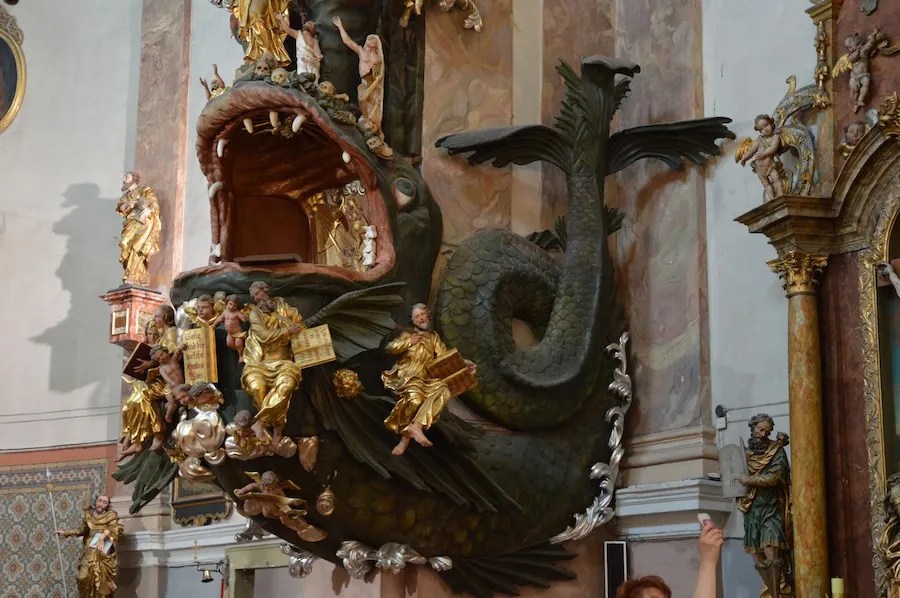
 “Whale Pulpit” Ss. Peter and Paul Church, Duszniki, Poland. Photo by Magdalena Łanuszka, http://en.posztukiwania.pl/2016/05/06/big-fish-in-a-pulpit/

It’s one of those great ironies, and perhaps an indictment of the 3-year lectionary cycle, that the Book of Jonah gets so little love in the Sunday Eucharistic lectionary. I mean, if you ever went to Sunday School as a kid, if you had a story bible, if you know anything about the Old Testament, and even if you don’t, you’ve heard something about Jonah and the whale. It’s a great story, full of drama, big fish, and lots of humor. But we will only hear from it once in the three-year lectionary, this reading of a smattering of verses from chapter 3 (the same chapter comes up as an alternative reading in year A).

I get it; I get the discomfort. I had figured out the problems with a literal, historical reading of Jonah when I was a young boy. Whales can’t ingest humans; people can’t survive for three days in a whale’s belly; a whale couldn’t get from the Mediterranean to the Persian Gulf to spew Jonah out, and on and on. One commentator remarked that of all the details in the story of Jonah, that he was eaten by a whale is the most plausible. But it’s a great story!

The cultural and theological significance of it go far beyond the story’s detail. Look at that image on the front cover of a pulpit in the shape of a whale. What must it be like to preach from such a thing? It certainly would enhance one’s sense of responsibility, of obligation and authority and it draws attention both the brevity of the sermon Jonah preached (six words in English, five in Hebrew) and the amazing response to that sermon by the people (and cattle) of Nineveh. 

On Friday, I had a conversation with some clergy friends that detoured into talking about preaching and about what we expect our sermons to do. Oddly enough, none of us brought up Jonah’s example as a sermon either to emulate, or to expect that level of response from one’s congregation. 

Well, let’s dig in a bit.

For if there’s anything unlikely, unbelievable, it’s the effect of Jonah’s preaching. The text says that Nineveh was a large city; it was a three-day’s walk from one end to the other, and that when Jonah arrived, he walked a day into it, and there preached his message of doom and destruction. That’s all it took. One lone voice, six simple words in Hebrew. Just this, coming from a foreigner, and the whole city, man and beast, put on sackcloth and ashes, and repented of their wickedness. It could happen, I suppose.

What comes next is equally surprising. Having prophesied doom and destruction, Jonah leaves the city, finds a hill overlooking it, and settles in to watch the carnage. God provides him with a bush that grows up to give Jonah shade from the hot sun, a turn of events that made Jonah quite happy, but the next day, God caused a worm to kill the bush so that it withered and Jonah got sunburnt. He also got angry.

If you were Jonah, how would you respond to this development? One would think he would be pleased with himself, proud of the effects of his preaching. But no. He complains to God, saying that the reason he didn’t want to go in the first place was because he knew this would happen. He knew God was a gracious God, full of mercy, slow to anger, and abounding in steadfast love, ready to relent. In other words, if Jonah was going to prophesy doom and destruction, he wanted to see it happen.

So what should we make of all this? A prophet who doesn’t want to be a prophet, certainly doesn’t want to be a successful prophet and resists his call. On that level, we can understand the story all to well. We can imagine resisting the tug of duty and responsibility, turning away from what we know we ought to do. We can even imagine, most of us, sensing God calling us in a certain direction, calling us to deeper commitment, to a richer spiritual life, and turning away.

That’s all easy to imagine, and in that sense, Jonah represents us, everyman. But there’s more to the story than just Jonah. Besides Jonah and God, there’s another actor, or set of actors in the story, and that is Nineveh itself. Now, Nineveh was the heart of the Assyrian empire, one of the great empires of the ancient near east, and one of the most brutal. It was Assyria that had destroyed the northern kingdom of Israel in the 8th century bce. Nineveh was the evil empire. Its power dwarfed all of its neighbors, including the kingdom of Judah. That makes Jonah’s resistance to God’s call all the more understandable, even if that’s not the excuse Jonah gave himself.

In the end, the book of Jonah is not primarily about Jonah. It is about God. It is a story of God’s love, mercy, steadfast love. It is about proclaiming not just God’s displeasure and threatening destruction, it is about knowing who God is, and proclaiming that message of love, mercy, and steadfast love. 

When God rebukes Jonah at the end of the story, God points out that if Jonah was concerned about a bush, how much more should God be concerned about the city of Nineveh with its more than 120,000 inhabitants, and also animals. This is a story about the universalizing of God’s love and mercy. Jonah, and the original readers of this text, were being challenged to expand their notion of God and of God’s love. For all God’s love and concern for the Jewish people in the post-exilic period, the Hebrew Bible and the book of Jonah, bear witness to a growing understanding that God is God of all creation, the God of all humanity and God’s love and mercy extends to all humans, even to one’s enemies.

I wonder how many of us are like Jonah, so hardened in our attitudes, so critical of those with whom we disagree, that what we really want is to see them destroyed by God’s wrath, embarrassment in the media, or humiliating political defeat? We proclaim God’s judgment on our opponents but do we ever consider what might happen if they changed their minds, if they repented of the actions that we regard as sinful, evil, oppressive and unjust? 

Are we like Jonah, who having delivered our prophetic message in the most self-righteous of language and attitude, are now sitting above the city, waiting for its destruction? Or can we imagine that God might accept the repentance and show mercy?

And that’s the message for us as well. Like Jonah, that is what God is calling us to, as individuals and as a congregation. The God who is calling us is not a God of wrath and destruction, no matter how much some Christians in our culture would have us and everyone else believe it. The God who calls us is unimaginable in the extent of the love, mercy, and patience God has. It is that God we have experienced ourselves in the forgiveness of our sins. It is that God we are called to share with a world that knows hate and fear and violence. It is that message, a message we know for ourselves, that we need to bring to those around us. And we need to proclaim it throughout the our community and the world. Wherever there is animosity and hate, whatever enemies we fear, God’s steadfast love and mercy is present even there, even among them. God is reaching out, seeking the lost, extending God’s love to the unloved, the hated, the reviled, whether they live on the other side of the world, or right next door. 

Wordle and the Word: A Sermon for Christmas Day, 2023

December 25, 2023

Do any of you know the New York Times word game “Wordle”? It became an internet sensation during the lockdown. The goal is to guess a five-letter word and you have 6 chances. It’s rather addictive, and for many months, everyone would post their results on social media. That’s become somewhat less common over the years, but yesterday, a former parishioner emailed me his results. On the third try, he got it “GRACE.” Over the course of the day, and night, yesterday, others mentioned it to me as well. 

Yes, I do it, but I’m rather embarrassed to admit that it took me 4 tries yesterday. On attempt 3, I went with “BRACE.” In case you’re curious,  I’m currently on a 239 day streak. And also, in case you’re wondering, I do them all: the crossword, the mini, spelling bee, and now connections. They’re all part of my morning ritual.

Words are fascinating things. That we play games with them like WORDLE is evidence of the power they have. They amuse and divert us; they hurt and heal us. They help to share our deepest thoughts and feelings; and are also woefully inadequate to express those thoughts and feelings. We are bombarded with words; we bombard others with words. And now, thanks to Chatgpt, we can use artificial intelligence to manufacture words for ourselves, for others, or for class assignments. You probably wouldn’t be surprised to learn that preachers are using AI to manufacture or produce sermons.

That’s quite an irony, isn’t it, given today’s gospel reading: “In the beginning was the Word, and the Word was with God and the Word was God.” 

I said to a couple of people last night as they were expressing sympathy for me having to get up today and do this service, that for me, in many ways, as beautiful and powerful as the Christmas Eve services are, with choir, and carols, candlelight, and a full church, this service is the one that matters most to me—and it’s for one reason, that I have the great honor and privilege to proclaim this gospel text: John 1:1-14, and to preach the good news from it. Although I’ve preached on this passage more than twenty times, it will never get old; I will never exhaust its meaning, and I will never fully comprehend it.

In the beginning was the word. In principio erat verbum. En arche en ho logos. The Greek word behind our translation of word is “logos.” It means much more than “word.” In Hellenistic philosophy, it referred to the underlying order and reason of the universe and many scholars think that the author of the gospel, or the author of the hymn on which the gospel’s author was drawing, used another Greek word—sophia, or wisdom, which in Greek thought and in Jewish scripture, was the personification of wisdom. Because it is in the feminine gender it is thought, it was changed from “Sophia” to “Logos.”

But word, or reason, or order, or even wisdom points to something deeper. It’s not just that the Word, Christ, the Second Person of the Trinity was present at creation. It’s that God created through the Word, by speaking. As Genesis 1 states, “God said, ‘Let there be light.’ And there was light.

This is powerful stuff. There’s another image that I find particularly compelling. When the great Dutch humanist Erasmus went about publishing the first Greek New Testament, and then re-translating the Greek into Latin, he recognized the inadequacy of “word” as a translation of “logos.” So he chose another Latin word “sermo.” While it’s the root from which our word “sermon” comes, it actually means something quite different: “conversation.” 

That image intrigues me. Erasmus is implying that at the heart of God’s nature, at the heart of the Trinity, is conversation, communication. I find it wonderfully reassuring that in spite of our experience of the inadequacy of words, and of communication, that in the Trinity, in God, there is perfect conversation, perfect communication.

Of course, all of that is fine theological speculation; much more than a word game, but also, in a way, a word game. To place Christ at the very beginning, in creation, the means of creation, is to say something or many things, about God’s nature, and about the nature of God revealed in Christ.

But our gospel goes further; our faith goes further. The majestic language, the lofty theological reflection that is revealed in the opening cadences of John 1: “In the beginning was the Word, and the Word was with God, and the Word was God,” concludes, “And the Word became flesh and lived among us.” 

That’s the message of the gospel, the message of Christmas. In fact, the Greek could be translated “tabernacled” or “tented” among us. Again, there are multiple meanings here. John is referring back to the way God was present among the Israelites during the Exodus, in a tabernacle or tent but there’s also a powerful sense, that he is alluding to the temporary, ephemeral nature of a tent. Like our bodies, tents are not permanent, they lack solidity; they are easily damaged. 

That is to say, the word took on frail human flesh to be like us. But John goes on and in one of his key paradoxes, reminds us that in that temporary dwelling, we catch sight of God’s glory.

So we are back in Bethlehem, back in the confusing paradox that God became incarnate in a very ordinary way, in the poorest of circumstances, in the weakest of all human forms, a baby. And it is in that paradox, that we see God’s glory. For John, it is the same paradox as the cross, which he almost always refers to as the glorification of Christ. What he is telling us is that in these moments of weakness, we see God’s majesty and power.

But we have the reality of that incarnation before us in many ways. We see it, we taste it in the bread and wine of the eucharist, when we receive the body and blood of Christ. We see it in the very imperfect Church, both our local community, and the worldwide communion, bodies filled with flaws and imperfections, but also, mysteriously, the body of Christ. And finally, we may see it in ourselves, imperfect human beings though we are, but by the grace of God filled with the presence of Christ. May this Christmas rekindle in all of us the knowledge of Christ’s presence, of Christ’s glory, in ourselves, in our church and community, and in all the world.

Christmas Rubble: A Sermon for Christmas Eve, 2023

December 24, 2023

At first glance, at first reflection, all seems as it should be. There’s something so seductive, so reassuring about entering a beautiful space like Grace Church, decorated as it is every year at Christmas time. There’s the garland, the wreaths, the beloved creche in front of the altar with the exquisitely carved magi and entourage in the back of the nave as they’ve begun their journey to Bethlehem. 

It all sounds the same, too, with familiar carols and our lovely choir and musicians. Where have you come from this evening? From holiday tables at restaurants, or festive gatherings with friends and family? Some of us may even be planning on going to other gatherings; others of us will make our ways  home at the end of a long, and exhausting Sunday. 

It’s so similar to so many other Christmases, my fifteenth here at Grace. Some of you have been coming much longer than that and are settling into the beauty and familiarity of rituals and memories that may go back decades. But those memories are also tinged with sadness as we remember those who aren’t here any longer.

But beneath that familiarity and beauty, tucked away in our memories, or perhaps shoved out of our immediate attention by that beauty, are other memories, other images—of those Christmases in 2020 and 2021 when there were no services here because of the pandemic. We’re reminded that the pandemic has not left us, that our return to normalcy takes place while many continue to contract the illness or suffer the effects of long covid.

There may be other images, other emotions that are hard to repress right now. One image that haunts me is a photo shared by the pastor of the Lutheran Church in Bethlehem, Palestine. The Churches in Jerusalem and the West Bank announced recently that there would be no public celebrations, no public displays during Christmas, so this pastor, instead of erecting the usual creche like ours, did something else in his church. He brought in a pile of rubble, and in the middle of it lies the Christ child, wrapped in a keffiyeh, the symbol of Palestinian peoplehood. It speaks directly and eloquently to the humanitarian crisis that we’ve watched over the last nearly two months, an indiscriminate and horrific destruction of a people who have been driven from their homes, oppressed and practically held captive for the last nearly 75 years.

The plight of Christians, and Muslims, in the West Bank receives less attention than that of Gaza, but their lives are also under attack on a daily basis, their existence and presence in their homeland more precarious than ever. In Gaza, our Christian siblings are being killed, their ancient churches bombed to rubble. Of course, it’s not just Christians who are suffering there. The bombs don’t distinguish on the basis of religious commitment. On top of the thousands dead and homeless, now we’re hearing of starvation as aid continues to be blocked. The world watches; our own government is complicit in the atrocities. War continues in Ukraine as well, and even where there is no war, there is famine, hunger, and homelessness, poverty and disease. 

As we celebrate Christmas with carols, happy gatherings, and parties, we know that across the globe, people are suffering. We have learned hard lessons over the last few years. We have learned and re-learned about the fragility of life—how easily and quickly loved ones may be snatched from us by disease. We have learned about the fragility of our political institutions, our national life. We see daily evidence of the fragility of the human global community, and we are growing more aware, even as many deny it, of the fragility of life on this planet. 

So too, do we know the fragility of our faith. It is easy to grow disheartened, for our doubts to spiral into despair. In the presence of all the world’s ills, to lose hope seems not only natural but obvious. We reel from broken relationships, from trauma that continues to haunt us. It may very well be that it took all the courage we have left in us to venture out this evening to this place, in a desperate, unspoken plea for God to speak to us, to heal us and the world.

But the disconnect between our lives and our world and that of first-century Palestine may seem greater than ever. What can an ancient faith, a familiar story say to us in the face of millions suffering and global climate catastrophe? Can the story of Christ’s birth still speak to us? Can the carols we sing, the familiar decorations, the season’s joys, fill our hearts?

 The story Luke tells is not only about the birth of Jesus Christ. He interweaves that story with the story, and the reality of the Roman Empire. And it’s not because Luke was one of those 21st century bros who thinks about the Roman Empire every day, as the recent internet meme would have it. He did think about it every day because it was an all-encompassing, totalizing reality. It insinuated itself into the lives of everyone from the British Isles to the Indian subcontinent—and even beyond as its cultural influence extended almost everywhere.

Luke is writing within the Roman Empire, to citizens and inhabitants of the Roman Empire. The subjects of his story belonged to a people who were prone to rebellion, repeated small ones, but larger ones, like the Jewish Revolt of the late 60s ce, which would have been fresh in Luke’s memory, or the one a generation later in the 130s, after which Rome razed Jerusalem, and forbid Jews to live there. 

By placing his story in the context of the Roman Empire, Luke is highlighting the contrast between that reality, and the reality of God’s reign, coming in a very different way, in poverty, humility, and weakness. Not the power of Roman legions, or tanks or military force, but the power of vulnerable and fragile, a baby, swathed in love, bringing love, inviting us to love.

We desperately want certainty, unmistakable signs of God’s power and might, fixing us, fixing the world. Instead, we get this: a baby born in a dusty town in a far-off place and a far-off time. We get stories of angels, shepherds, and magi. We want God to solve our problems, fix our world, to show Godself to us with power and majesty. Instead, we get this: a tiny new life, utterly vulnerable, utterly dependent, the fragility and weakness of an infant. And this, we believe, is God.

This is God: this tiny, utterly dependent and vulnerable baby is God come into the world. This first time, Christ did not come in power and great majesty, but quietly, almost unnoticed, in a remote corner of the Roman Empire, to a young woman who seemed wholly ordinary and unremarkable.

This is God, in Christ, coming to us, in all our fragility, vulnerability, and suffering, coming into our broken lives and broken world. A baby, coming into the rubble of our lives, the rubble of our world, filling it, and us, with grace and hope and love. Thanks be to God. 

Advent Poetry: A homily for Advent 3B, 2023

December 17, 2023

There’s something about the season of Advent that always draws me to poetry. It may be the ambiguity of the season, the idea that we are waiting for Christ coming to us in multiple ways. It may be the binary opposites of light and darkness, goodness and evil, that permeate the traditional imagery of the season, of our hymnody and scripture readings.

This week I’ve been reading the latest work by Christian Wiman, a poet and theologian who now teaches at Yale Divinity School. For many years, he was the editor of Poetry magazine. He writes with beauty, power, and elegance about his ambivalent faith and his decade-long struggle with cancer. His latest book is entitled Zero at the Bone: Fifty Entries against Despair. 

While there is a great deal that is worthy of reflection, the thing that stopped me cold—and keeps drawing me back, is a poem by Anne Carson that he includes and upon which he reflects. It’s entitled “God’s Justice”

I love that image: “on the day He was to create justice God got involved in making a dragonfly and lost track of time.” It alludes to something that I have come to believe more and more strongly—God’s boundless and infinite creativity, a joyfulness and play at the heart of creation and at the heart of God. 

But there’s something else here that’s poignant and sad—perhaps. The sense that there is something fundamentally wrong with the world as we experience it—that it isn’t just and right. We know that all too well—the suffering in the world and in our lives, the pain inflicted on human beings by other human beings and the inability, unwillingness to try to make this right. We know the evils of the world and, as the prophet does in today’s reading, we cry out for justice. 

In the beginning there were days set aside for various tasks
On the day he was to create justice 
God got involved in making a dragonfly
and lost track of time.

It was about two inches long
with turquoise dots all down its back like Lauren Bacall.

God watched it bend its tiny wire elbows
as it set about clening the transparent case of its head.
The eye globes mounted on the case.

rotated this way and that
as it polished every angle.
Inside the case

which was glassy black like the windows of a downtown bank
God could see the machinery humming
and He watched the hum

travel all the way down turquoise dots to the end of the tail
and breathe off as light.
Its black wings vibrated in and out.

Our lessons today remind us of where our focus should be, where and how we should proclaim Christ, where and how we should work for justice. 

The reading from Isaiah, the first verses of which provide the text for Jesus first public proclamation in the Gospel of Luke, offer both reassurance and command. As Christians, we read these words as promise of Christ’s coming, of the future reign of God that he proclaimed and for which we hope. We see ourselves as recipients of that good news, and of the promised healing and release.

At the same time, we must see ourselves in this story, not just as recipients of God’s grace and justice but as participants in the coming of that justice. We are called to rebuild the ruined cities—and here we might think not only of literal cities, but of all the ways that human community, the common good, have been undermined and attacked in recent years.

Even stronger are the words from the Song of Mary. It’s always helpful to remember just who she was—a young woman, likely a teenager, mysteriously, shamefully pregnant, as vulnerable in her historical context as a similar young woman would be in our day. Yet from that small, unlikely, reviled person, comes this powerful hymn that witnesses to God’s redemptive power:

My soul proclaims the greatness of the Lord,

my spirit rejoices in God my Savior; * 
for he has looked with favor on his lowly servant.

From this day all generations will call me blessed: *
the Almighty has done great things for me, and holy is his Name.

He has mercy on those who fear him *
in every generation.

He has shown the strength of his arm, *
he has scattered the proud in their conceit.

He has cast down the mighty from their thrones, *
and has lifted up the lowly.

He has filled the hungry with good things, *
and the rich he has sent away empty.

This familiar hymn has suffered for its popularity and familiarity. Its use in worship over the millennia has numbed us to its revolutionary power. We need to reclaim it today, sing it with meaning. We need to do more than sing it, we need to work so that it comes into being. We need to imagine the possibility that God is working in this way, in spite of all evidence to the contrary, in spite of all our fears, doubts, and despair. We need to believe that the words of a first-century teenaged single mom can inspire to see God at work in the world around us. For remember, the world in which she lived was unjust and violent as well, and for many people hopelessness and terror were ways of life.

Like the poem with which I began, Mary’s song is a thing of beauty, sung in the midst of injustice. It calls us to see beauty in the broken world around us. It calls us to see God at work in those beautiful things created by God, even in us. It calls us to to the hope that in spite of the ugliness and suffering in the world, God’s beauty and justice are present, making all things new, and through God’s grace, remaking us as well.

The Wildness of Advent: A Sermon for Advent 2B, 2023

On Monday, I had the opportunity to spend a few hours with poet, theologian, trans activist, and faithful Christian Jay Hulme. I have been following Jay on Twitter for many years. I’m not sure how I got connected but over the years, in addition to sharing his spiritual journey and some of his poems, he posted photos of many of the old churches he visited, and whose towers he climbed. He is currently churchwarden of St. Nicolas, Leicester, England, one of the oldest, perhaps the sixth oldest continuing church in England. Dating from the 8th or 9th century, it is built on the ruins of a sixth century church, which in turn is built on Roman ruins. 

Jay’s poetry is fierce and powerful. He writes about the many places he visits, about holy wells, and saints, and sacred places. There’s a wildness about his poetry and personality. He is courageous and frank. We talked about the very different senses of history that come from being among buildings that date back 500 years or a millennium and the relatively newness of our own buildings. I showed him Grace Church and sent him up the bell tower and I expect we might see a poem one day about that experience or about the cheese curds we shared at the Old Fashioned over lunch.

Listening to him read his poems brought home to me the wildness of the God he encounters in those strange places, on holy islands like Lindisfarne, or in the saints like Joan of Arc about whom he writes. So I was thinking about wildness when I reread the gospel for today, Mark’s take on John the Baptizer. 

In fact, there’s a wildness about Mark as a whole. Probably the first of the gospels to appear, Mark begins in the middle of things and ends abruptly, with an empty tomb and frightened women. In between, there are stories of Jesus encountering people possessed by evil spirits, by demons, Jesus taming storms, and there’s a sense that Jesus himself is doing battle with Satan and demonic forces. 

But wildest of all may be John the Baptizer himself. As Mark tells it, John suddenly appears in the wilderness, preaching and baptizing and attracting large crowds. He is clothed in camel hair and ate locusts and wild honey. Did the crowds come out of curiosity or a desire to hear the words of a prophet? Ultimately, his wildness, his uncontrollability will lead to the inevitable result, his arrest by the authorities, in this case Herod, and his execution.

Our observance of the season of Advent is complicated and contradictory. It is a season of preparation and waiting, preparing for Christ’s coming at Christmas, but as our scripture readings and hymns remind us, it is also about the Second Coming-Christ coming in majesty.

 We tend to downplay that aspect of the season. It can make us feel uncomfortable and inappropriate in light of the larger cultural focus on the coming of Christmas, the round of holiday concerts and get-togethers; the ways in which the advent wreath, for example, originally intended for use in homes, has found its way into churches and given liturgies that focus on themes like love and joy. 

And then we encounter John the Baptizer, with his wild hair, his wild dress, and his wild preaching—Repent! For the kingdom of God has drawn near. John breaks in on us and our complacency. John breaks in on our self-satisfaction and our delusions. John breaks in on the certainties of our lives and our of our seasonal celebrations and cries “Repent.”

This is wildness, uncontrollable. Like the images of the second coming that have dominated our readings over the last month. Like the threats of judgment and warning given to servants, and to bridesmaids, and to us.

That wildness surrounds us—wildness of our own making and not of God’s. The threats of climate change. Are we at a tipping point, with the threats of the melting of the Greenland icesheet while politicians dither over concrete actions, in of all places, Dubai, a monument to our thirst for fossil fuels and conspicuous consumption?

Are we at a tipping point, with thousands already dead in Gaza, and threats to hundreds of thousands, while politicians and pundits debate “genocide” and silence critics of the devastating war that is taking place in front of our eyes and with the support and weapons of the US.

We look around and see all of the crises that continue to threaten us—and the ways in which we threaten the lives of others and all the while we make our plans, do our shopping, plan our menus. The chaos of it all, the wildness, threatens to overwhelm us and so we grasp at those familiar rituals that help to center us and to stave off those feelings of fear and despair.

Wildness, chaos is often understood to be a product of evil yet it’s worth remembering that in the story of creation, God was there, in the midst of chaos, bringing order, speaking the universe into existence, bringing light, and life and creativity. The voice of John crying in the wilderness is not a sign of chaos but a call to repentance, a call from God to us.

Advent reminds us that God is coming into the world, a world beset by evil, threatened by chaos, changed and degraded by our own human actions, our hubris, greed, and rampant desires. But God is coming into the world, coming to us. Indeed, if we pay attention, as we should, we will realize that God is already here, in the wildness, and in the chaos, remaking us in God’s image, bestowing grace in our lives and in those we love.

We may be fearful; we may be disheartened; we may lose hope. But God calls us from the wilderness and the wildness, God calls us in our own wildernesses and wildnesses, when our steps falter, our faith flags, our strength fails. God calls us, comes to us and leads us into the future where there is hope, and justice, and peace.

The Reign of Christ: A sermon for the last Sunday after Pentecost, 2023

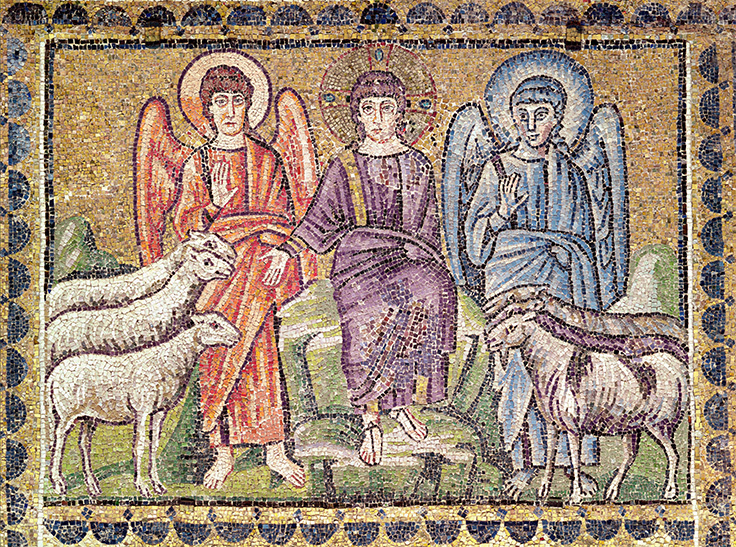
Christ separating the sheep from the goats, San Apollinaire Nuevo, Ravenna, 6th century

Reign of Christ

November 26, 2023

It’s been nearly forty years since I’ve visited Ravenna, Italy but its churches and their mosaics are still alive in my memory. So too is the awe and wonder that they evoked in me then. In the sixth century ce, Ravenna was the western capital of the Byzantine Empire, and the emperors and their families undertook a vast building project to express their power and faith. The mosaics conflate and combine imperial and religious imagery and while their meaning and significance are much debated among art historians and historians of late antiquity, their power, in the sixth century and today, are not.

You can see that imagery on full display on the the cover illustration of today’s service bulletin. What you cannot see is that in addition to looking like a ruler sitting on a throne, Christ in this mosaic is clad in imperial purple, wearing all the trappings and symbolism of a Roman emperor. 

I chose that image because today is the observance of Christ the King, or the Reign of Christ in contemporary parlance, is a 20th century innovation, this mosaic seems to capture perfectly the lectionary choice of Matthew 25:34-46. Christ, reigning in majesty, separating the sheep from the goats. 

Thinking about this image in the context of the parable may help us to encounter the story with new eyes, for it has become something of a favorite for many of us, a way of thinking about our responsibilities as followers of Jesus and to distinguish our sort of Christianity from that of many others—a focus on doing good rather than believing correctly. That interpretation is both comforting and self-gratulatory, and as always with the parables, I want us to experience its strangeness.

One way to do that is to note its context and the parables that precede it. Over the last few weeks, we’ve heard the parable of the wise and foolish bridesmaids, the talents, the wedding banquet. The parable of the wise and foolish bridesmaids concludes with the foolish ones locked out of the banquet hall. The parables of the wedding banquet and the talents end with someone cast into outer darkness, where there is weeping and gnashing of teeth. This one ends similarly with the goats banished to eternal punishment.

After the last two Sunday gospel readings, two parables of judgment and warning about the return of Christ, two parables that make us uncomfortable both in their urgency and in the message of judgment they proclaim, the judgment in this parable seems to support all of our prejudices and values.

In today’s reading, we are inclined, thanks to two thousand years of Christian reflection on this story, to see the separation of sheep and goats into good and evil as obvious, a given. Well, not so fast. In the ancient near east, goats were a prized animal. Their milk and meat were staples. They were not seen as evil—a goat was an acceptable sacrifice in Israelite religion. 

Perhaps more interesting is the fact that it was a common practice to keep goats and sheep together in a single flock. The only time the two animals were separated by the shepherd was on cold nights, when goats needed more protection. In short, in this reading as in the two preceding parables, the separation of sheep and goats into good and evil, is rather arbitrary. 

In fact, that’s something of a theme in Matthew’s gospel, that one can’t distinguish good from evil until the time of judgment—remember the parable of the wheat and the weeds, when “the devil” sowed weeds in a field and the farmer said that at the time of harvest, the wheat and the weeds would be separated and the weeds burned. So there’s something typically Matthean about this whole passage, something that Matthew as a gospel writer is especially interested in. It’s probably a result of something I mentioned a couple of Sundays ago, that a central concern for early Christians that Jesus had not yet returned.

I would like to draw your attention to something else in the text. Jesus is describing what the coming of the Son of Man will be like. First, he uses royal imagery. He will come in glory and sit on his heavenly throne. But immediately, that imagery is combined with another image, that of the shepherd. He will separate the people like a shepherd separates his flocks, the sheep from the goats. 

This image may draw us back to the reading from Ezekiel, where another visionary sees God coming like a shepherd, judging between the fat sheep and the lean sheep, rescuing them from wherever they have been scattered, feeding them, binding up the injured. We might find it odd that these two images—the shepherd and the king—are linked together in the biblical tradition. As the reading from Ezekiel makes clear, one reason for that linkage is the tradition that the founder of the Davidic monarchy—King David, was a shepherd. But for Christians, when shepherd imagery is used of Jesus, it is almost always used to emphasize Jesus’ care for us and his intimate love for us. 

Yet here in Ezekiel, the shepherd is a judge who culls his flocks, separating the fat from the lean sheep. So too in the gospel, the Shepherd King is a Judge who divides the sheep from the goats. In the Ezekiel passage the contrast between the care and tender concern the shepherd shows for the lean sheep and the harsh words with which he judges the fat.

The same is true in the gospel. The king judges harshly, unequivocally between the sheep and the goats. Christ appears to us here as a shepherd-king, but there are two other important images of Christ in the gospel. One is the obvious one. When the king says, inasmuch as you did it to one of the least of these my brothers and sisters, you did it to me, identifies the presence of Christ in the naked, the prisoner, the hungry, the sick. The third image is less obvious. The text begins with a reference to the Son of Man. In Matthew, when Jesus uses that title of himself, it almost always is in reference to his crucifixion. Christ the King is also the Crucified One and the least of these.

We are called to hold these three images together, we might think of them as three facets of a prism that together refract the light. If we ignore one of them, the other two become less brilliant. Emphasizing one over the other is a common temptation for Christians, but the gospel itself warns against it. We might prefer one image over the other. Some might want to encounter Christ only in the face of the poor and hungry; others only in an image of the Crucifixion. There are even those who can conceive of Christ only as the judge who comes on a cloud of thunder and reigns in majesty. 

Each image taken by itself will lead to a distortion of our faith. Those who focus only on the crucifixion will see Jesus only as the one who offers forgiveness for our sins. Those who focus on Christ in Majesty will think only about the second coming and making sure that they are on his right side. Those who focus only on outreach to others turn the Christian message into a social service agency. 

The judge separates sheep from goats, those who reached out to the needy and those who didn’t. The surprising thing here is that all are surprised. Neither group knew that Christ was present in the naked, the stranger or the prisoner. So for those whom the King welcomed into the kingdom, their actions in reaching out to the needy were not a conscious response to Jesus’ teachings or the result of acting out of duty or in order to gain their salvation. Their actions were an unconscious, unknowing part of who they were as Jesus’ disciples.

The same Christ who will come in Majesty to judge the living and the dead; the same Christ who was crucified for our sins; the Christ in whom we proclaim our faith when we recite the creed, that very Christ is present in all of those people—in the prisoner, the naked, the hungry, the stranger, and the sick. To hold these different images together, to confess Christ crucified, risen, reigning in majesty along with recognizing Christ’s presence in the sick, the imprisoned, the hungry and naked is our task as Christians seeking to follow him.

A changing neighborhood, a changing church: My annual report to the parish, 2023

Excerpted here. The full report is available on our website: www.gracechurchmadison.org

I’m sure that many saw the stories in Saturday’s State Journal about the potential sale of the Silver Dollar Bar and the possible redevelopment of that area opposite us on the corner of Fairchild and W. Mifflin. Perhaps you have questions about the implications of that redevelopment, as well as the Wisconsin History Center on the future of Grace Church, or whether, as was discussed in past years, Grace might be a part of any such development. 

Buried in the article was a detail that oldtimers might remember: Hovde Properties’ efforts to redevelop this block date back to 1998. Also buried was another detail: that there are no firm plans in place for redevelopment and that the goal right now is to raze the area in preparation for construction of the Wisconsin History Center. It’s also worth reminding ourselves that our own conversations with Hovde began in 2013 and have occurred off and on since then.

The History Center will begin construction next year—a fitting symbol of the enormous changes taking place in Madison. There are construction cranes all over the city and in the suburbs, evidence of the growth we are experiencing. But underneath the growth are other enormous changes—changes in the way we live and work and spend our free time. Alongside the stories of development are other stories—of continued office vacancies; the state is ridding itself of office space in the downtown area, meaning more development, but what will come? 

As we ponder and observe the changing landscape of our neighborhood and our city, we are also called to reflect on our place in it, as stewards of a historic building and congregation, and as followers of Christ called to love God and our neighbor. The enormous changes taking place include not just a transformation of our lived environment but also of our community and connections. We are all too aware of the continuing racial and economic disparities, with crises in affordable housing, economic and educational opportunity, food insecurity, health care. 

This has been a year of transition in other ways. So far, we’ve seen thirteen deaths in the parish—some of those were people who were only marginally connected to Grace. Others, were pillars of our congregation, volunteering their time, energy, and gifts for decades, and supporting our ministries financially. They have already left gaping holes in our pews and in our congregational life. Like mainline churches in general, ours is an aging congregation, and those who have led it over the decades are stepping back. They will be missed. But in the next few years, we will need to be more effective, and more proactive in cultivating new leadership that will sustain our congregation in the coming years. Like a new roof that will last 80-100 years, incorporating new generations into our congregation will help sustain it for decades to come.

Another important transition, or possible transition, is taking place beyond our walls—the ongoing work toward reunification of the three Episcopal dioceses of Wisconsin. As you know, all three dioceses voted in favor of moving forward—in Eau Claire and Milwaukee, more than 90% voted in favor; in Fond du Lac, roughly 60%. There is work to be done on the structure and governance that will emerge, and work to be done in building relationships among Episcopalians across the state. The joint convention that will vote on reunification will take place on May 4. I hope you will pay close attention to the information about reunification that will come out over the next months and engage in the conversations that will take place. This is an opportunity to reimagine being the Episcopal Church in Wisconsin; inviting our creativity, courage, and faith to move us forward into a new era.

This brings me back to where I began today. In a few months, our block may look very different—the only buildings remaining intact the Hovde Building to our west, the Churchill building to our north, and of course, our own beloved Grace Church which has stood on this spot as a witness for 165 years. Just as we are being invited to imagine the future of the Episcopal Church in the state of Wisconsin, our changing built environment invites us to reimagine our role and witness in downtown Madison. How might we connect and cooperate with the new Wisconsin History Center? How might our presence as the oldest church edifice in Madison, the oldest building on Capitol Square help to tell the story of Wisconsin’s history, and help to shape our neighborhoods future?

There are enormous challenges facing us, as a congregation, a community, a nation, a globe. I needn’t list them all. It would be easy to succumb to the temptation to withdraw, to close in on ourselves, to seek to protect what we have, to live in the past. It would be easy to let our fears for the future and our nostalgia for the past overwhelm us. But our God is calling us into the future. When Jesus ascended into heaven, he left his disciples with what we know as the great commission, to go into all the world, to share the good news, to baptize, and make disciples. That is still what we are called to do. Those disciples didn’t know what awaited them, what they would encounter but they stepped out in faith. So too must we, for Jesus’ words still call to us across the millennia; to share the good news, to make disciples. And he promised and us, another thing: “And remember, I am with you always, to the end of the age.” With these words, Matthew ended his gospel and comfort us today. Jesus is with us always. 

Happy Saints: A Sermon for All Saints’ Sunday, 2023

Today is All Saints’ Sunday. I love it because of its wide range of meanings and observances. Today, we remember the faithful departed, a commemoration that is connected with November 2, traditionally All Souls’ Day. We also remember all of the saints. The observance of All Saints’ goes back to the early Middle Ages and arose as an occasion on which to recognize all of the saints, mostly martyrs, mostly nameless, who did not have a day reserved for their memory. For us, it’s also an opportunity to think of those anonymous saints, the people in our lives and community that have helped to shape us as followers of Jesus and served as models of faith.

All Saints’ is also one of those days set aside in the liturgical calendar that is especially appropriate for baptism. So, in addition to remembering those who have passed, and acknowledging the pillars of faith that uphold our community now, we are bringing into the body of Christ new members. It’s a visible, and powerful symbol of body of Christ that includes those who have gone before us, and those who will come after us.

But what sort of community is this one to which belong and into which we are bringing Evie? It is a question that we must ask ourselves as we seek to be faithful disciples of Jesus Christ. It is a question we must ask as we explore God’s call to us in this place, in this moment. And there is perhaps no better place to begin exploring that question than in the words of Jesus we hear in the gospel this morning—the Beatitudes.

Today’s gospel helps us to make sense of the roles others play in our lives, and also about the roles we may play in the lives of others. It takes us back to the very beginning of Jesus’ public ministry in the Gospel of Matthew. For Matthew, these are the first words that Jesus says publicly. It’s the beginning of the Sermon on the Mount, and we commonly call these first verses the beatitudes—the blessings. Blessing or blessed is one of those words we don’t use in regular conversation anymore, except when someone sneezes, or in certain phrases, like the southern “Well, bless your heart!” and even then we use the word without thinking about it much.

The word that’s translated as “blessed” could also be translated “happy” and that translation may help us get at all this means. “Happy are those who mourn, for they will be comforted.” Get it now?

I didn’t think so. That makes no sense, but that may be what Jesus means by all this. Happy are the poor in spirit; happy are the meek, happy are the merciful, happy are they who hunger and thirst after righteousness, happy are the peace makers, happy are those who are persecuted for righteousness’ sake. We don’t associate any of those things with happiness. For us, happiness is associated with a very different range of ideas, emotions, and states of being. We can’t fathom how the poor in spirit might be happy.

 So we try to do something else with these sayings. We try to make them goals for ourselves—if we become poor in spirit, we will attain the kingdom of heaven, if we become merciful, we will receive mercy. But that’s not what Jesus is saying, either. Rather, those who are already poor in spirit are blessed, those who are merciful are blessed. Jesus is describing people who are already doing or being the things for which they are blessed.

We know the world we live in isn’t like the world that Jesus describes. We know that the meek, the pure in heart, peacemakers, the poor in spirit are not praised or rewarded in our culture. What Jesus is describing is an alternate reality with different values. Jesus is proclaiming, as he does throughout the gospel of Matthew, the reign of God. It’s a world turned upside-down, where the last are first and the first are last, where the meek, not the powerful inherit; where the merciful receive mercy.

There may be no more urgent message in our time than this—that God is not on the side of the powerful, the prideful, the wealthy but rather, on the side of the weak, the humble, the poor. In a time when military force is being used against captive populations; when nations seek to extend their influence by force of might, when those who are victims of state violence and climate change seek better lives in other places and are repelled at borders and treated inhumanely, to express the values of the beatitudes is revolutionary indeed.

And that is what we are called to be and to do as followers of Jesus. That is what we commit to in our baptismal covenant. When I baptize Evie later, I will ask all of you: 

CelebrantWill you proclaim by word and example the Good
News of God in Christ?
PeopleI will, with God’s help.
 
CelebrantWill you seek and serve Christ in all persons, loving
your neighbor as yourself?
PeopleI will, with God’s help.
 
CelebrantWill you strive for justice and peace among all
people, and respect the dignity of every human
being?
PeopleI will, with God’s help.

The commitments we make and remake today are signposts on the way to the world Jesus is calling into existence in his teaching and ministry. Our response to his teachings help to bring that world into being, even as all around us the forces of evil, death, and destruction fight mightily against it. That evil may seem more powerful than the words and vision of Jesus. Nevertheless, in the midst of that evil, we, and all the saints bear witness to the greater power of Jesus’ love. May his love and grace give us the strength to embody that love in all that we do.

Buried in Love: A Sermon for Proper 25A, 2023

October 29, 2023

This has been a year of funerals at Grace. By my count, including those of members both here and offsite, we’ve had twelve, including the one coming up on. That many funerals takes a toll, on volunteers and staff, on the life of the congregation, on our emotional and spiritual well-being. The number of those who have passed, their absence from our pews and from the life of our congregation is a burden we will carry with us. For me and for many of you, it’s not just those we’ve lost this year; it’s all the others who have entered the larger life; people who gave so much of their time, energy, skills, and expertise to Grace; people who meant so much to us.

This past Tuesday, I performed another ritual as part of our love and care for our deceased loved ones. I took a spade, and in the courtyard garden, dug a hole in which we would later inter the ashes of one of our faithfully departed members. “Earth to earth, ashes to ashes, dust to dust.” I would say those familiar words a few minutes later, but as I dug, a few steps away, volunteers were welcoming guests to the food pantry, and a few steps further away, people were walking by on the sidewalk, oblivious to what I was doing.

In today’s reading from Deuteronomy, we come to the final scene of Moses’ life. We have heard over the last months, the story of the God’s promise to Abraham, Isaac, and Jacob, that God would make of them a mighty nation, and that God would give them the land of Canaan as their possession. But those promises have not been realized. Now, at the end of Deuteronomy, the Israelites have still not entered the Promised Land, and their leader, Moses, who had brought them out of bondage in Egypt, would die, like his ancestors, with that dream and promise unfulfilled. 

But in the last scene of his life, God showed him all of that land. It’s particularly poignant to hear that story, and that promise now, in these weeks, as war rages in that very land, some three thousand years later. The effects of that promise endure, weaponized by hatred and the thirst for revenge, countless lives have been lost over the centuries and today.

But there’s the promise and God showing Moses all of that land, and then Moses dies. I would like to draw your attention to another theme in the story and that is the relationship between Moses and God. Here, we are told that God knew Moses face to face. We have seen details of the intimate relationship the two shared. We have seen Moses appeal to God on behalf of the Israelites, we have seen him ask to see God’s glory, and instead to be seen God’s backside from the cleft of a rock, while his face was shielded by God’s hand. We have seen his face transformed by his encounter with God, shining.

Now we see something else, although it is obscured by the translation we use. In the report of Moses’ death, our text reads, “He was buried in a valley in the Land of Moab…” The Hebrew actually reads, “he buried him” that is, God buried him. That tender, intimate act, the image of God taking up a shovel and burying God’s beloved and devoted servant is evidence of the intimacy the two shared. It points to God’s care and concern for God’s people.

It also calls to mind other stories. At the very beginning of the Pentateuch, in Genesis, we are shown God’s tender actions in creating human beings, the man out of the dust of the earth, and the woman from the man’s rib. We also see God’s tenderness, care, and protection of the first humans, when after they sinned, God made clothes for them out of animal skins.

We might be turned off by the intimacy and earthiness of this imagery, of the notion that God might create out of the dust of the earth, that God might take up needle and thread, or that God might bury Moses. Such language might seem overly mythological or anthropomorphic, a far cry from the God of the philosophers or of contemporary theology. 

But such language can offer us comfort and strengthen our faith. To imagine a God so intimately involved in the lives of those God loves, a God whose concern and care extends to the clothes on our back or the disposition of our final remains, a God who knows us face to face, can be a source of strength when we struggle or stumble.

And it also, I think, helps us reflect in a new way on the story from the gospel, in which a lawyer asks Jesus to prioritize the commandments. Jesus’ response is hardly revolutionary.  His words are quotations from Deuteronomy and Leviticus, straight out of Moses’ law. 

It’s worth stressing that Jesus is saying nothing outside of the Jewish tradition. It’s not just only that this understanding of the centrality of love of God and neighbor in the Mosaic law is enshrined in scripture. In Jesus’ own day, it was an idea that was widely shared. A contemporary of his, Rabbi Hillel, is remembered to have said in response to a similar question, “What is hateful to you do not do to your neighbor; that is the whole Torah, the rest is commentary; go and learn it.”—A reminder, much needed in these days of rampant Anti-Semitism, that Jesus’ teachings were well within the larger framework of 1st century Judaism.

Be that as it may, these words of Jesus continue to challenge us profoundly. We have compartmentalized so much of ourselves, so much of our lives. We place our faith in God in one small sphere of our lives, for Sunday mornings, for example, or for those quiet moments of prayer and meditation. We think of love as an emotion, we talk of falling in or out of love, or we say, we love this or that food, or activity. We are commanded, in Deuteronomy, here in Jesus’ words, to love the Lord our God with all of our heart, soul, and mind—we might say “with all of our selves, with our whole being.” I’m not sure I can even fathom what that might look like for me, what that would be like to love God with all of myself. And then, on top of that, we are commanded to love our neighbor as ourself. Is that even possible?

Here’s where I think the earthy, intimate image of God burying Moses might be of help. For in that very human, incredibly intimate action—I bet most of us are turned off by it, by the idea of the transcendent, immortal, invisible, omniscient, omnipotent, being though of performing that very intimate even offensive act, who of us could imagine, in this day and age, actually burying a loved one with our own hands—in that incredibly intimate action, we see a parable of God’s love for us. Imagine God lowering Godself to care for us so intimately. Imagine that love. If God can love us so powerfully and intimately, how can we not love God with the same intensity, with our whole selves, hearts, minds, and souls?

 And if God can love us, how can we not love our selves? That element of this statement is often ignored. We might think that to love ourselves is somehow sinful, inappropriate; yet if you think about it, love of neighbor is predicated on love of self; love of neighbor requires love of self. And when so many people have internalized self-hatred, to open out the possibility that we, too, are worthy of love, well; that’s a gift worth receiving.

And finally, if we love God, and love ourselves as God loves us, how can we not also love our neighbor, who like us, is loved by God? How we live out and incarnate love may take different forms. It may be in the way we at Grace care for members of our community and their loved ones when they pass. It may be through the work of our food pantry and its many volunteers who offer food to those who are food insecure. It may take many other forms as well, by welcoming the stranger; opening our doors for programs like Uptown Sanctuary or Off the Square Club. There may also be new opportunities that we haven’t yet discerned; ways the Holy Spirit may be moving among us to share God’s love, to be God’s love.

Have patience! I’ll pay everything: A Sermon for Proper 19A, 2023

Some of Jesus’ parables are enigmatic, puzzling. They seem to defy interpretation, like the parable of the Workers in the Vineyard, that we will hear next Sunday. Some are familiar, so familiar that their interpretations seem fixed for all time. Some seem to be obvious, stories with a single point that gets hammered home. Then there are parables like the one we heard this morning, a story that we can all connect with but that has some twists and turns that may make us uncomfortable.

On the surface we get it. Though it’s set in an ancient context, in slavery, with a lord or master who demands accounting from his slaves, debt is something we all know about. We’ve heard about the effects of crushing medical debt, incurred through no fault of one’s own, the product of illness, or injury, the random attack of cancer, but caused above all by a medical system that seems designed to draw profits from people at their most vulnerable and weakest. We know about student loan debt, again incurred in the effort to improve one’s lot in life, but thanks to federal policy, and a higher education system more interested in profits than learning, it can become crushing and impossible to pay off, with interest often far exceeding the original amount of the loans. 

So when we encounter a story about debt, and the forgiveness of debt, we think we’re in territory we know. But wait a sec. Let’s consider the numbers. What is a talent (and no, it’s not a God-given ability; in fact, our word talent derives from the Greek word that’s used here). A talent was a unit of measure, of weight. It was about 130 lbs, and in monetary terms, used of silver, and was roughly equal to 15 yrs of an ordinary worker’s wages. So 10,000 talents would be worth 150,000 yrs of work. To put it another way, about equal to 3000 lifetimes. An astronomical sum, isn’t it?

And so the questions start popping up. How could a slave incur so much debt? Well, say for a moment it’s hyperbole. The point is that it is an amount that could never be repaid in one’s lifetime—there, that brings it back down to earth, and to a place we’re familiar with. We have all heard the stories of people saddled with hundreds of thousands of dollars of medical debt; and the only way out from under that debt is to declare bankruptcy.

We get all that. We can even imagine pleading with a debt collecting agency for mercy. We can see our selves down on our knees, begging to be given relief from that staggering debt. And we can imagine also the joy when we hear the response: “Your debt is forgiven.”

But then comes the twist. Having received mercy, his enormous debt forgiven, the slave goes out and encounters another slave who owes him a debt. It’s not as big a debt as the first; only 100 denarii—a denarius being roughly a day’s wages for a laborer. We hear the very same words from the second slave, “Have patience with me and I will pay you everything.” 

But the first slave reacts differently than his master did. Instead of offering mercy, he has the second slave imprisoned. But he gets his comeuppance. The other slaves, having seen all this, probably having heard about what their master had done for him, his sudden good fortune, his freedom from debt; having heard all this, they go back to the master and tell him what happened. He ends up in the same place where he had sent the second slave, in prison being tortured for his lack of mercy. 

One of the challenges of this parable is that it is so easy to allegorize it—to equate the master, the lord with God. But if we do that, we’re left in a very uncomfortable place at the end of the story—with a master, a God, who retracts his mercy, punishes the slave for his actions and his debts. What was it Jesus said in the intro to the parable? To forgive as many as seventy seven times—hardly what the master did, is it?

I think there’s something else going on here. In the Roman empire as in our own day, debt was ubiquitous. It was hard to imagine a world without debt, an economy that didn’t rely on debt. In the end, neither the master, nor the slave could break free of those assumptions, that worldview that saw debt as essential, as all-pervasive.

But in the Jewish tradition, in the Biblical tradition there was an alternative. The Torah imagines a debt-free society; a day of rest when one has no work obligations; a sabbatical year when the land lies fallow; and the year of Jubilee, the 50th year, when all debts are erased, slaves freed, land that was sold returned to its original owner. 

You may be thinking of the Lord’s Prayer—In Matthew, the text reads, “Forgive us our debts as we also have forgiven our debtors.” To be free of debt; to live in a society that is debt-free, what would that even look like?

I was fascinated and saddened this summer as I watched the debate over student loan forgiveness unfold. Countless people spoke of their experiences, attending college without accumulating any debt; or working hard for years to pay it off as they criticized the president’s plan to forgive student loans. It wasn’t fair, they said. They rarely pointed out that when they were in school, the price of tuition was much lower, interest rates on student loans were much lower. They didn’t point out that all of those billions of dollars of payroll protection loans made during COVID were forgiven. Like the first slave, we may rejoice if our debts are forgiven, and we may be reluctant to forgive the debts of others.

The parable leaves us with questions, even though its meaning is quite clear. We should forgive those who owe us, just as God forgives us. But the questions—why does the king not forgive the slave a second time? After all, Jesus has told Peter to forgive not seven but seventy seven times. The parable invites us to think of forgiveness as a calculus—there exists, somewhere a finite number of times, beyond which it is not necessary to forgive. But that’s precisely the wrong way of thinking about things.

To think about forgiveness as a debt suggests that we understand it in terms we comprehend—mathematics or economics, and given all the talk of debt in our culture, we are sorely tempted to go down that route. That’s overlooking something that is crucial in understanding Peter’s question: “How often should I forgive my brother? For that question implies there is relationship between the one forgiving and the one owed. Including that in the equation changes everything. 

We ask God to forgive us and we experience God’s forgiveness, rich, unbounded, unmerited. It is that relationship and that experience that should shape our own forgiveness. That is the point both of Jesus’ answer to Peter and the parable itself.

I have lived long enough and served as a pastor long enough to know that pain and anger from hurt can last a very long time. We process things quite differently; in different ways and at different speeds. Even the same hurt inflicted on two different people can linger in very different ways in those who have been affected. That’s true not only in our personal lives, but also when we think about events like those we commemorate today. Forgiving others may be difficult, even, at times, impossible. Yet our God, who has forgiven us so deeply and so completely, invites us, not only to be forgiven, but to forgive in the same way, richly, unboundedly, and totally. Thanks be to God!