“The Peace of God, it is no peace” A sermon for Epiphany 3A, 2026

Ep

January 25, 2026

“The peace of God, it is no peace, but strife closed in the sod. But let us pray for but one thing—the marvelous peace of God.”

The third verse of our Gospel Hymn today (Hymnal 661 “They cast their nets in Galilee”) seem especially appropriate as we gather today.

Our hearts are breaking; our nation is breaking; our world is breaking. Sadness, despair, fear overwhelm us. We may feel impotent as we watch the scenes unfold on social media or the news. We may worry that there is no way forward; that the nation, the world we knew are being destroyed as we watch.  

Today, as I reflect on this gospel reading, I am overwhelmed by its aptness for our situation. In the first place, the very context of it. It begins on an ominous note, with a reference to the imprisonment of John the Baptist. Remember, Herod arrested John the Baptist because he preached against Herod’s rule, criticizing him for his evil deeds. Ultimately, John would be executed, a victim of state violence.

When John is arrested, we’re told that Jesus withdrew to Galilee. Presumably up until that point he had been in Judea, but his withdrawal suggests that he feared for his life as well. 

In essence, Jesus is going back home; but he’s going there because Herod arrested John the Baptist. It’s likely that Jesus felt himself under threat and suspicion because of the action taken against John; after all, the two were closely associated. 

So one might imagine that Jesus was feeling very much like many of us do today, fearful, concerned about the future, concerned about his future. But he did not hide. He may have gone to Galilee, but in the midst of whatever fear he might have had, he chose at that very moment, in all of the uncertainty, to begin his public ministry. More than that, Jesus emphatically chose to continue John the Baptist’s ministry. Matthew reports as a summary of Jesus’ proclamation: “Repent, for the kingdom of heaven is near.” In other words, he may have withdrawn, but he didn’t go underground. Instead, he chose to speak out, bravely and loudly, and to do so with the very same language that John had used.

Let me pause and make two observations because to twenty-first century ears, this language sounds overly pious and a bit old-fashioned. When we hear the word “repent” our minds go to the overt rituals and drama of repentance—feeling shame and guilt over sins and seeking God’s forgiveness, whether we do this individually and privately, or in the context of the sacrament of Confession. Similarly, “kingdom of heaven” sends our minds to pearly gates, angels with harps, and streets paved with gold. Both of those sets of images are misleading.

The word translated here as “repent” is the Greek “metanoiete” which literally means “change your mind.” So it’s not so much feeling remorse for one’s actions and seeking forgiveness, but a complete transformation in one’s point of view; the way one looks at the world, perhaps even, a transformation of who we are at our very core. 

Similarly, while Matthew almost exclusively uses the phrase “kingdom of heaven,” it’s his wording for what in the gospels of Mark and Luke is called the kingdom of God and kingdom should be thought of not as a place, a territory or nation, but a qualitative existence—we could say “reign of God.” We will have a great deal more to say about the reign of God as we work through the Gospel of Matthew this coming year. Especially now, we might even translate it as “empire” and interpret Jesus’ proclamation of the “empire of God” as a direct challenge to Rome. God’s power and justice is present around us and in this very world, confronting and overturning the power and oppression of Rome.

From that brief summary of the beginning of Jesus’ public ministry, Matthew turns to the story of Jesus calling the first disciples. In its brevity and simplicity, it invites all sorts of questions. Why did Peter and Andrew, James and John, respond in such a way to Jesus’ call? Did they know Jesus? Had they heard about him? Was it something in his demeanor that motivated them? Were they so ground down and dispirited by lives caught up in the grinding poverty and oppression of Roman occupation that they jumped at the opportunity to break free? 

What might have been holding them back? What might be holding you back? Were they caught up in the nets that they were mending? Were they tied down to old ways of thinking? Stuck in the system of oppression that overwhelmed them? How did they find the strength and courage to cast aside those nets and follow Jesus? 

How can we know? Jesus called them, and they followed him. They had no idea what would happen along the way. They had no idea where they were headed. They had no inkling how things would turn out. Of course family, work, all those connections and obligations tugged at them, held them back, but they answered the call and followed Jesus.

Jesus calls us as well, as individuals and as a congregation. Jesus calls us to journey with him, to learn from him, to share the good news of God’s coming reign, and to do our part to give others glimpses of that coming reign—of God’s healing power, of the justice and righteousness that it brings. Jesus calls us to join him alongside the vulnerable, the oppressed: widows, orphans, immigrants, refugees, victims of violence and hatred.

The road is hard, the journey long. Like Peter and Andrew, James and John, we don’t know how it will turn out. For Jesus, it ended on the cross; for those disciples, it ended in martyrdom. 

As we look around our community and world; as we watch events unfold in Minnesota and other places in our nation, as we witness the suffering in Gaza and the West Bank, and feel the fear of our fellow humans as we watch old norms collapse and familiar structures dissolve, we may feel despair and fear ourselves. We may wonder what we should do. We may ask ourselves, what next?

The answer is simple. Let’s follow Jesus. Let us hear and share the Good news of God’s reign. God’s reign does not depend on who occupies the White House or controls Congress. God’s reign depends on us and the way we witness to God’s love in this broken and hurting world.

Jesus went about the towns of Galilee proclaiming the good news that God’s reign is near. He healed the sick, restored people to their communities. Jesus calls us to follow him, to share in the proclamation of that good news. Jesus challenges us to welcome the stranger and the foreigner, to clothe the naked, to feed the hungry, to visit the sick and prisoners. Jesus challenges us to love our enemies. In all of that, we are participating in the coming of God’s reign of justice and peace. In all of that, we are following Jesus. 

May you hear his call; may you follow him.
Hanging Out with Jesus: A sermon for Epiphany 2A, 2026

January 18, 2026

For just about the last decade, I’ve been meeting regularly with an ecumenical clergy group. Its membership has changed over the years but there’s a core group of us remaining from when I first joined. As you might imagine, over that time we have gotten to know each other very well. We talk about issues facing our congregations, sticky pastoral situations that would benefit from an outsider’s perspective, and the big things—changes in our society and religious involvement. But we also just hang out. Sometimes, there’s no agenda for our meetings and we find ourselves. Being a clergy person can be extremely isolating and having a group of people with whom one can share one’s struggles safely and openly is a godsend. Over the years, we have developed deep relationships that are profoundly life-giving.

No doubt many of you have similar groups of friends or family with whom you regularly spend time. For some of you that community might be right here at Grace Church.

I was thinking about such gatherings as I began working on today’s sermon, for in it we see Jesus inviting would-be disciples, not to take up their crosses, but to stay for a while. We often take such groups for granted but the reality is that many people don’t have communities like ours; they’re isolated and lonely, without friends or family and sometimes seek connections online that can become toxic.

There’s a lot going on in these few verses. First of all, in some ways it’s a parallel to last week’s gospel reading in which John the Baptist baptized Jesus. It has all the same elements, except for one very important thing. There’s no mention of Jesus’ baptism! There’s much more I could say about this but I want to focus on other things.

For one thing, I want to point out something I hadn’t ever really considered before—the significance of John identifying Jesus as the “Lamb of God who takes away the sins of the world.” That language is so familiar to us, to me from our liturgy—that its strangeness and uniqueness had never crossed my mind. It has a place as one of the fraction anthems used at the breaking of the bread in the Eucharist, and musical settings of it are very common and familiar. But this is the only use of this language in all of the New Testament.

I can’t unpack all of the possible significance of this language here but what I do want to point out is that there’s a connection with the crucifixion, especially in the gospel of John’s timeline. You may recall that in the synoptic gospels, the last supper is presented as a Passover meal. However in John, Jesus’ trial takes place on the day of preparation for Passover and his crucifixion on the Passover itself suggests John is thinking of Jesus as the Paschal lamb. 

That’s a curiosity, worthy of deeper reflection, but I want to draw our attention to what comes next, John’s version of the calling of Jesus’ first disciples. 
You may recall the story of Jesus calling the first disciples from the synoptic gospels, especially Mark. Jesus is walking along the shore of the sea of Galilee. He sees Peter and Andrew, James and John repairing the nets on their fathers’ fishing boats. Jesus says to them, “Follow me and I will make you fishers of people.” The four get up, leave the nets, the boats, and their fathers behind, and follow Jesus. 

There’s a completely different dynamic here in John’s gospel. In the first place, Andrew and the other disciple (We never learn his name, by the way) are already disciples, but of John the Baptist. John and his followers come across Jesus in their wanderings, and John points Jesus out to them, saying, “Look, there’s the Lamb of God who will take away the sin of the world!” The next day, the same thing happens, and two of his disciples, follow Jesus. Jesus asks them, “What are you looking for?” And they respond oddly, by asking “Where are you staying?” To that question, Jesus answers, “Come and see.”

“Where are you staying?” What kind of question is that? What might the disciples learn about Jesus by staying with him for the day? To understand what’s going on we need to put this question, and the event itself, in the context of John’s gospel. Staying… to use the traditional language of the Authorized Version, to abide… is one of those themes that is repeated throughout the gospel. In fact, we heard the theme sounded already in John’s testimony about Jesus. When he reports that he saw the Holy Spirit come down like a dove, he says that “it remained on him.” In today’s gospel the words is used at least four times in quick succession. Much later in the gospel, in the lengthy farewell discourse that John puts in Jesus’ mouth at the Last Supper, he says, “Abide in me as I abide in you.” 

These two questions, “What are you looking for?” and “Where are you staying?” get at the heart of what the Gospel of John understands by discipleship and the nature of faith. More than that, these two questions, and the understanding of discipleship they open up, invite us to a new understanding of what it means to follow Jesus in our present day.

Discipleship is a word we use a great deal in the church but is easily misunderstood or distorted. Indeed, to the extent that it is a grounding metaphor for the Christian life, it can be as misleading as it is helpful. For one thing, we often think that faith, our Christian life, is primarily concerned with knowing a certain set of ideas, or holding a certain set of beliefs. But note that Jesus did not ask Andrew and the other disciple, “What do you know or want to know?”, or “What do you believe? He asked them, “What are you looking for?” Or perhaps, “What do you want?”

Posed in those terms, Jesus’ question gets at the very core of our being, our deepest desires and hopes, who we are and what we want to be. It’s a question of identity

And the question Andrew poses to Jesus in response, while seemingly unrelated to Jesus’ question, is very much of the same nature. “Where are you staying?”

Andrew’s question is an expression not of a desire to receive a set of instructions, or learn a set of doctrines. Andrew wants to be with Jesus. He wants to stay with Jesus so that he can experience the relationship that Jesus offers him. By abiding with Jesus, by staying with Jesus, Andrew will begin to experience the abundant life that Jesus talks about throughout the gospel. 

Thus for John, discipleship is about relationship, not right doctrine or the transmission of a body of knowledge. Discipleship is about being in community with Jesus, and with others who seek to follow Jesus. And there can be nothing more important than that, being in community in these uncertain and frightening times. 

In all of this disruption and disorientation, negotiating a path forward is perilous. We’re not quite sure what to do, how to act, how to be in the world. Here’s where this gospel reading offers a model. Relationship—abiding with Jesus. In the first place, we are called to open our hearts and our lives to deepening relationship with Jesus Christ, and through that relationship begin to experience and to live in the presence of God’s love for us. To open our hearts to Christ’s love is to begin to know the love of the God who became one of us and loved us and the world so much that he gave his life for the world.

And as we open ourselves to Christ’s love, experience Christ’s love, abide in Christ’s love, we also will begin to open ourselves to those around us, to others who experience that love of Christ and abide in that love. 

All of this is quite abstract and you may think it has little to do with our daily lives. But I wonder. In the midst of all that we have to do, do we take time to be with Jesus? Do we take time to be fully present to our loved ones? Do we really know our fellow members of the Body of Christ in this place? What might it be like for us to nurture deeper relationships with each other and with Jesus Christ in the coming months? What might it be like for us to take the time to get to know one another better, to listen to each others’ stories, to their hopes and fears? By nurturing those relationships, with Christ and with each other, not only would we be strengthened for the journey but the world around would catch a glimpse of the possibilities of new life in Christ’s love.

Three Kings? No Kings? One King: A Sermon for the Second Sunday of Christmas, 2026

C

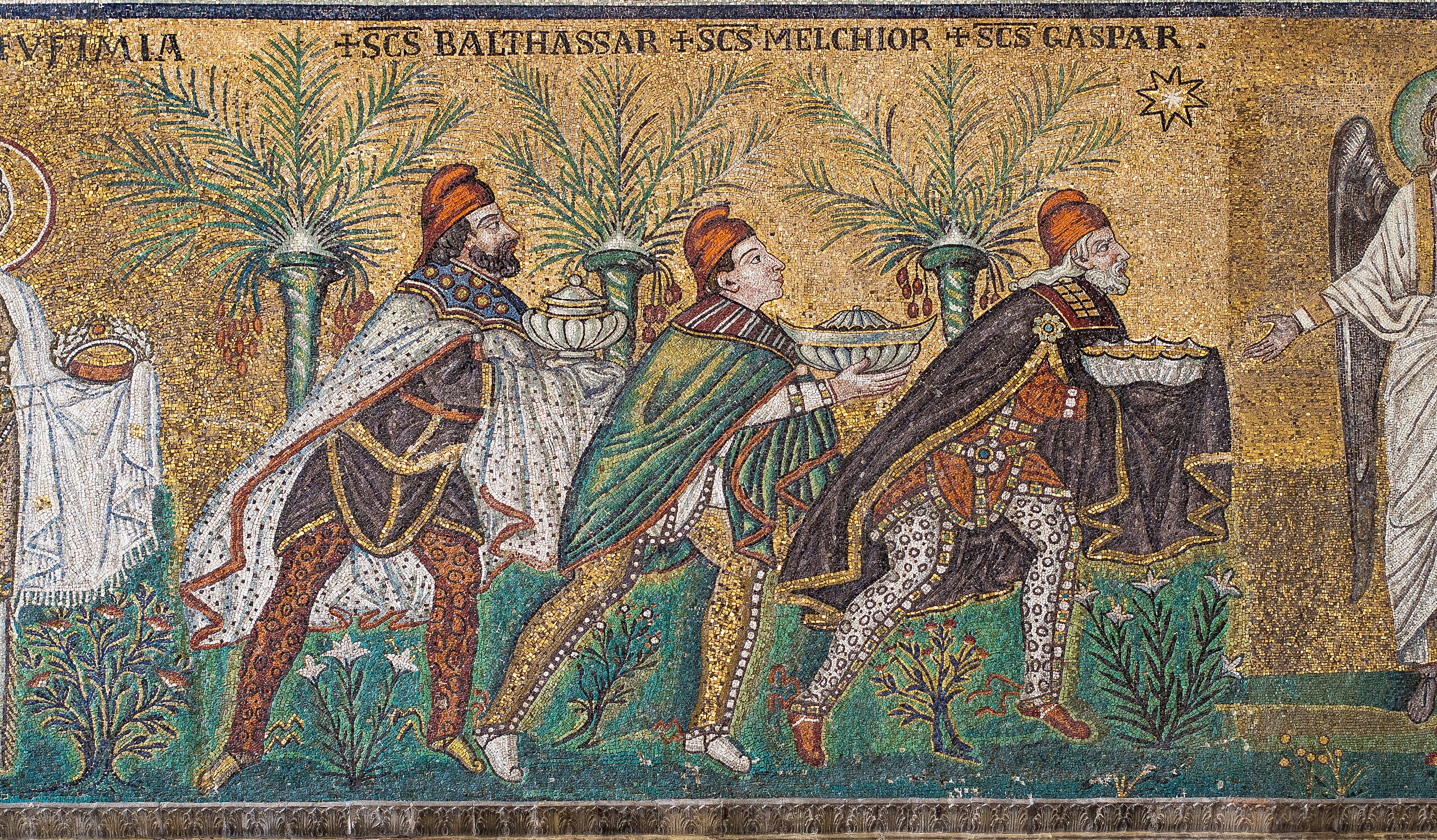
“The Magi” Mosaic, Sant’Apollinare Nuovo, Ravenna, Italy, 6th century

The cover image on today’s service bulletin is of a mosaic in the Basilica of Sant’Apollinare Nuovo in Ravenna. It probably dates to the 6th century and the reason I love it is because it shows how early Christians had already developed considerable speculation about the beloved figures in today’s gospel reading, the magi. For here we see that the tradition had fixed on the idea that there were three, although the only mention of that number is with regard to the gifts: gold, frankincense, and myrrh. In addition, they already have names attached to them: Balthasar, Melchior, and Caspar. It would be later in the Middle Ages, part of the general exoticizing of the figures, that one of them would usually be depicted as black. Other examples of such exoticizing can be seen in the figures in our creche. The elephant, for example is a wonderful symbol of the strange and foreign east, from which we are told the magi came.

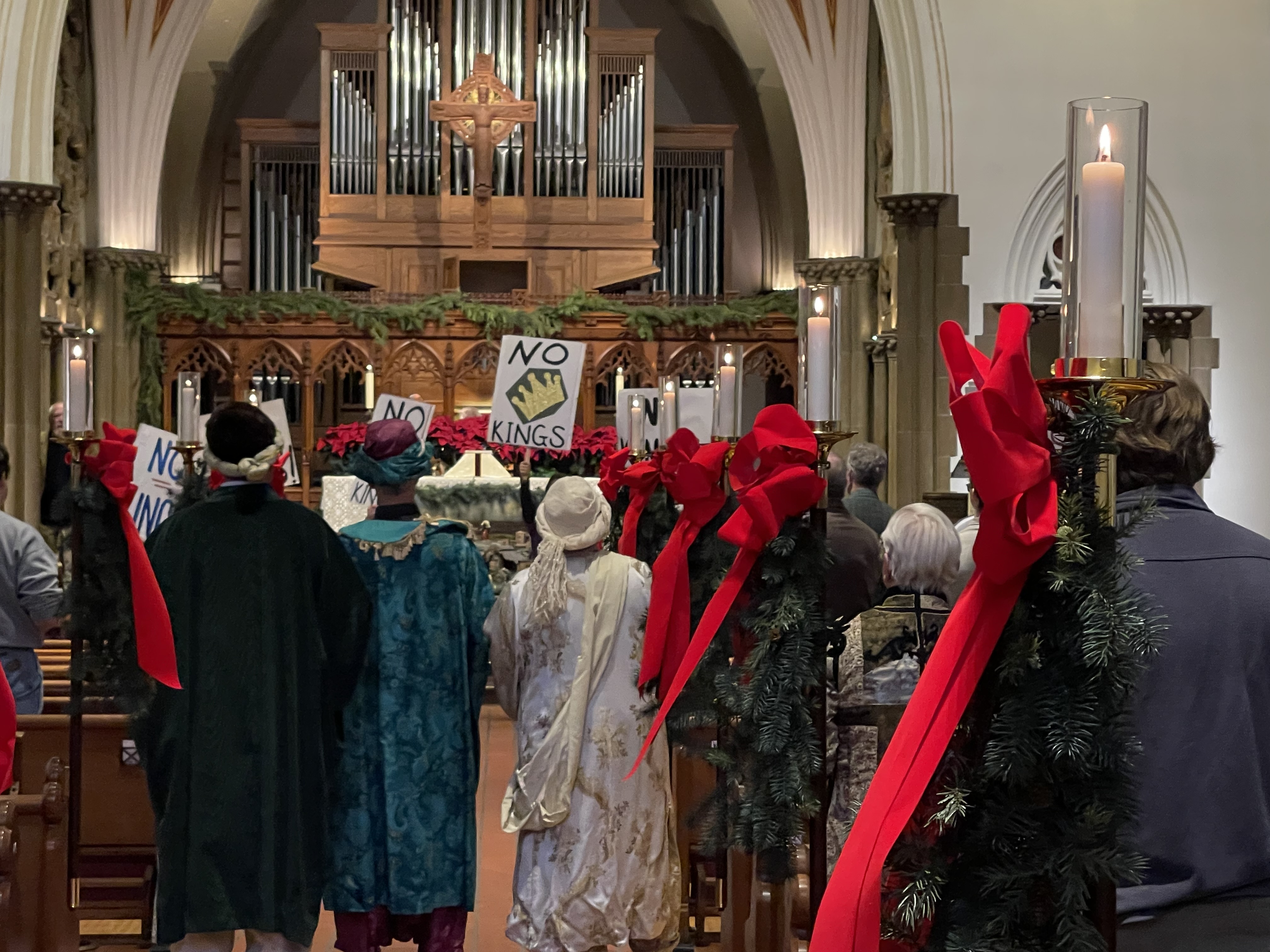
And while our skit insisted “No Kings” and in my sermon last Sunday I pointed out the presence of two kings in the story—Herod and Jesus, and noted that in Matthew’s gospel Jesus is referred to as “King of the Jews” only here in the nativity story and at the end in his trial and crucifixion. The elevation of the magi to “kings” is also a fairly early development in Christian devotion though there’s no scriptural warrant for it.

My point is not to debunk the story. In fact, I think these developments reflect deep Christian piety and devotion that can be instructive to us as well. At the same time, it’s worth noting the ways in which such images have reflected and continued to shape our prejudices. It’s a lovely, familiar story but it also packs a wallop. 

Perhaps especially today as we experience it while our nation undertakes yet another foreign adventure, initiating regime change for illegitimate reasons and flouting international law and human rights. Not content with blowing boats out of the water, our administration decided to intervene in another nation, and as has happened so often in the past, has little idea what to do now that it has removed the political leader. A region that has seen its share of ruthless dictators and petty tyrants, is now threatened with instability.

As if destabilizing one nation isn’t enough, spokespeople for the administration are sabre-rattling about regime change elsewhere as well and hinting at territorial expansion: Greenland, Canada. Those of us who have imagined our nation to be a force for peace, human rights, and democracy are watching in real time as those values are upended both here and globally. In a year when we observe the 250th anniversary of the Declaration of Independence, the gap between our ideals and the reality in which we live seems wider than ever.

Moreover, that so much of this is carried out in the name of Christian nationalism poses yet another challenge. Propaganda from the Department of Homeland Security and other federal agencies advocate for an ethnic cleansing of the nation in the name of Christ and whiteness. Of course, we’ve seen this before with language and imagery of crusade being invoked in the runup to and during the Iraq War of 2003. 

With all this as backdrop, with all this swirling through our minds on this day, we may be tempted to placate ourselves by ignoring it all and losing ourselves in a familiar story and well-known hymns. We may want a simple story that hearkens back to our childhoods, and allows us to linger in awe and worship at the creche on this 10th day of Christmas even as the attention of the rest of our culture is elsewhere, on military adventurism, or more likely, football.

But even here, in this story, there are ominous notes. We are introduced to Herod, the client ruler of Rome, 

Although a convert to Judaism, Herod was hated by most Jews as the king of Judea, in part because they thought he was Jew in name only and in part because of his pro-Roman leanings. He became king by submitting to Roman authority. He lavished his territory with building projects, including a renovation and expansion of the temple in Jerusalem. Known for his ruthlessness, Herod executed at least three of his sons for conspiring against him. The slaughter of the innocents, which Matthew recounts immediately after his story of the magi is not recorded in any history of the period, but is entirely consistent with Herod’s personality.

The exchange between the magi and Herod borders on the absurd. Who in their right mind would approach a king who has killed his own sons because of their designs on his throne, and ask him where the next “King of the Jews” would be born? But Matthew uses it to heighten the contrast between the reign of Rome through Herod, and the reign of Jesus Christ. The same is echoed at the end of Matthew’s gospel, when Pilate sarcastically asks Jesus, “Are you the King of the Jews?”

There is irony here for Matthew as well. Part of his point in telling the story of the magi is to emphasize that these gentiles, these foreigners, can recognize Jesus’ divinity, and worship him, even if his own people cannot. 

And that may be the message for us as well. We are distracted, angry, disheartened, fearful. We have seen so many succumb to the temptations of wealth and power, perverting the gospel to serve their own ends and to serve evil. The tyrants of this world, whether political or economic seek our submission and silence, demand we bow before them. 

But across the millennia, this familiar story offers us a different path, like the one taken by the magi on their return home, a path that leads us away from the centers of power and the seduction of wealth, and back to Bethlehem, to the creche, where the Christ child lays. 

It is a path that will lead also to the cross, where Jesus offers himself, a sacrifice of love in a world of hate. It is a difficult road, full of danger but it is the journey to which we are called as followers of Jesus, to listen to his voice, to hear his gospel of love, and to share the good news in a broken and hurting world, offering healing to those who are suffering and hope to those in despair. As we kneel at the creche with the magi in adoration and worship, may we gain the courage and strength for the journey ahead, and may the light and love of Christ fill our hearts.