
February 18, 2024
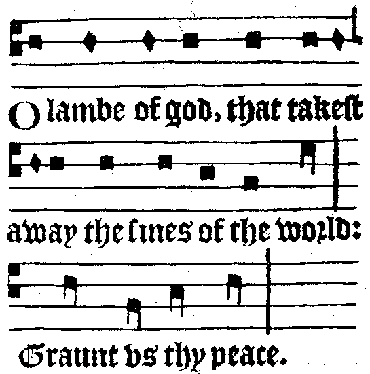
I love the Great Litany! I know it’s unfamiliar and strange to most of you. We use it only once a year at Grace, on the First Sunday in Lent and I’m guessing some of you, perhaps most of you, didn’t pay close attention to the words as they were chanted by Margaret as she has done every year I’ve been at Grace.
The Great Litany is one of those things that connects us powerfully to the past—to the past of the Anglican tradition, and also to the deeper past of our common humanity. It’s actually the first liturgical text created in English by Archbishop Thomas Cranmer, published in 1544 and used throughout the kingdom in the runup to Henry VIII’s military campaigns in Scotland and France. It was then included in the first Book of Common Prayer published in 1549, and republished and altered throughout the centuries.
The version we use has been cleaned up a good bit: there is no mention in the 1979 version of the “detestable enormities of the bishop of Rome” for example. But even our version connects us to the fragility of human life in the pre-modern period; reminders that childbirth was dangerous for both mother and child, that life was hard, short, and subject to the violence of nations and nature.
Twenty years ago, I might have drawn attention to the apparent dissimilarities between the pre-modern world and our own, as science and technology seemed to have protected us from so many of the dangers faced by earlier generations. But now, we are learning how tenuous life on earth and life in community are—we are living through plague and pestilence, earthquakes, fires, drought, and flood, and wars are ravaging.
To be confronted with this ancient text, its roots lie much deeper than 16thcentury England, in fact may feel like someone has poured cold water over our heads, shocking our system, our sensibilities, taking us out of our comfort zone. In that way, the Great Litany is very much like the imposition of ashes on Ash Wednesday. As familiar as that rite may be, to hear, or say “Remember that you are dust and to dust you shall return” strips us bare of all of our defenses, and reminds us profoundly, and utterly, of our humanity and our mortality, and our dependence on God for our lives.
Lent should disrupt us and our lives. Just as the ashes on Ash Wednesday remind us of our humanity, mortality, and the fragility of our existence, so to does the Great Litany remind us of our dependence on God, and the struggles-physical, spiritual, communal that we face day by day. Both of them call us to refocus our lives on the God who created us and on Jesus Christ, through whose death and resurrection we begin to experience our remaking in the image of God.
Each year, our gospel is the story of Jesus’ temptation in the wilderness. That’s a little bit of a misleading title, at least for the Gospel of Mark. For in these few verses, we see it all, the transition from baptism, to wilderness, to preaching the reign of God and we’re encouraged to see the connections between these three elements. But even as we do that, we’re probably inclined to overlook the brevity and simplicity of Mark’s version of Jesus in the wilderness, and what he might be trying to teach us.
Here’s Mark’s version:
And the Spirit immediately drove him out into the wilderness. He was in the wilderness forty days, tempted by Satan; and he was with the wild beasts; and the angels waited on him.
Perhaps the most important thing in Mark’s terse description of these events is the connections between Jesus’ baptism and the wilderness. I have stressed several times already the violent language Mark used in describing the baptism—the heavens were torn apart, ripped apart, and the Holy Spirit came down. Now, we see similar violent language in his description of the Holy Spirit.
What can Mark have meant by telling us that “immediately the Spirit drove Jesus into the wilderness?” “drove” that’s powerful, almost violent language, and indeed it’s the very same word that Mark uses to describe Jesus’ actions and power when he drives unclean spirits out of possessed people. And we might go further and see a deeper connection—the Holy Spirit entered into Jesus at his baptism, possessed him, we might say.
There’s something else worth noting. Our translation says Satan “tempted” him, in fact, a better translation would be tested, not tempted. That is to say, rather than be enticed or lured away from his mission, Mark seems to be suggesting that he is being assessed, evaluated—will he be up to the task that is set before him?
All of this takes place in the wilderness, where Jesus was with the wild beasts and the angels ministered to him. That’s all Mark tells us; that’s all he thinks we need to know. We don’t know the content of the “testing” nor do we know Jesus’ mental or spiritual state as he was undergoing it. All we know is that when he returned from the wilderness and his testing, he began his public ministry, proclaiming the good news of the reign of God.
The wilderness is a rich image, one with a lengthy history in the biblical tradition, going back to the sojourn of the Hebrews in the wilderness. Whatever else the wilderness might have been, it was wild, as Mark’s mention of the “wild beasts” emphasizes. The wilderness is not civilized; it is not a safe place.
All of us have experienced such wild and dangerous places. All of us have sojourned in the wilderness, whether for forty days or forty years. Some of us may feel ourselves in such a place today. We may be struggling to experience God’s presence in our lives; we may sense that we are beset by wild beasts or other struggles. Our spiritual lives may seem as dry and barren as a desert. We may be lost and discern no way forward.
Certainly, today, this week, we may feel very much like we are in a wilderness, in uncharted territory, beset by dangers. And whether our wilderness is something only we are experiencing—struggles in our families or work, with illness, or doubt, or it is because of larger events in our community, nation or world, it can very much seem like we are lost and alone.
It’s important to remember that Jesus experienced his period of testing after his baptism, after receiving the powerful affirmation of who he was. He had heard the voice from heaven saying, “You are my Son, the Beloved.” That affirmation went with him into the wilderness, into his period of testing and it went with him when he emerged and began his public ministry.
It is an affirmation we too have heard, that we are God’s beloved children. Like Jesus, we have been given the gift of the Holy Spirit to empower us to do God’s work in the world. We might even see ourselves like Jesus, driven into the wilderness, driven by the Holy Spirit into the world, to do that work.
Lent is a time when we are inclined to focus on internal work—on prayer, reflection, other spiritual disciplines. In the face of the horrible tragedies that we witness, and all of the problems that are swirling around in our culture and news, it often seems both like prayer is all that we can do, and that prayer is much too little, ineffectual. Praying the Great Litany, as powerful as its language is, may seem like little more than play-acting in the face of the world’s problems. But even as we are pleading with God to intervene, to save and protect us, the words of the litany are also working on and in us, as prayer always should. Those powerful and ancient words are shaping us, remaking us, helping us to see ourselves with new eyes and opening our hearts to God’s presence and redemptive work.
Jesus came back from the wilderness having claimed his call, found his voice. He returned from the wilderness and began his public ministry, healing the sick, casting out demons, proclaiming God’s reign. Remembering our baptisms, empowered by the Holy Spirit, may this Lent be not only a time of testing and reflection, but a time when we find our voices and call, and proclaim with renewed hope and courage, the good news of the coming of God’s reign.
 Preaching Grace on the Square