
Wordle and the Word: A Sermon for Christmas Day, 2023

December 25, 2023

Do any of you know the New York Times word game “Wordle”? It became an internet sensation during the lockdown. The goal is to guess a five-letter word and you have 6 chances. It’s rather addictive, and for many months, everyone would post their results on social media. That’s become somewhat less common over the years, but yesterday, a former parishioner emailed me his results. On the third try, he got it “GRACE.” Over the course of the day, and night, yesterday, others mentioned it to me as well. 

Yes, I do it, but I’m rather embarrassed to admit that it took me 4 tries yesterday. On attempt 3, I went with “BRACE.” In case you’re curious,  I’m currently on a 239 day streak. And also, in case you’re wondering, I do them all: the crossword, the mini, spelling bee, and now connections. They’re all part of my morning ritual.

Words are fascinating things. That we play games with them like WORDLE is evidence of the power they have. They amuse and divert us; they hurt and heal us. They help to share our deepest thoughts and feelings; and are also woefully inadequate to express those thoughts and feelings. We are bombarded with words; we bombard others with words. And now, thanks to Chatgpt, we can use artificial intelligence to manufacture words for ourselves, for others, or for class assignments. You probably wouldn’t be surprised to learn that preachers are using AI to manufacture or produce sermons.

That’s quite an irony, isn’t it, given today’s gospel reading: “In the beginning was the Word, and the Word was with God and the Word was God.” 

I said to a couple of people last night as they were expressing sympathy for me having to get up today and do this service, that for me, in many ways, as beautiful and powerful as the Christmas Eve services are, with choir, and carols, candlelight, and a full church, this service is the one that matters most to me—and it’s for one reason, that I have the great honor and privilege to proclaim this gospel text: John 1:1-14, and to preach the good news from it. Although I’ve preached on this passage more than twenty times, it will never get old; I will never exhaust its meaning, and I will never fully comprehend it.

In the beginning was the word. In principio erat verbum. En arche en ho logos. The Greek word behind our translation of word is “logos.” It means much more than “word.” In Hellenistic philosophy, it referred to the underlying order and reason of the universe and many scholars think that the author of the gospel, or the author of the hymn on which the gospel’s author was drawing, used another Greek word—sophia, or wisdom, which in Greek thought and in Jewish scripture, was the personification of wisdom. Because it is in the feminine gender it is thought, it was changed from “Sophia” to “Logos.”

But word, or reason, or order, or even wisdom points to something deeper. It’s not just that the Word, Christ, the Second Person of the Trinity was present at creation. It’s that God created through the Word, by speaking. As Genesis 1 states, “God said, ‘Let there be light.’ And there was light.

This is powerful stuff. There’s another image that I find particularly compelling. When the great Dutch humanist Erasmus went about publishing the first Greek New Testament, and then re-translating the Greek into Latin, he recognized the inadequacy of “word” as a translation of “logos.” So he chose another Latin word “sermo.” While it’s the root from which our word “sermon” comes, it actually means something quite different: “conversation.” 

That image intrigues me. Erasmus is implying that at the heart of God’s nature, at the heart of the Trinity, is conversation, communication. I find it wonderfully reassuring that in spite of our experience of the inadequacy of words, and of communication, that in the Trinity, in God, there is perfect conversation, perfect communication.

Of course, all of that is fine theological speculation; much more than a word game, but also, in a way, a word game. To place Christ at the very beginning, in creation, the means of creation, is to say something or many things, about God’s nature, and about the nature of God revealed in Christ.

But our gospel goes further; our faith goes further. The majestic language, the lofty theological reflection that is revealed in the opening cadences of John 1: “In the beginning was the Word, and the Word was with God, and the Word was God,” concludes, “And the Word became flesh and lived among us.” 

That’s the message of the gospel, the message of Christmas. In fact, the Greek could be translated “tabernacled” or “tented” among us. Again, there are multiple meanings here. John is referring back to the way God was present among the Israelites during the Exodus, in a tabernacle or tent but there’s also a powerful sense, that he is alluding to the temporary, ephemeral nature of a tent. Like our bodies, tents are not permanent, they lack solidity; they are easily damaged. 

That is to say, the word took on frail human flesh to be like us. But John goes on and in one of his key paradoxes, reminds us that in that temporary dwelling, we catch sight of God’s glory.

So we are back in Bethlehem, back in the confusing paradox that God became incarnate in a very ordinary way, in the poorest of circumstances, in the weakest of all human forms, a baby. And it is in that paradox, that we see God’s glory. For John, it is the same paradox as the cross, which he almost always refers to as the glorification of Christ. What he is telling us is that in these moments of weakness, we see God’s majesty and power.

But we have the reality of that incarnation before us in many ways. We see it, we taste it in the bread and wine of the eucharist, when we receive the body and blood of Christ. We see it in the very imperfect Church, both our local community, and the worldwide communion, bodies filled with flaws and imperfections, but also, mysteriously, the body of Christ. And finally, we may see it in ourselves, imperfect human beings though we are, but by the grace of God filled with the presence of Christ. May this Christmas rekindle in all of us the knowledge of Christ’s presence, of Christ’s glory, in ourselves, in our church and community, and in all the world.

Christmas Rubble: A Sermon for Christmas Eve, 2023

December 24, 2023

At first glance, at first reflection, all seems as it should be. There’s something so seductive, so reassuring about entering a beautiful space like Grace Church, decorated as it is every year at Christmas time. There’s the garland, the wreaths, the beloved creche in front of the altar with the exquisitely carved magi and entourage in the back of the nave as they’ve begun their journey to Bethlehem. 

It all sounds the same, too, with familiar carols and our lovely choir and musicians. Where have you come from this evening? From holiday tables at restaurants, or festive gatherings with friends and family? Some of us may even be planning on going to other gatherings; others of us will make our ways  home at the end of a long, and exhausting Sunday. 

It’s so similar to so many other Christmases, my fifteenth here at Grace. Some of you have been coming much longer than that and are settling into the beauty and familiarity of rituals and memories that may go back decades. But those memories are also tinged with sadness as we remember those who aren’t here any longer.

But beneath that familiarity and beauty, tucked away in our memories, or perhaps shoved out of our immediate attention by that beauty, are other memories, other images—of those Christmases in 2020 and 2021 when there were no services here because of the pandemic. We’re reminded that the pandemic has not left us, that our return to normalcy takes place while many continue to contract the illness or suffer the effects of long covid.

There may be other images, other emotions that are hard to repress right now. One image that haunts me is a photo shared by the pastor of the Lutheran Church in Bethlehem, Palestine. The Churches in Jerusalem and the West Bank announced recently that there would be no public celebrations, no public displays during Christmas, so this pastor, instead of erecting the usual creche like ours, did something else in his church. He brought in a pile of rubble, and in the middle of it lies the Christ child, wrapped in a keffiyeh, the symbol of Palestinian peoplehood. It speaks directly and eloquently to the humanitarian crisis that we’ve watched over the last nearly two months, an indiscriminate and horrific destruction of a people who have been driven from their homes, oppressed and practically held captive for the last nearly 75 years.

The plight of Christians, and Muslims, in the West Bank receives less attention than that of Gaza, but their lives are also under attack on a daily basis, their existence and presence in their homeland more precarious than ever. In Gaza, our Christian siblings are being killed, their ancient churches bombed to rubble. Of course, it’s not just Christians who are suffering there. The bombs don’t distinguish on the basis of religious commitment. On top of the thousands dead and homeless, now we’re hearing of starvation as aid continues to be blocked. The world watches; our own government is complicit in the atrocities. War continues in Ukraine as well, and even where there is no war, there is famine, hunger, and homelessness, poverty and disease. 

As we celebrate Christmas with carols, happy gatherings, and parties, we know that across the globe, people are suffering. We have learned hard lessons over the last few years. We have learned and re-learned about the fragility of life—how easily and quickly loved ones may be snatched from us by disease. We have learned about the fragility of our political institutions, our national life. We see daily evidence of the fragility of the human global community, and we are growing more aware, even as many deny it, of the fragility of life on this planet. 

So too, do we know the fragility of our faith. It is easy to grow disheartened, for our doubts to spiral into despair. In the presence of all the world’s ills, to lose hope seems not only natural but obvious. We reel from broken relationships, from trauma that continues to haunt us. It may very well be that it took all the courage we have left in us to venture out this evening to this place, in a desperate, unspoken plea for God to speak to us, to heal us and the world.

But the disconnect between our lives and our world and that of first-century Palestine may seem greater than ever. What can an ancient faith, a familiar story say to us in the face of millions suffering and global climate catastrophe? Can the story of Christ’s birth still speak to us? Can the carols we sing, the familiar decorations, the season’s joys, fill our hearts?

 The story Luke tells is not only about the birth of Jesus Christ. He interweaves that story with the story, and the reality of the Roman Empire. And it’s not because Luke was one of those 21st century bros who thinks about the Roman Empire every day, as the recent internet meme would have it. He did think about it every day because it was an all-encompassing, totalizing reality. It insinuated itself into the lives of everyone from the British Isles to the Indian subcontinent—and even beyond as its cultural influence extended almost everywhere.

Luke is writing within the Roman Empire, to citizens and inhabitants of the Roman Empire. The subjects of his story belonged to a people who were prone to rebellion, repeated small ones, but larger ones, like the Jewish Revolt of the late 60s ce, which would have been fresh in Luke’s memory, or the one a generation later in the 130s, after which Rome razed Jerusalem, and forbid Jews to live there. 

By placing his story in the context of the Roman Empire, Luke is highlighting the contrast between that reality, and the reality of God’s reign, coming in a very different way, in poverty, humility, and weakness. Not the power of Roman legions, or tanks or military force, but the power of vulnerable and fragile, a baby, swathed in love, bringing love, inviting us to love.

We desperately want certainty, unmistakable signs of God’s power and might, fixing us, fixing the world. Instead, we get this: a baby born in a dusty town in a far-off place and a far-off time. We get stories of angels, shepherds, and magi. We want God to solve our problems, fix our world, to show Godself to us with power and majesty. Instead, we get this: a tiny new life, utterly vulnerable, utterly dependent, the fragility and weakness of an infant. And this, we believe, is God.

This is God: this tiny, utterly dependent and vulnerable baby is God come into the world. This first time, Christ did not come in power and great majesty, but quietly, almost unnoticed, in a remote corner of the Roman Empire, to a young woman who seemed wholly ordinary and unremarkable.

This is God, in Christ, coming to us, in all our fragility, vulnerability, and suffering, coming into our broken lives and broken world. A baby, coming into the rubble of our lives, the rubble of our world, filling it, and us, with grace and hope and love. Thanks be to God. 

Advent Poetry: A homily for Advent 3B, 2023

December 17, 2023

There’s something about the season of Advent that always draws me to poetry. It may be the ambiguity of the season, the idea that we are waiting for Christ coming to us in multiple ways. It may be the binary opposites of light and darkness, goodness and evil, that permeate the traditional imagery of the season, of our hymnody and scripture readings.

This week I’ve been reading the latest work by Christian Wiman, a poet and theologian who now teaches at Yale Divinity School. For many years, he was the editor of Poetry magazine. He writes with beauty, power, and elegance about his ambivalent faith and his decade-long struggle with cancer. His latest book is entitled Zero at the Bone: Fifty Entries against Despair. 

While there is a great deal that is worthy of reflection, the thing that stopped me cold—and keeps drawing me back, is a poem by Anne Carson that he includes and upon which he reflects. It’s entitled “God’s Justice”

I love that image: “on the day He was to create justice God got involved in making a dragonfly and lost track of time.” It alludes to something that I have come to believe more and more strongly—God’s boundless and infinite creativity, a joyfulness and play at the heart of creation and at the heart of God. 

But there’s something else here that’s poignant and sad—perhaps. The sense that there is something fundamentally wrong with the world as we experience it—that it isn’t just and right. We know that all too well—the suffering in the world and in our lives, the pain inflicted on human beings by other human beings and the inability, unwillingness to try to make this right. We know the evils of the world and, as the prophet does in today’s reading, we cry out for justice. 

In the beginning there were days set aside for various tasks
On the day he was to create justice 
God got involved in making a dragonfly
and lost track of time.

It was about two inches long
with turquoise dots all down its back like Lauren Bacall.

God watched it bend its tiny wire elbows
as it set about clening the transparent case of its head.
The eye globes mounted on the case.

rotated this way and that
as it polished every angle.
Inside the case

which was glassy black like the windows of a downtown bank
God could see the machinery humming
and He watched the hum

travel all the way down turquoise dots to the end of the tail
and breathe off as light.
Its black wings vibrated in and out.

Our lessons today remind us of where our focus should be, where and how we should proclaim Christ, where and how we should work for justice. 

The reading from Isaiah, the first verses of which provide the text for Jesus first public proclamation in the Gospel of Luke, offer both reassurance and command. As Christians, we read these words as promise of Christ’s coming, of the future reign of God that he proclaimed and for which we hope. We see ourselves as recipients of that good news, and of the promised healing and release.

At the same time, we must see ourselves in this story, not just as recipients of God’s grace and justice but as participants in the coming of that justice. We are called to rebuild the ruined cities—and here we might think not only of literal cities, but of all the ways that human community, the common good, have been undermined and attacked in recent years.

Even stronger are the words from the Song of Mary. It’s always helpful to remember just who she was—a young woman, likely a teenager, mysteriously, shamefully pregnant, as vulnerable in her historical context as a similar young woman would be in our day. Yet from that small, unlikely, reviled person, comes this powerful hymn that witnesses to God’s redemptive power:

My soul proclaims the greatness of the Lord,

my spirit rejoices in God my Savior; * 
for he has looked with favor on his lowly servant.

From this day all generations will call me blessed: *
the Almighty has done great things for me, and holy is his Name.

He has mercy on those who fear him *
in every generation.

He has shown the strength of his arm, *
he has scattered the proud in their conceit.

He has cast down the mighty from their thrones, *
and has lifted up the lowly.

He has filled the hungry with good things, *
and the rich he has sent away empty.

This familiar hymn has suffered for its popularity and familiarity. Its use in worship over the millennia has numbed us to its revolutionary power. We need to reclaim it today, sing it with meaning. We need to do more than sing it, we need to work so that it comes into being. We need to imagine the possibility that God is working in this way, in spite of all evidence to the contrary, in spite of all our fears, doubts, and despair. We need to believe that the words of a first-century teenaged single mom can inspire to see God at work in the world around us. For remember, the world in which she lived was unjust and violent as well, and for many people hopelessness and terror were ways of life.

Like the poem with which I began, Mary’s song is a thing of beauty, sung in the midst of injustice. It calls us to see beauty in the broken world around us. It calls us to see God at work in those beautiful things created by God, even in us. It calls us to to the hope that in spite of the ugliness and suffering in the world, God’s beauty and justice are present, making all things new, and through God’s grace, remaking us as well.

The Wildness of Advent: A Sermon for Advent 2B, 2023

On Monday, I had the opportunity to spend a few hours with poet, theologian, trans activist, and faithful Christian Jay Hulme. I have been following Jay on Twitter for many years. I’m not sure how I got connected but over the years, in addition to sharing his spiritual journey and some of his poems, he posted photos of many of the old churches he visited, and whose towers he climbed. He is currently churchwarden of St. Nicolas, Leicester, England, one of the oldest, perhaps the sixth oldest continuing church in England. Dating from the 8th or 9th century, it is built on the ruins of a sixth century church, which in turn is built on Roman ruins. 

Jay’s poetry is fierce and powerful. He writes about the many places he visits, about holy wells, and saints, and sacred places. There’s a wildness about his poetry and personality. He is courageous and frank. We talked about the very different senses of history that come from being among buildings that date back 500 years or a millennium and the relatively newness of our own buildings. I showed him Grace Church and sent him up the bell tower and I expect we might see a poem one day about that experience or about the cheese curds we shared at the Old Fashioned over lunch.

Listening to him read his poems brought home to me the wildness of the God he encounters in those strange places, on holy islands like Lindisfarne, or in the saints like Joan of Arc about whom he writes. So I was thinking about wildness when I reread the gospel for today, Mark’s take on John the Baptizer. 

In fact, there’s a wildness about Mark as a whole. Probably the first of the gospels to appear, Mark begins in the middle of things and ends abruptly, with an empty tomb and frightened women. In between, there are stories of Jesus encountering people possessed by evil spirits, by demons, Jesus taming storms, and there’s a sense that Jesus himself is doing battle with Satan and demonic forces. 

But wildest of all may be John the Baptizer himself. As Mark tells it, John suddenly appears in the wilderness, preaching and baptizing and attracting large crowds. He is clothed in camel hair and ate locusts and wild honey. Did the crowds come out of curiosity or a desire to hear the words of a prophet? Ultimately, his wildness, his uncontrollability will lead to the inevitable result, his arrest by the authorities, in this case Herod, and his execution.

Our observance of the season of Advent is complicated and contradictory. It is a season of preparation and waiting, preparing for Christ’s coming at Christmas, but as our scripture readings and hymns remind us, it is also about the Second Coming-Christ coming in majesty.

 We tend to downplay that aspect of the season. It can make us feel uncomfortable and inappropriate in light of the larger cultural focus on the coming of Christmas, the round of holiday concerts and get-togethers; the ways in which the advent wreath, for example, originally intended for use in homes, has found its way into churches and given liturgies that focus on themes like love and joy. 

And then we encounter John the Baptizer, with his wild hair, his wild dress, and his wild preaching—Repent! For the kingdom of God has drawn near. John breaks in on us and our complacency. John breaks in on our self-satisfaction and our delusions. John breaks in on the certainties of our lives and our of our seasonal celebrations and cries “Repent.”

This is wildness, uncontrollable. Like the images of the second coming that have dominated our readings over the last month. Like the threats of judgment and warning given to servants, and to bridesmaids, and to us.

That wildness surrounds us—wildness of our own making and not of God’s. The threats of climate change. Are we at a tipping point, with the threats of the melting of the Greenland icesheet while politicians dither over concrete actions, in of all places, Dubai, a monument to our thirst for fossil fuels and conspicuous consumption?

Are we at a tipping point, with thousands already dead in Gaza, and threats to hundreds of thousands, while politicians and pundits debate “genocide” and silence critics of the devastating war that is taking place in front of our eyes and with the support and weapons of the US.

We look around and see all of the crises that continue to threaten us—and the ways in which we threaten the lives of others and all the while we make our plans, do our shopping, plan our menus. The chaos of it all, the wildness, threatens to overwhelm us and so we grasp at those familiar rituals that help to center us and to stave off those feelings of fear and despair.

Wildness, chaos is often understood to be a product of evil yet it’s worth remembering that in the story of creation, God was there, in the midst of chaos, bringing order, speaking the universe into existence, bringing light, and life and creativity. The voice of John crying in the wilderness is not a sign of chaos but a call to repentance, a call from God to us.

Advent reminds us that God is coming into the world, a world beset by evil, threatened by chaos, changed and degraded by our own human actions, our hubris, greed, and rampant desires. But God is coming into the world, coming to us. Indeed, if we pay attention, as we should, we will realize that God is already here, in the wildness, and in the chaos, remaking us in God’s image, bestowing grace in our lives and in those we love.

We may be fearful; we may be disheartened; we may lose hope. But God calls us from the wilderness and the wildness, God calls us in our own wildernesses and wildnesses, when our steps falter, our faith flags, our strength fails. God calls us, comes to us and leads us into the future where there is hope, and justice, and peace.

The Reign of Christ: A sermon for the last Sunday after Pentecost, 2023

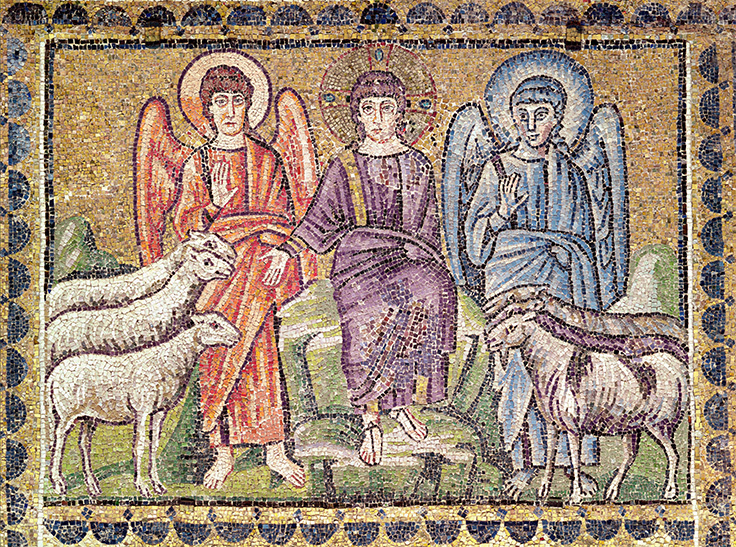
Christ separating the sheep from the goats, San Apollinaire Nuevo, Ravenna, 6th century

Reign of Christ

November 26, 2023

It’s been nearly forty years since I’ve visited Ravenna, Italy but its churches and their mosaics are still alive in my memory. So too is the awe and wonder that they evoked in me then. In the sixth century ce, Ravenna was the western capital of the Byzantine Empire, and the emperors and their families undertook a vast building project to express their power and faith. The mosaics conflate and combine imperial and religious imagery and while their meaning and significance are much debated among art historians and historians of late antiquity, their power, in the sixth century and today, are not.

You can see that imagery on full display on the the cover illustration of today’s service bulletin. What you cannot see is that in addition to looking like a ruler sitting on a throne, Christ in this mosaic is clad in imperial purple, wearing all the trappings and symbolism of a Roman emperor. 

I chose that image because today is the observance of Christ the King, or the Reign of Christ in contemporary parlance, is a 20th century innovation, this mosaic seems to capture perfectly the lectionary choice of Matthew 25:34-46. Christ, reigning in majesty, separating the sheep from the goats. 

Thinking about this image in the context of the parable may help us to encounter the story with new eyes, for it has become something of a favorite for many of us, a way of thinking about our responsibilities as followers of Jesus and to distinguish our sort of Christianity from that of many others—a focus on doing good rather than believing correctly. That interpretation is both comforting and self-gratulatory, and as always with the parables, I want us to experience its strangeness.

One way to do that is to note its context and the parables that precede it. Over the last few weeks, we’ve heard the parable of the wise and foolish bridesmaids, the talents, the wedding banquet. The parable of the wise and foolish bridesmaids concludes with the foolish ones locked out of the banquet hall. The parables of the wedding banquet and the talents end with someone cast into outer darkness, where there is weeping and gnashing of teeth. This one ends similarly with the goats banished to eternal punishment.

After the last two Sunday gospel readings, two parables of judgment and warning about the return of Christ, two parables that make us uncomfortable both in their urgency and in the message of judgment they proclaim, the judgment in this parable seems to support all of our prejudices and values.

In today’s reading, we are inclined, thanks to two thousand years of Christian reflection on this story, to see the separation of sheep and goats into good and evil as obvious, a given. Well, not so fast. In the ancient near east, goats were a prized animal. Their milk and meat were staples. They were not seen as evil—a goat was an acceptable sacrifice in Israelite religion. 

Perhaps more interesting is the fact that it was a common practice to keep goats and sheep together in a single flock. The only time the two animals were separated by the shepherd was on cold nights, when goats needed more protection. In short, in this reading as in the two preceding parables, the separation of sheep and goats into good and evil, is rather arbitrary. 

In fact, that’s something of a theme in Matthew’s gospel, that one can’t distinguish good from evil until the time of judgment—remember the parable of the wheat and the weeds, when “the devil” sowed weeds in a field and the farmer said that at the time of harvest, the wheat and the weeds would be separated and the weeds burned. So there’s something typically Matthean about this whole passage, something that Matthew as a gospel writer is especially interested in. It’s probably a result of something I mentioned a couple of Sundays ago, that a central concern for early Christians that Jesus had not yet returned.

I would like to draw your attention to something else in the text. Jesus is describing what the coming of the Son of Man will be like. First, he uses royal imagery. He will come in glory and sit on his heavenly throne. But immediately, that imagery is combined with another image, that of the shepherd. He will separate the people like a shepherd separates his flocks, the sheep from the goats. 

This image may draw us back to the reading from Ezekiel, where another visionary sees God coming like a shepherd, judging between the fat sheep and the lean sheep, rescuing them from wherever they have been scattered, feeding them, binding up the injured. We might find it odd that these two images—the shepherd and the king—are linked together in the biblical tradition. As the reading from Ezekiel makes clear, one reason for that linkage is the tradition that the founder of the Davidic monarchy—King David, was a shepherd. But for Christians, when shepherd imagery is used of Jesus, it is almost always used to emphasize Jesus’ care for us and his intimate love for us. 

Yet here in Ezekiel, the shepherd is a judge who culls his flocks, separating the fat from the lean sheep. So too in the gospel, the Shepherd King is a Judge who divides the sheep from the goats. In the Ezekiel passage the contrast between the care and tender concern the shepherd shows for the lean sheep and the harsh words with which he judges the fat.

The same is true in the gospel. The king judges harshly, unequivocally between the sheep and the goats. Christ appears to us here as a shepherd-king, but there are two other important images of Christ in the gospel. One is the obvious one. When the king says, inasmuch as you did it to one of the least of these my brothers and sisters, you did it to me, identifies the presence of Christ in the naked, the prisoner, the hungry, the sick. The third image is less obvious. The text begins with a reference to the Son of Man. In Matthew, when Jesus uses that title of himself, it almost always is in reference to his crucifixion. Christ the King is also the Crucified One and the least of these.

We are called to hold these three images together, we might think of them as three facets of a prism that together refract the light. If we ignore one of them, the other two become less brilliant. Emphasizing one over the other is a common temptation for Christians, but the gospel itself warns against it. We might prefer one image over the other. Some might want to encounter Christ only in the face of the poor and hungry; others only in an image of the Crucifixion. There are even those who can conceive of Christ only as the judge who comes on a cloud of thunder and reigns in majesty. 

Each image taken by itself will lead to a distortion of our faith. Those who focus only on the crucifixion will see Jesus only as the one who offers forgiveness for our sins. Those who focus on Christ in Majesty will think only about the second coming and making sure that they are on his right side. Those who focus only on outreach to others turn the Christian message into a social service agency. 

The judge separates sheep from goats, those who reached out to the needy and those who didn’t. The surprising thing here is that all are surprised. Neither group knew that Christ was present in the naked, the stranger or the prisoner. So for those whom the King welcomed into the kingdom, their actions in reaching out to the needy were not a conscious response to Jesus’ teachings or the result of acting out of duty or in order to gain their salvation. Their actions were an unconscious, unknowing part of who they were as Jesus’ disciples.

The same Christ who will come in Majesty to judge the living and the dead; the same Christ who was crucified for our sins; the Christ in whom we proclaim our faith when we recite the creed, that very Christ is present in all of those people—in the prisoner, the naked, the hungry, the stranger, and the sick. To hold these different images together, to confess Christ crucified, risen, reigning in majesty along with recognizing Christ’s presence in the sick, the imprisoned, the hungry and naked is our task as Christians seeking to follow him.