
Be merciful as God is merciful: A Sermon for 7 Epiphany, 2019

Who’s your enemy? Take a moment and think about them. Who is it? Why are they your enemy? Is it someone you know, someone who wronged or hurt you deeply? Is your enemy more abstract—do you think of political figures or groups whose ideas and actions offend you? Or is it members of another religious or ethnic group whose hateful rhetoric and violent tactics threaten you? Draw a picture in your mind of the person, real or imagined, whom you passionately and completely hate. Be honest with yourself; there’s someone or some group that you hate…

Jesus said, “I say to you that listen, Love your enemies, do good to those who hate you, bless those who curse you, pray for those who abuse you. If anyone strikes you on the cheek, offer the other also.

Hard words, challenging words. Words that seem so far beyond human possibility that we assume they must be hyperbolic, intended to demonstrate to us once and for all, human incapacity to do the right thing. Or perhaps they are meant only for the perfect few, saints like Francis or figures like the Dalai Lama who seem to be live on a completely different plane of existence than those of us in our busy, messy, complicated lives.

But what if they are meant for us, too?

Remember where we are in Luke’s gospel and what we have already heard. Jesus has come down from the mountain to a level place with his disciples. There was a large crowd pressing in on him, seeking the healing power that came out from. And in the middle of that throng, Jesus lifted his eyes up to his disciples and began to teach. As we saw last week, he began with the beatitudes, a series of blessings pronounced on the poor, the hungry, those in mourning and those being persecuted. Corresponding to that series of blessings was a series of curses: on the rich, the full, those who are laughing, and those who are respected or well-regarded.

Binary oppositions, blessings and curses, reversals of fortune. As I pointed out last week, how we react to these contrasts and reversals very much depends on where we situate ourselves; with which groups we identify.

Now Jesus shifts gears, and the ground under our feet shifts as well. For instead of allowing us to position ourselves comfortably, Jesus’ words strike home uncomfortably, challenging the distinctions we make, upending our assumptions, our attitudes, breaking down the lines we draw between “us” and “them” between those who belong to our group, deserve our love and compassion, and those on the other side of the border, our enemies, outsiders.

I feel the need to come clean with you—these verses: Love your enemy, turn the other cheek profoundly shaped my upbringing and ultimately how I still strive to follow Jesus. I hesitate to bring up my background as a Mennonite publicly because it too quickly becomes little more than a curiosity, something exotic. But these verses and stories interpreting or embodying them have entered the marrow of my bones and shaped my heart and soul. I’ll tell just one of those stories.

In the 17thcentury, Dutch Mennonites, after gaining toleration and becoming successful merchants, compiled a collection of stories of the men and women who had been killed for their faith in the sixteenth century. Many of the stories are accompanied by engravings. One of them depicts the story of Dirk Willms who had been convicted of heresy for believing and practicing adult rather than infant baptism. On the way to the place of execution, he somehow escaped from the authorities, running for his life. He crossed an ice-covered river, one of his captors in hot pursuit. But the pursuer broke through the ice and was in danger of drowning. Willems could have gone free, he was across the river, but instead, he went back, and helped his captor to safety. It may surprise you to learn that in spite of his heroism, Willems’ execution went on as planned.
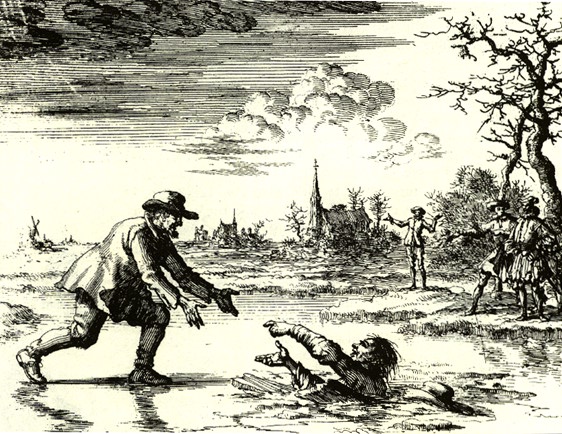
It’s a story that strikes us as unbelievable, relating behavior that to us is inexplicable and foolish. It’s no way to live one’s life, no way to survive as an individual, much less as a community, a church, a nation. Whether or not we find Jesus’ words believable, or relevant, or possible, the challenge to love our enemies, turn the cheek, to give one’s shirt as well as one’s coat, to lend expecting nothing in return confronts us with questions of personal worth and value, the relative importance of self and other, and yes, sheer survival.

But these words challenge us in other ways. For those of us with privilege and status, they pierce the armor of our wealth, gender, color. For those of us without, they work very differently. It’s important for us to be conscious of how they have been used and interpreted over the centuries and even today—how they have been used to oppress and to maintain structures of injustice. Even today, how many pastors counsel victims of domestic violence to turn the other cheek and passively accept the blows of their husbands or fathers?

What if, instead of commands, these words are meant to unsettle and de-center us, to move us away from the certainty of our existence and the world we know into a journey toward a new world, where God reign’s and where God’s love is the model for all of our relationships and for all of human community? Jesus came down from the mountain to a level place where he taught a vision of a new world order, coming into existence in the community of his followers. It is a vision of a community with no barriers or boundaries, no distinction between rich and poor, friend and enemy.

As hard as it is for us to imagine, or even to articulate, there is yet one more step to take. When we view these words as commands, we place our behavior on a continuum of obedience: Should I turn the other cheek? Did I turn the other cheek? And if in a particular instant we choose not to, because of fear or threat to life and limb, or simply because our anger overwhelms us, we may judge ourselves and feel shame and guilt for falling short.

Luke, in his compassion and concern for his readers, offers hope and consolation even on such occasions. In Matthew’s version of these sayings, Jesus concludes with the admonition: “Be perfect, as your Father in heaven is perfect.” Luke’s version is quite different, “Be merciful, just as your Father is merciful.”

Using this as a lens by which to read Jesus’ statements offers us a new way of seeing, a new world of possibilities, the reign and realm of God—where the neat calculus of debt and repayment, crime and punishment, eye for an eye no longer is operative. And that’s true not only for the specifics that Jesus talks about but also for us. We need not use this calculus on our own lives and actions. God is merciful and invites us to receive God’s mercy and in turn to offer it to others and to the world.

The instructions which Jesus gives his listeners on the level place are instructions that address our actions towards those who act violently or unjustly against us (love your enemy, turn the other cheek) and address our actions towards those with whom we are already in relationship (if you love those who love you). But the heart of the matter seems to be that whether friend or foe, our actions should not be guided by how others treat us but rather by how God treats us: Be merciful as your Father is merciful.

It may be that we often interpret God’s disposition toward us in terms similar to how we act towards others, loving friends, hating enemies experiencing guilt, expecting punishment when we sin. But God is merciful and forgiving. Receiving God’s mercy and grace gives us the power to share that mercy and grace with others.


Homelessness and Political Partisanship

I had one of those interesting experiences today that was both hopeful and clearly demonstrated the challenges we face as a society, nation, and state in dealing with difficult issues. Soon after arriving at the office, my Senior Warden who was waiting for a vendor, asked me what I had planned. Today was supposed to be devoted to finalizing plans for Lent and Confirmation classes and after dealing with several administrative matters, I set to focus on that work. But then I learned that a press conference was scheduled for the morning in the Men’s Drop-In Shelter in our basement. While we are landlords and not operators of the shelter, publicity, whether good or bad, reflects directly on Grace Church, so it’s my policy to be present when press and elected officials come to the shelter.

There were conflicting reports on who was going to be at the press conference but eventually the parties in question arrived—a group of Republican legislators who had been involved in the Wisconsin Interagency Council on Homelessness, established by the previous Governor and chaired by the former Lieutenant Governor. The legislators were using the press conference to announce the introduction of a number of bills addressing homelessness.

I’ve attended any number of press conferences called by social service, agencies, religious organizations, or advocacy groups and in my experience, often the press conference is held with no press in attendance. This time, because of the involvement of legislators, there were representatives from print and TV media. I had a chance to meet several of the legislators before the beginning of the event and shared with them some about the shelter. The conversations were cordial and the legislators were genuinely interested in learning more about the shelter and about homelessness in Madison. Karla Tennes, Executive Director of Porchlight, Inc. was in attendance and spoke at the press conference, and Shelter Manager Preston Patterson also was present.

When the cameras came on, and after the prepared remarks, the tone of the room and the event quickly shifted. There may have been a question about the content of the bills, but immediately, reporters began to highlight the partisan divisions, first by pointing out that no Democratic legislators were present, and then by changing the subject entirely to hot-button issues. The reporters got their soundbites and the press conference ended.


After all but one of the reporters had left, we continued our conversation. The Shelter manager described in detail shelter operations, policies and procedures, and both he and Porchlight Executive Director Karla Tennes talked about the involvement of volunteers in helping to provide 2 meals every day to shelter guests. Our conversation continued for more than twenty minutes. Legislators learned a great deal about what takes place only a few yards away from the State Capitol.


I am not one to bash the press—they are crucial to the survival of democracy and to the creation of a civil society, but I was struck by the immediate shift in tone and topic when they began to engage with the elected officials. The issue at hand, homelessness, didn’t really seem to interest them. Instead, the story they wanted to tell was the story of political conflict and political partisanship, and if they had to attend a press conference in a homeless shelter to get that story, so be it.


In my conversations with legislators and staff, we talked about issues like homelessness and opioid addiction that should matter to everyone and around which we need to come together across our divisions to find solutions. From what I could tell, there is genuine interest in such bipartisan efforts. That Governor Evers has announced he will chair the Interagency Council on Homelessness seems to be a move in the right direction.


I’ve been thinking a great deal about how we might create opportunities for conversations across the deep divisions in our state and society. Today made me both more hopeful about that possibility and more aware of the importance of such efforts in Madison and across the state.


Here’s how Madison.comis reporting the story.

The Glory of the Lord revealed in level places: A Sermon for 6 Epiphany, 2019

As we work through the Gospel of Luke this year, we will have a number of opportunities to explore this gospel writer’s unique perspective on Jesus and on the early Christian community. Like Matthew, it’s probable that Luke wrote with a knowledge of the Gospel of Mark and with Matthew he had access to a source that provided much of the material for Jesus’ teachings that appear in both Matthew and Luke, teachings like the ones here, known as the Beatitudes. But each of the gospel writers introduce additional material that is unique to their gospel. In Luke, this includes many of the most familiar and beloved parables—the Good Samaritan, The Prodigal Son, are examples of this other material. Continue reading

Listening to and reading Fleming Rutledge

I had the opportunity to hear the Rev’d Fleming Rutledge speak today. Her presentation was entitled “What happened to Theology?” I went out of curiosity and because I have read two of her books in recent months. Advent: The Once and Future Coming of Jesus Christ(2018) accompanied me as I prepared and preached Advent in 2018 and last week, I read Crucifixion: Understanding the Death of Jesus Christ(2015). I found both books challenging theologically and at times off-putting but engaging with them is time well spent. I had the same reaction to her presentation today.

One of the biggest challenges for me is simply her Barthian presuppositions. She contrasts Christian (biblical faith) with religion. The former originates with God; the latter with humans. I struggle with this for two reasons. First, because of the nature of scripture itself. Without going into a lengthy discussion, holy scripture is a compilation of books, deemed authoritative by human decisions, written by humans, using language which is also a product of human culture. Thus, revelation is necessary mediated through humans and to speak of God being the subject of theology, or that “scripture is the story God is telling of Godself” is true on the one hand, yet at the same time, it is also being told and preserved by humans.

Secondly, to contrast biblical (Christian) faith with religion is problematic in our religiously plural age. Does it result in a privileging of Christianity over against other religious traditions? Does it privilege Christianity over “not-Christianity” (ie., Judaism) in reading scripture? Does it overlook or ignore all of the ways in which the various forms of Christianity, historically and in the present are similar to other religious forms? Indeed, is it necessary for her project to make such distinctions?


One of the things she stressed today was the importance of learning and living in the biblical story. Whether or not I accept her views of the nature of revelation, I do agree that scripture tells the story of God, and that by wrestling with the story contained in scripture we encounter God, we learn about God’s relationship with humans, and we learn about human beings as well. To read scripture, to immerse oneself in scripture, is to immerse oneself in a conversation with God, in which God does the talking, but as we listen, we are compelled to ask questions, of ourselves, of the world, of scripture, and of God.

One of the things I appreciated most about Crucifixion was that instead of laying out a theory of the atonement, Rutledge explored the many images that the New Testament uses to talk about the crucifixion. Many of these images are problematic and challenging, but in her exposition, she showed their power to convey something unique and meaningful, without asserting that any single one conveyed all of the meaning of the cross. In that work, she very much shows what it means to enter the story of scripture, as she teases out the many possible meanings of “sacrifice” for example. She insists, for example, that it was an image used by early Christians, and for us to understand the faith of those early Christians, and for us to be faithful Christians in the twenty-first century, engaging with the entire range of biblical imagery concerning the cross helps us understand our faith, and perhaps come to deeper faith. I will never again be self-conscious about loving the great Lutheran passion chorales, for example.

I was as challenged by her emphasis on apocalyptic themes in Advent as I was by her appeal to take seriously the full range of biblical imagery surrounding the cross. Advent emphasizes the Second Coming in its scriptural passages as well as its hymnody much more strongly than it does the Nativity. Apocalyptic falls in and out of fashion as culture changes, and for many contemporary mainline Christians, its association with a particular emphasis in conservative Protestantism makes it suspect. Still, while scholars may debate the extent to which Jesus himself was an apocalyptic prophet or preacher, the fact of the matter is that early Christians, beginning with Paul, were convinced of his early return, and Paul’s letters are written with an urgency reflecting the imminence of the Second Coming. His theology is shaped by that apocalyptic perspective.

At the heart of apocalyptic is both the sense of a cosmic struggle between good and evil as well is a firm belief that in the end God will make all things right. In our context, it may be that such a worldview helps us make sense of our world better than any other.


But to return to the theme of her talk, as I left I wondered whether Rutledge is fighting a losing battle. Given the changes in our culture, the decline of Christianity, the multiple claims on our allegiances, is the sort of deep engagement with scripture even possible? In her talk and in the question and answer follow up, she told stories of people who were biblical theologians, people who were soaked in scripture and able to see God at work in the world through eyes opened by an intimate relationship with the text. Is that even possible any more? Are the kinds of “biblical theologians” Rutledge calls for a nearly extinct species, destroyed because the habitat that gave birth to and nurtured them is now a barren desert?


Encountering God: A Sermon for the Fifth Sunday after the Epiphany, 2019

I entered the chapel at the monastery of the Society of St. John the Evangelist exhausted by the long day of travel from Madison. I’d had only enough time to drop my things in my room before the evening Eucharist. Stressed, tired, distracted, as I entered the space, I was immediately reminded why I had come here. It’s a remarkable space, perfectly, beautifully designed. You’re suddenly thousands of miles and a thousand years away from Harvard Square in Cambridge. Designed by architect Ralph Adams Cram in the Romanesque style, the walls are stone, with roman arches throughout, lovely stained glass windows dominated by deep blues. Continue reading

Discomfort and love: A Sermon for the fourth Sunday after the Epiphany, 2019

I’m glad to see that all of you are surviving the crazy weather we’ve been having. We’ve survived it at the church and our ministries as well. I’m sure most have you have heard or seen stories of how Madison has coped with the bitter cold and especially how the weather affected our most vulnerable neighbors. The men’s shelter was well over capacity; the total number of guests on Tuesday night was 170. The Beacon was over capacity, and our friends at First Methodist provided emergency overflow shelter during the day for homeless families because there was not enough room for them at the Beacon. Through the coldest weather, our food pantry remained open, thanks to Vikki and her intrepid band of volunteers. I’m grateful to all of you who reached out to me or to others with offers to volunteer.

In times like these, we see both the strength and the weaknesses of our community—among the strengths, the resilience, cooperation, and all the amazing people who do so much to support our most vulnerable residents. But we also see the gaps or inadequacies of the services we do provide as well as the deep inequities and the number of people who lack adequate shelter or for other reasons struggle in weather emergencies. Our hearts ache as we see the need and we reach out generously but at the same time, it should become clear that our community needs to do more. As followers of Jesus and members of the body of Christ, we should help those in need but we should also call for policy changes that would help all members of our city flourish and thrive. With the mayoral campaign heating up, our voices are especially important.

It’s not always easy because calling for justice and an end to oppression, to proclaim release to the captives, can rouse opposition. That certainly happened to Jesus in today’s gospel reading.

Last week we heard Luke’s version of the beginning of Jesus’ public ministry. After a preaching and healing tour of the surrounding towns, he comes home to Nazareth, goes to synagogue on the Sabbath, reads a passage from Isaiah:

“The spirit of the Lord is upon me, he has anointed me to bring good news to the poor, He has sent me to proclaim release to the captives and recovery of sight to the blind, to let the oppressed go free. To proclaim the year of the Lord’s favor.”

He sits down and says, “Today the scripture has been fulfilled in your hearing.” That’s where today’s gospel reading picks up, with a repetition of that verse. And that’s where the trouble starts. While Luke reports that the people were amazed by what they heard, it’s pretty clear that Jesus wasn’t impressed with their response.

It’s almost as if he goads them to their negative response. It’s after that question that Jesus seems to provoke them. First he quotes the proverb, “Doctor, heal yourself;” and says that they will want him to do the sort of healings in Nazareth that he has done elsewhere. Instead of answering those objections directly, Jesus cites the two examples from Hebrew Scripture, the great prophets Elijah and Elisha, and their healing of two gentiles.

The meaning of this exchange is obscure. Does Jesus want to incite the crowd’s anger? Or is something else going? Is his challenge to them a response to the question, “Is not this Joseph’s son?” If we think back to what I said last week about the Isaiah text quoted by Jesus. It serves in Luke as what we could Jesus’ mission statement and his identity as Messiah is measured by the extent to which he preached good news to the poor, gave sight to the blind, etc. So, he is basically laying out his future ministry to his listeners, identifying himself as the Messiah, and declaring the year of the Lord’s favor. And the response from the crowd was not recognition that he is the Messiah, but recognition that he is one of their own, Joseph’s son. They are given everything they need to see him as the Messiah, but all they can see is the one who grew up among them.

There’s a great deal of discussion and debate about how churches and Christians should express their faith publicly and what that public expression or proclamation of faith should be. We have people who claim to be Christians on different sides of every hot topic in our culture and politics, from climate change to immigration, from abortion to criminal justice and we are often likely to say that those who disagree with our political view aren’t Christian at all or are perhaps “fake Christians.”

It’s easy for us to justify our political views with scripture. We, all of us, cherry-pick verses that seem to support our pet causes or political convictions, extracting them from their contexts and twisting their meaning beyond recognition. A good example of that comes from the first reading which is the story of the call of the Prophet Jeremiah “Before I formed you in the womb I knew you,
and before you were born I consecrated you;” which has been made to do some heavy lifting in the debate over abortion, and the doctrine of predestination. But it is about neither of those things. It is about the prophet’s call and identity.

Scripture becomes a mine from which we extract the necessary means to do battle rather than a treasure house in which to explore God’s beauty or a library in which to learn of God and of Jesus Christ. We impose our political views on the text rather than wrestling with scripture and seeking to follow Jesus.

Think about what happened in that synagogue in Nazareth. Jesus read from scripture, sat down, and interpreted it. Luke says the people were amazed by his words.

I find it instructive that Jesus elicited such a negative response in his hometown. What was it about what he said that roused the ire of his neighbors and fellow townspeople? The examples Jesus cited, Elijah and Elisha, were the two great prophets of the Jewish tradition. Elijah, alongside Moses was a mythical figure, in part because of the tradition that he did not die but was carried up to heaven. In Jesus’ day, many expected Elijah to return. The two of them were model prophets and Jesus cites their example to justify his own ministry. Two of their most spectacular healings took place away from home; they healed outsiders, Gentiles, not Jews.

For Jesus to cite these examples was to challenge his listeners’ expectations, to confront them with their biases and assumptions and encourage them to think differently about them.

To be honest, this incident is a challenge to me as well. Whenever someone says to me after a sermon, “That was a really good sermon,” I wonder whether they liked it only because I confirmed their biases and assumptions. The gospel should be unsettling. It should make us uncomfortable. Jesus certainly made his listeners uncomfortable. When we’re reading scripture, when we’re listening to a sermon, we should be asking ourselves whether we are being challenged to see things in a new way, whether our world and our worldview is being upended and unsettled, whether our deepest held values are coming under scrutiny. If we say yes to these questions, it may be that we are hearing the voice of Jesus.

But discomfort is not the only point of the good news or of following Jesus. It’s worth recalling the lesson from Paul’s First Letter to the Corinthians, the famous “Love Chapter” which has nothing to do with marital love, but rather with the love that binds the body of Christ together, and binds us all to God in Christ.

In the course of this beautiful and profound meditation on love, Paul reminds us that our perspective is narrow, faulty. “Now we see through a mirror darkly; now we know in part.” Recognizing our limitations, the limitations of our knowledge and perspective goes a long way toward teaching us humility, an important lesson in the divided world in which find ourselves. And finally, Paul tells us, at the end, there is only love. Love abides. May we know something of that love in this life, in our common humanity and in our community and congregation, and may we all experience the fullness of that abiding love in the age to come.

“The churches should do more” My response to those who say our response to need is inadequate

I’m told that elected officials and city staff have complained in connection with this week’s sub-zero temperatures, that churches should be doing more; for example, that they should open their doors 24/7 to people in need. Whether they mean we should offer temporary emergency shelter, or that our doors should literally be unlocked all of the time isn’t clear to me, and the comments have apparently been removed.

I suppose the logic runs something like this—we receive property tax exemptions as non-profits, we have facilities that can offer shelter, why don’t we do it? Well, we are doing it. Religious organizations provide the core of Madison and Dane County’s emergency shelter for the homeless: the Salvation Army, The Beacon, which though partially funded by city and county dollars, is operated by Catholic Charities. Then there is the Men’s Drop-In Shelter, operated by Porchlight, but housed at Grace Episcopal Church with overflow shelters at St. John’s Lutheran and First Methodist. Bethel Lutheran Church has also had a significant homeless ministry over the last years. This week, First Methodist and its Outreach Coordinator Karen Andro, received national media attention for offering their space as overflow shelter for families.

No doubt, any comments critical of churches would have excused the work of these downtown churches and religious organizations, aiming at other targets: the many neighborhood churches that dot the city, or perhaps, the megachurches that are mostly located in suburbs. But these churches also do their part, providing volunteer labor and funds, for example, helping to provide the meals at the Men’s Shelter 365 days a year, or supporting the Beacon, or by organizing food drives for food pantries and the like.

For many of these other churches, offering temporary shelter is unrealistic. I talked with one pastor on Friday who told me his church was 1 ½ miles from the nearest bus stop. Most of them are in unsuitable locations. But there are other problems. Temporary shelter, even on a short-term basis, requires incredible resources. Most churches lack the staff to operate such shelter. For example, our facilities are cleaned by a service that comes twice a week. We could not provide the necessary security. Our staff and volunteers are neither trained nor competent to deal with the issues raised by a large intergenerational group confined to a small space. Imagine a 75-year old volunteer trying to mediate and de-escalate a dispute between two men in their twenties, who might be mentally ill or high. In addition, volunteers would need to be vetted in advance. Our denomination requires, and quite rightly, that volunteers undergo training for the prevention of sexual abuse. We also carry out background checks, especially of volunteers working with children. We cannot accept the help of any random volunteer, and I’m sure the mayor and city staff understand why such measures are necessary.

This is the second Polar Vortex I’ve experienced since coming to Madison. I was reflecting this week how different it is in 2019 than it was the last time. Then, we scrambled day by day to make sure there were spaces for people to stay warm during the day. On MLK Day that year, with the libraries, and many churches closed in observance of the holiday and no day shelter, Grace Church opened its doors to more than 100 people who sought refuge with us. But we couldn’t have done it by ourselves. Karen Andro brought a group of volunteers from First Methodist to provide lunch and staff from the homeless ministry at Bethel as well as other volunteers and outreach workers offered their professional expertise. In 2019, the presence of the Beacon makes an enormous difference. And I’m so grateful for Catholic Charities, for Jackson Fonder, Executive Director, and the amazing staff and volunteers who help operate it.

I’m sure I speak for all other leaders of religious organizations throughout Madison who have met with people this week and throughout the year who are in need of food, shelter, or other services and who have seen the effects of these record-breaking temperatures on the most vulnerable of our neighbors. We are doing our part. Indeed, many of us are operating at or beyond our capacity in terms of our financial resources and our volunteer base.. The religious community will continue to do what we can, but to expect us to do more, in the midst of the long-term decline in American religion, changing demographics, and the amount of work we are already doing, comes across as nothing more than an attempt to shift blame and responsibility.  It is divisive, unhelpful, and counter-productive. In emergencies like this, the whole community needs to come together and cooperate on solutions.


So, rather than taking potshots or criticizing congregations and religious organizations for “not doing enough,” perhaps city officials ought to invite us into the conversation. I’m sure Dane County and the City of Madison have emergency plans in place for various natural disasters. Is there such a plan in place for another lengthy period of sub-zero temperatures? There certainly should be. Whether there is one or not, if city officials want congregations and religious organizations to “do their part,” they should invite us into the process, and work with us to develop a plan that will ensure no resident of Madison lacks shelter when temperatures hit -20.