Snatched up by the Spirit: A Sermon for the Fifth Sunday of Easter, 2018

This is one of the weeks of the Eucharistic lectionary when I have had to struggle extensively as I prepared this sermon. My struggle wasn’t with the dearth of material—over the years I’ve preached on both today’s gospel reading and the story of Philip and the Ethiopian Eunuch. And as you know, I have a particular fondness for the Gospel of John, for vineyards, and for that good old word “abiding, so I began working on the gospel reading, and was thinking about including a hefty dose of material from the epistle reading as well.” But I was struggling because I was trying to discern which direction to go, what the Spirit is saying to our church, Grace Church today. In fact, as I prepared for the Wednesday eucharist at Capital Lakes, I decided to focus on the gospel and epistle reading. A member who attended that service, joked that he enjoys seeing how my thoughts develop from Wednesday to Sunday. Well, he’s I for a surprise today. Continue reading

The Cross and the Lynching Tree: Words from James Cone for Good Friday

James Cone died on April 28. Here’s a brief excerpt from The Cross and the Lynching Tree

djgrieser's avatarPreaching Grace on the Square

To understand what the cross means in America we need to take a look at the lynching tree in this nation’s history–that “strange and bitter crop” that Billie Holiday would not let us forget. The lynched black victim experienced the same fate as the crucified Christ and thus became the most potent symbol for understanding the true meaning of the salvation achieved through “God on the Cross.” Nietzsche was right: Christianity is a religion of slaves. God became a slave in Jesus and thereby liberated slaves from being determined by their condition.

The real scandal of the gospel is this: humanity’s salvation is revealed in the cross of the condemned criminal Jesus, and humanity’s salvation is available only through our solidarity with the crucified people in our midst. Faith that emerged out of the scandal of the cross is not a faith of intellectuals or elites of any sort. This…

View original post 311 more words

Called to be a community of Good Shepherds: A Sermon for the Fourth Sunday of Easter, 2018

We are in Eastertide, the season of Easter that extends until the Feast of Pentecost, this year on May 20. Our lectionary readings over this season have a certain trajectory. The past three Sundays, we have heard stories of encounters with the Risen Christ. With today’s gospel, we are moving in a different direction as our readings seem to explore what it means to be  beloved community living in the presence of the Risen Christ.

This Sunday is informally known as “Good Shepherd Sunday.” Each year in the lectionary cycle, the gospel reading is taken from John 10, which contains Jesus’ discourse or sermon on the image of the good shepherd, sheep, and the gate of the sheepfold. Each year, the psalm appointed for the day is Psalm 23—The Lord is my Shepherd.

Each year, as I prepare to preach on this Sunday, I confront the same fundamental conflict or problem. On the one hand, there is the power and appeal of imagery that has persisted in the Christian imagination for two thousand years: the Good Shepherd. There is the familiarity of Psalm 23, one of the first portions of scripture I ever memorized, and I can probably still recite it using the language of the authorized, King James version.

On the other hand, I always find myself fighting against that imagery. There’s the individualistic, sugar-coated piety of the ubiquitous, kitschy paintings of Jesus in a white robe, surrounded by white lambs, and blond-haired blue-eyed, smiling children. There’s the paternalism and infantilization of laypeople as sheep, and clergy as shepherds or pastors. There’s the not-so-subtle seduction of a simpler, less-complicated, pre-industrial world, where we can escape the complexities, ambiguities, and challenges of contemporary life and rest in the comfort of green pastures and still waters.

As appealing and comforting this imagery is, I also find it deeply problematic, and its very familiarity can make finding a preaching word difficult.

Our reading comes half-way through the chapter, so Jesus has been using the imagery of the good shepherd, sheep, the sheepfold and gate at great length already. It’s also helpful to remember that the whole of this discourse comes immediately after the long story of Jesus healing the man born blind, a story in which there is conflict between Jesus, the blind man, and the Pharisees, a story also in which the blind man comes to know Jesus through the sound of his voice.

In our passage, Jesus begins with the statement, “I am the Good Shepherd.” He contrasts the behavior and character of the shepherd with the hired hand and we are likely to think of the adjective “good” in light of that, contrasting the “good shepherd” with the “bad” hired hand. But in this instance, the underlying Greek word has a slightly different connotation. We could translate it as noble, or ideal or model shepherd—in fact the contrast might better be understood as being between honor and shame, than between good and bad, or good and evil.

Does that matter? Well, it might, if we think about what Jesus is saying as a description of the ideal shepherd. The good shepherd lays down his life for his sheep—and immediately we’re put in mind of the cross, and of Jesus’ words to his disciples at the last supper: “No one has greater love than this, to lay down one’s life for one’s friends” (jn 15:13), a theme repeated in the lesson from I John that we heard this morning.

In fact, both this aspect of the ideal shepherd, that he lays down his life for his sheep, and the second aspect emphasized in today’s gospel, that the shepherd knows his sheep by name—are obvious to us readers of John’ gospel, approaching this passage after cross and resurrection. For we have seen the true, the model shepherd in action, laying down his life for his friends, for us, on the cross, and calling his own by their name, as he called Mary Magdalene in the garden and in that moment, she knew her Lord.

In other words, in the Gospel of John, we are not only given Jesus’ words about the character and behavior of the good shepherd, John also provides us with the paradigmatic example of the Good Shepherd, Jesus himself, the one who laid down his life for his friends; the one who knew his friends by name.

But there is also a challenge here. While the image of the Good Shepherd seems to invite us into a place of comfort, peace, and security, sheep under the protective care of the shepherd, within the walls of an enclosure, the image itself, as well as Jesus’ words, encourage us to think differently. The reading from I John seems almost to be a commentary on Jesus’ words here. The writer seems to say to us, yes, Jesus did lay down his life for us, but in response we are to lay down our lives for others. There’s no security blanket here, no protective wall, only the example of Jesus calling us out into the world, calling us to love others in the same way, and with the same consequences as he did.

On top of that, continuing the imagery, the walls within which the Good Shepherd gathers the flock are not closed off from the world. Though he may know us, and his own, by name, Jesus is also calling others into relationship. “I have other sheep that do not belong to this fold. I must bring them also, and they will listen to my voice.”

This statement offers an important corrective to other tendencies in scripture, and our own proclivities to remain within the familiar and the comfortable. We like the security and comfort of the Good Shepherd. We want to be nurtured and protected, but Jesus is also prodding us outward, into those difficult encounters with the strange, the other, the uncomfortable.

Think about all those places we go where we want safety, security, comfort. Church, yes, where we don’t want to deal with hard issues, or difficult people, or strangers. But apparently also, for many of us, encountering people unlike ourselves creates fear. Think about walking up State Street and dealing with panhandlers; or the horrific story that went viral this week about the African-American men who were arrested in a Philadelphia Starbucks, simply because they were waiting for someone and didn’t purchase anything. We want all of the spaces in which we work, and play, and live safe—and we bring down the full power of a militarized police to make sure that all of those spaces are comfortable for us.

But what would it be like if we opened up our hearts, our selves, our communities, our congregation, to the challenging and unsettling encounter with the stranger, the outcast, the other? What if we allowed those encounters to take place, not on our terms, but on their terms. I was deeply moved by another story I read this week, one that came across the Episcopal News Service, about churches that had made the commitment not to call the police when confronted with difficult or challenging people or situations. The reasoning goes that too often such incidents escalate quickly, that mental illness, homelessness, and other behaviors or conditions are criminalized, that an encounter of the police with people, especially people of color, too often end in violence and arrest, as we saw in Philadelphia, and as we indeed see on the streets of Madison as well.

That’s one way that the words of this gospel reading take us out of still waters and green pastures, out of the protective enclosure, and into the world, the valley of the shadow of death. Jesus reminds us that his call goes out into the world, to others, that he offers relationship,  abundant life to people who make us uncomfortable and unsettle our assumptions. He laid down his life for them as well.

He calls us, too, not only to be sheep, but also to be shepherds, to lay down our lives for others, to invite others into relationship with him. As a congregation, we are having conversations in a number of venues, among a number of groups, about our outreach into the community, about building relationships with our neighbors. As those conversations take place, and as we strategize next steps, I hope that we will take seriously Jesus’ example. As he laid down his life for his friends, may we be challenged to offer ourselves in similar ways, sharing our love and our faith. May we invite others into relationship with Jesus. May our community increasingly reflect and embody the diversity in our city and may our invitation to others be an invitation to us as well, an invitation to grow, and to change, and to experience more fully the abundant life that is relationship in and with Jesus Christ.


Being a community of resurrection in an age of fear: Reflections on an Active Shooter Training at Grace Episcopal Church, the Second Sunday after Easter, 2018.

On Sunday afternoon, we had an Active Shooter Training led by members of the Madison Police Department. It took several months to coordinate our calendars, so it was sheer coincidence that it occurred on the Sunday when the gospel reading began, “…the doors of the house where the disciples had met were locked for fear…” (John 20:19) but the contrast between the content of the afternoon’s presentation and the gospel text couldn’t have been more extreme.

To be honest, I was quite uncomfortable with the whole idea. When I heard other clergy discussing such trainings last fall in the aftermath of the Texas mass shooting, I was surprised, shocked, and saddened. I wondered why anyone would do such a thing. Not only do weapons not belong in houses of worship, but as people of peace and love, to discuss what might happen and how to respond to a mass shooting seemed inappropriate, even unfaithful to God and to the witness we are called to be in the world.

But as I continued mulling it over, and as the mass shootings continued to occur, it seemed more and more important that we think the unthinkable. Given our prominent location opposite the State Capitol, the possibility that we might be a random target of such an event is hardly unthinkable.

With a food pantry and men’s homeless shelter on site, in the center of Madison’s downtown, Grace staff and volunteers deal regularly with difficult situations during the week and on Sundays.  It’s easy to imagine someone experiencing substance abuse or mental illness might suddenly pull out a weapon in a confrontation. And as mass shootings have become more commonplace, it seemed to me an unfortunate necessity in contemporary life, especially for churches, the sort of training we need to provide for staff and volunteers.

My uneasy feeling going into the training was deepened when the instructor started out by talking about the importance of visualizing such events in daily life. He suggested that when we enter a restaurant, we should locate emergency exits and escape routes. It struck me then that doing so would require that I reorient my perspective on the world, that I look at my environment as fraught with peril at every turn. I had a visceral, overly negative reaction to that suggestion. To walk through the world with my senses focused on danger seems not only an overreaction to the possibility of catastrophe but would also rewire my brain to avoid risk or new experiences.

As the afternoon progressed, I continued to struggle with the training and with my response to the content that was being presented. There were some useful tips, or, should I say, some helpful suggestions on how to prepare for the possibility of an active shooter. Addressing our likely responses in such situations (duck and cover, run away, or run toward gun shots) and helping us strategize better, more effective responses was really quite helpful. The afternoon also included some first aid tips and self-defense.

I came away from the afternoon feeling like we had made the right decision in offering the training. To have even a few staff members and volunteers who might have learned some things that could help in emergency situations is an important step.. But at the same time, I was both angry and disheartened that such training is increasingly a necessity in our culture. We require volunteers and staff to participate in sexual abuse and sexual harassment training, and if our political culture doesn’t change, it’s likely that active shooter trainings will become commonplace for communities of faith.

But at what cost? Will the message of fear and preparedness inoculate us against the gospel of love and peace? Bible verses ran through my head throughout the afternoon: “Perfect love casts out fear;” “Be wise as serpent and gentle as doves;” “No one has greater love than this, to lay down one’s life for one’s friends.” What is the appropriate stance for followers of Jesus in our climate of fear and our violent culture?


In a way, to prepare for the unthinkable, as our instructor called it, is just further down the continuum from our usual preparedness. We balance our openness to the community with a need to provide safe space and security for our members and visitors. Our doors may be open on Sundays to all, but we have policies and procedures in place to address difficult situations and challenging behaviors. I’ve had to call the police more than once to deal with a disruptive situation. At the same time, we try to welcome anyone who does walk through our doors, offering them respite, whatever food we might have available, a friendly smile or conversation.

To be prepared, but not fearful, aware but not anxious, welcoming, open, and watchful. Perhaps this is the appropriate perspective to maintain when we don’t know whether the next active shooter event will occur inside, or outside of our doors.


Breathed into Resurrection Community: A Sermon for the Second Sunday of Easter, 2018


 Are you tired of this weather already? Snow last week, snow forecast for tonight and tomorrow morning, bitter cold. It feels more like February than April, and while we didn’t have a particularly hard winter, this prolonged cold has put me in a rather bad mood, and I’ve got a persistent cough. The daffodil and tulip bulbs that we carefully planted last fall and nursed throughout the winter in the garage that are intended  to go in our window boxes are in full bloom, but they’re in the house, not outside, because it’s just too cold for them. Continue reading

Resurrection Imperfect–John Donne

djgrieser's avatarPreaching Grace on the Square

RESURRECTION, IMPERFECT.
by John Donne

SLEEP, sleep, old sun, thou canst not have repass’d,
As yet, the wound thou took’st on Friday last ;
Sleep then, and rest ; the world may bear thy stay ;
A better sun rose before thee to-day ;
Who—not content to enlighten all that dwell
On the earth’s face, as thou—enlighten’d hell,
And made the dark fires languish in that vale,
As at thy presence here our fires grow pale ;
Whose body, having walk’d on earth, and now
Hasting to heaven, would—that He might allow
Himself unto all stations, and fill all—
For these three days become a mineral.
He was all gold when He lay down, but rose
All tincture, and doth not alone dispose
Leaden and iron wills to good, but is
Of power to make e’en sinful flesh like his.
Had one of those, whose credulous piety
Thought that a…

View original post 42 more words

Poetry for Easter Monday: Seven Stanzas for Easter by John Updike

djgrieser's avatarPreaching Grace on the Square

Make no mistake: if He rose at all
it was as His body;
if the cells’ dissolution did not reverse, the molecules
reknit, the amino acids rekindle,
the Church will fall.

It was not as the flowers,
each soft Spring recurrent;
it was not as His Spirit in the mouths and fuddled
eyes of the eleven apostles;
it was as His flesh: ours.

The same hinged thumbs and toes,
the same valved heart
that–pierced–died, withered, paused, and then
regathered out of enduring Might
new strength to enclose.

Let us not mock God with metaphor,
analogy, sidestepping, transcendence;
making of the event a parable, a sign painted in the
faded credulity of earlier ages:
let us walk through the door.

The stone is rolled back, not papier-mâché,
not a stone in a story,
but the vast rock of materiality that in the slow
grinding of time will eclipse for each of…

View original post 80 more words

Poetry for Easter: Easter Communion by Gerard Manley Hopkins

djgrieser's avatarPreaching Grace on the Square

Easter Communion

Gerard Manley Hopkins (1844–1889)

Pure fasted faces draw unto this feast:
God comes all sweetness to your Lenten lips.
You striped in secret with breath-taking whips,
Those crooked rough-scored chequers may be pieced
To crosses meant for Jesu’s; you whom the East
With draught of thin and pursuant cold so nips
Breathe Easter now; you serged fellowships,
You vigil-keepers with low flames decreased,

God shall o’er-brim the measures you have spent
With oil of gladness, for sackcloth and frieze
And the ever-fretting shirt of punishment
Give myrrhy-threaded golden folds of ease.
Your scarce-sheathed bones are weary of being bent:
Lo, God shall strengthen all the feeble knees.

View original post

Named, known, and loved by the Risen Christ: A Sermon for Easter, 2018

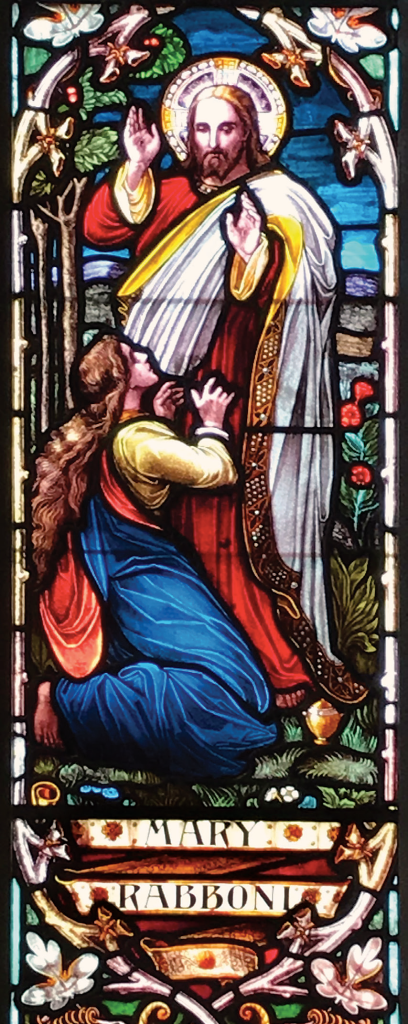
   Vilas Memorial Window, Grace Episcopal Church


 I was fortunate as a college professor that I taught at small liberal arts college where the number of students in my courses never exceeded 30. This was back before the age of smart phones and our department had a camera that some of my colleagues used on the first day of class to take photos of their students so they could put faces to names more quickly.

In my own experience, I learned that if I called the roll for two weeks, by the end of that time, I would know the students’ names by heart. Of course, they made it easier for me because they always sat in the same seat in the room. It would often happen that I would encounter a student on the sidewalk or in the library two or three years after I’d had them in class. I could recall where they sat in the room, what their final grade was, but often their name would be a complete mystery. Usually, several nights later I would suddenly wake up and there it was, on my lips, the name of that student.

The same thing happens at church, of course. If you’ve visited a few times, it’s likely I’m going to remember your face—but unless I see your name written out, it will take quite some time for me to remember it. There are also some people who come regularly whose name I don’t know—often, it’s because they want to remain invisible, or unnoticed. And then there’s the phenomenon of me walking into a restaurant or grocery store out of uniform, and encountering someone from church or someone I know from some other official capacity. They’ll take a second look, a puzzled expression comes on their face, and finally, I will end the suspense. Without a collar, it’s as if I’m in disguise (well, to be honest, sometimes I am in disguise).

While there are some places, and some groups, where we want to remain anonymous, there are also times when, as the theme song to the 1980s sitcom Cheers, put it: “Sometimes you want to go where everybody knows your name.”

That moment in John’s gospel where Jesus calls Mary Magdalene by name is intimate, dramatic, and revelatory. It’s a moment captured in the image on today’s service bulletin, courtesy of a last-minute request I made to our Communications Coordinator, Peggy Frain, a photo of one of the panels from the Vilas Window which is to my right.

But let’s step back a moment and explore this wonderful story in greater detail. The Gospel of John is wonderful, perplexing, challenging, at times, infuriating. It provides us so much imagery, so many ideas, tantalizing nuggets of information that it’s easy to get caught up in the detail and over interpret, or read too much into relatively minor points. Still, there is so much here—first, unlike in the other gospels where Mary Magdalene is accompanied by other women, and they have a set purpose in mind, anointing Jesus’ body with burial spices, in John, Mary comes alone, and for no particular purpose (Nicodemus took care of the embalming earlier).

In the other gospels, the women come at the break of day, here Mary comes at night—which reminds us of other nights in the gospel, the night early on when Nicodemus came to Jesus; the night a few days earlier, when Judas left Jesus and the others on his mission of betrayal; the night or darkness, throughout the gospel that stands in contrast to the light of Christ. We might infer that Mary herself is coming in the night, because she doesn’t know the light…

Then there’s the footrace between Peter and the beloved disciple, a race one by the other disciple, but he waits, and lets Peter enter first. There is the careful detail describing how the linen grave clothes are arranged, and the observation that the beloved disciple sees and believes, though what precisely he believes isn’t clear.

But back to Mary. After Peter and the Beloved Disciple go home after their morning run, probably stopping for coffee along the way, Mary stays behind in the garden, overwhelmed by grief. Probably, she’s still struggling to understand what’s happened, not quite believing that the tomb is empty. For the first time, she decides to look inside for herself, perhaps wondering what the other disciples had seen when they entered. Instead of grave clothes, she sees two angels who ask her, “Woman, why are you weeping?”

Mary’s response is partly bewilderment, partly a declaration of faith. While she can’t make sense of the scene in front of her, by refering to Jesus as her Lord, she proclaims her belief that, all evidence to the contrary, Jesus is (or was) the Son of God.

In the middle of her encounter with the angels, Mary senses another presence behind her and turns. John puts it succinctly, and lets we the readers in on the secret before Mary figures it out: “…saw Jesus standing there, but she did not know that it was Jesus.” We know it’s Jesus, and John writes it in such a way that we want to know how or when Mary will figure it out.

Jesus calls her by name and the eyes of her soul are opened. She recognizes him and calls him, “Rabbouni” Teacher. It’s a poignant, powerful moment, and it’s not just about Mary finally figuring out who Jesus is. Rather, when he calls her by name, he tells her who she is, and their relationship is restored and deepened. Mary is known and loved by Jesus and when he calls her by name, she enters into that love and knowledge.

We live in a world in which our lives are played out for the world to see. We share intimate details and photos of ourselves on facebook or instagram; we are connected to people across the globe via twitter and engage in debate and controversy with people we’ve never met face to face. Our personal details are mined for our political and shopping preferences and our efforts to maintain personal privacy rarely succeed.

Still, in all of that, the intimacy we so often desire remains elusive. Our mobility, jobs that require our attention and focus far beyond forty hours a week, the temptations of social media, mean that our relationships are tentative, often shallow, temporary. We want to hide so much of ourselves from others, out of fear or shame.

“Mary,” Jesus said. And in that instant, the veil that separated the two of them in the garden fell away and Mary saw her Lord. He called her by name, and not only did she recognize him, she also came to understand and know herself, in relationship with Jesus, and known, and loved, by him.

The Risen Christ calls us by name, knows us by name. When we hear his voice, we begin to know ourselves and are invited into relationship with him, to become his.

The Risen Christ stands before us in the garden. The Risen Christ comes to us in bread and wine of the Eucharistic feast. The Risen Christ encounters us in the community gathered to hear the proclamation of the Word. The Risen Christ encounters us in the faces of the outcast, the homeless and hungry, the widow and orphan, in immigrants, prisoners, the LGBT community.

The Risen Christ calls us by name, inviting us into relationship with him. He invites us to bring all of our baggage, all of our wounds and scars, all of our sins and brokenness. When we hear his voice, and answer his call, we become whole and healed, loved and known by him. May the sound of his voice fill you with joy, heal your brokenness, dry your tears. May we all know the joy and love of the Risen Christ. Thanks Be to God!


Silence and Resurrection: A Sermon for the Great Vigil of Easter, 2018


“… they went out and fled from the tomb, for terror and amazement had seized them; and they said nothing to anyone, for they were afraid. (Mk 16:8)

Terror and amazement, fear and silence. The silence of the tomb; the silence of Holy Saturday, when the earth goes still, Jesus in his grave.

Silence. Think of all the ways people are silenced—witnesses to oppression or violence, their testimony quashed by the powers that protect the status quo. All the women whose experience of sexual abuse and sexual harassment has been silenced by bullying, or threats, or pay-offs. The silence of victims, whose voices were, are, suppressed. The voices of prophets, who were silenced, like Martin Luther King, jr, assassinated almost 50 years ago today.

In Mark’s gospel, there is silence. There is the silence Jesus commands repeatedly when people he has healed, or evil spirits want to declare the Son of God. There is the silence he commands after the Transfiguration, as he, Peter, James, and John come back down from the mountain after their vision of Moses and Elijah. There is the silence of Jesus, when he is brought before the Chief Priests and he is accused of blasphemy. There is Jesus’ silence, when he stands before Pilate, and Pilate asks him about the charges against him.

And there is the silence, the silence of the women, who fled in terror and amazement.

An empty tomb, a message that Jesus is not here he is risen and he will meet you in Galilee, and then the women depart in fear and amazement and silence.

And nothing else. No miraculous appearance, no reassurance from the risen Christ, no sending out. Just an empty tomb, a command to go to Galilee, fear, and amazement, and silence.

Like so much of this gospel, from the very beginning right through to the crucifixion, it leaves us with few concrete answers, little certainty and no reassurance. We are left hanging, wondering. Like the women, we are fearful and silent.

An empty tomb, fear, amazement, silence.

Can you imagine those women, who had come with Jesus and the other disciples from Galilee. Women, and men, who had pinned all their hopes on this teacher. They had seen him heal people, cast out demons. They were with him along the road from Galilee. They heard him proclaim the coming of God’s reign, a new way of being in the world. They had watched in amazement as he forgave sins, ate with tax collectors and sinners, confounded the religious experts.

They may have had questions, all of them, about what it all meant, but they knew one thing, when they got to Jerusalem, something amazing, something big would happen.

And in Jerusalem, all signs pointed to that cataclysmic event. The triumphal entry, the debates in the temple with the authorities. Jesus running circles around them, embarrassing them publicly, the crowds delighted with what he said and how he bested his opponents.

Then it all came to an end, an arrest by night, a staged trial, and an execution by Rome. It was all over, except the grieving. All the men had fled or were laying low, fearful that their Galileean accents would bring them under suspicion from Roman troops and the religious authorities. So the women could stand near the cross bearing witness to Jesus’ death, and then watch as others buried him, and could come to the tomb to finish the embalming process and above all, grieve.

To this point, women had been Jesus’ most steadfast supporters. One had even been commended when she anointed him a few days earlier. Jesus said that she was doing it because she knew what was going to happen to him. Others had accompanied him, provided for him and the others along the way.

But the final mystery of the story, the final question Mark leaves is this. The women fled in terror and amazement, and told nothing to anyone for they were afraid. That’s another one of those ironic statements of which Mark is so fond. After all, if they told nothing to anyone, where did he get the story? Where did he, or anyone else hear of the empty tomb? How did they know to go on to Galilee to meet the risen Christ? Of course, they told someone, they must have, else Mark would not have written his gospel. If they had not told anyone, we would not be here!

That’s the line I’ve used repeatedly over the years—in sermons, bible studies, when quizzical, doubtful students asked me whether Mark could have ended the gospel this way, or whether those additional verses in chapter 16, verses that were clearly added later, were in fact a better ending to Mark’s gospel.

Tonight, I want to reflect on something else, on the women’s fear. Why were they afraid? Were they frightened of the empty tomb? Of the young man who appeared there?

Think about it. Whatever fears they might have had, they were brave enough to stand by publicly and watch Jesus die. Sure, they were “just” women, less threatening to Rome, but at the same time, they were his followers, his disciples, and the Romans must have known that. However afraid they may have been of Rome, of the religious authorities, they were brave enough to come out, early in the morning on the first day of the week, to come to the tomb.

We can think of this as their final act of love and devotion. They were performing their duty as Jesus’ loved ones, to perform the ritual anointing that was associated with burial. Caring for him, loving him, they came to the tomb, to do all those loving, intimate things, that human beings have done to their loved ones’ since the beginning of the species, the beginning of culture, to prepare their bodies for passage to the next life.

And then, suddenly, everything has changed. The body they were expecting to anoint and embalm was gone, and they were told, “He is risen!”

What if their fear was not about what had happened, but due to their uncertainty about what would happen next? What if they were afraid, not because of Jesus’ arrest and execution, but because they couldn’t understand the empty tomb and the young man’s words, He is raised from the dead.”

What if their fear had mostly to do not with the fact that their hopes were dashed by Jesus’ crucifixion, but by the miracle of resurrection?

We know the story; we know how it turns out, we know all the ways it’s been explained and interpreted over the centuries, and we’re all so familiarized to spectacular events by Hollywood special effects and computer generated imagery, that the otherness, the strangeness, the complete surprise of resurrection is hard for us to imagine.

To have our world blown open, our perspective transformed, our expectations upended—to have all that? Can we imagine that?

Can the cynicism, anger, and fear of our age be overwhelmed by the miracle and reality of resurrection? That the suffering of Jesus, the obedience and love that brought him to the cross, that made him just another victim alongside the hundreds of thousands, millions, perhaps who fell victim to Rome’s power, ended, not in defeat, death, and silence, but in something quite unexpected quite new.

The resurrection was so unexpected, that how could one respond in any other way than fear? It was proof, not just that God was vindicating Jesus, that God had intervened on Jesus’ behalf, just at the moment of greatest fear and despair. It was, is proof, that God is making things new, that God’s power and love are transforming the world, bringing about a reign of justice and peace.

They may have fled from the tomb in fear and amazement, and told no one, but in the end, they did tell what they had seen. Thanks be to God. Their fear was overcome by joy, and the good news burst forth from their lips. May our silence and fear also give way to joy, and may we also shout out the good news: Alleluia! Christ is Risen!