Good Friday in the Shadow of the Lynching Tree

To understand what the cross means in America we need to take a look at the lynching tree in this nation’s history–that “strange and bitter crop” that Billie Holiday would not let us forget. The lynched black victim experienced the same fate as the crucified Christ and thus became the most potent symbol for understanding the true meaning of the salvation achieved through “God on the Cross.” Nietzsche was right: Christianity is a religion of slaves. God became a slave in Jesus and thereby liberated slaves from being determined by their condition.

The real scandal of the gospel is this: humanity’s salvation is revealed in the cross of the condemned criminal Jesus, and humanity’s salvation is available only through our solidarity with the crucified people in our midst. Faith that emerged out of the scandal of the cross is not a faith of intellectuals or elites of any sort. This is the faith of abused and scandalized people—the losers and the down and out. It was this faith that gave blacks the strength and courage to hope, “to keep on keeping on,” …. The cross and the lynching tree interpret each other. Both were public spectacles, shameful events, instruments of punishment reserved for the most despised people in society. Any genuine theology and any genuine preaching of the Christian gospel must be measured against the test of the scandal of the cross and the lynching tree…..

As I see it, the lynching tree frees the cross from the false pieties of well-meaning Christians. When we see the crucifixion as a first-century lynching, we are confronted by the re-enactment of Christ’s suffering in the blood-soaked history of African Americans.

Thus the lynching tree reveals the true religious meaning of the cross for American Christians today. The cross needs the lynching tree to remind Americans of the reality of suffering-to keep the cross from becoming a symbol of abstract, sentimental piety. Before the spectacle of the cross we are faced with a clear challenge: as Latin American liberation theologian Jon Sobrino has put it, “to take the crucified down from the cross.”

Yet the lynching tree also needs the cross, without which it becomes simply an abomination. It is the cross that points in the direction of hope, the confidence that there is a dimension to life beyond the reach of the oppressor….

Though the pain of Jesus’ cross was real, there was also joy and beauty in his cross. This is the great theological paradox that makes the cross impossible to embrace unless one is standing in solidarity with those who are powerless. God’s loving solidarity can transform ugliness–whether Jesus on the cross or a lynched black victim–into beauty, into God’s liberating presence.

—James Cone, The Cross and the Lynching Tree

Good Friday, 1613, Riding Westward by John Donne

GOOD-FRIDAY, 1613, RIDING WESTWARD.
by John Donne

LET man’s soul be a sphere, and then, in this,
Th’ intelligence that moves, devotion is ;
And as the other spheres, by being grown
Subject to foreign motion, lose their own,
And being by others hurried every day,
Scarce in a year their natural form obey ;
Pleasure or business, so, our souls admit
For their first mover, and are whirl’d by it.
Hence is’t, that I am carried towards the west,
This day, when my soul’s form bends to the East.
There I should see a Sun by rising set,
And by that setting endless day beget.
But that Christ on His cross did rise and fall,
Sin had eternally benighted all.
Yet dare I almost be glad, I do not see
That spectacle of too much weight for me.
Who sees Gods face, that is self-life, must die ;
What a death were it then to see God die ?
It made His own lieutenant, Nature, shrink,
It made His footstool crack, and the sun wink.
Could I behold those hands, which span the poles
And tune all spheres at once, pierced with those holes ?
Could I behold that endless height, which is
Zenith to us and our antipodes,
Humbled below us ? or that blood, which is
The seat of all our soul’s, if not of His,
Made dirt of dust, or that flesh which was worn
By God for His apparel, ragg’d and torn ?
If on these things I durst not look, durst I
On His distressed Mother cast mine eye,
Who was God’s partner here, and furnish’d thus
Half of that sacrifice which ransom’d us ?
Though these things as I ride be from mine eye,
They’re present yet unto my memory,
For that looks towards them ; and Thou look’st towards me,
O Saviour, as Thou hang’st upon the tree.
I turn my back to thee but to receive
Corrections till Thy mercies bid Thee leave.
O think me worth Thine anger, punish me,
Burn off my rust, and my deformity ;
Restore Thine image, so much, by Thy grace,
That Thou mayst know me, and I’ll turn my face.

Poetry for Maundy Thursday: Descending Theology: The Garden by Mary Karr

Descending Theology: The Garden
Mary Karr
We know he was a man because, once doomed,
he begged for reprieve. See him
grieving on his rock under olive trees,
his companions asleep
on the hard ground around him
wrapped in old hides.
Not one stayed awake as he’d asked.
That went through him like a sword.
He wished with all his being to stay
but gave up
bargaining at the sky. He knew
it was all mercy anyhow,
unearned as breath. The Father couldn’t intervene,
though that gaze was never
not rapt, a mantle around him. This
was our doing, our death.
The dark prince had poured the vial of poison
into the betrayer’s ear,
and it was done. Around the oasis where Jesus wept,
the cracked earth radiated out for miles.
In the green center, Jesus prayed for the pardon
of Judas, who was approaching
with soldiers, glancing up—as Christ was—into
the punctured sky till his neck bones
ached. Here is his tear-riven face come
to press a kiss on his brother.

Poetry: Wednesday in Holy Week by Christina Rossetti

djgrieser's avatarPreaching Grace on the Square

Wednesday in Holy Week

by Christina Georgina Rossetti
Man’s life is death. Yet Christ endured to live,
Preaching and teaching, toiling to and fro,
Few men accepting what He yearned to give,
Few men with eyes to know
His Face, that Face of Love He stooped to show.

Man’s death is life. For Christ endured to die
In slow unuttered weariness of pain,
A curse and an astonishment, passed by,
Pointed at, mocked again
By men for whom He shed His Blood—in vain?

View original post

Poetry for Holy Week

“And I, when I am lifted up from the earth, will draw all people to myself.” (John 12:32, from the Gospel reading for Tuesday in Holy Week)

Lachrimae Amantis

GEOFFREY HILL

What is there in my heart that you should sue
so fiercely for its love? What kind of care
brings you as though a stranger to my door
through the long night and in the icy dew

seeking the heart that will not harbour you,
that keeps itself religiously secure?
At this dark solstice filled with frost and fire
your passion’s ancient wounds must bleed anew.

So many nights the angel of my house
has fed such urgent comfort through a dream,
whispered “your lord is coming, he is close”

that I have drowsed half-faithful for a time
bathed in pure tones of promise and remorse:
“tomorrow I shall wake to welcome him.”

How to weather Holy Week

As the events of Holy Week unfold, and as we share in them and make our own pilgrimage to the foot of the cross, it should be impossible for us simply look on and register them as an odd quirk of history. This was the perfect storm. This was where the hurricane of divine love met the cold might of empire and the overheated aspiration of Israel.

N.T Wright

Read it all here.


The Poet thinks about the donkey: Poetry for Monday in Holy Week

The Poet thinks about the donkey
On the outskirts of Jerusalem
the donkey waited.
Not especially brave, or filled with understanding,
he stood and waited.
How horses, turned out into the meadow,
leap with delight!
How doves, released from their cages,
clatter away, splashed with sunlight.
But the donkey, tied to a tree as usual, waited.
Then he let himself be led away.
Then he let the stranger mount.
Never had he seen such crowds!
And I wonder if he at all imagined what was to happen.
Still, he was what he had always been: small, dark, obedient.
I hope, finally, he felt brave.
I hope, finally, he loved the man who rode so lightly upon him,
as he lifted one dusty hoof and stepped, as he had to, forward.

Mary Oliver from her book Thirst.
reblogged from Blue Eyed Ennis

The Silence of Jesus: A Sermon for Palm Sunday, 2017


“But he gave him no answer, not even to a single charge, so that the governor was greatly amazed.” (Matthew 27:14)

Some of us were joking with Michael Covey earlier this week when he told us that he was going to read the part of Jesus in today’s reading of Matthew’s passion narrative. Michael is a criminal defense attorney. He travels across the state to defend clients in all sorts of cases, including murder trials. One week he might be up in Bayfield, another week he’s in La Crosse. His is an important, but often unappreciated, even vilified job, because he represents people accused of sometimes horrific crimes. He advocates for them, gives them voice, protects their rights. It’s ironic, though fitting, that he read Jesus’ role, because in this trial, Jesus stood alone, abandoned by his friends, confronting the most powerful authority in the known world, without rights or hope. And as Matthew tells the story, from his arrest through his execution, Jesus remained silent for the most part in the face of his accusers.

It’s hard for us in the twenty-first century to understand how enormous a problem it was for early Christians that the person they regarded as the Son of God, risen from the dead, had been executed by the Roman Empire. Crucifixion was, as one scholar has called it, “execution by torture.” It was used against those Rome regarded as its worst offenders, especially revolutionaries. Crucifixion was a public display. The upright posts were permanent fixtures on roads coming into important towns and cities—the condemned would often carry the crossbeams themselves, as the gospels say Jesus did. And the deaths were prolonged as well as excruciating. It could take days to die. The corpses would be left hanging as mute witnesses to the fate of those who opposed Rome. For Jesus to have been crucified was to mark him, and his followers, as enemies of Rome.

It’s hard for us, in twenty-first century America to comprehend the ignominy, the disgust with which those condemned to crucifixion were regarded by the good people of the Roman Empire, the fine upstanding citizens of Jerusalem, or Rome, or any other prosperous Roman city. The best comparison for us might be to understand crucifixion for the Roman empire and culture as we regard someone branded, and prosecuted, as a terrorist—an enemy of the state, an enemy of everything we hold dear, all of our cultural values.

That’s how Rome regarded Jesus. That’s why he was executed, because he was fomenting rebellion against the state, because he was advocating an alternative to the Roman Empire, to Roman cultural values.

Of course, Jesus wasn’t just a rabble-rouser, nor was he a terrorist, although it is likely that the two men who were executed with him were something of the sort. As bandits, they were involved in some sort of armed resistance against Roman authority. What brought Rome’s attention to Jesus, and what finally resulted in his execution, was his proclamation of the coming reign of God, a realm in which values diametrically opposed to Rome were proclaimed, experienced, and shared.

We heard those values announced and explicated in the Sermon on the Mount. The vision laid out by Jesus there and throughout his public ministry is a vision of a transformed world, transformed relationships, where the poor, outcasts, outsiders are welcome; where enemies as well as neighbors are loved, where violence and oppression give way to peace. It is a vision of self-giving love, for individuals and for the whole people of God. Most of all, it is a vision of a world in which the values held dear by the wider culture—celebrity, success, wealth, and power give way to a different set of values—where the first will be last and the last first.

We see something of that vision expressed by Paul in today’s reading from the letter to the Philippians. It is the Christ hymn that sings of Christ emptying himself to become human, humbly and obediently living in such a way to show us God’s love incarnate; living in such a way that he aroused the hatred and enmity of Rome, and died on the cross.

We may want to focus on the cross today and in the days to come, but the important point to remember is that death is not the end of the story, either for us or for Jesus. As Paul argues here, Christ’s obedience, humility, his incarnating of God’s love that ended in the cross was vindicated. The gory, painful, ignominious death transformed into life, a victory over the forces of evil and death.

Jesus’ silence comes to an end on the cross with his final, despairing cry, “My God, my God, why have you forsaken me?” It is a cry of despair, doubt, and pain, at a moment when all seems lost, when the reign of God seems farther away than ever before, when the message of love proclaimed and lived by Jesus seems to be refuted completely by the power of the Roman state.

But in that moment we see the power of God; we see God suffering with us in all of our struggles, suffering, and pain, we see God with us, in the struggle for justice and peace, we see God breaking open the gates of hell and conquering evil.

Many of us struggle; we are disheartened by the world in which live; horrified by the fate of refugees and immigrants, fearful for the future of human life and our planet, crushed by the weight of injustice, our hearts breaking for the victims of oppression and violence, including those who were gassed this week in Syria and the US’s knee-jerk military response to that carnage.

The cross offers no escape from any of this. The cross is a symbol of the reality of our world, the depths of human evil and depravity. But in its horror, in the horrors of our world, the cross also symbolizes the presence of God in all of those places, suffering with us, suffering with victims of injustice, violence, and oppression.

The cross is a symbol that even when things seem darkest, when it seems that evil has triumphed, the story is not over. God hears the cries of the suffering and the oppressed. Sometimes, we cry with them, sometimes we cry on their behalf. Sometimes, God cries with those who are suffering and in pain. The cross is a symbol of hope, of our hope that ultimately God will prevail. God does prevail.

 

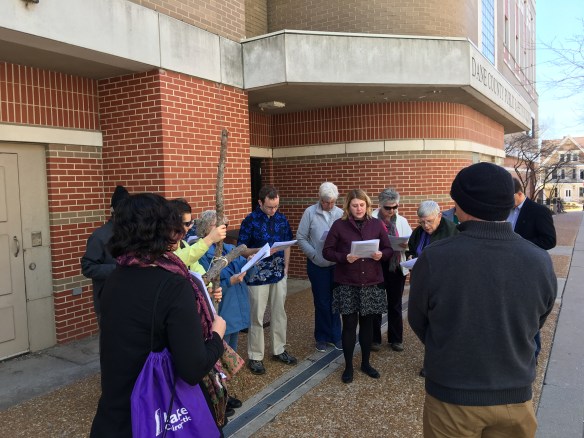
Walking the Stations of the Cross in Downtown Madison, April 7, 2017

At the entrance of the Dane County Jail

This is the fourth (I think) year we’ve walked the Stations of the Cross in Downtown Madison. It’s a strange, uncomfortable experience in that for me, I’m walking streets I walk nearly every day as I go to and from work or grab lunch or run errands. This year, as in past years, I encountered familiar faces as I walked, among them two elected officials of county and city government.

This year, in addition to the usual distractions of city traffic and people going about their business, we had to compete with construction on Capitol Square and with the Solidarity Singers, who seemed to be a larger group than they had been in recent weeks.

To be honest, I wasn’t really looking forward to today’s event. For whatever reason, my spiritual focus has been elsewhere, and my energy diverted to other matters. If it hadn’t concluded at Grace, I doubt whether I would have participated.

I was surprised how quickly I was caught up in the experience. It wasn’t just the familiar stations, and the meditations that connected Jesus’ suffering with the suffering on the streets of Madison. It was also about making Christ’s suffering present on these streets, at the door of the Dane County Jail, opposite the Wisconsin Veterans’ Museum, and at the steps of Grace where a homeless person died in the winter of 2014, and where so many homeless people have sought refuge over the last thirty years, and hungry people have been fed.

We do so much to protect ourselves from the knowledge and experience of human suffering on the streets of our city. The homeless and panhandlers are harassed and shoved out of sight. The inhumanity of the Dane County Jail is at its worst several stories above the room in the City County building where Madison’s Common Council and the Dane County Board of Supervisors deliberate.

To walk the way of the cross in Downtown Madison is to bear witness to the blood on our streets and in our city. It is also to see in that suffering and pain, the suffering and pain of Jesus Christ.

Today I realized that our little Stations of the Cross, walked as we’ve done it every year on the Friday before Palm Sunday, has become an essential part of my preparation for the drama of Holy Week.


For background on the devotion of the Stations of the Cross and how we do it here in Madison, follow this link.

Raised with Lazarus: A sermon for the fifth Sunday in Lent, 2017


I hope that you’ve come to appreciate something of the complexity, depth, and riches in the gospel of John as we’ve worked through these readings over the last several weeks. Today, we have come to the end of this series of stories from John’s gospel, and with this reading, we have come to something of an early climax in the gospel as well. This story of the raising of Lazarus is the last of the seven “signs” recorded by John. It’s a clear demonstration of Jesus’ power but also, in its focus on his emotions it describes Jesus’ humanity in ways that we don’t see elsewhere in the gospel. Continue reading