An Empty Tomb, A Resurrection Journey: A Sermon for the Great Vigil of Easter, 2015

Does anybody know what the score is right now?

How strange it is that we are gathered here tonight on a Saturday night, while the beloved Badgers are hopefully playing their hearts out in the Final Four! Yes, we do it every year, and yes, every year it’s just a little bit jarring to be worshiping and celebrating the resurrection in a dark night while all around us the world goes about its regular Saturday night routine. What’s different tonight is only that some of us are just a little more distracted than usual, as the city around us pays attention to more important things, one of our annual sporting rituals. Continue reading

Holy Saturday

“… does the precise locus of this Saturday, at the interface between cross and resurrection, its very uniqueness as the one moment in history which is both after Good Friday and before Easter, invest it with special meaning, a distinct identity, and the most revealing light? Might not the space dividing Calvary and the Garden be the best of all starting places from which to reflect upon what happened on the cross, in the tomb, and in between? The midway interval, at the heart of the unfolding story, might itself provide an excellent vantage point from which to observe the drama, understand its actors, and interpret its import. The nonevent of the second day could after all be a significant zero, a pregnant emptiness, a silent nothing which says everything.” Alan Lewis, Between Cross and Resurrection: A Theology of Holy Saturday (Eerdmans, 2001).

The Cross and the Lynching Tree: Words from James Cone for Good Friday

To understand what the cross means in America we need to take a look at the lynching tree in this nation’s history–that “strange and bitter crop” that Billie Holiday would not let us forget. The lynched black victim experienced the same fate as the crucified Christ and thus became the most potent symbol for understanding the true meaning of the salvation achieved through “God on the Cross.” Nietzsche was right: Christianity is a religion of slaves. God became a slave in Jesus and thereby liberated slaves from being determined by their condition.

The real scandal of the gospel is this: humanity’s salvation is revealed in the cross of the condemned criminal Jesus, and humanity’s salvation is available only through our solidarity with the crucified people in our midst. Faith that emerged out of the scandal of the cross is not a faith of intellectuals or elites of any sort. This is the faith of abused and scandalized people—the losers and the down and out. It was this faith that gave blacks the strength and courage to hope, “to keep on keeping on,” …. The cross and the lynching tree interpret each other. Both were public spectacles, shameful events, instruments of punishment reserved for the most despised people in society. Any genuine theology and any genuine preaching of the Christian gospel must be measured against the test of the scandal of the cross and the lynching tree…..

As I see it, the lynching tree frees the cross from the false pieties of well-meaning Christians. When we see the crucifixion as a first-century lynching, we are confronted by the re-enactment of Christ’s suffering in the blood-soaked history of African Americans.

Thus the lynching tree reveals the true religious meaning of the cross for American Christians today. The cross needs the lynching tree to remind Americans of the reality of suffering-to keep the cross from becoming a symbol of abstract, sentimental piety. Before the spectacle of the cross we are faced with a clear challenge: as Latin American liberation theologian Jon Sobrino has put it, “to take the crucified down from the cross.”

Yet the lynching tree also needs the cross, without which it becomes simply an abomination. It is the cross that points in the direction of hope, the confidence that there is a dimension to life beyond the reach of the oppressor….

Though the pain of Jesus’ cross was real, there was also joy and beauty in his cross. This is the great theological paradox that makes the cross impossible to embrace unless one is standing in solidarity with those who are powerless. God’s loving solidarity can transform ugliness–whether Jesus on the cross or a lynched black victim–into beauty, into God’s liberating presence.

James Cone, The Cross and the Lynching Tree

Good Friday, 1613, Riding Westward–John Donne

GOOD-FRIDAY, 1613, RIDING WESTWARD.
by John Donne

LET man’s soul be a sphere, and then, in this,
Th’ intelligence that moves, devotion is ;
And as the other spheres, by being grown
Subject to foreign motion, lose their own,
And being by others hurried every day,
Scarce in a year their natural form obey ;
Pleasure or business, so, our souls admit
For their first mover, and are whirl’d by it.
Hence is’t, that I am carried towards the west,
This day, when my soul’s form bends to the East.
There I should see a Sun by rising set,
And by that setting endless day beget.
But that Christ on His cross did rise and fall,
Sin had eternally benighted all.
Yet dare I almost be glad, I do not see
That spectacle of too much weight for me.
Who sees Gods face, that is self-life, must die ;
What a death were it then to see God die ?
It made His own lieutenant, Nature, shrink,
It made His footstool crack, and the sun wink.
Could I behold those hands, which span the poles
And tune all spheres at once, pierced with those holes ?
Could I behold that endless height, which is
Zenith to us and our antipodes,
Humbled below us ? or that blood, which is
The seat of all our soul’s, if not of His,
Made dirt of dust, or that flesh which was worn
By God for His apparel, ragg’d and torn ?
If on these things I durst not look, durst I
On His distressed Mother cast mine eye,
Who was God’s partner here, and furnish’d thus
Half of that sacrifice which ransom’d us ?
Though these things as I ride be from mine eye,
They’re present yet unto my memory,
For that looks towards them ; and Thou look’st towards me,
O Saviour, as Thou hang’st upon the tree.
I turn my back to thee but to receive
Corrections till Thy mercies bid Thee leave.
O think me worth Thine anger, punish me,
Burn off my rust, and my deformity ;
Restore Thine image, so much, by Thy grace,
That Thou mayst know me, and I’ll turn my face.

Knowing that … he got up from the table, took off his robe: A Sermon for Maundy Thursday

I still remember vividly the first Episcopal Maundy Thursday service I attended. It was probably in 1992. I had begun attending an Episcopal Church in a city north of Boston earlier that year and for whatever reason I decided to check out the service that Thursday. I’m glad I did. Together with the Great Vigil of Easter that I attended two nights later, that experience of Holy Week made me an Episcopalian. Continue reading

10largep

Albrecht Dürer, Christ taken Captive (The Large Passion)

The Collect

Almghty Father, whose dear Son, on the night before he suffered, instituted the Sacrament of his Body and Blood: Mercifully grant that we may receive it thankfully in remembrance of Jesus Christ our Lord, who in these holy mysteries gives us a pledge of eternal life; and who now lives and reigns with you and the Holy Spirit, one God, for ever and ever. Amen.

Wednesday in Holy Week

giotto7


Lord God, whose blessed Son our Savior was betrayed, denied, and abandoned by his friends: Give us grace to accompany him on his journey to the cross and to share in his resurrection; through Jesus Christ your Son our Lord, who lives and reigns with you and the Holy Spirit, one God, for ever and ever. Amen.–An alternative collect for Wednesday in Holy Week

Wednesday in Holy Week is traditionally known as Spy Wednesday, so-called because it is remembered as the day when Judas betrayed Jesus.

As I listened to the passion narrative from Mark’s gospel, I was struck by his depiction of Judas in relation to the other disciples. For some reason, I was surprised by Mark’s description of the Anointing at Bethany, where the criticism of the woman’s actions was put in the mouths of anonymous people at the meal (In Matthew, it’s the disciples; in Luke and John, it’s Judas). Mark immediately follows the anointing with Judas seeking out the chief priests and scribes, but doesn’t link the two events at all.

As the passion narrative builds, the theme of Jesus’ abandonment by his disciples becomes ever more important. Interestingly, Mark does not have Jesus identify Judas as his betrayer at the Last Supper. Instead, Jesus predicts one of them will betray him. A few verses later, as they begin the walk to Gethsemane, Jesus tells them they will all desert him, the occasion for him to predict that Peter will deny him.

Then comes the kiss, the betrayal and arrest, and Mark’s insertion of the story of the disciple who fled from the scene naked. Given that all of the disciples will abandon him, that Peter denied him, that Jesus cried from the cross in despair, “My God, My God, why have you forsaken me?” Judas’ betrayal of Jesus, far from being the worst sin ever committed, is on one end of a continuum that includes the actions of all of the disciples (and perhaps, God).

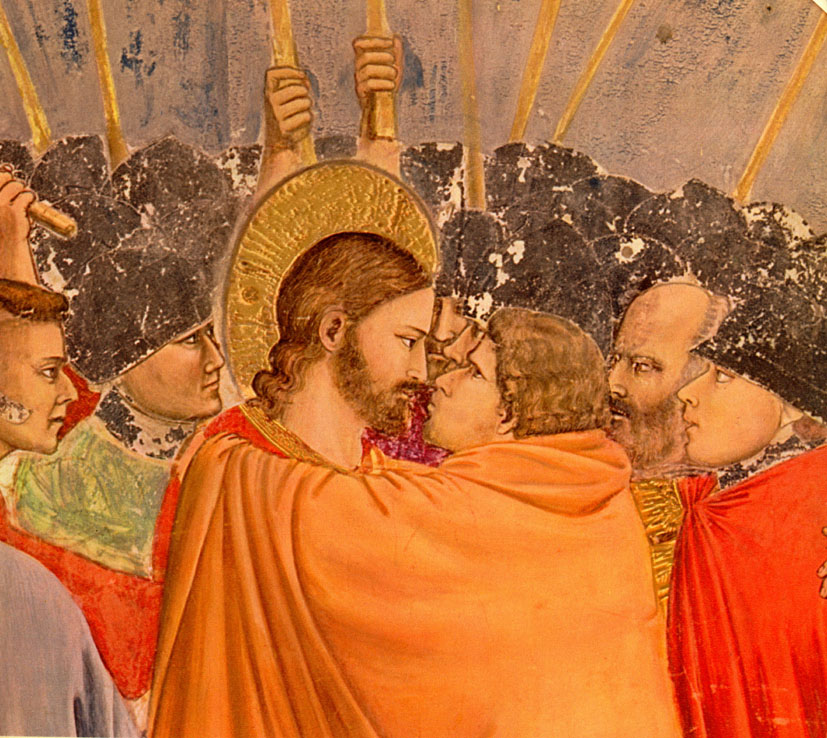
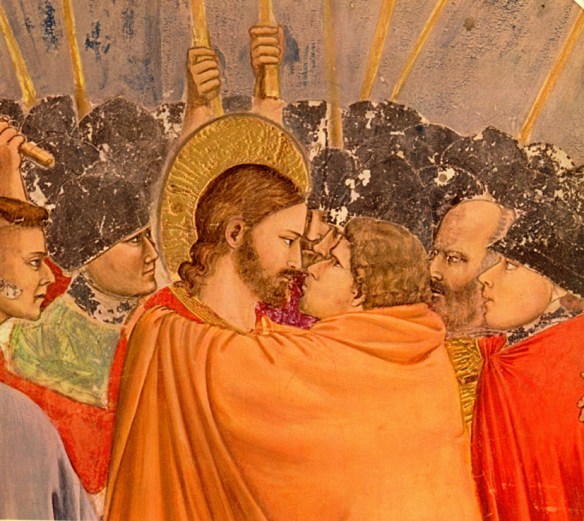
By John’s gospel, that’s no longer the case. He still doesn’t quite understand why Judas betrayed Jesus. He offers at least two explanations, that he was a thief (John 12:6) and that Satan entered him (John 13:2, 27). Over the centuries, Christians have come to view Judas in increasingly negative terms. One need only look at images of Judas from the Middle Ages or Renaissance to see the point clearly. He is depicted with animal-like features, demonic, or as the most Jewish-looking of the disciples. Giotto’s depiction of Judas is a good example of this.

What that demonization of Judas has done is let us (and the disciples) off the hook. Holy Week, the passion narratives invite us to imagine ourselves in the story, to see ourselves as one of the characters. A demonic Judas resists our efforts to see ourselves in that role as one who betrayed or abandoned Jesus, as one who was disappointed by Jesus and sought to force his hand. For all our faults, sins, and shortcomings, we can’t imagine ourselves the embodiment of evil like Judas has become.

But we should remember. Judas was a follower of Jesus, he did share in the last supper, receive the bread and wine. Even in John 13, where it’s possible to interpret Jesus’ actions in taking up the towel and basin as a response of his knowing that Judas would betray him, Jesus washed his feet just he washed the feet of all the disciples.

We do need to see ourselves in Judas, as followers of Jesus who betray him in small and large ways, seeking our own glory, not his, expecting him to conform to our expectations of what a Messiah should be, demanding that he share our prejudices and values, giving him up to the powers and principalities of this world.

I wonder if there’s a message to us in John’s final juxtaposition of Judas’ departure and Jesus’ words: “I give you a new commandment, that you love one another. Just as I have loved you, you also should love one another. By this everyone will know that you are my disciples, if you have love for one another.”

Jesus demonstrated his love for his disciples and the world. Having loved his own who were in the world, he loved them to the end. As his disciples, are we called to love Judas as Jesus did, and as Jesus loves and forgives the Judas in us?