Almost a year ago, The Rev. Alex Gee, jr. wrote an op-ed piece in the Madison State Journal in which he described his experience as an African American male in Madison, and called on our community to address head-on the issues of racism, inequality, and injustice in our midst. Since then, there have been a series of meetings, a great deal of press coverage, and new energy in the African American community to speak out on the issues that divide us. Continue reading
Monthly Archives: November 2014
Advent 2014:
My reflections on Advent have been profoundly affected this past week by the events in Ferguson and the way the mask of a post-racial America has been ripped off to expose the bitter and deep realities of racism and injustice. I’m not alone. #StayWokeAdvent is a thing.
Have you ever been stuck in a dark place with only a sliver of light or no light at all? You know those times waiting for news that could bring just as much struggle as it brings resolution? Remember the times of waiting and waiting, not knowing when the answers will come? Times of anticipation, of unknowing, of darkness before more light, are not always joyful, peaceful, or even largely hopeful. These are times of struggle, times of wrestling, doubting, mourning, crying, yearning, times of staying alert to the signs that light may be coming, that things are changing.
This is the time, the time of Advent, to stay alert…to “stay woke”…to your senses, your mind, your body, your feelings, your spirit to where to Spirit is stirring and leaning. Stay woke….to the impact your life has on others…Stay woke…to the injustice that we either contribute to or diminish…Stay woke….to the groanings of the world…Stay woke…to the humble, radical, empire-upsetting ways of Jesus…Stay woke…to the darkness…Stay woke…to the light…and to the sacred and profane in both.
Christina Cleveland reminds us that Advent is a season of darkness:
But we do the Light a disservice when we underestimate the darkness. Jesus entered a world plagued not only by the darkness of individual pain and sin, but also by the darkness of systemic oppression. Jesus’ people, the Hebrews, were a subjugated people living as exiles in their own land; among other things, they were silenced, targets of police brutality, and exploitatively taxed. They were a people so beaten down by society that only a remnant – most notably Anna and Simeon – continued to believe that the Messianic prophecies would one day come to pass. For many, the darkness of long-standing oppression had extinguished any hope for liberation.
The Very Rev. Mike Kinman of Christ Church Cathedral in St. Louis has called on Episcopal Cathedrals (and other churches) to take some time in Advent to address the “he issues Ferguson has raised and where those issues of race, class and the oppression of God’s children are present in your community.” More information on that is here. Grace Church, Madison will be participating.
Also on Ferguson and Advent from David Bailey at the Missio Alliance:
The Washington Post has the story of the church apparently destroyed by arson this week in Ferguson and its pastor’s struggle to understand (Michael Brown, Sr. is a member of the congregation).
A Thanksgiving Prayer
As we gather at tables, grieving the state of our nation, may we gain spiritual strength for the journey ahead, drawing on the deepest wells of wisdom from those on whose shoulders we stand and the various faith traditions that have fueled their freedom march and continue to energizee ours.
In the spirit of Rabbi Abraham Joshua Heschel and Dr. King, may the pioneers of the civil rights movement collaborate with the young leaders in Ferguson, New York City and other cities, and may they impart their knowledge and understanding of nonviolent resistance that is not passive, but is spiritually active with an abiding faith that the universe is on the side of justice, and that, in the end, love will triumph over evil.
May this spiritual strength, fueled by prophetic fire and love, reveal to us our neighbors’ humanity, our own complicity in their suffering and liberate us once and for all from the history that continues to enslave us.
An Epistemology of Ignorance: Charles Mills on Racism
The radically divergent perspectives on reality of blacks and whites are a straightforward reflection of the radically different realities in which they live. Segregation has deep cognitive consequences as well as the more familiar consequences for one’s chances at a good education, home ownership in good neighborhoods, being able to escape gang violence, etc. That doesn’t mean that black majority opinion is always going to be right, of course. But you would expect that those more subject to the inequities of the system will in general be the ones more likely to have a realistic perspective on it. Whites have not merely an unrepresentative group experience, but a vested group interest in self-deception. Sociologists have documented the remarkable extent to which large numbers of white Americans get the most basic things wrong about their society once race is involved. (See, for some hilarious examples, Eduardo Bonilla-Silva’s “Racism Without Racists.”) My favorite example, from a poll about three years ago, is that a majority of white Americans now believe that whites are the race most likely to be the victims of racial discrimination! If that’s not an epistemology of ignorance at work, I don’t know what would be.
Ta-Nehisi Coates on Non-Violence, Ferguson and American Society
What clearly cannot be said is that American society’s affection for nonviolence is notional. What cannot be said is that American society’s admiration for Martin Luther King Jr. increases with distance, that the movement he led was bugged, smeared, harassed, and attacked by the same country that now celebrates him. King had the courage to condemn not merely the violence of blacks, nor the violence of the Klan, but the violence of the American state itself.
What clearly cannot be said is that violence and nonviolence are tools, and that violence—like nonviolence—sometimes works. “Property damage and looting impede social progress,” Jonathan Chait wrote Tuesday. He delivered this sentence with unearned authority. Taken together, Property damage and looting have been the most effective tools of social progress for white people in America. It describes everything from enslavement to Jim Crow laws to lynching to red-lining.
Read it all. Read it all here.
Prayers for Ferguson and for us
Almighty God, who created us in your image: Grant us grace fearlessly to contend against evil and to make no peace with oppression; and, that we may reverently use our freedom, help us to employ it in the maintenance of justice in our communities and among the nations, to the glory of your holy Name; through Jesus Christ our Lord, who lives and reigns with you and the Holy Spirit, one God, now and for ever. Amen. (BCP, 260)
A Prayer for the Whole Human Family.
O God, you made us in your own image and redeemed us through Jesus your Son: Look with compassion on the whole human family; take away the arrogance and hatred which infect our hearts; break down the walls that separate us; unite us in bonds of love; and work through our struggle and confusion to accomplish your purposes on earth; that, in your good time, all nations and races may serve you in harmony around your heavenly throne; through Jesus Christ our Lord. Amen. (BCP, 815)
A Prayer for Social Justice.
Grant, O God, that your holy and life-giving Spirit may so move every human heart [and especially the hearts of the people of this land], that barriers which divide us may crumble, suspicions disappear, and hatreds cease; that our divisions being healed, we may live in justice and peace; through Jesus Christ our Lord. Amen. (BCP, 823)
Advent Resources 2014
I’ve compiled links to some sites and Advent calendars I think help us in this season. Check back from time to time as I’ll update the list.
Some online Advent Calendars:
- From the Anglican Communion: http://www.aco.org/adventword.cfm
- From the Society of St. John the Evangelist: http://ssje.org/adventword
- From Busted Halo: www.bustedhalo.com/advent
Occupy Advent
- on facebook: https://www.facebook.com/OccupyAdvent
- twitter: @OccupyAdvent or https://twitter.com/OccupyAdvent
Rediscovering Advent from Full Homely Divinity: http://fullhomelydivinity.org/articles/advent%20fullpage.htm
From Creighton University, Praying Advent: http://onlineministries.creighton.edu/CollaborativeMinistry/Advent/
A giant collection of Advent Resources from Anglicans Online: http://anglicansonline.org/special/advent.html
A brief youtube video from Rowan Williams:
Looking for something to read during Advent?
Try Christian Wiman, My Bright Abyss: Meditation of a Modern Believer
or Wiman’s recent collection of poems:
Christ the King and our comfortable assumptions: A Sermon for Christ the King, 2014
Today is the last Sunday of the liturgical year, and for many years it has been known as Christ the King. More recently, the politically correct liturgical police have renamed it “The Reign of Christ” because the imagery and idea of Christ the King has become increasingly problematic in the twentieth and twenty-first centuries. It offends our notions of democracy and egalitarianism; it smacks of violence and militarism; it seems to encourage gender stereotypes. For all of those reasons, and for others, including the image of a crowned Jesus robed in splendor, seated on a throne, judging between the good and evil; for all of these reasons I find the commemoration of Christ the King problematic. Continue reading
Lectionary Reflections for Christ the King Sunday
This Sunday’s texts are available here.
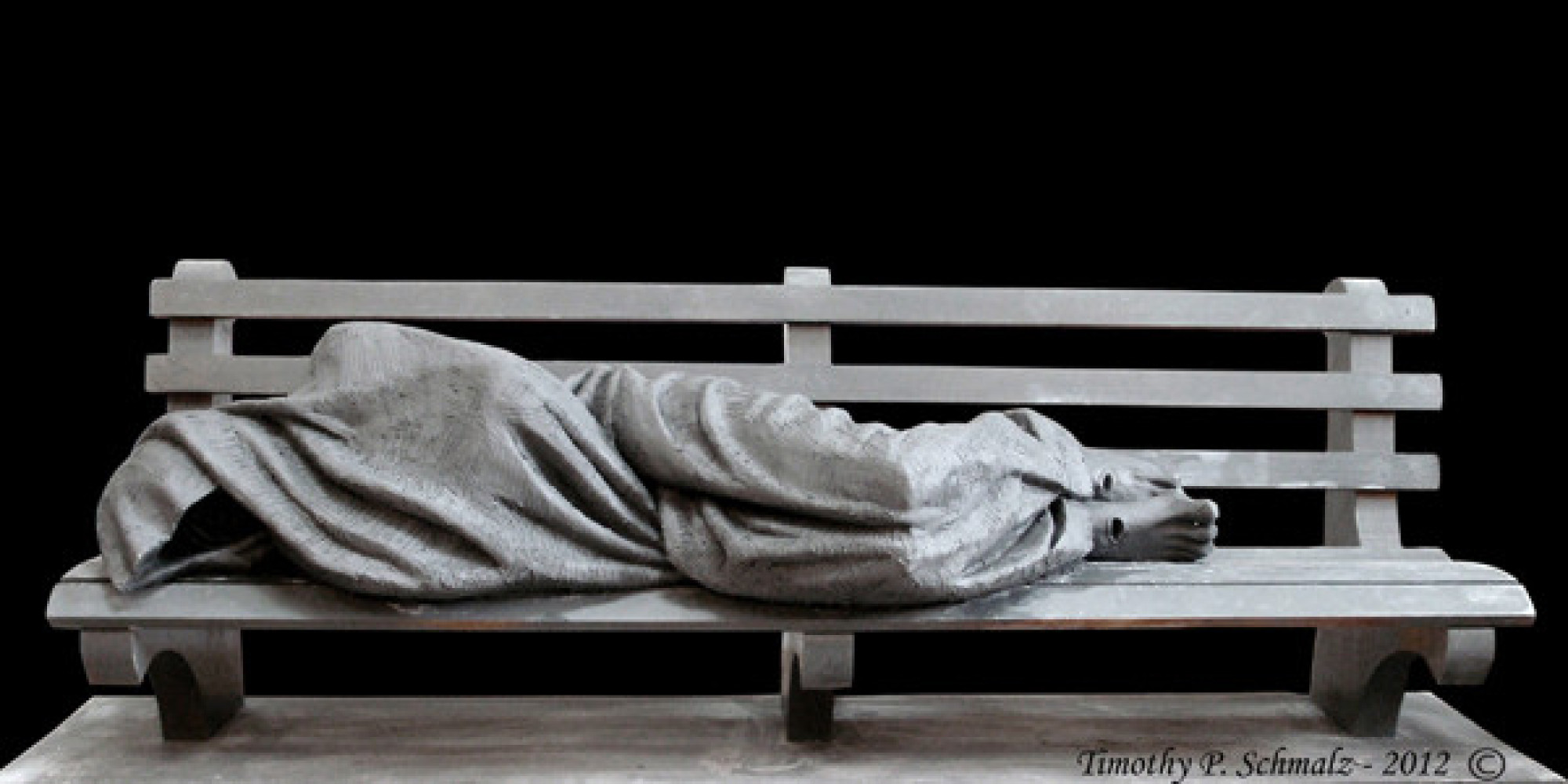
Canadian sculptor Tim Schmaltz has incited controversy with his bronze statue “Jesus the Homeless.” The image gained notoriety when it was rejected by St. Patrick’s Cathedral in New York City and St. Michael’s Cathedral in Toronto. The latter image was installed at the Jesuit School of Theology in Toronto and another cast was purchased and installed at St. Alban’s Episcopal Church in Davidson, NC. The statue depicts a homeless man sleeping on a park bench. His facial features are partially obscured by the blanket that covers him but the marks of crucifixion on his hands and feet clearly identify him as Jesus. After the statue appeared in Davidson, the police were called by a woman who thought it was a real homeless person and others complained that it demeaned the neighborhood. One woman was quoted as saying, “Jesus is not a vagrant; Jesus is not a helpless person who needs our help.” (A story on Huffington Post with images of the statue is here).
This Sunday, the last Sunday of the liturgical year, is Christ the King Sunday, a day when we are encouraged to reflect on the reign of Christ. Often, such reflection takes the form of images of Christ ruling in majesty or coming in triumph. Today’s gospel from Matthew 25, points in a very different direction. We read the familiar parable of sheep, goats, and judgment. For all its familiarity, it continues to challenge us at the core of our existence and at the core of our faith. The king divides sheep and the goats on the basis of how they responded to the deepest human needs: to the hungry and the thirsty, the stranger, the sick, the naked and the prisoner. But when told of their respective fates and the basis for the judgment, sheep and goats answered alike, “Lord, when did we see you hungry or thirsty or naked?”
The Kingship of Christ, the Reign of Christ, is not primarily about recognizing Christ in majesty and triumph. It is about being Christ—in the weakest, lowliest, and most vulnerable of humans; in feeding and clothing, ministering to and being with the stranger, the sick, the friendless. In acts like these, the reign of God is announced and made present. The reign of Christ is proclaimed in a homeless Jesus.

How’s that “read, mark, learn, inwardly digest” thingie going? A sermon for Proper 28, Year A
This Sunday’s collect, the collect for Proper 28, is one of my favorites:
Blessed Lord, who caused all holy Scriptures to be written for our learning: Grant us so to hear them, read, mark, learn, and inwardly digest them, that we may embrace and ever hold fast the blessed hope of everlasting life, which you have given us in our Savior Jesus Christ; who lives and reigns with you and the Holy Spirit, one God, for ever and ever. Amen.