Images of Maundy Thursday

I’ve been worshiping at Episcopal Churches on Maundy Thursday for more than 20 years; the last ten participating actively in the liturgy in some way. I’ll never forget the first time I witnessed the procession of the Blessed Sacrament to the Altar of Repose and the Stripping of the Altar. It was at St. Paul’s Newburyport, MA. It broke me.

I don’t know how people experience it in the pews but I do know that of all the liturgies throughout the year, Maundy Thursday and Good Friday are times that I am caught up in the ritual even as I am thinking about what’s going to happen next and worrying that something might go wrong. None of it matters. The drama of the Triduum transcends any of the rest of our mundane concerns, even when, as tonight, there were issues with the sound system and flickering lights.

Ritual connects us with God. It also connects us with all of the communities in which we have experienced those rituals in the past. It also connects us with communities who are performing and experiencing those rituals in different ways across the world. Maundy Thursday especially connects me with my past. Not just with those congregations where I have worshiped or participated, or celebrated in the past, but also with my deeper past.

I grew up in the Mennonite Church. At that time, communion was celebrated twice a year and included not just the Lord’s Supper but also footwashing. Baptized members washed each other’s feet and greeted each other with the Holy Kiss. The power of those symbolic acts remained with me long after I left my home church when I graduated from High School. I suspect that the next time I actually attended a footwashing was that first Episcopal Maundy Thursday service in Newburyport in the early 90s. And I know that those powerful memories kept me from participating in it for myself as an Episcopalian until I had to, when I was serving at the altar, as a Postulant for Holy Orders.

Now when I wash feet and when my feet are washed, I think back to that Mennonite congregation in which I was raised and where I was baptized. I remember washing the feet of friends, of men my dad’s age, and of elderly men. And I remember having my feet washed by them. Most poignantly, I remember my dad, who was usually the song leader and as we washed our feet, he would lead us out in familiar hymns that we would sing, a Capella, as we imitated Jesus Christ, serving each other and demonstrating in that lowly and uncomfortable act, Christ’s commandment to love one another as he loved us.

So tonight, I was remembering my dad. I was also remembering the people of West Clinton Mennonite Church in rural Wauseon, OH. I was remembering the people of St. Paul’s Newburyport, of All Saints Chapel, Sewanee, of All Souls’ Cathedral, Asheville, of St. Margaret’s, Boiling Springs, SC, Church of the Redeemer and St. James, Greenville, and Grace, Madison, WI. I was remembering all of them as I was remembering those disciples gathered with their Lord in Jerusalem nearly 2000 years ago.

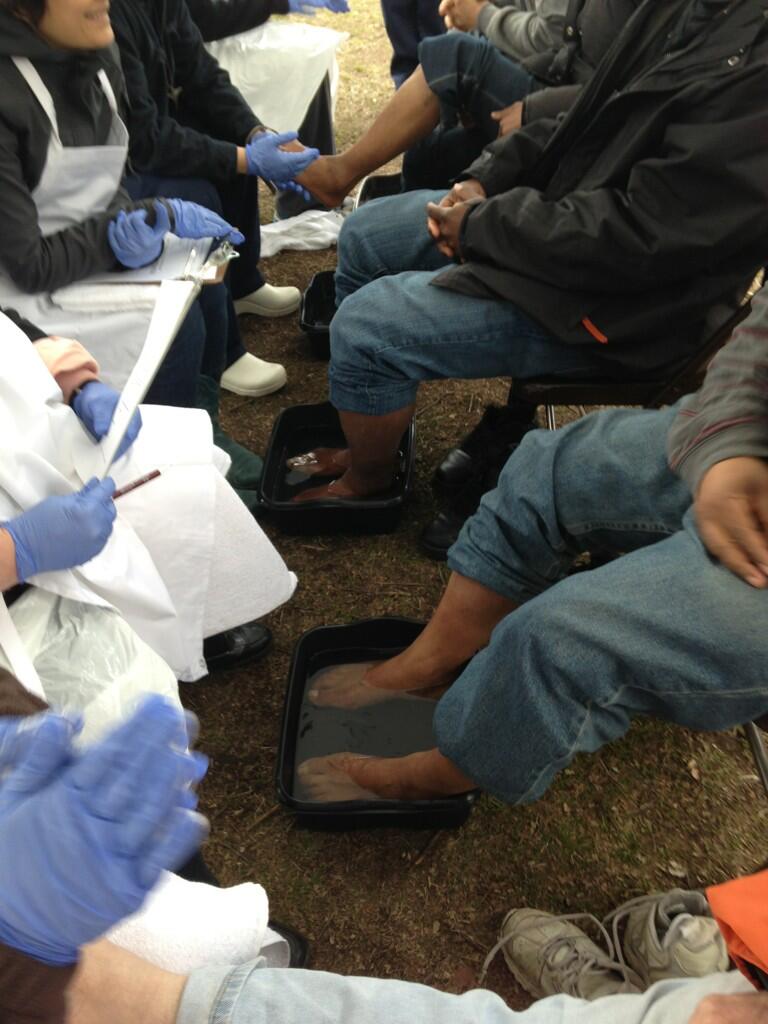
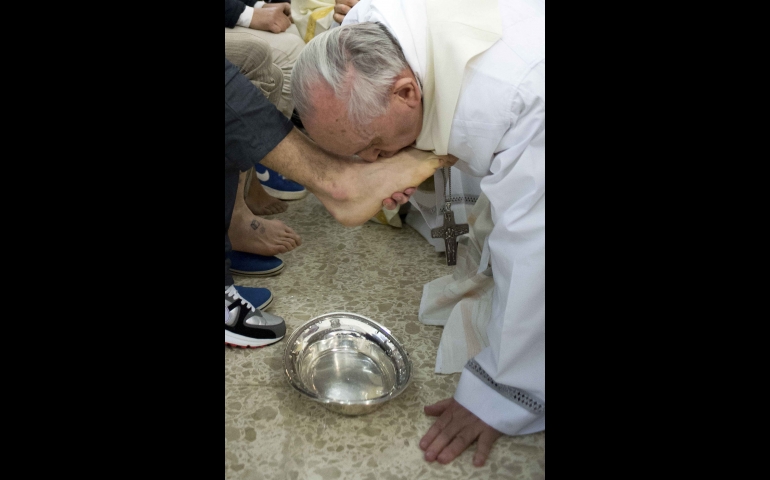
And I was also mindful of images from today. Of Pope Francis, who continues to surprise, washing the feet of a young Muslim female prisoner and of the foot care clinic at the Church on the Green in New Haven, CT

If you’ve not seen them, here’s a shot of Pope Francis today20130328cnsbr14973
And from the Church on the Green

BGdpU13CEAAsRzu

“I give you a new commandment, that you love one another. Just as I have loved you, you also should love one another. By this everyone will know that you are my disciples, if you have love for one another.’” Jn 13:34-35

Judas Iscariot

I’ve been thinking about Judas a good bit. The initial prompt was the gospel for the 5th Sunday in Lent about which I preached here. There we learn pretty much everything we know about Judas Iscariot–that he is the son of Simon Iscariot, that he is one of the twelve, that he keeps the common purse. John also calls him a thief and puts in his mouth the criticism that Mark attributed to “the disciples”–that the money Mary spent on the perfume would have better gone to help the poor.

In the gospel for Wednesday in Holy Week, we read the story of Judas’ betrayal of Jesus in John 13. Of all the gospels, John is the most insistent on the devil’s role in Judas’ actions but Judas’ reasons for betraying Jesus are not at all clear. Many scholars have speculated that the name “Iscariot” refers to a group of assassins named the “sicarii” who were active a couple of decades after Jesus and that Judas may have been actively engaged in revolt or resistance against Rome. Others suggest the term is derived from a village in Judea and point out that Judas’ father is also known as Iscariot. Matthew attributes Judas’ motives to money, although the sum he receives, 30 pieces of silver, is not especially valuable and Judas seeks to return it as he repents of his actions.

I think the most likely motivation for Judas lies in the political sphere. From the synoptics, it’s apparent that the disciples don’t really know why Jesus is going to Jerusalem. They don’t understand the predictions of his death. It’s likely that any messianic speculation they might have had would have focused on Jesus leading a revolt against Rome, perhaps invoking heavenly armies to do battle with the Roman Empire. Judas may have betrayed Jesus in an effort to force his hand, to compel him to take action against Rome. If so, he was wrong, and his repentance after the fact may be evidence that he came to understand what Jesus was really about.

Judas is an enigmatic figure not just because we know so little about him (the uproar about the Gospel of Judas notwithstanding). He is enigmatic because we struggle to understand his motives. If Satan was the driving force in his betrayal, then Judas is more a tragic figure than a villain.

The Christian tradition has tended to interpret Judas as a diabolical figure in his own right. That’s particularly true of artistic representations. The famous fresco by Giotto in the Arena Chapel has been a powerful influence on later interpretations of Judas. Giotto depicts him as barely human. His features are ape-like, animal, and he radiates hate and evil.

kiss-of-judas-detail-of-giotto-fresco-in-the-arena-chapel-padua

A later depiction, by Caravaggio, takes Judas’ other-ness in a different direction. Now, he is the most “Jewish” looking of anyone in the painting:

cvggo_taking

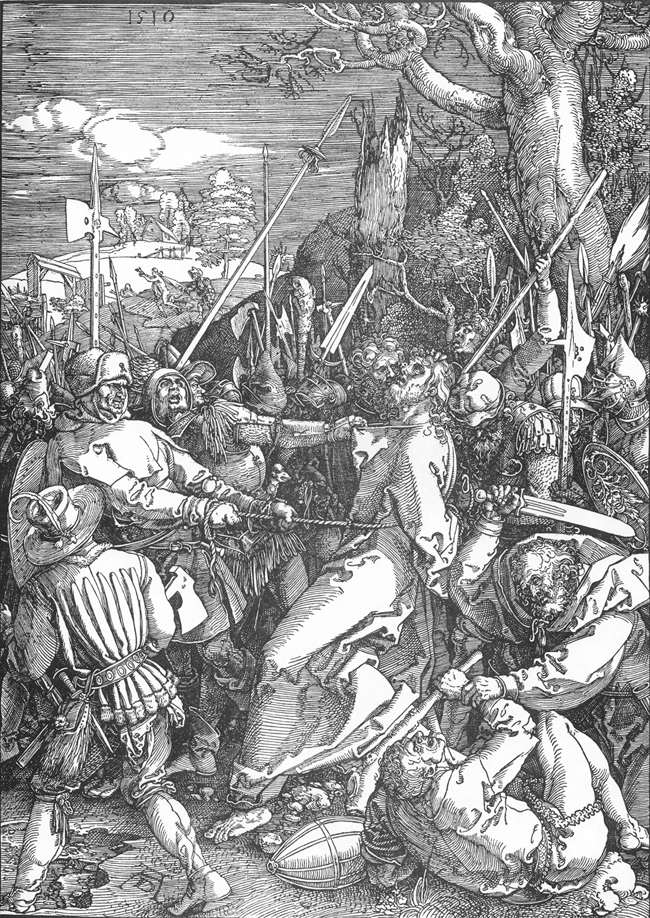
In each case, Judas becomes someone with whom we can no longer identify: the personification of evil, of other-ness. And the same is true in recent cinematic or television portrayals of Judas. He is dark and swarthy, easily imagined as an undocumented immigrant or a muslim, certainly not “one of us.” That’s unfortunate because one of the things we can say certainly about Judas was that Jesus called him as a disciple, as one of the inner circle, the twelve. He walked with Jesus through Galilee and on the road to Jerusalem. He heard him teach, saw the miracles he performed. In that he was like all of the other disciples. His misunderstanding of Jesus was no deeper than that of any of the others, although he acted on it in ways they did not. But none of them understood what it meant to follow Jesus. None of them understood fully who Jesus was. That understanding came only after cross and resurrection.

There are ways in which we are very much like Judas. We heap all sorts of expectations on him, we want him to be a certain way, to do certain things, to confirm our expectations. We may not betray him as dramatically as Judas betrayed Jesus, but we do betray him, when we refuse to share his love, when we neglect the needs of those around us, when we seek to remain in our secure and complacent faith, and fail to follow Jesus on the road that leads to the cross. We are Judas, at least some of the time, just like there are times when we are Peter who denied him, and like all those who abandoned him. But Jesus loves us, just like he loved Peter, and the other disciples, and even, dare I say it, Judas?


Maundy Thursday

10largepAlbrecht Dürer, Christ taken Captive (The Large Passion)

The Collect

Almghty Father, whose dear Son, on the night before he suffered, instituted the Sacrament of his Body and Blood: Mercifully grant that we may receive it thankfully in remembrance of Jesus Christ our Lord, who in these holy mysteries gives us a pledge of eternal life; and who now lives and reigns with you and the Holy Spirit, one God, for ever and ever. Amen.