Nicodemus, 100 pounds of embalming spices, and the Resurrection of Christ: A Sermon for Easter, 2013

Alleluia! Christ is Risen! The Lord is risen, indeed. Alleluia!

What are we doing here? Is there anything more unbelievable, outlandish, absurd, than the idea that 2000 years ago, someone was raised from the dead? Let’s get real and be honest with each other. It’s flat out unbelievable. Continue reading

Remembering Resurrection: A Homily for the Great Vigil of Easter, 2013

In addition to everything else, Holy Week and Easter are all about memories for me. Memories of family and childhood, memories of the church I grew up in, memories of college and young adulthood. But the most vivid memories are of the Holy Weeks I spent with Episcopal congregations, first as a worshiper, then as a participant and finally as celebrant. The Triduum, the Great Three Days of Maundy Thursday, Good Friday, and the Great Vigil of Easter are as powerful experiences for me now as they were the first time I witnessed them. Continue reading

Holy Saturday

The Collect

Lord God our Father, 
maker of heaven and earth: 
As the crucified body of your dear Son 
was laid in the tomb 
to await the glory that would be revealed, 
so may we endure 
the darkness of this present time 
in the sure confidence 
that we will rise with him. 
We ask this through your Son, 
Jesus Christ our Lord, 
who lives and reigns 
with you and the Holy Spirit, 
one God, now and forever. 
Amen.

From an Ancient Homily:

“What is happening? Today there is a great silence over the earth, a great silence, and stillness, a great silence because the King sleeps; the earth was in terror and was still, because God slept in the flesh and raised up those who were sleeping from the ages. God has died in the flesh, and the underworld has trembled.

Truly he goes to seek out our first parent like a lost sheep; he wishes to visit those who sit in darkness and in the shadow of death. He goes to free the prisoner Adam and his fellow-prisoner Eve from their pains, he who is God, and Adam’s son.

The Lord goes in to them holding his victorious weapon, his cross. When Adam, the first created man, sees him, he strikes his breast in terror and calls out to all: ‘My Lord be with you all.’ And Christ in reply says to Adam: ‘And with your spirit.’ And grasping his hand he raises him up, saying: ‘Awake, O sleeper, and arise from the dead, and Christ shall give you light.

‘I am your God, who for your sake became your son, who for you and your descendants now speak and command with authority those in prison: Come forth, and those in darkness: Have light, and those who sleep: Rise.

‘I command you: Awake, sleeper, I have not made you to be held a prisoner in the underworld. Arise from the dead; I am the life of the dead. Arise, O man, work of my hands, arise, you who were fashioned in my image. Rise, let us go hence; for you in me and I in you, together we are one undivided person.

‘For you, I your God became your son; for you, I the Master took on your form; that of slave; for you, I who am above the heavens came on earth and under the earth; for you, man, I became as a man without help, free among the dead; for you, who left a garden, I was handed over to Jews from a garden and crucified in a garden.

‘Look at the spittle on my face, which I received because of you, in order to restore you to that first divine inbreathing at creation. See the blows on my cheeks, which I accepted in order to refashion your distorted form to my own image.

‘See the scourging of my back, which I accepted in order to disperse the load of your sins which was laid upon your back. See my hands nailed to the tree for a good purpose, for you, who stretched out your hand to the tree for an evil one.

`I slept on the cross and a sword pierced my side, for you, who slept in paradise and brought forth Eve from your side. My side healed the pain of your side; my sleep will release you from your sleep in Hades; my sword has checked the sword which was turned against you.

‘But arise, let us go hence. The enemy brought you out of the land of paradise; I will reinstate you, no longer in paradise, but on the throne of heaven. I denied you the tree of life, which was a figure, but now I myself am united to you, I who am life. I posted the cherubim to guard you as they would slaves; now I make the cherubim worship you as they would God.

“The cherubim throne has been prepared, the bearers are ready and waiting, the bridal chamber is in order, the food is provided, the everlasting houses and rooms are in readiness; the treasures of good things have been opened; the kingdom of heaven has been prepared before the ages.”

Love was His meaning: A Homily for Good Friday, 2013

Is there any symbol more ubiquitous in our culture than the cross? We see it everywhere. Although the crosses here in the church are veiled, we can detect their outlines behind the veils. We wear them on pendants around our necks; we see it in ads; some even have crosses tattooed on their bodies. Most of the time, when we see a cross, we don’t give it another thought. It may not even have religious significance for the one who wears it as jewelry. Continue reading

Good Friday, 1613, Riding Westward

GOOD-FRIDAY, 1613, RIDING WESTWARD.
by John Donne

LET man’s soul be a sphere, and then, in this,
Th’ intelligence that moves, devotion is ;
And as the other spheres, by being grown
Subject to foreign motion, lose their own,
And being by others hurried every day,
Scarce in a year their natural form obey ;
Pleasure or business, so, our souls admit
For their first mover, and are whirl’d by it.
Hence is’t, that I am carried towards the west,
This day, when my soul’s form bends to the East.
There I should see a Sun by rising set,
And by that setting endless day beget.
But that Christ on His cross did rise and fall,
Sin had eternally benighted all.
Yet dare I almost be glad, I do not see
That spectacle of too much weight for me.
Who sees Gods face, that is self-life, must die ;
What a death were it then to see God die ?
It made His own lieutenant, Nature, shrink,
It made His footstool crack, and the sun wink.
Could I behold those hands, which span the poles
And tune all spheres at once, pierced with those holes ?
Could I behold that endless height, which is
Zenith to us and our antipodes,
Humbled below us ? or that blood, which is
The seat of all our soul’s, if not of His,
Made dirt of dust, or that flesh which was worn
By God for His apparel, ragg’d and torn ?
If on these things I durst not look, durst I
On His distressed Mother cast mine eye,
Who was God’s partner here, and furnish’d thus
Half of that sacrifice which ransom’d us ?
Though these things as I ride be from mine eye,
They’re present yet unto my memory,
For that looks towards them ; and Thou look’st towards me,
O Saviour, as Thou hang’st upon the tree.
I turn my back to thee but to receive
Corrections till Thy mercies bid Thee leave.
O think me worth Thine anger, punish me,
Burn off my rust, and my deformity ;
Restore Thine image, so much, by Thy grace,
That Thou mayst know me, and I’ll turn my face.

Images of Maundy Thursday

I’ve been worshiping at Episcopal Churches on Maundy Thursday for more than 20 years; the last ten participating actively in the liturgy in some way. I’ll never forget the first time I witnessed the procession of the Blessed Sacrament to the Altar of Repose and the Stripping of the Altar. It was at St. Paul’s Newburyport, MA. It broke me.

I don’t know how people experience it in the pews but I do know that of all the liturgies throughout the year, Maundy Thursday and Good Friday are times that I am caught up in the ritual even as I am thinking about what’s going to happen next and worrying that something might go wrong. None of it matters. The drama of the Triduum transcends any of the rest of our mundane concerns, even when, as tonight, there were issues with the sound system and flickering lights.

Ritual connects us with God. It also connects us with all of the communities in which we have experienced those rituals in the past. It also connects us with communities who are performing and experiencing those rituals in different ways across the world. Maundy Thursday especially connects me with my past. Not just with those congregations where I have worshiped or participated, or celebrated in the past, but also with my deeper past.

I grew up in the Mennonite Church. At that time, communion was celebrated twice a year and included not just the Lord’s Supper but also footwashing. Baptized members washed each other’s feet and greeted each other with the Holy Kiss. The power of those symbolic acts remained with me long after I left my home church when I graduated from High School. I suspect that the next time I actually attended a footwashing was that first Episcopal Maundy Thursday service in Newburyport in the early 90s. And I know that those powerful memories kept me from participating in it for myself as an Episcopalian until I had to, when I was serving at the altar, as a Postulant for Holy Orders.

Now when I wash feet and when my feet are washed, I think back to that Mennonite congregation in which I was raised and where I was baptized. I remember washing the feet of friends, of men my dad’s age, and of elderly men. And I remember having my feet washed by them. Most poignantly, I remember my dad, who was usually the song leader and as we washed our feet, he would lead us out in familiar hymns that we would sing, a Capella, as we imitated Jesus Christ, serving each other and demonstrating in that lowly and uncomfortable act, Christ’s commandment to love one another as he loved us.

So tonight, I was remembering my dad. I was also remembering the people of West Clinton Mennonite Church in rural Wauseon, OH. I was remembering the people of St. Paul’s Newburyport, of All Saints Chapel, Sewanee, of All Souls’ Cathedral, Asheville, of St. Margaret’s, Boiling Springs, SC, Church of the Redeemer and St. James, Greenville, and Grace, Madison, WI. I was remembering all of them as I was remembering those disciples gathered with their Lord in Jerusalem nearly 2000 years ago.

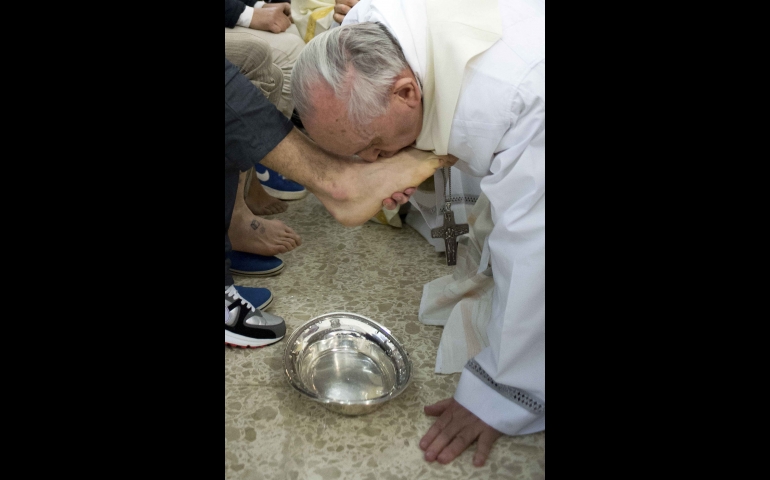
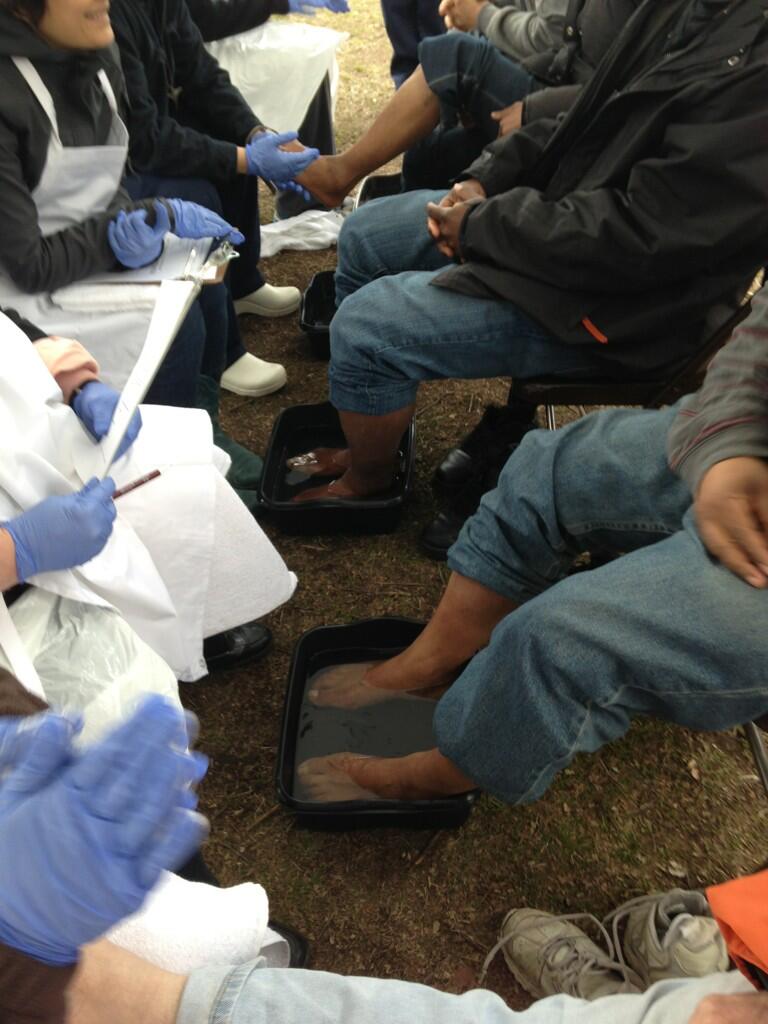
And I was also mindful of images from today. Of Pope Francis, who continues to surprise, washing the feet of a young Muslim female prisoner and of the foot care clinic at the Church on the Green in New Haven, CT

If you’ve not seen them, here’s a shot of Pope Francis today20130328cnsbr14973

And from the Church on the Green

BGdpU13CEAAsRzu

“I give you a new commandment, that you love one another. Just as I have loved you, you also should love one another. By this everyone will know that you are my disciples, if you have love for one another.’” Jn 13:34-35

Judas Iscariot

I’ve been thinking about Judas a good bit. The initial prompt was the gospel for the 5th Sunday in Lent about which I preached here. There we learn pretty much everything we know about Judas Iscariot–that he is the son of Simon Iscariot, that he is one of the twelve, that he keeps the common purse. John also calls him a thief and puts in his mouth the criticism that Mark attributed to “the disciples”–that the money Mary spent on the perfume would have better gone to help the poor.

In the gospel for Wednesday in Holy Week, we read the story of Judas’ betrayal of Jesus in John 13. Of all the gospels, John is the most insistent on the devil’s role in Judas’ actions but Judas’ reasons for betraying Jesus are not at all clear. Many scholars have speculated that the name “Iscariot” refers to a group of assassins named the “sicarii” who were active a couple of decades after Jesus and that Judas may have been actively engaged in revolt or resistance against Rome. Others suggest the term is derived from a village in Judea and point out that Judas’ father is also known as Iscariot. Matthew attributes Judas’ motives to money, although the sum he receives, 30 pieces of silver, is not especially valuable and Judas seeks to return it as he repents of his actions.

I think the most likely motivation for Judas lies in the political sphere. From the synoptics, it’s apparent that the disciples don’t really know why Jesus is going to Jerusalem. They don’t understand the predictions of his death. It’s likely that any messianic speculation they might have had would have focused on Jesus leading a revolt against Rome, perhaps invoking heavenly armies to do battle with the Roman Empire. Judas may have betrayed Jesus in an effort to force his hand, to compel him to take action against Rome. If so, he was wrong, and his repentance after the fact may be evidence that he came to understand what Jesus was really about.

Judas is an enigmatic figure not just because we know so little about him (the uproar about the Gospel of Judas notwithstanding). He is enigmatic because we struggle to understand his motives. If Satan was the driving force in his betrayal, then Judas is more a tragic figure than a villain.

The Christian tradition has tended to interpret Judas as a diabolical figure in his own right. That’s particularly true of artistic representations. The famous fresco by Giotto in the Arena Chapel has been a powerful influence on later interpretations of Judas. Giotto depicts him as barely human. His features are ape-like, animal, and he radiates hate and evil.

kiss-of-judas-detail-of-giotto-fresco-in-the-arena-chapel-padua

A later depiction, by Caravaggio, takes Judas’ other-ness in a different direction. Now, he is the most “Jewish” looking of anyone in the painting:

cvggo_taking

In each case, Judas becomes someone with whom we can no longer identify: the personification of evil, of other-ness. And the same is true in recent cinematic or television portrayals of Judas. He is dark and swarthy, easily imagined as an undocumented immigrant or a muslim, certainly not “one of us.” That’s unfortunate because one of the things we can say certainly about Judas was that Jesus called him as a disciple, as one of the inner circle, the twelve. He walked with Jesus through Galilee and on the road to Jerusalem. He heard him teach, saw the miracles he performed. In that he was like all of the other disciples. His misunderstanding of Jesus was no deeper than that of any of the others, although he acted on it in ways they did not. But none of them understood what it meant to follow Jesus. None of them understood fully who Jesus was. That understanding came only after cross and resurrection.

There are ways in which we are very much like Judas. We heap all sorts of expectations on him, we want him to be a certain way, to do certain things, to confirm our expectations. We may not betray him as dramatically as Judas betrayed Jesus, but we do betray him, when we refuse to share his love, when we neglect the needs of those around us, when we seek to remain in our secure and complacent faith, and fail to follow Jesus on the road that leads to the cross. We are Judas, at least some of the time, just like there are times when we are Peter who denied him, and like all those who abandoned him. But Jesus loves us, just like he loved Peter, and the other disciples, and even, dare I say it, Judas?


Maundy Thursday

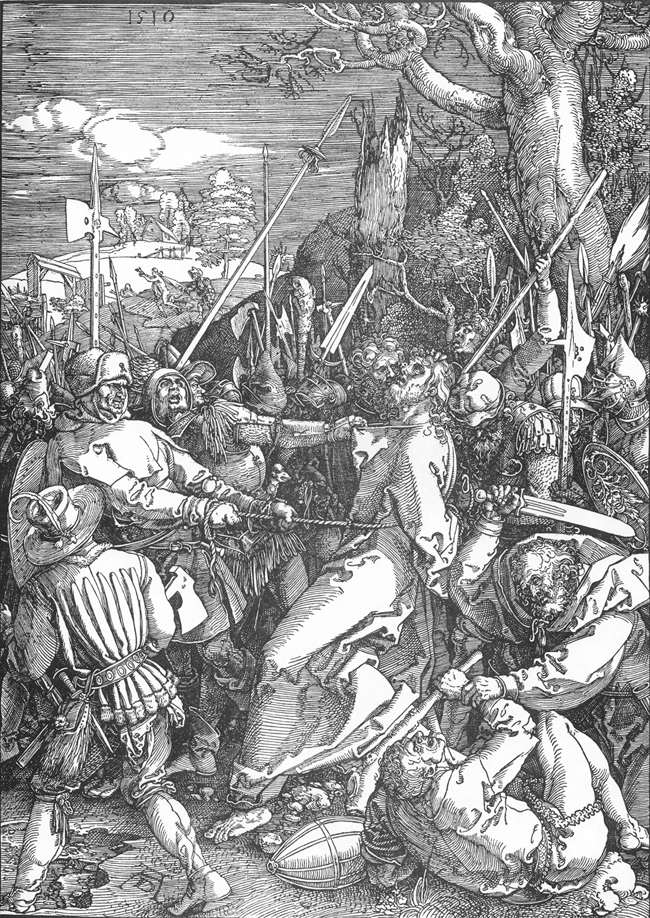
10largepAlbrecht Dürer, Christ taken Captive (The Large Passion)

The Collect

Almghty Father, whose dear Son, on the night before he suffered, instituted the Sacrament of his Body and Blood: Mercifully grant that we may receive it thankfully in remembrance of Jesus Christ our Lord, who in these holy mysteries gives us a pledge of eternal life; and who now lives and reigns with you and the Holy Spirit, one God, for ever and ever. Amen.

Anti-Judaism and Holy Week

One of the central issues facing Christians during Holy Week (in fact it’s central to Christianity itself) is the pervasive anti-Judaism in the Christian tradition and in parts of the New Testament. It’s particularly prevalent in the Gospel of John and reaches its highest intensity in the passion narrative (John 18 and 19). It’s traditional that John’s Passion Narrative is read on Good Friday. The raw power of the story of Jesus’ betrayal, trials, and crucifixion that culminate with the silence of the tomb, combines with the larger liturgical context to confront worshipers with the enormity of the crucifixion and with human culpability in it. The concluding prayer includes this sentence:

we pray you to set your passion, cross, and death between your judgment and our souls, now and in the hour of our death

As much as the overall liturgy seeks to make us participants in the drama of Good Friday, John’s Passion Narrative seems designed to leave us in the audience, observers of a drama in which the main actors are only Jesus, Pilate, and “the Jews.” Pilate declares Jesus innocent of the charges against him, saying three times, “I find no case against him” (Jn 18:38, 19:4, 6). Each time, “the Jews” protest and force Pilate to reconsider. In the end, Pilate hands Jesus over to them for crucifixion (John does not explicitly state that Romans were involved in the crucifixion. “Pilate handed Jesus over to them to be crucified” 19:16).

While the presence of “the Jews” as Jesus’ opponents is especially prevalent in the passion narrative, throughout John’s gospel, Jesus comes into conflict with “the Jews.” On one level, such a term is utterly meaningless because Jesus and his disciples were Jews just like those who opposed him. But John’s gospel reflects a later stage of historical development when it seems that opposition between some Jews and those Jews who had come to believe Jesus was the Messiah had become especially pronounced. Thus in 9: 22-23, the parents of the blind man whom Jesus healed were “afraid of the Jews” because they had already decided “that anyone who confessed Jesus to be the Messiah would be put out of the synagogue.”

On careful reading, it becomes apparent that only “some Jews” were so opposed to Jesus that they sought his death. Others supported him; some of the latter were people like Joseph of Arimathea, who John says was a disciple of Jesus, but only secretly, “for fear of the Jews.”

Our preaching, liturgies, and reflection in Holy Week should include a healthy dose of repentance for Christian anti-Judaism. Whatever the historical context that gave rise to John’s portrayal of “the Jews” in his gospel, that portrayal has had a long and evil afterlife. Over the centuries, Christians have used the charge of “Christ-Killer” to oppress and persecute Jews. In the European Middle Ages, for example, Holy Week often meant increased incidents of anti-Judaism, including the blood libel and riots.

For more on John’s portrayal of “The Jews” read excerpts from Raymond Brown’s postumously published Introduction to the Gospel of John

The 20th and 21st centuries have seen many efforts by Christians to deal with past Anti-Judaism. An article on Christian philosemitism among Evangelicals is helpful.

A recent book examines the long history of Christian Anti-Judaism. R. I. Moore reviews David Nirenberg’s Anti-Judaism: The Western Tradition here:

The enduring legacy of the early Church, Nirenberg makes clear, was far more than the familiar stereotype of anti-Semitism: it was a language and a set of oppositions and associations in which any conflict could be framed, or any community, party or position attacked or defended by contrasting it with Judaism—irrespective of the presence, still less the participation, of flesh-and-blood Jews.

Martin Marty reflects on the Anti-Judaism in John and in Bach’s St. John’s Passion here:

but the Gospel of John, which provides the framework for Bach’s work, poses extremely harsh and judgmental accusations which turn “the Jews”—some Jews, since Jesus and his followers were all Jews—into primal and enduring villains. Being a Christian and a Lutheran, whose faith-communities include horrible records against Jews and Judaism—records finally being addressed with penitence and resolve in recent decades—I must deal with the “shadow” of this Passion. So: do we shun or evade the dark side, and make a big show of how uniquely righteous “we” and our contemporaries are? Or do we note the central, focal stream in Bach’s work, where in the classic Chorales and Arias the emphatic and even obsessive concern is for the contemporary disciples of Jesus to see that it was and is “they” who by their faults were and are guilty—until his death freed them from guilt. That’s Bach’s “bright side,” part of the allure of this transcendent musical work.