Anne LaMott on the death of her beloved cat

As we prepare for Margery’s death, some words from Anne Lamott (from Help, Thanks, Wow)

Now it turns out that my cat is going to die later today. She is struggling to breathe. I had hoped and prayed that she would slip off in the night and that I would not have to have the bet come by to put her down. I said, Help. Also, I gave her a lot of morphine, what had to have been an overdose, which she just slept off. All I wanted was for her not to die miserable and afraid. That’s all.

It is nighttime now, and Jeanie passed an hour ago, miserable and afraid.

When the vet came, we tried to gently get her out from under the futon, and she went crazy, and the next ten minutes were so awful that I won’t describe them. Suffice it to say that she did not go gently into that good night. It broke my heart. But she had been suffering, and is suffering no more. She had an amazing run of love with my family. She was a proud little union cat, and also a model of queenly disdain with a bit of grudging affection for most people, and pure adoration for me.

Was my prayer answered? Yes, although I didn’t get what I’d hoped and prayed for, what I’d selected from the menu. Am I sick with anxiety, that I did the wrong thing? Of course. Sad? Heartbroken. But Jeanie hit the lottery when she got me as her person for thirteen years, and the bad death was only ten minutes. So let me get back to you on this.

Certainly the same could be said of Margery. Had we not noticed her that afternoon in Sewanee, or had we accepted the first vet’s opinion, Margery would have died as a kitten. She’s had a good life. She’s been loved and loved us and she’s endured all of the other cats we’ve brought into her life. She’s brought us joy and she’s enjoyed shrimp and calamari, and all manner of other things, including a nap on a sunny day on a screened-in porch in Madison.

Renovating and Rethinking Sacred Space

An article in today’s New York Times entitled “Building Congregations around Art Galleries and Cafes as Spirituality Wanes” explores the latest innovations in church planting among Evangelicals. Several things to note.

1) that the number of new evangelical churches has gone up every year since 2006 (despite the fact that attendance at services is on the decline

2) a quotation from Warren Bird of the Leadership Network:

For new leaders coming out of seminary, “the cool thing is church planting,” Mr. Bird said. “The uncool thing is to go into the established church. Why that has taken over may speak to the entrepreneurialism and innovation that today’s generation represents.”

3. An interesting detail in the description of the National Community Church in Washington. It has 3000 members and yearly turnover of 40%.

Readers of this blog know that I am very interested in some of the new forms that are emerging in Christianity, in outreach to young adults and millennials, and in the role of sacred space in mission and ministry. One of the important things about sacred space is that it roots us in the tradition and connects us with the divine. There’s a sense of permanence there that runs counter to the ideas expressed in all three of the points I numbered above.

The articles below offer several different approaches to sacred space; the renovation of space to fit in with current liturgical principles, the creation of new sacred space, and appreciation of sacred space that has been around a very long time.

An Episcopal Church in Allentown, PA won an award from Faith & Form, the quarterly journal of the Interfaith Forum on Religion, Art and Architecture (IFRAA), part of The American Institute of Architects, for his leadership of the award-winning liturgical renovation of Grace Church in Allentown, PA. IFRAA will bestow the 2012 Religious Art & Architecture award next June in Denver, Colorado.

Designed by its Rector Patrick Malloy who is now Dean of General Theological Seminary, it is intended to reflect the liturgical principles of the 1979 Book of Common Prayer. In classes on worship and architecture, Dean Malloy:

invites students to explore the intersection of architecture, art, and liturgy, and how they meet to shape the experience of sacred space. “I wished to provide a context in which students could consider how space and the liturgies we celebrate in those spaces interact. How might liturgical spaces be designed to inspire a community’s ways of celebrating? Those who plan liturgy, too, must conceive of the liturgy spatially: how it will inhabit the space.”

There’s an article on the church’s renovation available from the Diocese of Bethlehem. And more about the awards, including information on all the winners, is available here.

On a very different note, Notre Dame (Paris) is celebrating its 850th anniversary this year

Design for the new Roman Catholic Cathedral in Port-au-Prince, Haiti.

Kenan Malik writes about St. Etheldreda Church, perhaps the oldest Catholic Church in England. As he says, “An ecclesiastical gem soaked in blood and history.”

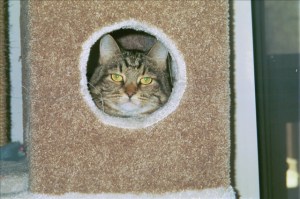
Cat-Blogging: Margery Kempe

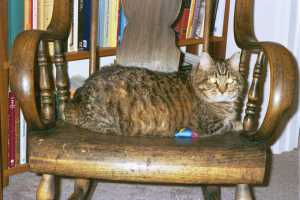
Margery Kempe came to us in the fall of 1995. It was Parents’ Weekend at Sewanee and we suspected that she was dropped off by people who had come up to the Mountain for the weekend. We found her running from the general direction of St. Luke’s Chapel towards All Saints’ Chapel, crying with all of her might (Hence the name Margery Kempe). She was an itty-bitty little thing. When we took her to the vet for the first time to have her checked out, he told us she tested positive for Feline Leukemia and needed to be put down. We disagreed.

Another vet, vitamins and interferon, plus a couple of months of isolation away from our Maggie Pie, Margery was retested and came up negative. She was a feisty thing. She had a dear friend in Sewanee for a couple of years, Tigger, who would come and visit every day after his girls went off to school. And we’ll never forget the summer Reginald Fuller and his wife lived next door, and when a dead cat appeared on the street below us, Mrs. Fuller worried that it was Margery, or the “little fat one” as she called her. In Sewanee, our cleaners named her “Large Marge.” Although she was small-bodied, she ate her fill.

When we moved to South Carolina, Corrie wanted to get her a new playmate to replace Tigger. That explains Merton but they never really got on. Perhaps the most poignant moment ever for me and Margery came upon Maggie Pie’s death. For the last couple of years of her life, Maggie always slept up next to my head. It was the spot where she felt protected from Merton’s onslaughts. Margery never slept in the bed. She had grown accustomed to sleeping on her own, probably because of her early months in isolation.

Maggie’s last night, I knew she something was wrong. She couldn’t get comfortable next to me and in the morning, we took her to the vet and he discovered a huge tumor in her lungs. That night, for the first time, Margery came in the bed and settled down next to my head.

A couple of photos from Margery in her prime:

1(3) copyMargery copy

As I wrote this a couple of nights ago, Margery was sleeping on my lap. She barely moved her limbs in an hour. Her breath at times seemed forced; at other times it came easily. She’s on pain medication, blood pressure medication, subcutaneous fluids. But she’s still eating and especially enjoyed bites of shrimp cocktail on Christmas Eve.

photo

The 125th Anniversary of the Vilas Window

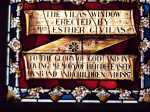
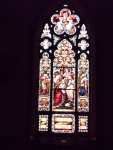
When precisely Grace Church’s oldest stained glass window, the “Resurrection” Window, was dedicated, is unclear. Various historical accounts claim it was on Holy Innocents’ Day, December 27, 1887. Then as now, however, Holy Innocents was observed on December 28. My guess is given that it was in memory of Esther Vilas’s husband and five of her children, the connection with Holy Innocents is correct and an error down the line turned the 28th into the 27th.

The Vilas family was among the most important families in Madison in the second half of the nineteenth century. Mrs. Vilas’ husband, Levi, served as Madison’s mayor and their son William was a US Senator, Postmaster General, and Secretary of the Interior under President Grover Cleveland. William’s daughter Cornelia is memorialized in Grace’s Vilas Guild Hall and his son Henry by the Henry Vilas Zoo.

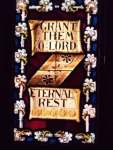
The window was made by Cox and Sons of London, England. The window’s colors are rich and deep and it is especially beautiful when it refracts the afternoon and early evening sun. Commonly called the “Resurrection” window, the window depicts three stories from the gospels’ accounts of Jesus’ resurrection. The large central image shows the women at the tomb hearing the angel say, “He is not here, he is risen.” The two images to the left and right are of Jesus on the road to Emmaus and Mary Magdalene’s encounter with the risen Christ in the garden. The window was restored in 2005 as a memorial to Mrs. Betty Kurtenacker with funds raised by the Episcopal Church Women.

Some photos of the window are here:

And Every Stone Shall Cry: A Sermon for Christmas Eve, 2012

Where is God? It’s a question we often hear in the aftermath of a natural disaster but especially after a tragedy like the massacre at Newtown. When we ask the question where is God, we are asking not only about God’s presence in a particular instance. We are also questioning God’s presence in the world, in our lives. We are questioning God’s providence—the idea that God is in charge of things. Sometimes behind our question is another question, Is there a God? Continue reading

My Soul Proclaims the Greatness of the Lord: A Sermon for Advent 4, Year C

The familiar story we have heard today has been painted thousands of times throughout history. Two women, one young, one elderly, both of them pregnant, greeting each other. Often, the elderly one is deferring to the younger one, kneeling before her. Other times, the two are embracing. It’s such a familiar image, such a familiar story, that we tend to pay it little attention. Certainly, it does not factor largely in our devotion. Though it’s the occasion for two of the most common hymns or devotions in Catholicism—the Ave Maria and the Magnificat—we probably rarely reflect on the narrative context from which these hymns come. And really, it’s hardly shocking that we don’t pay closer attention to the Visitation, for it’s a brief episode, not more than a couple of verses (not including the magnificat itself).

pontormo3

Jacopo da Pontormo, 1528

ghirlandaio_visitation

Ghirlandaio, 1491

Continue reading

Archbishop of Canterbury weighs in on gun control

Rowan Williams who is soon to leave office spoke out on a BBC radio program, “Thought for the Day. Here’s an excerpt:

And there is one thing often said by defenders of the American gun laws that ought to make us think about wider questions.  ‘It’s not guns that kill, it’s people.’  Well, yes, in a sense.  But it makes a difference to people what weapons are at hand for them to use – and, even more, what happens to people in a climate where fear is rampant and the default response to frightening or unsettling situations or personal tensions is violence and the threat of violence.  If all you have is a hammer, it’s sometimes said, everything looks like a nail.  If all you have is a gun, everything looks like a target.

People use guns.  But in a sense guns use people, too.  When we have the technology for violence easily to hand, our choices are skewed and we are more vulnerable to being manipulated into violent action.

Perhaps that’s why, in a passage often heard in church around this time of year, the Bible imagines a world where swords are beaten into ploughshares.  In the new world which the newborn child of Christmas brings into being, weapons are not left to hang on the wall, suggesting all the time that the right thing to do might after all be to use them.  They are decommissioned, knocked out of shape, put to work for something totally different.

You can listen to the program here; or read a transcript here.

I wonder how conservative American Episcopalians and Anglicans will respond, perhaps by telling him to butt out of our affairs?

Some links on Newtown

I’ve gathered here some of what I consider to be the most important and thoughtful things I’ve read this week. If you’re still struggling to make sense of it all (and who isn’t) I hope you will find one or more of them helpful.

My friend and colleague Andy Jones points to Episcopal Bishop of Washington Marianne Edgar Budde’s Christmas letter in which she calls for Christians to lead efforts for gun control. The NYTimes has an article about the efforts of religious leaders. Dean Gary Hall of the National Cathedral is taking leadership in this effort. He preached a powerful sermon on Sunday on Newtown.

The article mentions a call for a moment of prayer at 9:30 AM tomorrow and asks churches to ring their bells 28 times. If I can get to Grace tomorrow morning, I’ll do it.

Some other thoughtful reflections on Newtown:

  • From Ian Douglas, Bishop of Connecticut
  • From Stephen Prothero: “Six Things I Don’t Want to Hear after the Sandy Hook Massacre”
  • From Rachel Held Evans (on Advent, Christmas, and Sandy Hook): “God Can’t Be Kept Out”

Katherine Newman offers a fascinating sociological analysis of the roots of school shooting rampages:

There has been only one example of a rampage school shooting in an urban setting since 1970. All the others have taken place in rural towns miles from places like New York or Chicago, or in suburbs in the Western states.

What is it about these towns where no one locks their doors that generates these deadly outbursts? We argued the very thing most Americans celebrate about small-town life—close-knit neighbors, friendly families, adults engaged in the schools and churches—become sources of stultifying depression for marginal boys. We interviewed kids who were attending the same high school as their grandparents, in communities where very few left town for college, preferring to stay home and attend the local community college or state institution. For most people, this is a sign of social solidarity. For Michael Carneal, the shooter in a 1997 attack at Heath High School (outside Paducah), that solidarity felt like a life sentence of exclusion.

Theological reflection in the same vein from Marilyn McCord Adams:

Those of us who have experienced rage or fear, would probably do well not to be confident about what we would have done in Nazi Germany. Maybe we should not overestimate our own mental health or degree of spiritual integration. Still, I venture to say, most of us could not have done what Adam Lanza did on Friday: shot little children, school teachers and staff in cold blood.

For that very reason, we need to heed Jesus’ warning that “otherizing” is spiritually dangerous. Otherizing undermines sympathy, pronounces the perpetrator “beyond the pale,” definitely not one of us. We could not have shot children and school workers in cold blood, because we identify with them: they are us, their children could be our children, their town could be our town. But it is counting killers as not one of us, that tempts us to acquiesce in state-sponsored cruelty, torture, and executions. Who knows? Perceived alienation may have prompted Judas to betray Jesus, permitted Adam Lanza to “otherize” the children and adults he was shooting at the school. Our instinct to “otherize” should make us shudder with the realization that we are more like traitors and socio-paths than we would like to admit.

Jesus’ injunction to love enemies is a hedge against otherization. My point is not that parents and citizens of Newtown, Connecticut should forgive the killer, today, tomorrow, next month, or next year. That would be another “quick fix.” Grief and trauma have their seasons. I would not say any of these things to them. I am speaking to us, who the dubious luxury of standing back and assessing, to remind that otherizing is part of, sometimes lies close to the roots of our problem.

Kottke.org links to “Portraits of gun owners in their homes.”

The photos seem to prove Garry Wills’ point in his powerful essay “Our Moloch.” He begins with some lines from Paradise Lost:

First Moloch, horrid king, besmear’d with blood
Of human sacrifice, and parents’ tears,
Though for the noise of Drums and Timbrels loud
Their children’s cries unheard, that pass’d through fire
To his grim idol. (Paradise Lost 1.392-96)

And then comments:

The gun is not a mere tool, a bit of technology, a political issue, a point of debate. It is an object of reverence. Devotion to it precludes interruption with the sacrifices it entails. Like most gods, it does what it will, and cannot be questioned. Its acolytes think it is capable only of good things. It guarantees life and safety and freedom. It even guarantees law. Law grows from it. Then how can law question it?

Its power to do good is matched by its incapacity to do anything wrong. It cannot kill. Thwarting the god is what kills. If it seems to kill, that is only because the god’s bottomless appetite for death has not been adequately fed. The answer to problems caused by guns is more guns, millions of guns, guns everywhere, carried openly, carried secretly, in bars, in churches, in offices, in government buildings. Only the lack of guns can be a curse, not their beneficent omnipresence.

The Magnificat: The Songs of Advent, Part 3. Lectionary Reflections for 4 Advent, Year C

This week’s readings are here.

This week’s gospel is the story of the Visitation, Mary’s visit to her elderly cousin Elizabeth. The focus of the selected verses is on the interaction between the two women as well as the response of the child Elizabeth is carrying in her womb. There’s a great deal of artifice in Luke’s depiction of this scene (what do two pregnant women talk about when they get together for coffee or a visit?) and our interest is easily diverted from their conversation to the sons they are carrying.

There’s a third woman present in the scene, not physically, but in her words. Mary’s song echoes the Song of Hannah from I Samuel 2:1-10. The ties between Mary and Hannah extend beyond the similarities of their songs. In I Samuel 1:11, Hannah identifies herself as the “handmaid of the Lord” just as Mary identifies herself in the same terms (Lk 1:38 and 1:48). The NRSV translates “servant” but the word means female slave.

Again, as in the other songs Luke uses in his story of the Nativity, the resonances with Hebrew Bible language, imagery, and psalmody are very strong. Like Elizabeth, Hannah was barren. She had prayed devoutly in hopes of having a child and promised to dedicate her son to the service of God. Both Hannah and Mary sing of God’s activity on behalf of the poor and oppressed; strikingly, Mary puts God’s actions on their behalf in the perfect tense. That is to say, God has already begun intervening on behalf of the oppressed; it is not only something we can hope for in the future and (there’s something of a parallel here to Luke’s version of the Beatitudes although in this case, God’s action lies in the future:

‘Blessed are you who are poor,
for yours is the kingdom of God.
‘Blessed are you who are hungry now,
for you will be filled.
‘Blessed are you who weep now,
for you will laugh.

When we sing or reflect on the Magnificat our tendency is to see these words as Mary’s words, not our own. We lack the imagination and faith to make these statements ours. But if we believe in a God who comes to us in a manger in Bethlehem, it shouldn’t be beyond our capacity to believe in a God who acts in history on behalf of the poor, powerless, the hungry and the oppressed. If Mary and Hannah can believe it, so ought we.

Joy in the midst of mourning: A Sermon for Advent 3, Year C

The images have become so familiar to us, the stories so eerily similar that we had almost become immune to their horror. They no longer surprise us. A shooting in a mall in Oregon went by almost unnoticed. Then on Friday, another horrific event. This time, because it was an elementary school, because children were involved, the shock and horror penetrated our thick skins. We watched as parents rushed to the scene to comfort their children who survived the massacre. We watched and heard as other parents wept inconsolately. As a society, we watched, we grieve, wonder. Continue reading