
St. Francis of Assisi–October 4, 2012

St. Francis of Assisi is among the most beloved, perhaps the most beloved of the saints. We are drawn to his simple, child-like love of Jesus Christ, his preaching to the birds, his impulsive actions in trying to make the gospel concrete for himself and those around him, his attempt to bring peace between Crusaders and Saracens. In the twenty-first century, he is revered as a proto-environmentalist.

But there are aspects of his biography and his piety that elude our grasp to comprehend and occasionally alienate modern sensibilities. His visceral hatred of money, for example. Also, perhaps, his devotion to the passion and suffering of Jesus Christ. His identification was so complete that he received the stigmata, the wounds of Christ on his own body, during a mystical vision. Here’s the classic rendering of that event, from a fresco, attributed to Giotto, in the Basilica of St. Francis in Assisi:

St. Francis is a model saint not only for who he was and what he did, not only because of the deep devotion he had for Jesus Christ, and for the deep devotion he has inspired in millions of Christians over the centuries. St. Francis is a model saint because he continues to challenge us to reflect on our faith, to deepen it, and to be bolder and more complete in our imitation of Jesus. His continuing “otherness” challenges us to confront our compromising attitude to the world, to our selfish desires, and our comfort.

St. Francis died on this day in 1226.
Winter is getting closer, so that means the debate over homelessness is ramping up again

So the county has proposed a day shelter for Madison’s eastside, a site picked apparently out of the blue and with no input from the neighborhood. Mayor Soglin is outraged because the city wasn’t consulted and is having none of it. What frustrates me is that we’ve come down to the last minute again. Here it is early October and there are no definite plans in place for providing day shelter in the winter. No doubt the powers that be are hoping the problem will just go away and that when the library reopens next year, the seasonal fuss will die down.

Soglin is convinced that Madison is a magnet for homeless people from across the region:

“I have made it clear that the city of Madison does not have the resources or the responsibility to take care of Dane County’s and Wisconsin’s homeless population,” Soglin wrote.

Has he noticed that it is a magnet for people with homes as well? For students and young adults?

In fact, on Sunday I met a homeless man who asked me if I could make some copies of his resume. He is in Madison because he came here from a small town elsewhere in the state, not in hopes of mooching off of Madison’s largesse, but because he’s looking for work. The unemployment rate is much lower here than elsewhere in the state, lower than most of the small towns that dot the countryside.

The debate over a day center is not about providing a hang-out. It is about basic human needs–providing shelter from inclement weather–and about providing services as efficiently as possible. Rather than forcing people to traipse across the city lugging their possessions while they search for food, laundry facilities, a shower, as well as a job, a day center would put most of those services in a single place and staff it with human service professionals who could help people negotiate the labyrinthine bureaucracy of city, county, state, and federal services.

Madison.com coverage of the day center controversy is available here.

Chris Rickert writes here about Mayor Soglin’s position.

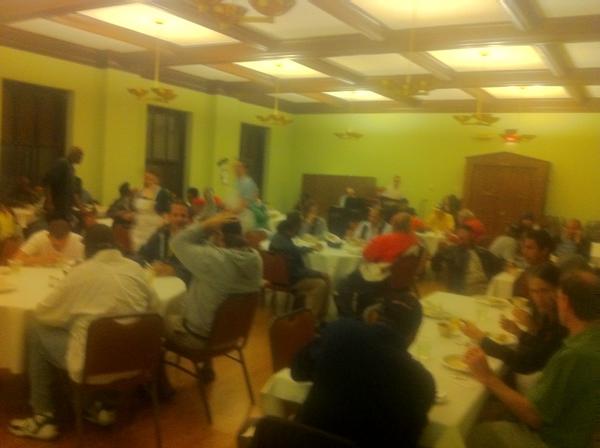
Meanwhile, we fed about 100 people last night at First Monday: meatloaf, potatoes, green beans, ice cream. Music ranged from Leonard Cohen to Opera and was very well received. There were men and women, including one family who enjoyed our hospitality:

Consider your servant Job: Lectionary Reflections for Proper 22, Year B

This week’s readings are here.

One of the great problems with the lectionary is that its editors had to pick and choose texts and inevitably were able to include only portions of important works. That was a problem with last week’s reading drawn from the book of Esther. The same is true this week as we move into another book from the Hebrew Bible, Job. We will have a total of four readings from the book: this one, from the first and second chapter that sets up the problem. Later readings will introduce us to Job’s challenge of God; essentially Job puts God on trial. Later we will hear God’s response to Job’s case for the prosecution and finally we will hear how it all ends up (Job is richer than ever). Omitted are lengthy speeches from Job and Job’s friends that raise questions about divine justice and theodicy (why bad things happen to good people) as well as the initial tragedies that befall Job’s family.

This brief introduction to the book fails to do justice either to its literary genius or its theological depth. A careful reading of the whole book is most rewarding and brings a profound challenge to the complacency of our faith. It also helps to overcome the image of Job in popular culture—the patience of Job is a trope, but in fact the Job of scripture is not patient at all, nor does he suffer silently. He demands that God explains why suffering has come upon him.

In this week’s reading, we have the second of two encounters of God with “The Satan.” The portrayal of the Satan in the text is curious. In chapter 1, he seems to be a member of God’s heavenly court and it’s almost as if God and Satan have made a bet (“Have you considered my servant Job?”). God draws Satan’s attention to Job as a righteous man, and Satan responds by saying that Job is righteous only because he’s had it easy. So God responds to the challenge by allowing Satan to test Job, giving him power to take away all that Job has, and in chapter 2, to afflict Job himself, but forbidding him to take his life. Job is left with nothing, riddled with disease, and still he does not curse God.

The book’s answers, such as they are, will come later, in God’s response to Job. In fact, the book’s fundamental question remains unanswered and remains one of humanity’s most basic questions, asked every time there is a natural disaster, or when illness or death comes to a loved one. We want life to make sense, we want the world to make sense, but too often, it all seems meaningless. But as the Burial Office says,

“All of us go down to the dust; yet even at the grave we make our song: Alleluia, Alleluia, Alleluia.”