A lovely article on his life and witness
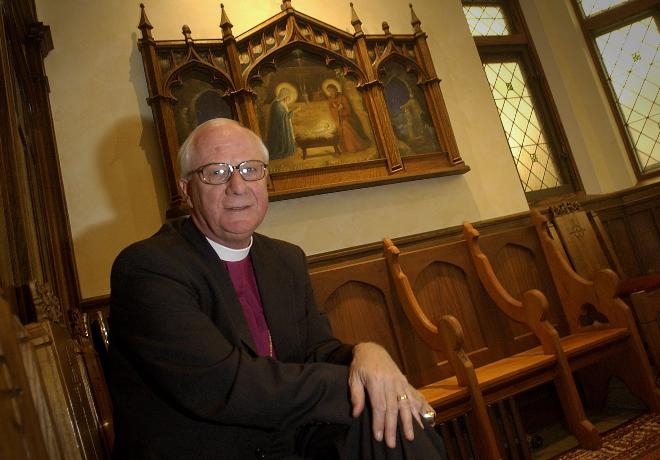

A lovely article on his life and witness
This week’s readings are here.
This week’s lessons include the only appearance of the Song of Solomon in the three-year lectionary cycle. For those of us who have been reading the David-Solomon track, the shift is rather abrupt. From the events of David’s and Solomon’s lives culminating in last week’s reading concerning the dedication of the temple at Jerusalem, we turn now to the Song of Solomon, a series of verses with no narrative, historical, or even theological context to help us understand them.
The reason this selection is included is because of the connection with Solomon. In the coming weeks, we will be reading from the Book of Proverbs. Both of these texts have been associated with Solomon for a very long time. In the superscript (title) of the work appears Solomon’s name. Its appearance in the canon of both Hebrew and Christian scripture has been controversial because it is love poetry. Full of erotic imagery, the text describes and praises a sensual world of beauty. In both Jewish and Christian interpretation, the poem has been interpreted allegorically, describing God’s love for Israel, or Christ’s love for the church (or the individual soul).
Contemporary readers find some of the imagery amusing: Your hair is like a flock of goats, … your teeth are like a flock of ewes. But the desire, the love that is expressed in this poem transcends time and place.
Often, allegorical interpretation detracts from the meaning of a text. Sometimes, as in this case, it opens up new vistas of spiritual experience. Bernard has this to say about The Song of Solomon:
This sort of song only the touch of the Holy Spirit teaches, and it is learned by experience along. Let those who have experienced it enjoy it; let those who have not burn with desire, not so much to know it as to experience it. It is not a noise made aloud, but the very music of the heart. It is not a sound from the lips but a stirring of joy, not a harmony of voices but of wills. It is not heard otwardly, nor does it sound in public. Only he who sings it hears it, and he to whom it is sung–the Bride and the Bridegroom. It is a wedding song indeed, expressing the embrace of chaste and joyful souls, the concord of their lives and the mutual exchange of their love.”
Sermon 1, translated by G.R. Evans, from Bernard of Clairvaux, Selected Works, Classics of Western Spirituality
From Confessions:
“Late have I loved you, beauty so old and so new; late have I loved you. And see, you were within and I was in the external world and sought you there, and in my unlovely state I plunged into those lovely created things which you made. You were with me; and I was not with you. The lovely things kept me far from you, though if they did not have their existence in you, they had no existence at all. You called and cried out loud and shattered my deafness. You were radiant and resplendent, you put to flight my blindness. You were fragrant, and I drew in my breath and now pant after you. I tasted you, and I feel but hunger and thirst for you. You touched me, and I am set on fire to attain the peace which is yours.” Book 12.xxvii. 38
My blog post from two years ago.
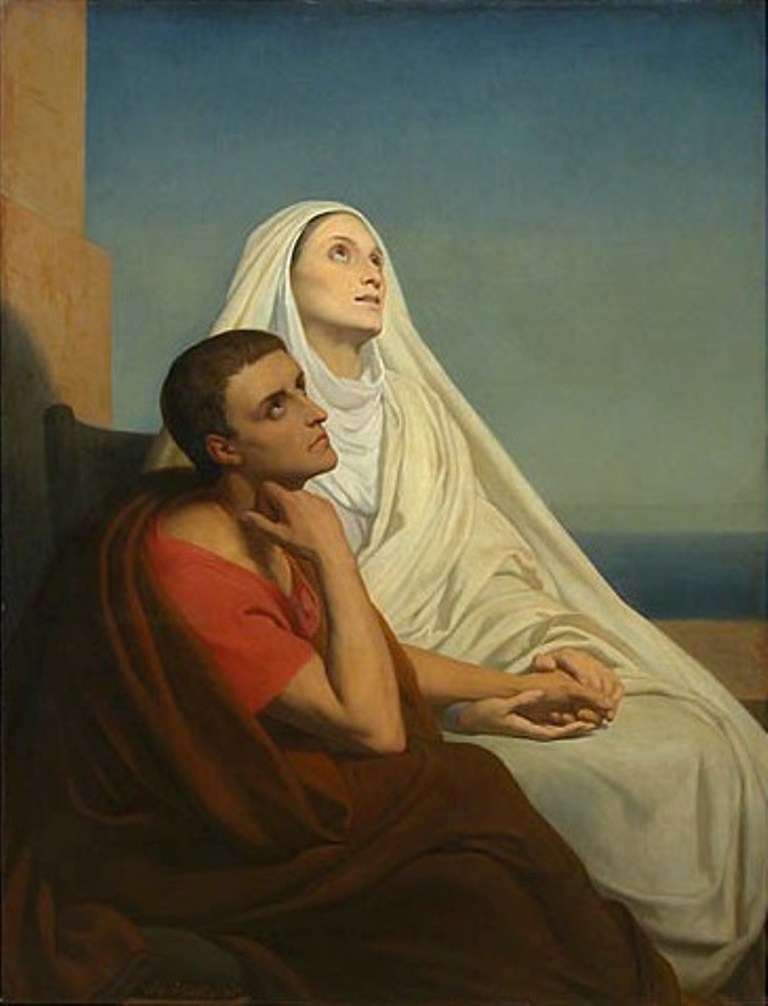
An image of Augustine and his mother:
 A recent conversation about his attitude toward rape (I’m not sure I fully agree with Burrus’ statements about Augustine’s argument concerning the rape of Lucretia. It’s been several years since I’ve read the text and I recall him using the story also to talk about suicide).
Doug Erickson has a piece on Madison.com about the religious presence in last Sunday’s Pride Parade. He pointed out:
I counted at least 13 Madison-area churches or religious denominations with contingents of worshippers in the parade, out of 43 total parade entries. Given that some entries were a single person, such as Miss Gay Madison, it’s entirely probable a majority of parade participants were church-affiliated people.
August 26, 2012
It’s August, the general election is still more than two months away. Of course, in Wisconsin, it seems like we’ve been in election mode for the last two years. We’ve been inundated by ads. Those of you with landlines have had to deal with pollsters. The news is full of partisan rancor. Most of us long ago made up our minds and most of us can’t quite understand how anyone could disagree with the perfectly rational choices we’ve made, politically or otherwise. Continue reading
I’ve written about this before but an article in this week’s Isthmus addresses both the efforts on behalf of a day shelter and the forces arrayed against it. Here is the letter I’ve written to Mayor Soglin, County Executive Parisi, Madison alders, and the Dane County board.
A few weeks ago as I was leaving Grace in the middle of the afternoon, I noticed a man sitting on the stone wall in our courtyard garden. I greeted him and asked him if he needed anything. He told me that he had been released from the VA hospital earlier in the day and sent here. He asked me about the shelter–when it opened, what the policies and procedures were. I told him that the shelter wouldn’t open until that evening but that it would be best if he waited on the grounds of the Capitol or somewhere else.
I realize that this brief vignette raises all sorts of questions about our society–our treatment of veterans, our healthcare system are both implicated in this man’s plight. What I would like to focus on, however, is that this man had nowhere to go. Staff at the VA could only tell him about the shelter, a place to stay that night, but there was nowhere for him to sit comfortably, his possessions secure, while he waited for the shelter to open.
His is not an isolated incident. Madison’s hospitals discharge patients directly to the men’s shelter; the jails and prisons do as well. And there are those who find themselves homeless for the first time. They have no idea where to go or what to do. If they’re lucky, someone tells them about the shelter. If they’re really lucky, when they check in, they find someone who will show them the ropes, help them negotiate through the night, and tell them how to keep themselves and their possessions safe. I can’t tell you how many times I encounter someone who’s been in the shelter several days or even weeks, and has never seen a representative from a social service agency or been directed to places and people that might be helpful.
The effort to establish a day resource center for homeless people is one of the few hopeful signs I see in Madison’s approach to homelessness. I’ve lived here for three years. When I arrived, I was shocked to discover that homeless services here seemed to lag behind what I had observed in Boston twenty-five years earlier. Even Greenville, SC, where I had lived and worked most recently, and hardly a center of progressivism, has facilities where homeless people can come during the day to receive a nutritious meal, get a shower, do laundry, receive mail, and stow their possessions. More importantly, there is an array of services offered, including GED classes and the like.
The reality for most homeless people is that most of their energy is spent trying to survive on the street, making sure they know where they will spend the night, where they will get a meal, where they might find a warm (or cool) spot to spend the day. There is little physical or emotional energy left to negotiate the system in order to access resources necessary to find permanent housing, a job, or to get training or education.
A day resource center, or day shelter is just such a place. It an bring together all sorts of resources not only to provide protection from inclement weather, but to provide the infrastructure and services that can help someone move off the street and into a more stable living situation. The fact that Madison lacks an adequate facility of this sort is an outrage.
I urge the Mayor, County Executive, members of the Madison Common Council and Dane County Board to support this effort financially. Such a center is not a bandaid, it offers concrete solutions to the problem of homelessness. It offers hope to the hopeless.
Another act of mass violence today. The media went wacko. Meanwhile, yesterday in Chicago, nineteen people were shot, including eight in a drive-by shooting. Roger Ebert pointed out the parallel.
A story on inner-city Philadelphia examines the effects of gun violence on the community and on individuals, focusing on the trauma caused by the level of violence:
Between January 1, 2001, and May 29th of this year, 18,043 people were shot in Philadelphia. That equates to about one shooting every six hours. In that same time period, there were 3,852 murders—a new body yielded up for disposal nearly every day. The entire length of the conflict in Afghanistan hasn’t produced as many dead Americans as we’ve picked up off our city’s streets.
As others have pointed out, media coverage of mass shootings conforms to our own fears. Random shootings seem to receive more attention than targeted ones (does this explain the relative lack of attention to the Oak Creek shootings?) We’ve become inured to certain kinds of violence–the shootings in Chicago being an excellent example, and our own ongoing participation in wars abroad. It’s only when that violence affects us, or people like us, that we seem to take notice.
There have been many attempts to make sense of the recent epidemic of shootings. Of course each shooter had his own set of fears and disappointments, his own set of demons, to make generalization dangerous.
What strikes me about our national mood is our level of fear. We are afraid of the future and afraid of the future direction of our country and world. We worry about the economy, about our jobs and families. We worry whether we will be able to make ends meet, or whether we will have adequate resources or medical care in our retirement. That fear percolates under the surface all of the time and is given voice in our degraded political culture.
One thing that unites these recent shootings is that the perpetrators are all white men. Elizabeth Drescher has pointed to the significance of this:
Whatever the unique complex of psychosocial, religious, financial, moral, political, or other issues that tormented the mass killers recently populating Twitter feeds and news headlines, they all sought to solve their problems with a particular expression of gun violence that maps easily to particular configurations of masculinity—apparently across classes and political ideologies. Those of us concerned with how religious ideologies participate in narratives of domination and violence, then, would do well to explore the masculinist roots of Christianity or other religious traditions, particularly as male authority and normativity are emphasized in more conservative expressions.
How do we as communities of faith respond the shootings as well as the underlying fears, the very notion of “redemptive violence” that permeate our culture? How can we offer hope and life in this culture of fear and death? How can we proclaim a gospel that might work toward the transformation of our society? How can we name and combat the evil in our midst and offer life-giving alternatives?
That phrase from I John 4, “but perfect love casts out fear,” has been running through my head the past several weeks. If we can experience that sort of love in our hearts. If we can experience that sort of love in our congregations, if we can invite and express that sort of love with those we encounter in our neighborhoods and communities, we will go a long way toward overcoming our national culture of fear and violence.
Yesterday was a remarkable day at Grace Church. On an August Sunday, two weeks before the start of school, we had attendance that rivaled our average Sunday attendance. There were visitors from out of town as well as newcomers and church shoppers. There were also visitors from other Episcopal churches who joined us before participating in the Capitol Pride march.
After our 8:00 and 10:00 services, we introduced members and visitors to the master planning process on which we are about to embark and invited them to dream about the future of Grace Church, how, as I like to put it, we might become sacred space for our whole community.
While we were talking, people gathered for Capitol Pride. Some of our members joined the parade at its start; others joined after participating in the conversations we were having inside the building. I was struck by the juxtaposition of the two events. We were talking about mission in our neighborhood, while thousands gathered and marched outside. Here’s a photo from the parade (from Fred-Allen Self):

And I thought about something else, the way our building enables and limits our mission. I’m linking below to a couple of blog posts that challenge us to rethink the way we do mission or evangelism. It’s not enough to claim to be welcoming, our to assert our radical hospitality, we have to go out into the community and into the square, talk about our faith and invite people to encounter Jesus Christ with us.
Reaching Out to the Unchurched – Dr. James Emery White Christian Blog.
In today’s paper, there were probably dozens of ads for new cars. If you read the paper, did you notice them? It’s doubtful – unless you are in the market for a car. (These days, it’s doubtful you even read a newspaper – but let’s play this out).
If you’re not in the market for a car, it doesn’t matter to you if a dealer is having a sale, promises a rebate, has a radio on-site broadcast, hangs out balloons, says they’re better than everyone else, promises that they will be different and not harass you or make you bargain over the price, or sends you a brochure or push email.
Why? You’re not in the market for a car.
It’s no different with a church. People today are divorced from seeing it as a need in their life, even when they are open to and interested in spiritual things. They no longer tie that to the need to find a particular faith, much less a particular church.
And:
So how do you grow a church from the unchurched?
I’ll assume you know the “pray like mad” part.
Here’s step two:
Crawl underneath the hood of any growing church that is actually growing from the unchurched and you will find that the number one reason newcomers attend is because they were invited by a friend.
Churches grow from the unchurched because their members and attenders talk about it to their unchurched friends. It comes up in their conversations like the mention of a good movie, a favorite restaurant, or a treasured vacation spot.
There is a culture of invitation.
Earlier, Scott Benhase said similar things in A Theology of Attraction:
Our churches ought to be places of pure welcome and grace. We truly ought to be communities of “radical hospitality” to the stranger.
And yet, the theology behind this practice, however right and good, has tended to mask something else that we need to acknowledge and address. For the sake of argument, I would call the theology behind the movement of “radical hospitality” a “Theology of Attraction.”
Such a theology holds that if we’re just open and welcoming enough people will naturally be attracted to us and want to come and join our churches. So, with this theology we declare that all people are welcome and we will offer them “radical hospitality” when they come into our churches.
Instead, he advocates a Theology of Mission:
We need a “Theology of Mission” like the early church had, in which modern day “apostles” (literally “ones who are sent out”) leave the friendly confines of our church buildings and go to where people are. We need to go to where people are because they are not coming to us, no matter how attractive we might be.
September 16 is Back to Church Sunday
August 19, 2012
As most of you know, Grace Church has embarked on a master planning process. I hope you will stay after services today to learn more about that process and begin imagining what our congregation might look like in five years. As I have said before in several contexts, this process encourages us to ask the questions: Who is God calling us to be as a congregation in the coming years? What is our mission in our particular context of Madison’s Capitol Square? Continue reading
Both reviewers are prominent historians. Keith Thomas reviews The Watchers: A Secret History of the Reign of Elizabeth I by Stephen Alford. It’s a study of Elizabethan spies and intelligence efforts. He concludes:
Stephen Alford’s engrossing book reminds us that most governments will stop at very little if national security is at stake. When political conflicts are exacerbated by fanatically held religious differences, the outcome is even more deadly.
The other review is by Diarmaid MacCulloch of Eamon Duffy’s Saints, Sacrilege and Sedition. It’s a collection of essays by the author of Stripping of the Altars and The Voices of Morebath (both of which I assigned in my classes over the years). MacCulloch is critical of Duffy for overemphasizing popular resistance to Reform and argues in the review that by the mid-Tudor period, the lines between Catholic and Protestant were fairly clearly drawn, that Duffy tends to overemphasize Catholic sentiment, and occasionally simply misreads the evidence. Most interesting, MacCulloch ends with an anecdote new to me that reveals the complexity of religion in sixteenth-century England:
In 1566, Elizabeth I’s archbishop of Canterbury, Matthew Parker, was disconcerted to receive a bill from the bailiffs of the city of Oxford. They were still owed £43 out of the £63 that was their expenditure for guarding and burning Hugh Latimer, Nicholas Ridley and Thomas Cranmer, back in Mary’s reign. Mary’s government added meanness to its brutality, and had not paid up. “The case is miserable, the debt is just,” the Puritan president of Magdalen College wrote in perplexity to the archbishop. So Parker, feeling that it was only fair, had a whip-round among his fellow Protestant bishops to pay for the expenses of burning England’s most famous Protestant martyrs. I wonder if any counter-reformation bishops would have reimbursed damnable heretics, had they presented that sort of bill.
 Preaching Grace on the Square