All are welcome here!

I really don’t want to use news about other denominations as marketing for my own church, but living in Madison, it’s hard not to want to take advantage of developments in the Roman Catholic Church. Now, Bishop Morlino has recommended that a hymn entitled “All are Welcome” is not appropriate for use in the Mass. Here’s Doug Erickson’s article on Madison.com. Apparently, Bishop Morlino believes that all are not welcome at the Lord’s table.

I’ve toyed over the years with several marketing strategies for disaffected Catholics: “The Episcopal Church: All of the liturgy, none of the guilt” is one. OK, yes, that was a joke. The national church has had a slogan “The Episcopal Church welcomes you.” Perhaps we need to be even more clear in our message, at least in Madison: “The Episcopal Church: All are welcome here!”

And we mean it, whether you’re Episcopalian, or Roman Catholic, or just seeking!


Hugo

As I mentioned in a previous post, I’m a huge fan of Martin Scorsese. I saw Hugo this afternoon and I’m still processing it. The difficulty is not so much the movie itself; it’s beautiful, well-made, and a delightful paean to the power of imagination, dreams, and film. The puzzle for me is fitting it into Scorsese’s oeuvre.

First, if you’ve not seen it, some other reviews:

There’s a moment in the film when Hugo, the young orphan who lives in the train station and is trying to repair the automaton because he believes his dead father will deliver a message from beyond the grave, and because as a boy on his own he is seeking to end his loneliness in the company of this magical creation, talks about his place in the universe. He imagines it as a giant machine. Just as machines have no unnecessary or superfluous parts, so too the universe. He must have a place in it.

The film, on one level, offers praise of technology. But it is technology that has the power to bring our dreams to life. There is Georges Mulies himself who begins as a magician, creates an automaton that can write, and when he encounters the movies of the Lumieres brothers, imagines the power of film.

On another level, the film is a hymn to technology, to the power of technology to transport us from the lives we live into an imagined world, limited only by our imaginations. Scorsese plays off the power of film, using the story of the first viewers of the Lumieres brothers movie of a train entering a station, an experience so powerful that the first audience flinched and ducked as they feared the train hitting them. We see the train again, entering the station in Hugo’s dreams, then again, when Hugo tries to rescue the automaton from the tracks.

We see the power of imagined worlds–Scorsese’s, Hugo’s, the world of the first film-makers, and the world of books. The latter comes to life as Hugo and his friend Isabelle look at a history of movies and see pictures in a book come to life.

We see the possibility of a different world, a possibility opened up by the power of art, and love. But we also see technology. The mechanisms of clockworks dominate the film, mechanisms that make a toy wind-up mouse run across a store counter, the mechanisms that make clocks tick, automata do their magic, and movie cameras create the new worlds. Scorsese seems to be saying that this technology can create dreams, bring our dreams to life, and help us find our place in the universe. But as he looks back at the history of film, he also is calling for the importance of the preservation of its past, and the power of that old technology, and old dreams, to transport us as well. He seems to be saying, even as he makes superb use of the most modern of technology, that the vision of the first film-makers is as powerful as his own. It’s a beguiling vision.

But I’m still thinking about what he is saying about technology, even as he makes use of it. Reviewers like Roger Ebert have made a great deal of his use of 3D. I’m going to confess that this is the first 3D film I’ve ever seen. I found it curious. As a neophyte, my first exposure was not to Hugo but to the trailers that were shown first, a series of animated movies that were advertised and visually, in 3D seemed over the top and over-stimulating. Hugo was quite different. The 3D seemed to add a dimension (duh), to add depth, rather than force itself on the viewer. But I wonder what it added, other than another level of special effect to a technological marvel.

In the end, I suppose Hugo is another example of Scorsese’s love of film. He has been a leader in the preservation of of film history. In addition, it reminds of the care he takes in creating a vision of a different world for his audience. Whether it was The Age of Innocence or Casino, Scorsese draws us into the world he creates and invites us to imagine that world.

It’s also a remarkable confession of faith–to assert, as Hugo does, that everyone has a place in this universe is a remarkable statement of faith.

I’ve finally found a reason to become a Packers fan

Aaron Rogers quotes St. Francis of Assisi:

“I feel like my stance and my desire has always been to follow a quote from St. Francis of Assisi, who said, ‘Preach the gospel at all times. If necessary, use words.’

Yes, I’ve got an issue with the ostentatious and “in-your-face” display of Christianity. It always puts me in mind of a student I had in my first term teaching Intro to the Bible at Furman. The year was 1999. The kid was completely, 100% secular, a fish out of water at Furman. When we were talking about the Sermon on the Mount, he raised his hand and asked about Matthew 6:5-6

5 ‘And whenever you pray, do not be like the hypocrites; for they love to stand and pray in the synagogues and at the street corners, so that they may be seen by others. Truly I tell you, they have received their reward. 6But whenever you pray, go into your room and shut the door and pray to your Father who is in secret; and your Father who sees in secret will reward you.

Specifically, he wondered why kids did the “meet me around the flagpole” thing. I don’t know if it’s still popular, but back then, in the first weeks of public school in the fall, there was a designated time when “Christians” would gather together to pray. He found it very alienating and obviously not in keeping with Jesus’ words. To watch  Tim Tebow, or for that matter, any other athlete, pray after a touchdown, may be equally alienating to non-Christians.


So how’s that restructuring working out, Chuck?

For those of us who are Episco-geeks, news this week of a divorce between the Anglican Church of Rwanda and the Anglican Mission in America (AMiA) is like the Rose Bowl for Wisconsin Badger fans–we’re lovin’ it!

But for those who aren’t, here’s a bit of explanation, and I’m doing it off the top of my head, so chances are I’ll get some details wrong, but probably not the overall gist.

The issue of the ordination of gays and lesbians has been around for quite some time. Conservatives bristled at the prospect, even before Gene Robinson’s election as Bishop of New Hampshire. Chuck Murphy was Rector of a large parish, All Saints’ Pawley’s Island. From encounters with members, children who grew up there, and seminarians who came out of that parish, it was clear to me that All Saints’ commitment to Anglicanism was tenuous at best (My wife once had a student who was raised there ask her what the Book of Common Prayer was).

Murphy retired and at some point was ordained Bishop by the Archbishop of Rwanda, who was deeply opposed to developments in the Episcopal Church. The AMiA developed something of a parallel structure to the Episcopal Church, attracting some conservative parishes and planting congregations in various places, hoping to pick off disgruntled conservative Episcopalians (this was especially true in South Carolina).

Now, it seems, Murphy and the AMiA have run into conflict with the Anglican Church of Rwanda. Apparently, they are no longer connected. Murphy was called out for insubordination and the like and has gone his separate way. The story can be followed in various places, including Episcopal Cafe.

It may be that as George Conger puts it, “It’s just a sad, sad case all around,” Conger said. “There are no doctrinal or theological issues. It’s not about women priests or homosexuality or race. It’s entirely about egos.”

Here’s an article from Christianity Today on the break.

Apparently, they will be seeking a “council of archbishops” who will provide them with some sort of concrete link to the Anglican Communion. We’ll see how that works out.

I put “restructuring” in the title of this blog post, because this division is really about restructuring. Murphy and others, including those American clergy who sought episcopal ordination in the Anglican Church of Nigeria, or the Southern Cone, or Uganda, were (and in many cases, still are) attempting a radical restructuring of Anglicanism in North America. But as the AMiA example, demonstrates, restructuring is a difficult thing.

On one level, I have no problem with people seeking out like-minded people in other countries to help build institutions and to provide some legitimacy. I thought it somewhat odd, and particularly in the case of Rwanda, which, when Murphy was ordained Bishop, was only a few years after the genocide and had enormous issues of its own to deal with. I always thought that the Americans were exploiting a church, and a nation, that was weak and vulnerable. I also found it ironic, even tragic, that Southern descendants of slaveowners, and parishes created by slaveowners, were  looking to Africans for authority. In other words, I thought it all a mess.

But now, it seems, we see what it really is all about, and once more, the loser is the Church of Jesus Christ. I hope that whatever conversations occur in the Episcopal Church about restructuring develop in more productive directions. May God have mercy on all of us.


Ambrose of Milan, December 7

Today is the commemoration of Ambrose of Milan. I had this to say about him last year. With a nod to the season, here is one of his hymns:

1. Redeemer of the nations, come;
Virgin’s Son, here make Thy home!
Marvel now, O heaven and earth,
That the Lord chose such a birth.

2. Not by human flesh and blood;
By the Spirit of our God
Was the Word of God made flesh,
Woman’s offspring, pure and fresh.

3. Wondrous birth! O wondrous Child
Of the virgin undefiled!
Though by all the world disowned,
Still to be in heaven enthroned.

4. From the Father forth He came
And returneth to the same,
Captive leading death and hell
High the song of triumph swell!

5. Thou, the Father’s only Son,
Hast over sin the victory won.
Boundless shall Thy kingdom be;
When shall we its glories see?

6. Brightly doth Thy manger shine,
Glorious is its light divine.
Let not sin overcloud this light;
Ever be our faith thus bright.

7. Praise to God the Father sing,
Praise to God the Son, our King,
Praise to God the Spirit be
Ever and eternally.

Here’s one version of it: http://youtu.be/amkzPGSf-y4


Milton’s Paradise Lost

Jessica Martin, in The Guardian, has begun a series examing Paradise Lost. It’s well-timed given the promised release of a movie based on Books V and VI of the great English epic.

Here’s part 1, part 2. Other parts to follow.

Here’s Martin on Milton’s choice of epic as his genre:

And so Milton folds together two stories focused on different heroes, placing them in balance. On one side, and opening the poem, the defeated figure of Satan following a first great fall, his fall from heaven. Corrupted by overweening ambition, morally tormented, subtle and charming, Satan presents like a melange of the best villains of the stage-plays of Milton’s youth; but his strand of the story follows the epic tradition.

To him belongs the journeys, the politics, the battles, a growing insupportable self-knowledge that will, eventually, diminish him to almost nothing. He travels to encounter and corrupt his opposite numbers, the counter-heroes Adam and Eve – united where he is solitary, ignorant where he is knowing, happy where he is miserable. Their meeting will result in the poem’s second and very different fall, raising Adam and Eve separately and for different reasons to tragic stature. Out of its disaster, as out of Troy’s burning, we see them at the beginning of an odyssey. Their final “wandering steps and slow” will walk them out of the poem and into history, an untold journey leading humanity – eventually, eventually – into the embrace of a lost beloved.

I’ve probably blogged about this before, but looking back on my teaching career, one of the great gifts I received was teaching for most of my fifteen years in an interdisciplinary humanities program, and in almost every year, in a term that had us reading at least some of Paradise Lost. I hadn’t read it before beginning to teach and learning from my colleagues at Sewanee and Furman, and growing to love Milton’s language and genius, is one of the great gifts I’ve received.

It’s probably time to read it again. It’s been almost four years.

First Monday, December 5, 2011

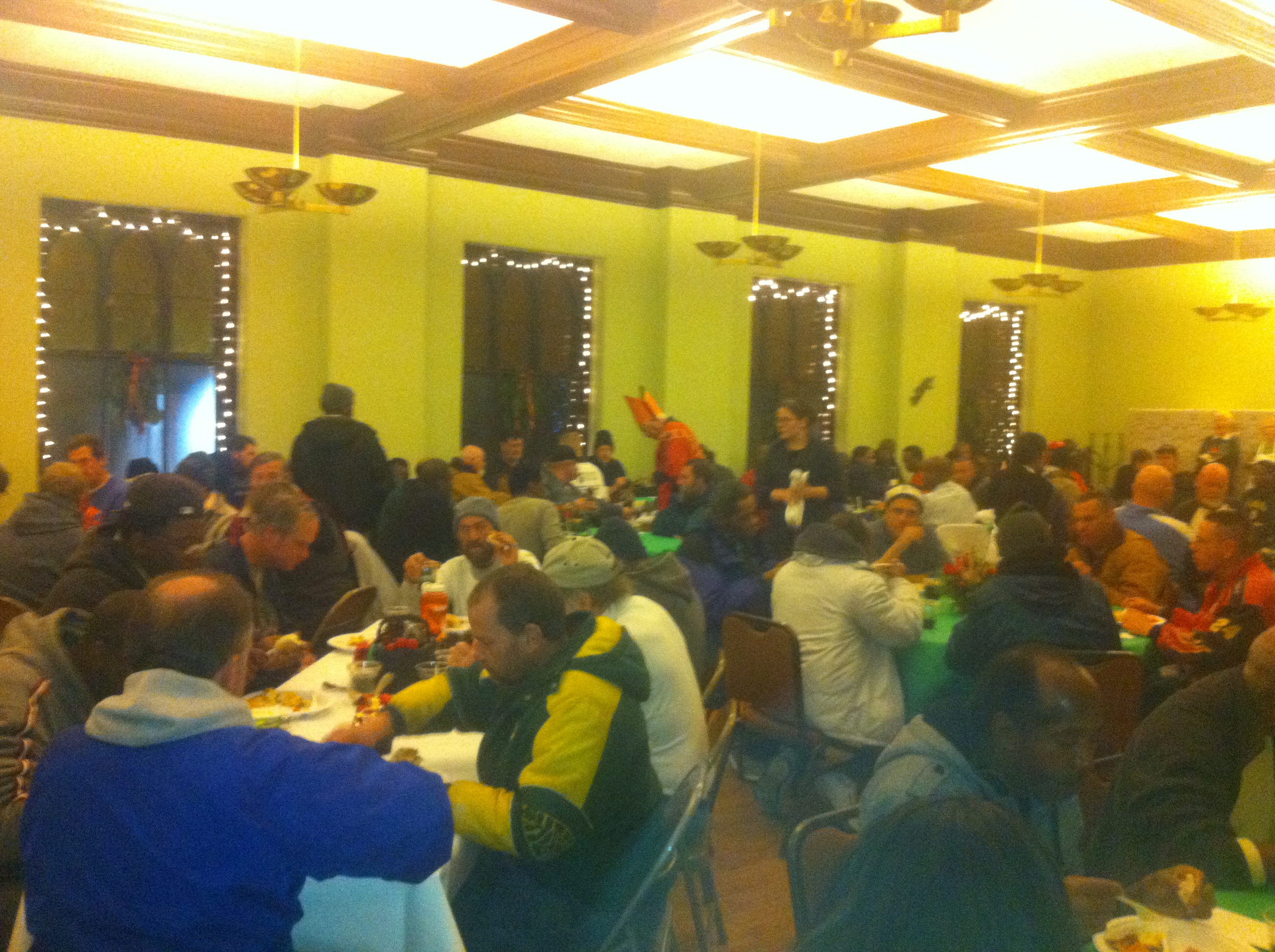
Tonight was First Monday. As tomorrow is St. Nicholas Day, we had a visit from St. Nick himself. He distributed winter socks to our guests, who were treated to a hearty meal of ham, macaroni and cheese, carrots, and cake. We fed more than 150 people and along with our regular group of volunteers, we had several first-timers who enjoyed themselves and said they would be back to help again.

The music was provided by the children of Grace Church, and by our adult choir, who sang a variety of holiday music, Christmas carols and holiday favorites like Frosty the Snowman.

One of our volunteers remarked to me at the end of the evening that the guests were incredibly appreciative of the food and our hospitality. It’s an incredible amount of work, especially the preparation, but it’s also very rewarding. It’s also eye-opening to be reminded of the diversity of homelessness, even among our overwhelming male population.

A couple of pictures:

Lectionary Reflections on Advent 3, Year B

This week’s lectionary readings.

The contrast between the presentation of John the Baptizer in Mark and the Gospel of John’s portrayal of him is striking. For one thing, in the fourth gospel, John doesn’t actually baptize Jesus. In addition, Jesus begins his public ministry before John’s arrest. There are other differences, too.

In this week’s gospel reading, we learn about who John is not. He is a witness, or testifier to Jesus Christ, but when asked who he is, whether he is the Messiah, or a prophet, or Elijah, he replies, “I am not.” Later in chapter 1, when John sees Jesus, he points to him and says twice, “Behold the Lamb of God.”

The gospel writer is concerned to heighten the difference between John the Baptizer and Jesus, to make clear that John is less important, but by writing in this way, he presents us with questions that, in a sense, we struggle with as Christians. Who is Jesus Christ? For all of the doctrinal formulations that attempted to fix and define Jesus Christ’s identity for all time, the question of who he is, for us as individuals and for our congregations presses itself on us.

How do we experience Jesus Christ? How does he come to us? How do we encounter him in our lives and in our world? We are often tempted, just like those who defined the doctrines of Jesus Christ’s nature, to fit him into a certain philosophical or theological framework. We are tempted, like those who asked John who he was, to try to fit our experience of Jesus Christ into certain pre-defined categories or terms. That’s the case all of the time, but it may be particularly true in this season, when we look for Jesus Christ’s coming in a manger in Bethlehem, and ignore other ways in which Jesus Christ comes to us.

The Gospel of John consistently asks, “Who is Jesus Christ?” As often as not, those who ask Jesus the question, “who are you?” have questions asked back of them, or experience Jesus shattering the categories they use to ask him.

Who is Jesus Christ? To ask that question in Advent is to invite two very different, and in some ways contradictory responses. He is the babe who is born in Bethlehem, but he is also to one who will come to usher in a new age. Those two answers force us to open ourselves up to contradictory and unsettling ways in which Jesus Christ comes to us. To be open to his coming, however it is he chooses to come, is one of the disciplines of Advent.

Art, neuroscience, and religion

Alva Noe has a thoughtful essay on “Art and the Limits of Neuroscience” on the Opinionator.

He criticizes the field of neuroaesthetics:

Semir Zeki, a neuroscientist at University College London, likes to say that art is governed by the laws of the brain. It is brains, he says, that see art and it is brains that make art. Champions of the new brain-based approach to art sometimes think of themselves as fighting a battle with scholars in the humanities who may lack the courage (in the words of the art historian John Onians) to acknowledge the ways in which biology constrains cultural activity. Strikingly, it hasn’t been much of a battle. Students of culture, like so many of us, seem all too glad to join in the general enthusiasm for neural approaches to just about everything.

There’s a deeper criticism here. Noe attacks the view, held from Descartes on, that there is in us something “that thinks and feels and that we are that thing.” For Descartes, it was the soul; for neuroscientists, it is the brain. Noe counters:

What we do know is that a healthy brain is necessary for normal mental life, and indeed, for any life at all. But of course much else is necessary for mental life. We need roughly normal bodies and a roughly normal environment. We also need the presence and availability of other people if we are to have anything like the sorts of lives that we know and value. So we really ought to say that it is the normally embodied, environmentally- and socially-situated human animal that thinks, feels, decides and is conscious. But once we say this, it would be simpler, and more accurate, to allow that it is people, not their brains, who think and feel and decide. It is people, not their brains, that make and enjoy art. You are not your brain, you are a living human being.

Finally,

Far from its being the case that we can apply neuroscience as an intellectual ready-made to understand art, it may be that art, by disclosing the ways in which human experience in general is something we enact together, in exchange, may provide new resources for shaping a more plausible, more empirically rigorous, account of our human nature.

What Noe says about art, could be said, mutatis mutandi, about religion. While I am deeply interested in what researchers studying the brain can tell us about religious experience, I think that, as Noe says, we are people, embodied, engaged in a web of relationships, in a context larger than our brain. Our attempt to make sense of ourselves and our world is more than mental activity; it involves our entire being.

Rod Dreher, who is a bit over the top for me, says something along the same lines in a brief comment on Bellah’s Religion in Human Evolution (h/t Andrew Sullivan):

If you read Bellah’s book, “Religion in Human Evolution,” you understand why ritual is more important than theology. No doubt that ritual completely disconnected from theology is empty. But humans never outgrow the deep need for ritual. It’s built into the biological fabric of our being. You mess with that, you’re messing with things you ought not touch.

Beginnings Matter: A Sermon for the Second Sunday in Advent, Year B

December 4, 2011

Beginnings matter. Memorable beginnings can make all the difference. “Call me Ishmael.” What novel is that from? “It was the best of times; it was the worst of times.” Recognize that? “It was a dark and stormy night,” the first sentence of a novel by Bulwer-Lytton, a nineteenth century English novelist, made famous by Charles Schulz in the comic strip Peanuts. That sentence is so famous that there is now a contest each year for the best worst opening of a novel.

If novels aren’t your thing, what about movies? Are there any opening shots in movies that are fixed in your memory, or even fixed in our cultural consciousness? For people of a certain age, perhaps the opening sequence of 2001: A Space Odyssey, or perhaps Star Wars. Long, long ago, in a galaxy far far away. Continue reading