On preaching to oneself in Advent

Yesterday was one of those difficult days in ministry. I was tired and frazzled. A funeral last Friday was followed by the usual Saturday and Sunday events and business. Sunday afternoon, I sat by the bedside of a dying parishioner, praying and reading Psalms as I listened to her labored breathing. Monday morning, I received word that she had died, so there was another funeral to plan this week. Monday also was our regularly scheduled vestry meeting. All of that meant I woke on Tuesday after little sleep, knowing that the day would be long, busy, and exhausting.

By the time I arrived at church yesterday, it was already full of activity. Members of the altar guild were decorating the nave for Christmas and full of questions about upcoming services, including the funeral. There were bulletins to prepare and questions from staff, lay leaders, and others about Christmas Eve and Christmas Day services. In the middle of all that, I paused for an hour to talk with family members and plan the Thursday funeral service. Then there was a staff meeting, and a walk-through of Christmas Eve with the thurifer.

I was physically and spiritually exhausted as I welcomed people to our evening Eucharist and began the service. But something miraculous happened, at least for me. As I spoke about the gospel for Tuesday in 4 Advent (Luke 1:26-38–the same gospel that we read on Sunday), I realized that the words I was saying were addressed not primarily to the congregation gathered there. They were addressed to me. I spoke about all that had been going on in my life the past few days, all that had been going on the world around us, and the difficulties many of us face in this season. Christmas is meant to be a time of joy and celebration, but for many it is a time of great stress, sadness, even conflict. It is often difficult to be open to God’s presence in such times, to welcome the coming of God into our midst.

As I was speaking, I sensed that all of the day’s–the week’s–stresses were leaving me and my heart was making room for God. As I looked at the faces in the congregation, it seemed as if something similar was happening to some of them. I left my burdens at the altar, received Christ in the bread and wine, and received strength for the journey. The words I preached changed me. I’m told from time to time that a sermon of mine has had a powerful impact on a hearer. This is the first time in my memory, that a sermon of mine has had such an impact on me.

Today, there is more bustle at church with workmen in the nave, arrangements concerning the funeral, pastoral appointments in the afternoon. But today, at least for a bit, I am prepared for the coming of Christ.
 

Perplexed and Pondering: A Sermon for the Fourth Sunday in Advent, Year B

December 18, 2011

Today is the fourth Sunday of Advent and our attention turns to the story of the birth of Jesus. Our attention turns to Mary. As you know Christians have speculated for nearly two thousand years about Mary. Why Mary? In answer to that question, elaborate theologies and doctrine have developed to explain what set Mary apart, why God chose her as the woman who would give birth to Jesus Christ. The irony is that as important as the question why Mary has been for two thousand years of the Christian tradition, it’s not a question Luke, the gospel writer who tells us the most about her, is interested in. Continue reading

Occupy Trinity Church

This isn’t going to end well, and once again, the hierarchy of the Episcopal Church is not acquitting itself particularly well.

I’ve blogged about the relationship between Trinity and the Occupy Wall Street protestors before. Things have only gotten more tense in the last month. There was actually something of a moment of grace last week, when retired Bishop George Packer and his wife, accompanied by the Rector of Trinity and his wife, visited the OWS encampment. After conversation, many of the protestors attended services at Trinity. Read about it here.

Unfortunately, that was only a temporary break in the growing tension. On Friday, Bishop of New York Mark Sisk and Presiding Bishop Katharine Jefforts Schori weighed in, urging the protestors to abandon their demands that Trinity allow them use of a portion of Duarte Square for their encampment.

These events brought front page coverage in The New York Times and increasing debate among Episcopalians about the controversy. Elisabeth Drescher offers her perspective here.

Today, Bishop Packard, who has been advocating more loudly on behalf of the protestors, was arrested for entering the disputed area of Duarte Square.

As Drescher points out in her essay:

Trinity Wall Street and the Episcopal Church are, it seems, trying to maintain a delicate balance in their approach to Occupy Wall Street, and their consistent ministry to participants in the movement is laudable. Their active chaplaincy, preaching, and material support has been a powerful reminder of the moral role that churches and other religious groups continue to play even as institutional religion becomes more and more irrelevant in everyday life. Indeed, Trinity Wall Street and many other Episcopal Churchcommunities, have made clear that “being church” is much more than maintaining a building where fewer and fewer people gather to worship for an hour or so on Sundays. They have illustrated the Christian understanding of the call of the faithful to be Christ’s body in the world throughout the Occupy protests, and this has made me proud to be an Episcopalian.

Unfortunately, with the responses from Sisk and Jefforts Schori, as well as the ongoing response from Trinity, the Episcopal Church seems once again to be coming down on the side of the powers that be. For Trinity, that might not be surprising given the amount of real estate they own in the area. I also know well how difficult it is to maintain program, ministry, and perspective in the midst of ongoing protests, so I am not unsympathetic with the position Trinity’s leadership finds itself in. But I believe there ought to be some room for compromise, some creative response to the situation that would begin to shape a vision of what church might be in the twenty-first century.

I find it especially troubling that all those goes on as I prepare a sermon on Mary, and reflect on her words in the Magnificat:

he has scattered the proud in their conceit.
He has cast down the mighty from their thrones,
and has lifted up the lowly.
He has filled the hungry with good things,
and the rich he has sent away empty.

Bishop Packard’s blog is probably well-worth following.

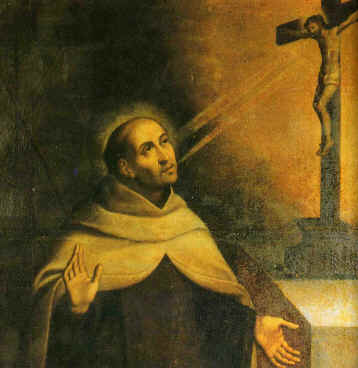
St. John of the Cross, December 14

Today is the commemoration of the great Spanish mystic, St. John of the Cross. My blog post from last year is here.

As a complement to last year’s quotation from “The Dark Night of the Soul,” a few stanzas from “The Spiritual Canticle:”

SONG OF THE SOUL AND THE BRIDEGROOM

I

THE BRIDE

Where have You hidden Yourself,

And abandoned me in my groaning, O my Beloved?

You have fled like the hart,

Having wounded me.

I ran after You, crying; but You were gone.

II

O shepherds, you who go

Through the sheepcots up the hill,

If you shall see Him

Whom I love the most,

Tell Him I languish, suffer, and die.

III

In search of my Love

I will go over mountains and strands;

I will gather no flowers,

I will fear no wild beasts;

And pass by the mighty and the frontiers.

IV

O groves and thickets

Planted by the hand of the Beloved;

O verdant meads

Enameled with flowers,

Tell me, has He passed by you?

V

ANSWER OF THE CREATURES

A thousand graces diffusing

He passed through the groves in haste,

And merely regarding them

As He passed

Clothed them with His beauty.

VI

THE BRIDE

Oh! who can heal me?

Give me at once Yourself,

Send me no more

A messenger

Who cannot tell me what I wish.

VII

All they who serve are telling me

Of Your unnumbered graces;

And all wound me more and more,

And something leaves me dying,

I know not what, of which they are darkly speaking.

VIII

But how you persevere, O life,

Not living where you live;

The arrows bring death

Which you receive

From your conceptions of the Beloved.

Eucharistic whiplash–I love being a priest

Today was one of those days that nothing prepares you for. I woke up exhausted, feeling I hadn’t had a wink of sleep, and knowing that it was going to be one of those days. After the usual round of emails, that included a delightful surprise (more about that later), I made my way for the annual rector’s obligatory Christmas Eucharist for the Rector’s Guild. This is an organization that was founded decades ago, by a rector who was hoping to encourage women of the parish to support particular projects that he thought were worthy. Over time, it has become primarily a social organization and its membership is largely rather elderly.

I attended the meeting today and celebrated Eucharist for the some twenty-five women who were in attendance. I neglected to bring the pile of service booklets that were on my desk, so when I arrived, I decided that it would make most sense to celebrate a Rite I Eucharist. As I said to the ladies in attendance, most of them knew the responses, and then I quipped, if they didn’t know the responses in Rite I, they probably shouldn’t belong to the Guild. Indeed, the responses were loud and clear, and when I announced we would be doing Rite I, there were exclamations of joy.

I had a delightful time, connecting with some folks I rarely see, and enjoying being with a group of women in a context I rarely have the opportunity to be in.

This evening was a very different celebration of the Eucharist. I decided, very last minute, to try a Celtic Eucharist during Advent, choosing Tuesdays, because it seemed the best night, given other activities at Grace. Tonight was a revelation. The numbers weren’t particularly large, but given the minimal publicity, to have 13 in attendance is something of a feat. But more remarkable were the demographics. Of the 13, six were young adults and/or relative newcomers. They had heard about it only from our internal publicity. Since I’ve been at Grace, we’ve attempted a number of things on weeknights in Advent and Lent–Evening Prayer, Eucharist, book studies, but tonight’s turn-out was by far the largest for anything we’ve done on our own.

Of course there’s a certain amount of curiosity, but I think trying something new is worth the effort. I’m especially encouraged by the presence of young adults and am hopeful that when the Episcopal Campus Ministry moves to Grace in the New Year, we may find new ways of reaching out to students and young adults in our neighborhood.

It might also be that a straight Rite I service could be as appealing to people as the Celtic Eucharist we’ve been doing this Advent.

Let’s try it and see!

Lectionary Reflections, Advent 4, Year B: Occupy Bethlehem?

This week’s readings.

Our readings bring us ever closer to the coming of Christ, and it is easy for our attention to focus on Mary this week, with the story of the Annunciation as the gospel reading and the Magnificat as an option for the Psalm. But we shouldn’t let our expectation of Christmas divert our attention from the other readings. In particular, the reading from 2 Samuel is fascinating on its own, and meaningful too in its lectionary context, with God’s promise to David that “your throne shall be established forever.”

The passage from 2 Samuel occurs just after David has gained control of the monarchy and has begun the building projects that every victorious ruler undertakes–to demonstrate their power and symbolize their reign. David has built a “house of cedar” for himself, and gets the idea to build a temple for Yahweh. Nathan the prophet supports him in this effort, saying “The Lord is with you.”

Apparently Nathan wasn’t paying attention, because Yahweh speaks directly to David, asking him where he got this bright idea and whether Yahweh had ever asked to have a temple built. In fact, the Hebrew suggests that Yahweh has walked alongside and with the Israelites. For all of the effort in 1 and 2 Samuel to offer a defense of David’s rise to power and of his monarchy, there remains in the text considerable antagonism toward monarchy in general. This seems to be one example of that.

The lectionary editors no doubt wanted to focus our attention on the promise that David’s house would last forever and that his throne would be established forever, a prophecy of the coming of the Messiah. But there’s another connection between this reading and our other texts. Yahweh tells David that “I took you from the pasture, from following the sheep to be prince over my people Israel; and I have been with you wherever you went, and have cut off all your enemies from before you; and I will make for you a great name.” In the Magnificat, Mary sings:

He has shown the strength of his arm, *
he has scattered the proud in their conceit.
He has cast down the mighty from their thrones, *
and has lifted up the lowly.
He has filled the hungry with good things, *
and the rich he has sent away empty.
He has come to the help of his servant Israel, *
for he has remembered his promise of mercy,
The promise he made to our fathers, *
to Abraham and his children for ever.

Just as Yahweh lifted up the lowly David and made him king, Mary sings that God casts down the mighty from their thrones and sends the rich away empty. There’s a connection here, not just the genealogical connection with David that Matthew and Luke want to emphasize. We are invited to compare the rule of David, perhaps the rule of Rome, too, with the rule, the reign of God, and the coming of the Messiah. To put our hopes in the power and justice of human rulers and institutions is to hope falsely, for 1 Kings goes on to describe how Solomon, the wisest of all kings, oppressed the people. His son Rehoboam promised to do even worse, a promise that was met with rebellion and led to the division of the Northern and Southern monarchies.

As Advent nears its end, this season in which we prepare for the coming of Jesus Christ and reflect on his coming to us in Christmas and in the Second Coming, we do well to remember that God’s power is greater than that of any human agency or institution, and that Mary’s song praises a God who upends power relationships, reverses the status of rich and poor, and feeds the hungry. These latter are especially important to keep in mind with all the news of Occupy Wall Street, the 99%, and Republican efforts to lower taxes on the wealthiest of our citizens.

The sad decline of the war on Christmas

I went to the Capitol today. It was kind of eerie, because I hadn’t entered it since the protests last February, when it was occupied by thousands, and a group of interfaith clergy made their way from the steps of Grace to the rotunda to show our solidarity.

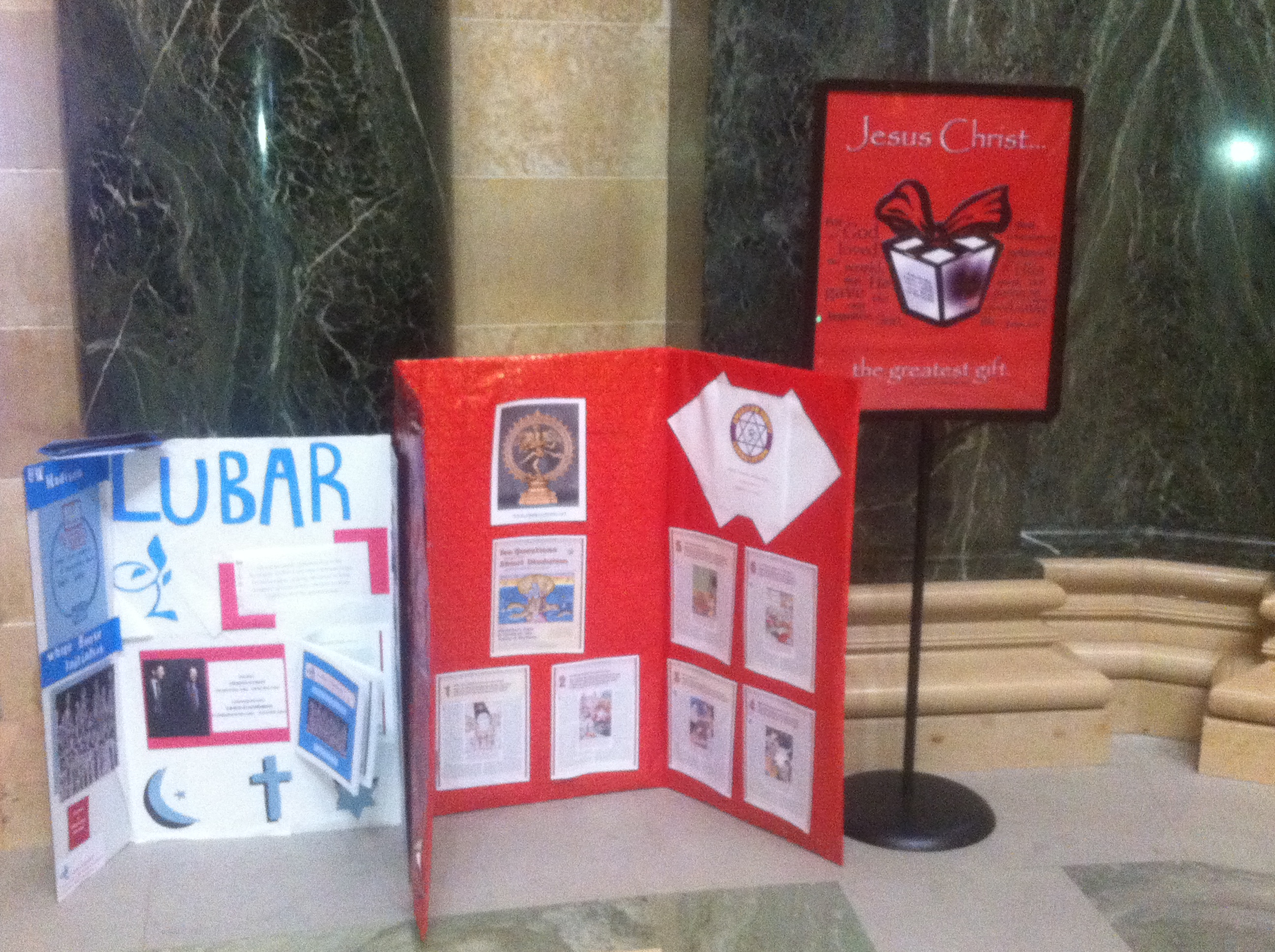
It was much quieter today. The Christmas tree (before this year, it was a Holiday tree) is beautiful. I was on a mission, looking for the nativity scene put up by a conservative Christian organization that wanted to witness to the “true meaning of Christmas.” It took me a while to find the display, on the second floor of the rotunda. But there it was, as were a couple of signs proclaiming loudly the Christian faith, and near them, the remains of last week’s interfaith display–posters from UW’s Lubar Institute and from a group of Hindus. Here’s the article from Madison.com

No doubt those who erected the creche are convinced that they are making a profound and valiant witness to the truth of Christianity in the face of a secular onslaught. In fact, they have done little more than attract notice from the Freedom from Religion folks, who are always looking for a good fight.

Here are photos:

here's the infamous nativity scene

here’s the accompanying message

No sign yet of the display from Freedom from Religion.

Meanwhile, sophisticated Christians are laughing about the youtube video of a Christian choir singing about Merry Christmas: http://www.youtube.com/watch?v=TWrrvQ_3-40&feature=share

The second verse features the following lines:

If you don’t see Merry Christmas in the window,

No, you don’t go in that store …

It’s the one and only reason

we celebrate the season,

wishing love to all and peace upon the earth

But not, apparently, to retailers.

As I was greeting people after the service yesterday, one parishioner said, Merry Christmas, to me, and then apologized, saying she wasn’t sure anymore what she could say. I pointed out to her that in the liturgical calendar, the season of Christmas begins only on December 24, so technically, one shouldn’t say “Merry Christmas” until then. And then I laughed.

The Hinduization of death? Please, give me a break!

An article in the New York Times today about the growing appeal of cremation in the US quotes Stephen Prothero of BU:

“America is becoming Hinduized in this way,” said Stephen Prothero, a professor of religion at Boston University and the author of “Purified by Fire: A History of Cremation in America.” “We’re increasingly seeing the human as essentially spiritual and gradually giving up on the Judeo-Christian idea of the person in the afterlife.”

He might want to talk to some people involved in caring for those facing decisions about burial. Yes, it’s economic. When I served in Greenville, I could tell people that cremations done by the South Carolina Cremation Society cost $600, as opposed to whatever funeral homes were charging. To choose cremation in those circumstances is not about the resurrection of the body, it is about stewardship. For people who no longer have close ties to particular places, to think about tying their bodies, and the emotions of their loved ones, to a particular place in a cemetery seems inappropriate, especially when they may never return there.

We have a columbarium at Grace where the ashes of former members and members’ loved ones can be inurned. It is a symbol of the community of the faithful that extends beyond death and the grave and includes us all in the great cloud of witnesses.

Yes, there is a transformation in Americans’ attitudes toward the body and how one treats a body at death, but whether that has anything to do with an changing understanding of what constitutes a human person seems to me very much debatable. My father, for example, donated his body to the Medical College of Ohio, not because he didn’t believe in the resurrection of the body, but because he considered his body something that might be of use to society. He died in sure and certain hope of the resurrection, confident that if his body could be raised, so too could his ashes.

A decision like this is often one of the most difficult an individual, or the surviving loved ones have to make. Of course, economics plays a role, so do many other factors, including our transient society, and personal experiences related to places other than cemeteries. I think the choice of cremation has as much to do with the American funeral industry as it has to do with changes in the understanding of the bodily resurrection. And it doesn’t take more than a glance to experience the radically different spiritual experience of a typical cemetery with a beautiful place like the memorial garden at St. James Episcopal Church in Greenville, SC.