Eucharistic whiplash–I love being a priest

Today was one of those days that nothing prepares you for. I woke up exhausted, feeling I hadn’t had a wink of sleep, and knowing that it was going to be one of those days. After the usual round of emails, that included a delightful surprise (more about that later), I made my way for the annual rector’s obligatory Christmas Eucharist for the Rector’s Guild. This is an organization that was founded decades ago, by a rector who was hoping to encourage women of the parish to support particular projects that he thought were worthy. Over time, it has become primarily a social organization and its membership is largely rather elderly.

I attended the meeting today and celebrated Eucharist for the some twenty-five women who were in attendance. I neglected to bring the pile of service booklets that were on my desk, so when I arrived, I decided that it would make most sense to celebrate a Rite I Eucharist. As I said to the ladies in attendance, most of them knew the responses, and then I quipped, if they didn’t know the responses in Rite I, they probably shouldn’t belong to the Guild. Indeed, the responses were loud and clear, and when I announced we would be doing Rite I, there were exclamations of joy.

I had a delightful time, connecting with some folks I rarely see, and enjoying being with a group of women in a context I rarely have the opportunity to be in.

This evening was a very different celebration of the Eucharist. I decided, very last minute, to try a Celtic Eucharist during Advent, choosing Tuesdays, because it seemed the best night, given other activities at Grace. Tonight was a revelation. The numbers weren’t particularly large, but given the minimal publicity, to have 13 in attendance is something of a feat. But more remarkable were the demographics. Of the 13, six were young adults and/or relative newcomers. They had heard about it only from our internal publicity. Since I’ve been at Grace, we’ve attempted a number of things on weeknights in Advent and Lent–Evening Prayer, Eucharist, book studies, but tonight’s turn-out was by far the largest for anything we’ve done on our own.

Of course there’s a certain amount of curiosity, but I think trying something new is worth the effort. I’m especially encouraged by the presence of young adults and am hopeful that when the Episcopal Campus Ministry moves to Grace in the New Year, we may find new ways of reaching out to students and young adults in our neighborhood.

It might also be that a straight Rite I service could be as appealing to people as the Celtic Eucharist we’ve been doing this Advent.

Let’s try it and see!

Lectionary Reflections, Advent 4, Year B: Occupy Bethlehem?

This week’s readings.

Our readings bring us ever closer to the coming of Christ, and it is easy for our attention to focus on Mary this week, with the story of the Annunciation as the gospel reading and the Magnificat as an option for the Psalm. But we shouldn’t let our expectation of Christmas divert our attention from the other readings. In particular, the reading from 2 Samuel is fascinating on its own, and meaningful too in its lectionary context, with God’s promise to David that “your throne shall be established forever.”

The passage from 2 Samuel occurs just after David has gained control of the monarchy and has begun the building projects that every victorious ruler undertakes–to demonstrate their power and symbolize their reign. David has built a “house of cedar” for himself, and gets the idea to build a temple for Yahweh. Nathan the prophet supports him in this effort, saying “The Lord is with you.”

Apparently Nathan wasn’t paying attention, because Yahweh speaks directly to David, asking him where he got this bright idea and whether Yahweh had ever asked to have a temple built. In fact, the Hebrew suggests that Yahweh has walked alongside and with the Israelites. For all of the effort in 1 and 2 Samuel to offer a defense of David’s rise to power and of his monarchy, there remains in the text considerable antagonism toward monarchy in general. This seems to be one example of that.

The lectionary editors no doubt wanted to focus our attention on the promise that David’s house would last forever and that his throne would be established forever, a prophecy of the coming of the Messiah. But there’s another connection between this reading and our other texts. Yahweh tells David that “I took you from the pasture, from following the sheep to be prince over my people Israel; and I have been with you wherever you went, and have cut off all your enemies from before you; and I will make for you a great name.” In the Magnificat, Mary sings:

He has shown the strength of his arm, *
he has scattered the proud in their conceit.
He has cast down the mighty from their thrones, *
and has lifted up the lowly.
He has filled the hungry with good things, *
and the rich he has sent away empty.
He has come to the help of his servant Israel, *
for he has remembered his promise of mercy,
The promise he made to our fathers, *
to Abraham and his children for ever.

Just as Yahweh lifted up the lowly David and made him king, Mary sings that God casts down the mighty from their thrones and sends the rich away empty. There’s a connection here, not just the genealogical connection with David that Matthew and Luke want to emphasize. We are invited to compare the rule of David, perhaps the rule of Rome, too, with the rule, the reign of God, and the coming of the Messiah. To put our hopes in the power and justice of human rulers and institutions is to hope falsely, for 1 Kings goes on to describe how Solomon, the wisest of all kings, oppressed the people. His son Rehoboam promised to do even worse, a promise that was met with rebellion and led to the division of the Northern and Southern monarchies.

As Advent nears its end, this season in which we prepare for the coming of Jesus Christ and reflect on his coming to us in Christmas and in the Second Coming, we do well to remember that God’s power is greater than that of any human agency or institution, and that Mary’s song praises a God who upends power relationships, reverses the status of rich and poor, and feeds the hungry. These latter are especially important to keep in mind with all the news of Occupy Wall Street, the 99%, and Republican efforts to lower taxes on the wealthiest of our citizens.

The sad decline of the war on Christmas

I went to the Capitol today. It was kind of eerie, because I hadn’t entered it since the protests last February, when it was occupied by thousands, and a group of interfaith clergy made their way from the steps of Grace to the rotunda to show our solidarity.

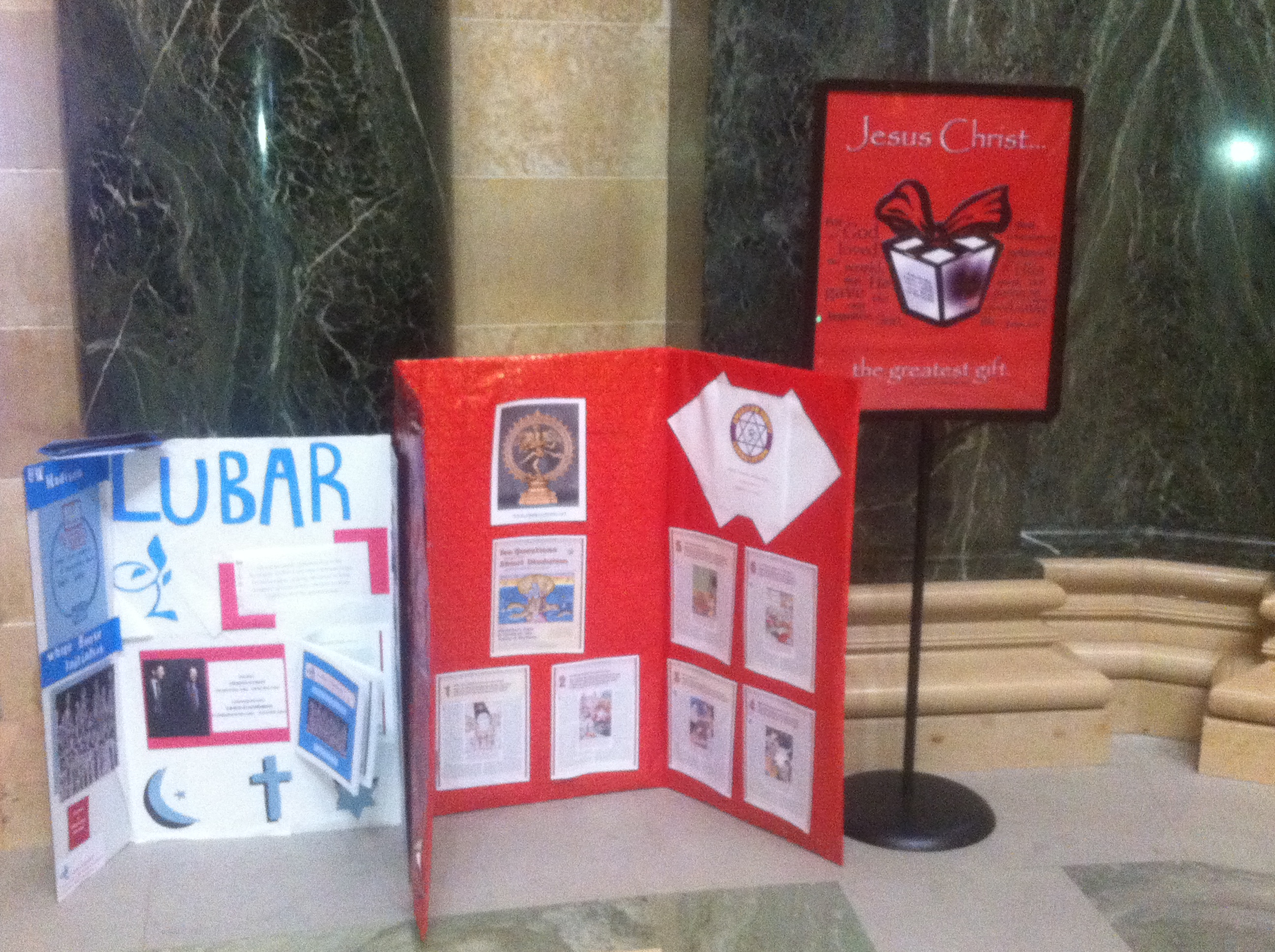
It was much quieter today. The Christmas tree (before this year, it was a Holiday tree) is beautiful. I was on a mission, looking for the nativity scene put up by a conservative Christian organization that wanted to witness to the “true meaning of Christmas.” It took me a while to find the display, on the second floor of the rotunda. But there it was, as were a couple of signs proclaiming loudly the Christian faith, and near them, the remains of last week’s interfaith display–posters from UW’s Lubar Institute and from a group of Hindus. Here’s the article from Madison.com

No doubt those who erected the creche are convinced that they are making a profound and valiant witness to the truth of Christianity in the face of a secular onslaught. In fact, they have done little more than attract notice from the Freedom from Religion folks, who are always looking for a good fight.

Here are photos:

here's the infamous nativity scene

here’s the accompanying message

No sign yet of the display from Freedom from Religion.

Meanwhile, sophisticated Christians are laughing about the youtube video of a Christian choir singing about Merry Christmas: http://www.youtube.com/watch?v=TWrrvQ_3-40&feature=share

The second verse features the following lines:

If you don’t see Merry Christmas in the window,

No, you don’t go in that store …

It’s the one and only reason

we celebrate the season,

wishing love to all and peace upon the earth

But not, apparently, to retailers.

As I was greeting people after the service yesterday, one parishioner said, Merry Christmas, to me, and then apologized, saying she wasn’t sure anymore what she could say. I pointed out to her that in the liturgical calendar, the season of Christmas begins only on December 24, so technically, one shouldn’t say “Merry Christmas” until then. And then I laughed.