This is a fascinating video from Jim Gilliam who was raised among fundamentalists, home-schooled, is a graduate of Jerry Falwell’s Liberty University, and has had quite a spiritual journey. He reflects on that journey, and on the important role the Internet has played both in that journey and in his struggle with cancer here:
Pascal-Emmanuel Gobry has this to say:
Perhaps the best and most significant part of the talk is this quote: “God is just what happens when humanity is connected.” And indeed the unique feature of Christianity is that it is based on a personal relationship with God—indeed, a god who is both fully human and fully divine. I do believe that God “happens” when humanity is connected. I also believe that God is more and not “just” that, but I also think it’s as important to get the first part as it is to get the second part.
I’ve said before that I am sometimes curious about your response to the scripture readings. I know that many of you pay close attention during the readings, but I wonder what you are thinking as you listen and read. What images come to mind? What connections do you make between what is being read and what you see as you look up from the service bulletin and look around you? Do you even ponder the vast distance that separates our lives from those about which we are reading? Do you wonder whether the events recounted in the Book of Acts have any relevance to Grace Church? Well, I do. Continue reading →
Josh Knobe wrote a piece on the New York Times in which he asked “How is one to know which aspect of a person counts as that person’s true self?” He begins with the example of Mark Pierpont, a Christian who was deeply involved in the ex-gay movement, even though he had to repress his own sexual desires for men. Eventually, Pierpont came out. Knobe uses his example to ask which was Pierpont’s true self, the one that had gay desires, or the one that sought to live according to the “Christian values” he held dear. Most of us would probably say that one’s deepest desires are a reflection of the authentic self, but Knobe wonders. For philosophers, he says, “what is most distinctive and essential to a human being is the capacity for rational reflection.” Knobe has put his ideas to test in the emerging field of experimental philosophy.
His essay has received considerable discussion on the web. A thoughtful perspective is offered by Noah Millman that what is important to recognize is that the conflict within the self is real; perhaps, in fact, the authentic self is conflicted.
This week, I was having a beer with a parishioner and our conversation turned to Augustine. Perhaps it was because I had recently read Knobe’s piece, but as we talked, I was put in mind of Augustine in Confessions, as he tries to deal with his divided will in the moments leading up to his conversion:
The mind commands the body and is instantly obeyed. The mind commands itself and meets resistance. The mind commands the hand to move, and it so easy that one hardly distinguishes the order from its execution. Yet mind is mind and hand is body. The mind orders the mind to will. The recipient of the order is itself, yet it does not perform it. What causes this monstrosity and why does this happen?
I am a graduate of Goshen College. It has recently returned to the news. In 2010, the college’s president, James Brenneman, announced that for the first time in the school’s history, the National Anthem (an instrumental version, without words) would be played at athletic events. This decision aroused controversy among students, faculty, alumni, as well as within the Mennonite Church. I blogged about it here and here.
This week I received a communication from Goshen College announcing the results of the lengthy review of that earlier decision. The upshot:
Following months of prayerful consideration, the Board, in consultation with President Brenneman, has asked the President to find an alternative to playing the National Anthem that fits with sports tradition, that honors country and that resonates with Goshen College’s core values and respects the views of diverse constituencies.
Apparently, the media is spinning this rather differently: it was banned, it is said, because the lyrics are too violent.
We live in a culture in which patriotism and Christianity are easily conflated, “God bless America” rolls unthinkingly off the lips of politicians, and most people assume that to be a faithful Christian means being a good American, and vice versa. A healthy love of country is no bad thing, but there should always be a tension between one’s love of country and commitment to membership in the Body of Christ.
For Mennonites, whose citizenship was for centuries shaped by their commitment to Jesus’ teachings of non-resistance to evil, love of enemy, and turning the other cheek, flying the American flag or singing the National Anthem was problematic when the memories of those who suffered because of their commitment to follow Jesus Christ came into conflct with their country’s demand that they take up arms in its defense.
The Episcopal Church has not had the same set of conflicts. Traditionally, we were in some sense the nation’s church. Our members served as presidents, beginning with George Washington, and served in the military as well. That includes figures like Leonidas Polk, Bishop of Alabama, who was also a General in the Confederate Army.
Christians of every political persuasion need to remember that one of our great threats to our faithfulness is idolatry, to worship things lesser than God including nation, in place of God. It was one of the great sins of Israel in the Hebrew Bible and has continued to afflict nations throughout history down to the present. Goshen College’s struggle with the National Anthem is a stark reminder of the importance of remaining vigilant against the threat of idolatry.
Will Willimon former Dean of the Chapel at Duke University, now United Methodist Bishop of Northern Alabama, reflecting on congregations, communities and change. While driving to services at a rural parish, he reflects that “the community that gave birth to this congregation has moved away.”
That’s one of the things people love about a church – it doesn’t move. It blooms where planted and, long after it has ceased to be fruitful, stays planted. We build our churches to look at least two hundred years older than they actually are. Inside, we bolt down the pews and make the furniture heavy and substantial. That the world around the church is chaotic and instable is a further justification for the church to be fixed and final.
And, he adds:
What is incomprehensible is that we call this stability-protecting, past-perpetuating institution “the Body of Christ.” All the gospels present Jesus as a ceaseless peripatetic. Never once did he say, “Settle down with me.” No, with vagabond Jesus it was always, “Follow me!”
Willimon concludes by saying that “one way to tell if a congregation is healthy is that it is on the move, trying to keep up with the machinations of the risen Christ.”
This afternoon, while I was talking about communications with Jody, our Sexton Russ ran into the office holding two pieces of rotted wood that had fallen from the soffit on the corner of the nave’s roof. Looking up, we could see what looks like an opening into the building and evidence of bird habitation. With a building that is more than 150 years old, such things are to be expected. We have an obligation, indeed, part of our mission is to preserve our building for future generations, to pass on the legacy that we’ve received and to ensure that it will continue to be a presence on Capitol Square.
But our mission needs to encompass much more than that. After coming back into the office and digging back into my sermon in search of material, I encountered this video:
Here is some of the script:
“We don’t know the people next door anymore. Why would they want to come to church?”
“We are inside; they are outside. People pass by. No one comes in.”
“We are inside waiting, watching, and we don’t know what to do.”
“ And then it happens: wind… fire… noise.. and, [Silence]. What just happened?”
“The bad news is there is no one coming to fix your problems.”
“The good news is the solutions you seek are all around you.”
Walking around the building daily, I see both its beauty as well as those things that need ongoing maintenance and attention. And I think about those disciples, in the Gospel of John, huddled together behind locked doors and in Acts, huddled together, waiting for what would come next. Pentecost is all about power and chaos and the sheer unexpected direction of God’s call. The image of tongues of fire, dancing on the heads of the disciples, and the power of being sent. In John, the disciples were commissioned to do Jesus Christ’s work–to forgive sins, restoring the penitent. But even more powerfully, Jesus Christ commissioned them to do his work in the world: “As the Father sent me, so I send you.”
Perhaps it’s because of the storms that went through last night with their high winds and chaotic effects. I am thinking about the power of the Spirit, the power of wind to create chaos and opportunity, to shake us up, toss us around, and land us in unexpected places. Where is God sending us, and who will we encounter?
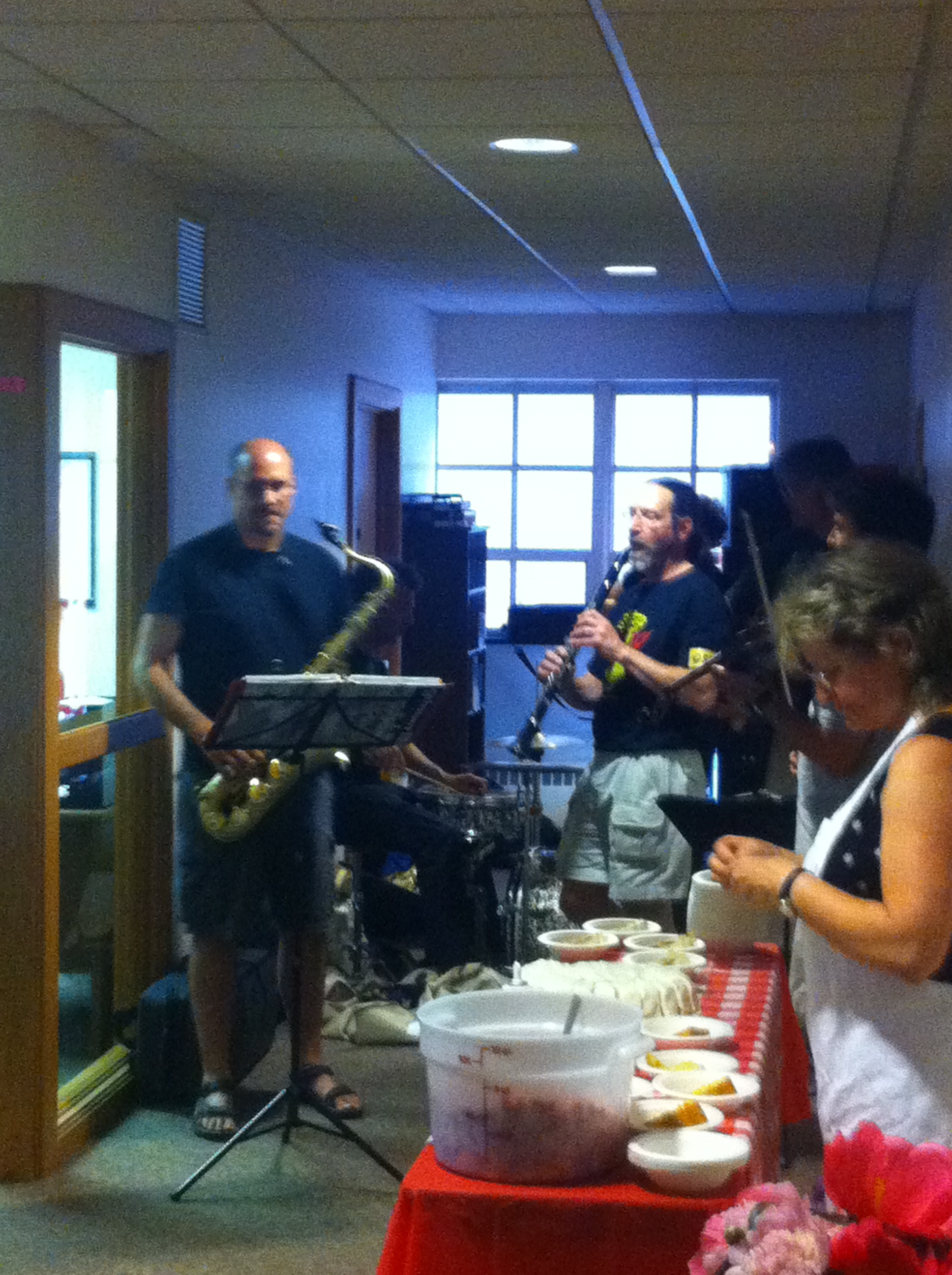
It was over 90 outside; in the kitchen it was probably 20 degrees warmer. We improvised, serving our guests in the air-conditioned reception area. The music was provided by Yid Vicious.
The menu was ham, macaroni and cheese, and coleslaw. For dessert, wedding cake or pound cake with strawberries. Here are photos:
The numbers were small last night; perhaps many of our usual guests took advantage of the free food offered in Walkerville (apparently shelter numbers have been quite low the past few nights).
This has been one of those weeks where being a priest seems a whole lot like being a victim of whiplash. Four parishioners are dealing with the deaths of parents, either in the last week, or in the past few weeks, and chance encounters with them, or planned meetings became occasions for making room for the presence of God in the midst of grief. Someone else is dealing with an unexpected diagnosis of cancer but uncertainty as well until there are further tests. And one of the children in our parish is looking forward to hospitalization and possible pacemaker surgery. For all of these people, and their loved ones, the world they knew no longer exists—they are entering uncharted territory. Continue reading →
Here’s what was going on at Grace this morning during the Farmer’s Market. Members of the Camerata String Quartet played to pitch for the upcoming Bach Dancing and Dynamite Society (if you’re in Madison, their season is not to be missed).
Here is a photo:
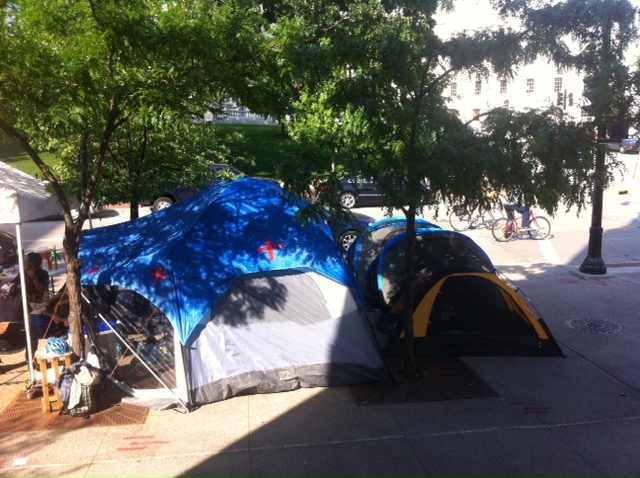
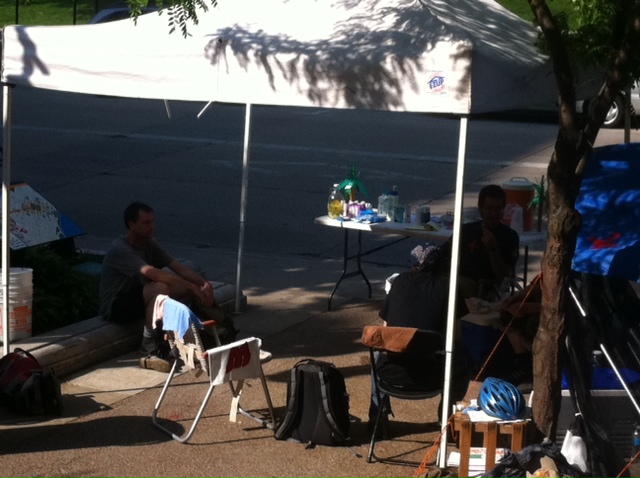
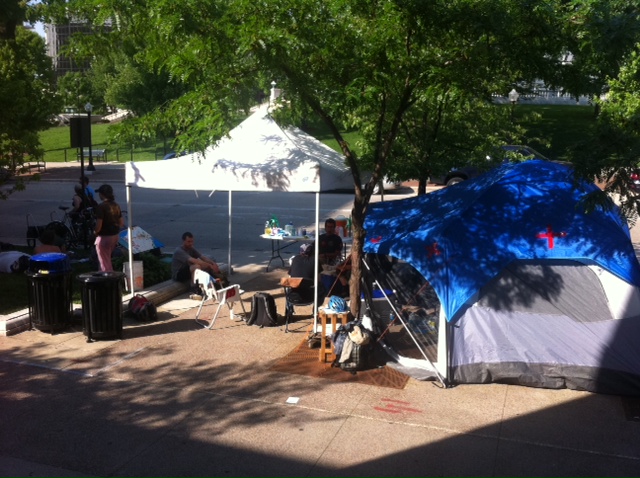
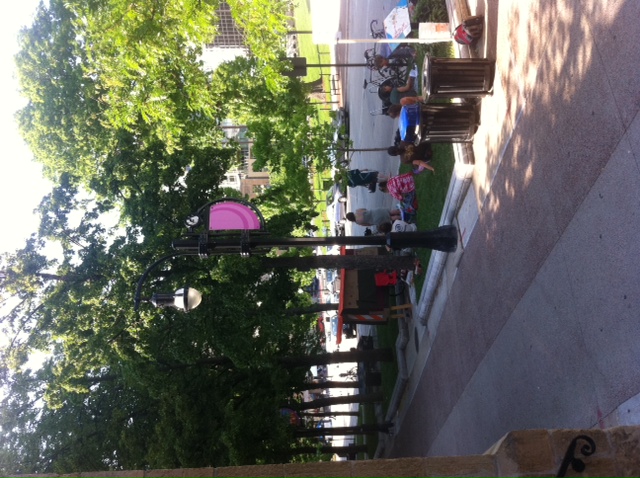
We’ll see what the sidewalk outside our doors looks like tomorrow.
Oh, and by the way, apparently the city of Madison does value a church as much as an empty storefront; it turns out both of the other locations where 24-hour tents are permitted are in front of vacant commercial space.




 Preaching Grace on the Square