
On Sam Harris

Allen Orr on Sam Harris in the New York Review of Books:

Harris’s view that morality concerns the maximization of well-being of conscious creatures doesn’t follow from science. What experiment or body of scientific theory yielded such a conclusion? Clearly, none. Harris’s view of the good is undeniably appealing but it has nothing whatever to do with science.

Orr concludes the essay:

In the end, it’s odd that one can share so many of Harris’s views and yet find his project largely unsuccessful. I certainly share his vision of the well-being of conscious creatures as a sensible end for ethics. And I agree that science can and should help us to attain this end. And I certainly agree that religion has no monopoly on morals. The problem—and it’s one that Harris never faces up to—is that one can agree with all these things and yet not think that morality should be “considered an undeveloped branch of science.”

Even more brilliant is Jackson Lears’ article on Sam Harris: Same Old New Atheism: On Sam Harris | The Nation. In addition to providing historical perspective to Harris’ position, and pointing out his historical ignorance, Lears connects Harris’ project with the Bush war on terror:

Hitchens and Harris, in particular, wasted no time enlisting in Bush’s crusade, which made their critique of religion selective. It may have targeted Christianity and occasionally Judaism, but hatred and fear of Islam was its animating force. Despite their disdain for public piety, the New Atheists provided little in their critique to disturb the architects and proselytizers of American empire: indeed, Hitchens and Harris asserted a fervent rationale for it. Since 9/11, both men have made careers of posing as heroic outsiders while serving the interests of the powerful.

The essay is brilliant and the final two paragraphs a scathing indictment of Harris’ optimism:

Moral progress is unmistakable, he believes, at least in “the developed world.” His chief example is how far “we” have moved beyond racism. Even if one accepts this flimsy assertion, the inconvenient historical fact is that, intellectually at least, racism was undone not by positivistic science, which underwrote it, but by the cultural relativism Harris despises. Ultimately his claims for moral progress range more widely, as he reports that “we” in “the developed world” are increasingly “disturbed by our capacity to do one another harm.” What planet does this man live on? Besides our wars in Afghanistan and Iraq, “we” in the United States are engaged in a massive retreat from the welfare state and from any notion that we have a responsibility to one another or to a larger public good that transcends private gain. This retreat has little to do with Islamic radicalism or the militant piety of the Christian right, though the latter does remain a major obstacle to informed debate. The problem in this case is not religion. Despite the fundamental (or perhaps even innate) decency of most people, our political and popular culture does little to encourage altruism. The dominant religion of our time is the worship of money, and the dominant ethic is “To hell with you and hooray for me.”

Harris is oblivious to this moral crisis. His self-confidence is surpassed only by his ignorance, and his writings are the best argument against a scientific morality—or at least one based on his positivist version of science and ex cathedra pronouncements on politics, ethics and the future of humanity. In The Moral Landscape he observes that people (presumably including scientists) often acquire beliefs about the world for emotional and social rather than cognitive reasons: “It is also true that the less competent a person is in a given domain, the more he will tend to overestimate his abilities. This often produces an ugly marriage of confidence and ignorance that is very difficult to correct for.” The description fits Harris all too aptly, as he wanders from neuroscience into ethics and politics. He may well be a fine neuroscientist. He might consider spending more time in his lab.
Bad History, Bad Religion

I’m surprised there’s so little chatter in the blogosphere about the article in the NYTimes profiling David Barton, who argues that most of the Founding Fathers were “evangelical Christians,” cherry-picking quotations and sources to argue against the separation of church and state.

A complete smackdown of him and his pseudo-history by People for the American Way.

May 4: Monnica

Today is the commemoration of Monnica, the mother of St. Augustine of Hippo. I can’t let the day pass without some comment.

I used her commemoration at today’s Eucharist. It was difficult for me to say the collect without snickering, having internalized the Confessions through teaching it yearly for some 15 years, “love and prayers and tears” hardly describes Augustine’s depiction of her. She was a woman of deep faith: among those who sang with Ambrose in the Milan basilica while surrounded by imperial troops demanding it be given over to the Arians; her deep piety to the martyrs that Augustine (and Ambrose were uncomfortable with) and as mentioned in an earlier comment, her status in the Cassaciacum Dialogues as the model of theological wisdom gained through faith that could instruct young intellectuals. She did pray for Augustine’s conversion, but she also acted to make it more likely, by pleading with him and by encouraging him to listen to Ambrose’s sermons, and to talk with the great Bishop.
The beautiful scene that Augustine describes in Ostia when together, in conversation, they ascended from earthly love and conversation, to the beatific vision, is one of the great moments in Christian spiritual writing, and presumably in Christian spiritual experience. It continues to give me chills every time I read it (30? 40? times) as it did during today’s Eucharist, in spite of the suppressed snicker during the collect.

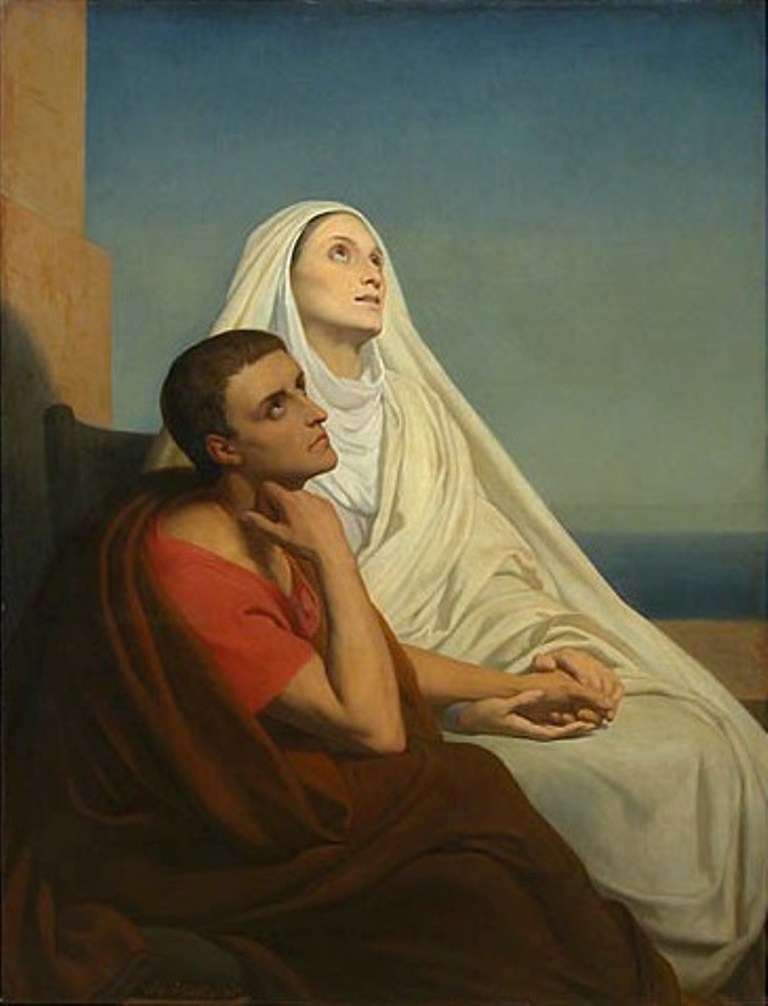
A print of this painting hangs on the wall of my office–it is intended as a depiction of that experience in Ostia:

I doubt whether either of them looked anything like that. She certainly wasn’t clad in a nun’s habit and it’s all a little bit precious, but still…

First Monday at Grace–May

The menu was ham (again from Weber’s Meats in Cuba City–They’re the best!) and macaroni and cheese (one guy said it was the world’s best, another said it was better than his momma made), biscuits, green beans, and pound cake with strawberries. Music was provided by the Kat trio. They were great!

We served about ninety last night. The total number of shelter guests is down because of summer hours, but we had a line of people waiting for dinner who weren’t staying in the shelter. Many of them had eaten with us in previous months and remembered the good food and the good times.

What’s especially exciting to see is the emergence of real community among the volunteers. We’ve got a core of folks who come every week, some of them from Grace, some of them from the community, and as we work together, we are developing camaraderie and deepening relationships. That’s picked up on by newcomer volunteers who want to come back after their first time.

Here are a couple of photos:

That’s the Kat Trio

The joy of last night was tempered this afternoon when a guy came by the church looking for me. I don’t remember if he was at the meal last night, but I know he was at last month’s, because he was drunk and maudlin and asked to talk with me privately for a time. Today, he was drunk again, and he wanted me to help him get to detox. He said he hadn’t eaten in two days. I called the cops to transport him and off he went. I hope it goes well for him.

The Beatification of John Paul II

Between the royal wedding and the death of Osama bin Laden, I barely noticed the beatification of John Paul II–there was a brief, and not-very-edifying conversation at coffee hour over the relic, but other than that, I wasn’t paying attention. I’m not a big fan of canonization, knowing the politicization of the process throughout history and the way the church, and especially popes have used sainthood to cement their power, coopt local devotions, and channel piety. I find the rush to canonize John Paul II somewhat unseemly. There should be time, and historical distance to reflect on and place in longer perspective the achievements, life, and sanctity of people.

That being said, I’m not Roman Catholic, so I’ve “got no dog in this fight” as they say in the South. But there are some thoughtful perspectives, for and against, and some writers who connect John Paul’s beatification with the week’s other events.

Tim Muldoon connects the beatification with the royal wedding, seeing in both stories of hope.

Others are concerned about more negative aspects of John Paul’s papacy, especially the clergy sexual abuse, that many think was swept under the rug during his tenure. Max Lindenman sees it differently.

Ingrid Rowland, the great Renaissance historian, brings another perspective, looking at the beatification in the context of the city of Rome is it is today.

Initial reflections on the death of Osama bin Laden

After turning in early last night, I learned the news this morning. Like many, I was troubled by the celebrations that broke out spontaneously. Many of those most affected, whose loved ones were killed directly or indirectly bin Laden or Al Qaida had a natural emotional response to news of his death. But I wonder why a celebration of this sort turned into what one commentator called a “Frat Party.” And there were other comments and actions that put this event on the level of a sports team’s national championship. We haven’t won by any stretch of the imagination. The wars that were unleashed in response to bin Laden’s actions continue; terrorists continue to plot attacks, and our freedoms diminished in the name of these wars.

About rejoicing over the death of one’s enemies:

Susanna Brooks has some brief comments

Rabbi Schmuel Herzfeld asks: “Is it wrong to feel joy at Bin Laden’s death?” and points to the talmudic story that God rebuked the angels for excessive joy when Pharaoh’s army was destroyed while the Israelites crossed the Red Sea.

My Facebook newsfeed was filled with friends posting verses from scripture about loving one’s enemy or Proverbs 24:17: “Do not gloat when your enemy falls; when they stumble, do not let your heart rejoice.” There were also prayers for peace and prayers for our enemies.

I’ve been thinking again about just war theory–Nato’s actions in Libya have raised the issue again. The use of drone aircraft raise significant questions about the exercise of war. Paul Zahl asked whether their use was just in the context of Afghanistan; that they are now being used in Libya as well is perhaps more troubling.

Osama’s death will overshadow the news that Nato made a targeted attack on a site where members of Muammar Qaddafi’s family were staying, resulting in the death of family members. As numerous commentators have pointed out, this is a significant step beyond the original UN mandate.

One of the things that concerns me most, both about the bin Laden attack and the events in Libya is that we continue to abrogate human rights and the rule of law.

An appropriate, Christian (or even human) response to bin Laden’s death is difficult to gauge in light of our competing loyalties to family, friends, nation and Jesus Christ, and the real emotional responses we have to the news. James Martin, SJ, writes on America’s In all Things:

So the question is whether the Christian can forgive a murderer, a mass murderer, even–as in the case of Osama bin Laden–a coordinator of mass murder across the globe.  I’m not sure I would be able to do this, particularly if I had lost a loved one.  But as with other “life” issues, we cannot overlook what Jesus asks of us, hard as it is to comprehend.  Or to do.

For this is a “life” issue as surely as any other.  The Christian is not simply in favor of life for the unborn, for the innocent, for those we care for, for our families and friends, for our fellow citizens, for our fellow church members or even for those whom we consider good, but for all.  All life is sacred because God created all life.  This is what lies behind Jesus’s most difficult command: “I say to you, Love your enemies and pray for those who persecute you.”

The whole thing is well worth the read.

Sermon Follow-Up: The ABC on “Doubting Thomas”

From Mark Vernon:

So clearly there’s a pattern emerging. This is a sceptic and the gospel says it’s quite important that in the balance of personalities around Jesus there is somebody who asks the awkward questions who is not a kind of Pollyanna optimist and who eventually will only be convinced by the confrontation of a relationship. At the end of the day, in fact, he says ‘I need to touch the risen body.’ But when Jesus appears to him as a risen body, Thomas doesn’t touch. He says ‘now, I see enough.’

My Lord and My God: A Sermon for the Second Sunday of Easter

May 1, 2011

The story of Thomas’ encounter with the Risen Christ may be my favorite gospel story. I love it because I have long felt a kinship with Thomas. When I was growing up, I was one of those kids that Sunday School teachers must have hated because I liked to ask uncomfortable questions. I still do. I remember one time in particular when an exasperated teacher responded to one of my questions with “Well, doubting’s a sin.” I thought at the time, if that’s the case, then I know I’m going to hell. I still have questions, I still doubt, but I’ve also learned through life and from the story of Thomas, that far from being a sin, at least for me, doubting opens the door to a deeper faith, it opens the door to a richer encounter with God, and a richer life of faith. Continue reading