Religious Belief is Human Nature?

Yes, according to a recent, massive study done at Oxford. Here’s the report from CNN; here’s another account from The Telegraph.

Given the widespread presence of religious notions, the study concluded that religious belief is not likely to wither away: “The secularization thesis of the 1960s – I think that was hopeless,” one of the study’s authors said.

If that’s the case, one wonders what he thinks about the announcement that Pfizer College (in California) will establish a Department of Secular Studies.

Weekly Anglican Covenant Round-Up

The Church of Ireland “subscribes.”

The Church of SE Asia “accedes.”

Last week, the Diocese of Quincy said no.

Episcopal News Service points out the wiggle-room in the language used: “The original request to the communion’s primates and moderators was that the member churches should consider the covenant and decide ‘on acceptance or adoption’.”

Last week, Tobias Haller had some useful reflections on the notion the Anglican Communion and the Covenant. He concludes:

since only those who adopt the Covenant have any chance to help guide it in a productive, rather than a destructive, direction; and further, since at this point among the most vocally opposed to it are those who also most wished to employ it in this surgical fashion, this may present a reason for those who really do want to encourage the communion to stay together in spite of disagreements — at least among those who wish to self-select togetherness over institutionalized schism — to adopt the Covenant with the understanding that Section Four shall never be appealed to or employed, and perhaps to move for its amendment or removal.

More on GLBT inclusion

Wow! It’s been an eventful week!

First, there was the spat over Sojouners decision not to run an ad. I posted about that here.

Then we learned that the Presbyterian Church (USA) voted for full inclusion of GLBTQ clergy.

The same day came the news that chaplains in the US Navy could perform same-sex blessings. That was walked back later.

And in Uganda, continuing confusion over the progress of the anti-gay bill, that would allow capital punishment. Episcopal Cafe has the rundown on the on-again, off-again debate.

To follow up on the Sojourners issue, my friend Brian Maclaren, who served on Sojourners board of directors, shares his pilgrimage on full inclusion. In Part I he writes:

But at this point I was a pastor and had to deal with the conflict between two commitments: first, one of my primary job requirements – to keep together rather than divide my congregation on the one hand, and second, to stand up with integrity and be counted as an advocate for people I had become convinced were being treated with neither justice nor compassion. I negotiated this tension by speaking up when I could and by seeking to use my influence to increase sensitivity to people whom I felt were being treated by Christians in a truly sub-Christian way.

But at every turn I felt that I couldn’t speak out too strongly too fast without dividing the church that I was called to serve. At times I probably pushed too far too fast – and got angry letters and emails about it, and at times I didn’t lead strongly enough – and got angry letters and emails about that too, just from other people.

In Part II he writes:

If I were to boil down messy contemporary reality to an equation, here’s what it would be:

– You can’t lead a coalition of progressive Christians without being an outspoken leader on LGBTQ issues.
– You can’t lead a coalition that includes mainstream Evangelical and conservative Catholic Christians if you are an outspoken leader on LGBTQ issues.

For progressive Christians, it is often difficult to comprehend the excruciating problem for conservative Christians to move toward a position that fully includes Gays and Lesbians, what the toll is personally, and what the toll is for their relationships. Brian’s two posts on the topic may help others comprehend.

For a profound theological perspective on the Christian argument for same-sex blessings, Eugene Roger’s piece in Christian Century is breath-taking.

Christians duking it out

There’s quite the dust-up going on over Sojourners Magazine’s decision not to run an ad from Believe Out Loud urging congregations to welcome gay families to worship.

Here’s the response from Episcopal Cafe. Here’s Susan Russell’s take 1 and take 2.

Religion Dispatches never misses an opportunity to comment on religious conflict (especially when it involves Evangelicals, even “progressive” ones).

whether Wallis actually represents a movement that could be described as the religious left is highly doubtful. First, Wallis himself has rejected the “religious left” label. Moreover, many who would consider themselves on the religious left reject Wallis as their leader.

I find all this rather amusing. Jim Wallis, to my knowledge, has never claimed to be a voice of progressive Christians or a leader of the Religious left. His roots are in conservative Evangelicalism and Sojourners has consistently opposed abortion, to take one example. Sojourners has distributed bumper stickers that shout: God is not a Democrat or a Republican.

Quite apart from the merits of the ad campaign and the importance of the inclusion of GLBT individuals and families into churches, it should not surprise anyone that Sojourners refused to run the ad. The issue of inclusion is as hot-button in more conservative denominations as it is in mainline ones, and we Episcopalians have reached no consensus on it. To see how it is playing out in one such denomination, check out gaymennonite.wordpress.com.

More importantly, I think it is important to admit that “progressive” Christians were quite willing to accept Jim Wallis as their spokesperson, because he high visibility and access to the halls of power and the media. They were happy to downplay significant theological differences and ethical/moral differences (a woman’s right to choose) and let Wallis speak for them because of his visibility. Wallis tries to make clear his reasoning here. Here’s another piece from Sojo, written by Tim King.

Such conflict provides media outlets with something more to write about. Controversy sells–witness the Rob Bell phenomenon. At the same time, the whole incident reminds me of the controversy a couple of weeks ago having to do with the law firm that was going to represent the House of Representatives defending DOMA in court. We have a tendency to want to damage, destroy, or silence those with whom we disagree. Whether or not one supports the Sojourners editorial decision, one ought to recognize their right to make it and hope that it is consistent with their editorial and theological positions. We should also hope and pray that in time their positions will evolve to what we believe are ones more in keeping with the Gospel and the Love of Christ.

On the Visitation of a Bishop

One of the fun things for me about having a doctorate in the History of Christianity and being an Episcopal priest is musing over the historical background of particular customs or even canons. Bishop Miller’s visit to Grace has been the occasion for some not-so-serious reflection on the history of Episcopal visitations.

The visitation was introduced in the late middle ages as an effort at reform. First targeting monastic houses, reform-minded bishops and church organizations began visitations of parishes as well. One of the early, and most famous, visitations was that of Electoral Saxony (Luther’s home) in 1528. Eventually, the requirement for regular visitations was enshrined for Roman Catholics at the Council of Trent. When I was working on my doctorate, visitation records were all the rage. Visitors (not bishops, but state or church bureaucrats) would go to all of the parishes and inquire about the religious life and faith of the community, asking as well about the priest or minister. From these records, we gain insight into the level of religious commitment, religious practice, and other things like magic, witchcraft, heresy, and clerical malfeasance. The visitors often had a set of very detailed questions to ask, and they also demanded that people do things like say the 10 Commandments or creed.

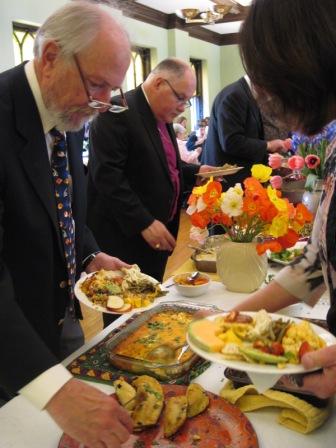
In the Episcopal Church, the Bishop’s visit is usually the occasion for confirmation. Such was the case for us, but unlike visitors of yore, Bishop Miller did not query confirmands on their catechism (good thing!). After confirmation, as is the custom in many places, we had a reception. Here are some photos:

Thy table now is spread

The Bishop and the Senior Warden analyzing the situation

There was music as well:

From the children:

And from Los Soles:

In addition to celebrating the confirmands and all of our mothers, we belatedly celebrated the Rev. Pat Size’s ministry among us. She retired at the end of 2010.

Mary Ray Worley gives Pat a scrapbook of her ministry with the Hispanic community

Participants or Spectators? Consumers or producers?

Bishop Miller made his biennial visitation to Grace Church yesterday. In his sermon, he referred to a college course he once took on the history of sport in America. The professor’s thesis was that Americans’ involvement in sports was the movement from participation to being fans. He compared that to the church and proclaimed that Christianity is not a spectator sport.

I found a connection between his sermon and a blog entry that asked whether worshipers are consumers or producers. The author began with music–the difference between consuming (turning on the radio, listening to one’s ipod) and producing, whether as a musician or as a songwriter. She then turns to worship, asking whether we perceive worship leaders (clergy, choir, professionals) as producers, and those who sit in the pew as consumers of worship. She concludes that to some degree the notion of the lay consumer of worship is an accurate representation:

It’s true that we consume the Word which is given to us, something we did not produce ourselves.  But as we chew and swallow and ponder what we freely receive, we do go out to produce, to create, to produce fruit, to create community, to do justice and to love kindness.

One could have deepened the comparison by pointing out that people’s “consumption” of music has changed since the nineteenth century, with the selling of sheet music giving way to the selling of recordings, and the important value that educated, cultured persons could play an instrument, or that popular entertainment for many among the poorer classes, was self-created. In these cases, music also created community.

The problem with the consumer/producer model is not just that tends towards passivity; it also tends towards isolation. I think that’s true of much of worship as well, even in the Anglican tradition.

In honor of the 300th Anniversary of the Birth of David Hume

The 300th anniversary of David Hume’s birth was yesterday. An appreciation by Morgan Meis that concludes with this paragraph:

Dialogues Concerning Natural Religion is a discussion between an all-around skeptic, Philo; a religious dogmatist and believer in abstract reason named Demea; and a moderate empiricist, Cleanthes. The three characters debate the existence of God and other light topics. Scholars have long debated the question as to which of the interlocutors represents Hume’s true position. The answer is that none of them do, and all of them do. Hume was fully reconciled to being bifurcated, trifurcated even, if we can put it that way. He tried to love the war that was always raging inside. In this, he was an honest philosopher, and an honest man.

I didn’t read Hume with any care until I began teaching, and I quickly realized what all the fuss was about. His attack on rational religion of the 18th century is devastating and continues to resonate across the centuries. I used to include in my lecture on 18th century religion the following quotation:

So that upon the whole, we may conclude that the Christian religion not only was at first attended with miracles, but even at this day cannot be believed by any reasonable person without one. Mere reason is insufficient to convince us of its veracity: and whoever is moved by faith to assent to it, is conscious of a continued miracle in his own person, which subverts all the principles of his understanding, and gives him a determination to believe what is most contrary to custom and experience. David Hume, Essay on Miracles

Hume was also partly responsible for one of my great memories of teaching. When teaching Bible to students from conservative religious backgrounds, there inevitably came the moment when students would ask how one could believe in God if the Bible was not God’s inerrant Word. My response was usually to ask them from where their assurance and certainty of faith came. On probing, they usually agreed that such certainty came from experience, from their relationship with Jesus Christ. On one occasion, however, a student responded with, “the argument from design.”

I tried to suppress a guffaw and urged the student to go read Hume’s  Dialogues on Natural Religion.

Civil Religion, Monarchy, Establishment, and the Church of England

still reflecting on the royal wedding and what it says about the role of religion in the UK.

Jonathan Chaplin and Religion, Royalty, and the Media. He concludes with the following:

But it surely is primarily responsible for how far the liturgical offerings it seems so eager to supply to what is a largely inattentive and uncomprehending nation are actually consistent with its own theological integrity, even its self-respect.

For many defenders of establishment, the royal wedding will no doubt provide glorious confirmation of their claim that the church remains the spiritual hub of the nation, sending out signals of transcendence from the heart of a unifying national celebration. For many opponents, it will raise the question whether the meaning of even a robustly orthodox wedding liturgy – for such it certainly was, as Martin Bashir so tactlessly pointed out – is effectively neutered when placed in service of a survival strategy for a political institution with an uncertain future. They will interpret the day’s events as yet further evidence of church’s captivity to civil religion, and will ask whether on April 29th the church really “served” the nation or rather was “used” by it. Will the church dare to have a serious discussion about that question?

The situation is quite different in the US than in the UK because of establishment. Still, there is an American civil religion, and the Episcopal Church has very often provided the setting as well as the content for the exercise of it. Witness the prominence of the “National Cathedral.” Sometimes, civil religion is relatively innocuous, such as the requirement that presidents end their speeches with “God Bless America.” It easily shades into the dangerous, however, when civil religion and Christianity are equated, as they so often are, by politicians, people, and pseudo-historians like David Barton.

Still, I’m not sure the appropriate response for concerned theologians is to adopt a neo-Anabaptist position like Simon Barrow and Nick Knisely seem to advocate. Nick Kniseley asks “Co-opting the Church?”  In response to an essay by Simon Barrow. It’s not that I’m not sympathetic to their position; it was difficult to distinguish the worship of God from the worship of the royal family during the wedding, and the prominence of the nation-state in the form of dress uniforms was especially disconcerting. Still, the Anabaptist, and neo-Anabaptist response of withdrawing, figuratively or literally, from engagement with the spiritual concerns of the larger society is troubling to me. Our sacred spaces and rituals need to be available to those who turn to them for support and meaning at times of crisis or transition. The task is to use that tentative engagement as a step to deeper involvement, all the while recognizing that such deeper commitment might not be forthcoming.

And Frederick Schmidt  on the inadequacies of our traditional-language liturgy seems to have struck precisely the wrong note a few days before the use of traditional language in the royal wedding. One of the great powers of ritual is that it can invest with great power, language that seems meaningless or dead in other contexts.

This in the context on continuing doom and gloom concerning the future of Anglicanism in the UK.

Archbishop Barry Morgan of Wales chimes in: “the Church in Wales must adapt to cope with the decline in clergy, waning investments and falling congregations.”

I do think it is time for the Church of England to be disestablished; this would free it up to have precisely the sort of theological conversation that Jonathan Chaplin advocates.

Forgiving Bin Laden

All week, we have been thinking about bin Laden’s death and our reactions to the news. Emotions have ranged from joy to outrage; there have been celebrations as well as concerns about the legality of the action. Andrew Sullivan and the readers of his blog have been struggling to understand their responses to the death of Osama bin Laden.

This, from a reader, may be the most moving of all. But following the whole conversation, beginning with Sullivan’s original statements is testimony to the complexity of the question.

Eric Reitan, a Christian universalist, explores our need for cosmic retribution and concludes:

So, is Osama bin Laden in hell? Yes, absolutely. But I will not be at peace, I will not believe that justice has been done, until he is redeemed.

His essay puts me in mind of the piece by Jonathan Jones I read this morning. It’s an appreciation of Dante’s Divine Comedy.