Doubt and Certainty

Mark Vernon writes in The Guardian today:

Doubt in relation to religion is almost mandatory in public life, whereas doubt in relation to politics is almost forbidden.

He is talking about the situation in the UK, of course, but what he says is of interest to me, especially given two issues I’ve been following in my blog–the debate over Rob Bell and universalism and the protests in Madison.

Vernon asks:

If God is not to be a tyrant, but is to allow us a degree of autonomy, must God not introduce a corresponding degree of doubt and uncertainty into human experience?

It’s an excellent question. Certainty, whether in politics or religion, tends to heighten conflict and cause suffering.

To Change the World

I’m working through James Davison Hunter’s To Change the World: The Irony, Tragedy, and Possibility of Christianity in the Late Modern World.

I’ve been carrying it around in my bag for the last few weeks, in hopes of cracking it open. I finally did today. It’s quite interesting. Hunter is a Professor at the University of Virginia. The book is an analysis and critique of the ways in which Christians, left and right, have approached cultural change. Hunter argues that change in culture occurs largely by means of networked elites, i.e., top-down, rather than bottom-up. He points out that for all of their efforts in the second half of the twentieth century, Christians were unable to effect much cultural change at all. Take a hot-button issue like same-sex marriage. Recent polls suggest that in spite of all of the efforts against it, a majority of Americans now support it in some form.

I’m not all the way through, but it’s clear where Hunter is headed. He starts, not with Jesus’ teachings, but with creation: “In the Christian view, then, human beings are, by divine intent and their very nature, world-makers.” He argues against the politicization of Christianity, either by left and right, and seeks to place Christianity’s role in “faithful presence.” I will say more about this idea in a later post.

It’s interesting reading in the context of what is taking place in Madison right now. I have made the case that Grace Church, by its very presence on the square, is an actor in the current drama. Whatever we do or don’t do sends a message. Hunter, I’m sure, would agree, because of his perception that politics (power) has become all-pervasive in our culture. Yet what should I or Grace do?

We have opened our doors, welcoming in those who are protesting in the streets, offering hospitality, a place to warm up and rest. As we open our doors, we offer something else, too. Grace is a beautiful space. As I’ve said here before, people sense its beauty, experience it, and for many who enter, they have never experienced anything quite like it before.

This weekend we will be doing a couple of other things. First, we will make more room for prayer. I don’t know how many people will come in tomorrow, but we will offer our chapel as a place where those who seek silence and prayer can find it.

Serendipitously, we will also be offering two musical experiences that will also evoke the beautiful. The first is a concert Saturday night by Seraphic Fire. The second is a performance in the liturgy at 10:00 on Sunday morning of a missa brevis by Haydn. Each will be an opportunity to encounter beauty. Whatever else we might do this weekend, we can do that. We can invite people to encounter beauty, and through beauty, to encounter God.

I don’t mean this as a distraction from what’s taking place on the streets. Rather, it seems to me that beauty can put everything else into its proper perspective, and by helping us touch the divine, help to ground us when all around seems to be chaos.

 

Rob Bell and Universalism

There’s been quite the dust-up among Evangelicals about Rob Bell’s new book, in which, according to HarperOne’s marketing, “With searing insight, Bell puts hell on trial, and his message is decidedly optimistic—eternal life doesn’t start when we die; it starts right now. And ultimately, Love Wins…”

Here’s Christianity Today’s take on the controversy.

Rob Bell, for those who don’t know, is pastor of Mars Hill Church, and has produced a wildly popular video series, entitled NOOMA. The series was used for a time by a group at my former parish. Many of those in attendance found him inspiring. Maggie Dawn judges his genius in his ability to communicate rather than in the depth of his theology.

As Dawn points out, universalism is not particularly rare in the History of Christianity, nor even among evangelicals or conservatives. As examples, she cites no less an orthodox figure than C.S. Lewis. It’s an issue that continues to fascinate people, just as it continues to rouse the ire of many. In part that’s because the notion of a loving God who condemns people to hell for eternity seems an oxymoron and is an issue which for many thinking people lies at the center of their discomfort with Christianity.

It’s a question that often comes up in my random encounters with people. Sometimes it’s couched in terms of whether adherents of other religions can be saved. Sometimes it’s phrased as I did it above, as a problem in the nature of God. In either case, it is almost always asked by someone who is sincerely struggling with the issue and is seeking guidance or clues on how to begin to think about the question in such a way that helps them make sense of their own experience and deepest values, as well as their experience of God.

When I respond to them, I try to honor their experience, values, as well as their understanding of God and try to explore with them the full implications of belief in a loving God, and what might limit that love.

A few links related to the Wisconsin Protests

It really is becoming surreal. After the arrival and departure of the concrete barriers, access to the Capitol remains very limited. Even former Democratic congressmen can’t get in.

Democratic members of the Assembly have taken their desks outside and meet with constituents there.

There are voices of moderation. One is that of Republican State Senator Dale Schultz, who also happens to be Episcopalian. Here are excerpts from a recent interview. It’s well worth watching, wherever your political sympathies lie:

Here’s a link to a thoughtful piece by Paul Grant, a doctoral student at UW Madison, in which he talks a little bit about the unique culture of Wisconsin, going back to the 19th century.

Thinking about Lent

Ash Wednesday is just a week away. One of the casualties of the Budget crisis in Wisconsin has been my Lenten preparations. Oh, we got started on the right foot. We had a liturgy meeting on the first Sunday in February and began planning for our worship in Lent and Holy Week. I had high hopes then of having all of our planning done, both for the Lenten programs and our Lenten worship, well before Ash Wednesday. It shouldn’t have been a problem, with Ash Wednesday coming so late.

But it was not to be. Caught unawares by the developing protests, and needing to respond quickly to events as they developed, much of the work of the church had to become lower priorities. Among that work was Lent.

Today I got some space, a little at least, to begin thinking about what’s going to be happening next week, to begin thinking as well, about my observance of Lent. One of my questions is how to make our Lent a time that allows us to reflect on what is taking place around us, to consider our complicity and participation in the structures of society and in our interpersonal relationships that are life-denying rather than life-giving.

We tend to focus in Lent on our individual sins and experiences, to see Lent as a time to get right with God, to practice some spiritual discipline more intently, or to try to find ways of deepening our spirituality. I came across this wonderful reflection on Lent by Marilyn McCord Adams, in which she describes us, even believers as “spiritually autistic.” She argues that Lent should be a time when we should try to “restructure our personality to center on lived partnership with God.”

She says Lent should be a time when we break down the defenses that separate us from other human beings, but also break down the defenses that prevent us from experiencing God.

It’s a thought-provoking piece, well-worth reading. For me, in this time, it reminds me that with everything that is going on around us, with the noise that intrudes on our work from time to time, and the palpable anxiety that we encounter in the streets and when we interact with our neighbors on the square, finding space, time, and energy to do the work that Lent calls us to, will be a monumental task, perhaps a Lenten discipline of its own

Images from Grace Church today

I really did try to take a day off today. I also tried to stay away from the Square, and the Church, but I couldn’t resist coming down to see what was going on.

Some interesting images. First off, when we got there around 3:30, we saw workers unloading concrete barriers on West Washington Ave. It was surreal and evoked images of the security steps taken in the days after 9/11. It wasn’t at all clear what the barriers were for. Even after they were set up around the W. Wash. entrance to the Capitol, I couldn’t figure out why they were needed and what they were protecting.

Here’s a picture of them unloading the barriers:

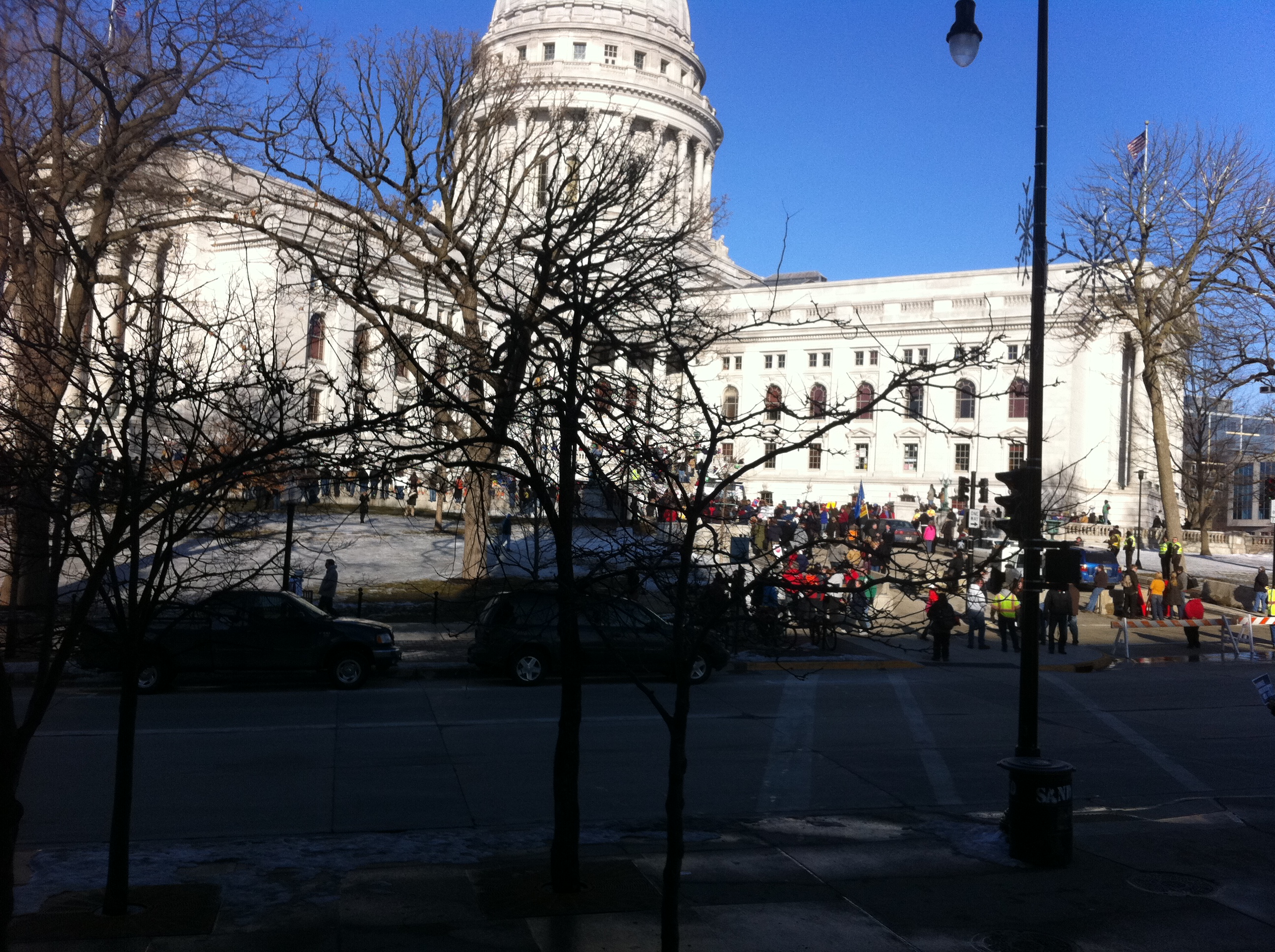
Here’s a photo of the W. Washington entrance to the Capitol from the steps of Grace Church. Shortly after this was taken, the crowd here moved to the left, to the State Street entrance, on the theory that the noise they made could disrupt the Governor’s budget speech:

We went home after an hour or so, and passed another stark image. To get to our car, which was parked in the alley next to Grace Church, we had to pass through the line of guys waiting for the doors of the Men’s Drop-In Shelter to open so they could get a meal and a place to sleep for the night.

I had read about some of the cuts Governor Walker is proposing, and as I chatted with the guys in line, I wondered how many more people would end up on the street if the cuts went through, how many people would die because they couldn’t get access to health care or housing or mental health care.

Most of the protesters are union members–teachers, public service workers, police and firefighters. There were representatives from other unions as well. They have a great deal to lose, of course, but the stakes are even greater for the poor, the sick, the mentally ill, and the other marginalized members of society.

Peter Gomes, RIP

I woke up this morning to learn of the death of the Rev. Peter Gomes, whose official title at Harvard was “Plummer Professor of Christian Morals and Preacher to the University.” He suceeded George Buttrick in that position in the early 1970s. When I arrived at Harvard Divinity School in the early 1980s, Peter was already a fixture at Harvard. His weekly teas at Sparks House were a popular tradition and his sermons at Memorial Church were brilliant and beautifully-written.

Peter, along with New Testament Professor Helmut Koester, taught the course from which I gained the most for my ministerial practice, and on which I continue to draw. Entitled “Exegesis and Preaching,” the two picked the most challenging texts in the New Testament. We were assigned three of them. One week, we would have to write an exegesis paper that would pass muster with one of the greatest New Testament scholars of his generation. The next week we would write and deliver a sermon on that text. Each step was a lesson in humility, as well as in the interpretation of scripture and the proclamation of the Word.

Following the public delivery of the sermon, we would spend an hour in a one-on-one tutorial with Peter. That amount of time with a Harvard professor was unheard-of. I don’t think I got that much individual attention from a professor in a semester, even when I was writing my dissertation.

The tutorial was humiliating. We were to bring the manuscript to the tutorial. Peter would take it from our hands when we entered his office, we would sit down, then he would deliver it back to us; our pathetic words in his majestic voice. I remember the first session like it was yesterday. As I heard him read my text, I wanted the floor to open up and bury me. It was perhaps the most difficult moment of my entire academic career.

What an experience and how exhilarated I was when both he and Helmut praised my final work, passable exegesis on Revelation 21 and a decent sermon. Whatever my gifts and skills as a preacher, I owe them to that class and those two brilliant professors.

Peter was also quite funny. I still remember the story he told about communion wine. One of the students in class asked him about what wine he used for communion. Peter replied:

My predecessor, George Buttrick, always said that one should use nothing but the best domestic port for communion wine, and he deemed Taylor’s Tawny Port to be that wine.”

I always hoped to see a commercial for Taylor’s with Peter standing on the steps of Memorial Chapel, in full ministerial regalia, holding a bottle of Taylor’s Tawny Port in his hand, and saying those words.

In the 1980s, Peter was often vilified by progressive students at Harvard Divinity School for being a Republican. He gave the benediction at Reagan’s second inaugurals, preached at the National Cathedral in conjunction with George H. W. Bush’s inaugural. That all changed when he “came out” in the 1990s.